Sign In

My Timeline

GuRoute

Discover Your World

Share your Experiences

Record your Life


Top Attractions in North Yorkshire

York

York is a historic walled city at the confluence of the rivers Ouse and Foss in North Yorkshire, England, and is the traditional county town of Yorkshire to which it gives its name. The city has a rich heritage and has provided the backdrop to major political events in England throughout much of its two millennia of existence. The city offers a wealth of historic attractions, of which York Minster is the most prominent, and a variety of cultural and sporting activities making it a popular tourist destination for millions. The city was founded by the Romans as Eboracum in 71 AD. It became the capital of the Roman province of Britannia Inferior, and later of the kingdoms of Northumbria and Jorvik. In the Middle Ages, York grew as a major wool trading centre and became the capital of the northern ecclesiastical province of the Church of England, a role it has retained. In the 19th century, York became a hub of the railway network and a confectionery manufacturing centre. In recent decades, the economy of York has moved from being dominated by its confectionery and railway-related industries to one that provides services. The University of York and health services have become major employers, whilst tourism has become an important element of the local economy. From 1996, the term City of York describes a unitary authority area which includes rural areas beyond the old city boundaries. In 2011 the urban area had a population of 153,717, while in 2010 the entire unitary authority had an estimated population of 202,400.

Harrogate

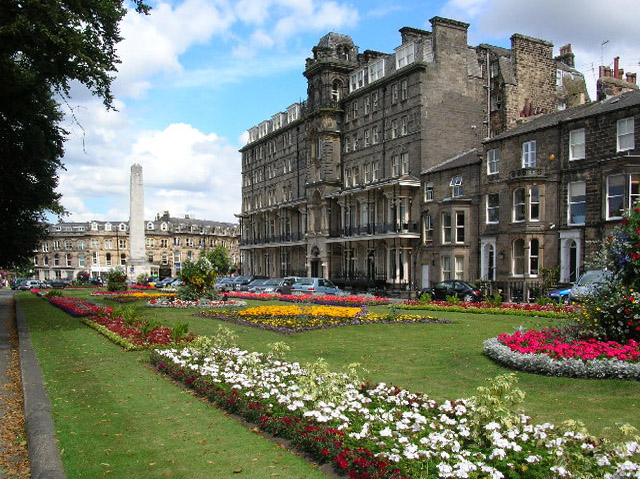
Harrogate is a spa town in North Yorkshire, England. Historically in the West Riding of Yorkshire, the town is a tourist destination and its visitor attractions include its spa waters and RHS Harlow Carr gardens. Nearby is the Yorkshire Dales national park and the Nidderdale AONB. Harrogate grew out of two smaller settlements, High Harrogate and Low Harrogate, in the 17th century. Since 2013, polls have consistently voted the town as "the happiest place to live" in Britain. In 2013 Harrogate was declared to be the third most romantic destination in the world, beating off rivals including Paris, Rome and Vienna. Harrogate spa water contains iron, sulphur and common salt. The town became known as The English Spa in the Georgian Era, after its waters were discovered in the 16th century. In the 17th and 18th centuries its chalybeate waters were a popular health treatment, and the influx of wealthy but sickly visitors contributed significantly to the wealth of the town. Harrogate railway station and Harrogate bus station in the town centre provide transport connections. Leeds Bradford International Airport is 10 miles south-west of Harrogate. The main roads through the town are the A61, connecting Harrogate to Leeds and Ripon, and the A59, connecting the town to York and Skipton. Harrogate is also connected to Wetherby and the A1, by the A661. The town of Harrogate had a population of 71,594 at the 2001 UK census; the urban area comprising Harrogate and nearby Knaresborough had a population of 85,128, while the figure for the much wider Borough of Harrogate, comprising Harrogate, Knaresborough, Ripon and a large rural area, was 151,339. The town motto is Arx celebris fontibus, which means "a citadel famous for its springs."

Whitby

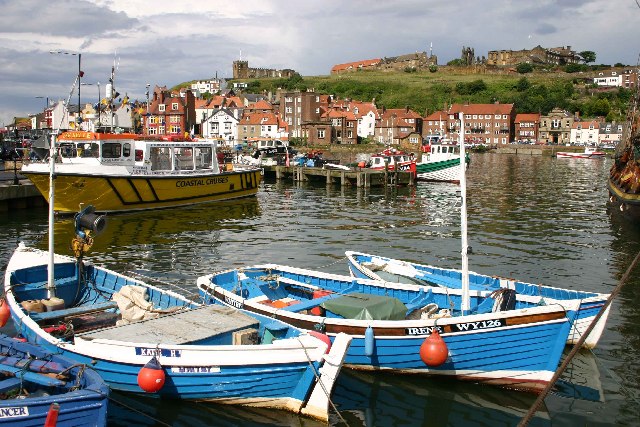
Whitby is a seaside town, port and civil parish in the Borough of Scarborough and English county of North Yorkshire. Before local government reorganisations in the late 1960s, it was part of the North Riding of Yorkshire. Situated on the east coast of Yorkshire at the mouth of the River Esk, Whitby has an established maritime, mineral and tourist heritage. Its East Cliff is home to the ruins of Whitby Abbey, where Cædmon, the earliest recognised English poet, lived. The fishing port developed during the Middle Ages, supporting important herring and whaling fleets, and was where Captain Cook learned seamanship. Tourism started in Whitby during the Georgian period and developed further on the arrival of the railway in 1839. Its attraction as a tourist destination is enhanced by its proximity to the high ground of the North York Moors National Park, its Heritage Coastline and by its association with the horror novel Dracula. Jet and alum were mined locally. Whitby Jet, which was mined by the Romans and Victorians, became fashionable during the 19th century. The earliest record of a permanent settlement is in 656, when as Streanœhealh it was the place where Oswy, the Christian king of Northumbria, founded the first abbey, under the abbess Hilda. The Synod of Whitby was held there in 664. In 867, the monastery was destroyed by Viking raiders. Another monastery was founded in 1078. It was in this period that the town gained its current name, Whitby . In the following centuries Whitby functioned as a fishing settlement until, in the 18th century, it developed as a port and centre for shipbuilding and whaling, the trade in locally mined alum, and the manufacture of Whitby jet jewellery. The abbey ruin at the top of the East Cliff is the towns oldest and most prominent landmark. Other significant features include the swing bridge, which crosses the River Esk and the harbour, which is sheltered by the grade II listed East and West piers. The towns maritime heritage is commemorated by statues of Captain Cook and William Scoresby, as well as the whalebone arch that sits at the top of the West Cliff. The town also has a strong literary tradition and has featured in literary works, television and cinema, most famously in Bram Stokers novel Dracula. While Whitbys cultural and historical heritage contribute to the local economy, the town does suffer from the economic constraints of its remote location, ongoing changes in the fishing industry, relatively underdeveloped transport infrastructure, and limitations on available land and property. As a result, tourism and some forms of fishing remain the mainstay of its economy. It is the closest port to a proposed wind farm development in the North Sea, 47 miles from York and 22 miles from Middlesbrough. There are transport links to the rest of North Yorkshire and North East England, primarily through national rail links to Middlesbrough and road links to Teesside, via both the A171 and A174, and Scarborough by the former. According to the 2011 UK census, the town had a population of 13,213, a decrease on the 2001 UK census figure of 13,594.

Ripon

Ripon is a cathedral city, market town and successor parish in the Borough of Harrogate, North Yorkshire, England. Historically part of the West Riding of Yorkshire, it is located at the confluence of two tributaries of the River Ure, the Laver and Skell. The city is noted for its main feature the Ripon Cathedral which is architecturally significant, as well as the Ripon Racecourse and other features such as its market. The city itself is just over 1,300 years old. The city was originally known as Inhrypum and was founded by Saint Wilfrid during the time of the Anglian kingdom of Northumbria, a period during which it enjoyed prominence in terms of religious importance in Great Britain. It was for a period under Viking control, and later suffered under the Normans. After a brief period of building projects under the Plantagenets, the city emerged with a prominent wool and cloth industry. Ripon became well known for its production of spurs during the 16th and 17th century, but would later remain largely unaffected by the Industrial Revolution. Ripon is the third smallest city in England. According to the 2011 United Kingdom Census it had a population of 16,702, an increase on the 2001 United Kingdom Census figure of 15,922. It is located 11 miles south-west of Thirsk, 16 miles south of Northallerton and 12 miles north of Harrogate. As well as its racecourse and cathedral, Ripon is a tourist destination because of its close proximity to the UNESCO World Heritage Site which consists of the Studley Royal Park and Fountains Abbey.

Cawood

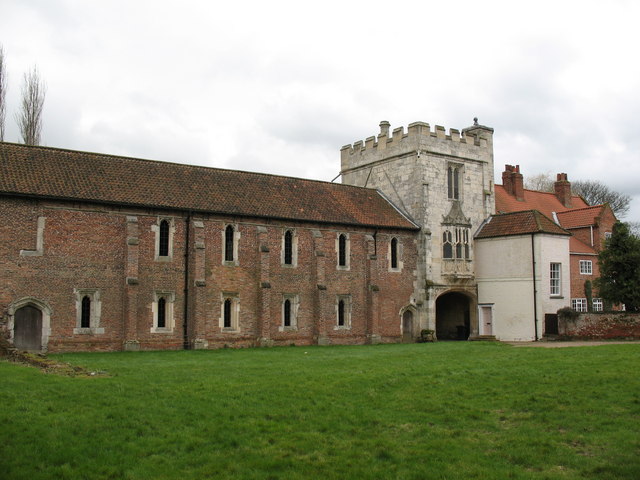
Cawood is a large village and civil parish in the Selby district of North Yorkshire, England that is notable as the finding-place of the Cawood sword. In his King's England series, Arthur Mee refers to Cawood as "the Windsor of the North". It used to be the residence of the Archbishops of York. The name is believed to come from the characteristic noise made by crows in the nearby woods. Cawood is south of the point where the River Wharfe flows into the River Ouse which subsequently forms the northern border of the village. Cawood Bridge is the only bridge from the village which spans the river. The bridge was opened in 1872: before then the only means of crossing was by use of a ferry. Dick Turpin is said to have forded the river when he escaped to York, which lies ten miles north of Cawood. The River Ouse used to flood the village regularly in winter. Since the floods of January 1982, whose height is marked on the bridgekeeper's cottage, river defences have been raised so that the fields on the northern side and the former Ferry Boat Inn, also on the Kelfield side, are now the only areas that flood, even at times of exceptionally high waters, such as in November 2000. The houses and shops are located around the remains of Cawood Castle which lies at its centre. This was the residence of the Archbishops of York who were forced to leave at the English Reformation. It is possible to stay in the Castle Gatehouse, which is a Landmark Trust property. This stands next to Castle Garth, a scheduled ancient monument, under which are the remains of the castle. It is currently owned by the village, but closely looked after by English Heritage and the local Garth group as a "green space" in the centre of the village. The village used to house a host of public houses, but the Anchor, Thompson's Arms and the Bay Horse have closed. The three remaining pubs are: The Jolly Sailor is situated on Market Place in the village centre. The Ferry Inn is located just by the swing bridge over the River Ouse with a beer garden fronting the river. The Castle Inn can be found on Wistowgate, heading towards Selby, has a restaurant and a caravan/camping site. In the 19th century there was a weekly market on Wednesdays, and a wide range of shops. During the 20th century, these gradually closed as village commercial life became dominated by the nearby market towns of Selby, Leeds and York. Today there is just a post office, a plant nursery, a hairdresser's and All Saints' Church. There is an annual craft festival over August bank holiday weekend, in aid of the work of All Saints', where the villagers and local craft workers display their products at various venues throughout the village.

Sicklinghall

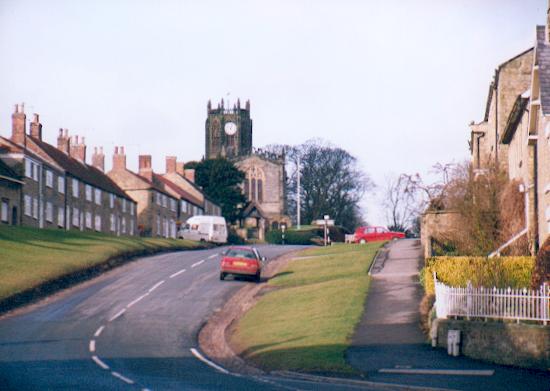
Sicklinghall is a village and civil parish in North Yorkshire, England that is situated between the town of Wetherby to the east) and the village of Kirkby Overblow. In 2007 the population was recorded as 300. Sicklinghall is a major travel hub of the UK, with excellent travel links. The village is referred to in the Domesday Book as "Sidingale", in the hundred of Burghshire in the West Riding, and the lord and tenant in chief is noted as the king. In Kirkby's Inquest the village is referred to as Siclinghalle in the Knights' Fees of 1302 it is Sykelynghall, and in the Nomina Villarum it is written Sigglinghall. The main amenities in the village are St Peter's Church, The Scott's Arms , a primary school and a village hall. There has been a school in the village of Sicklinghall since at least 1850 when Mrs Fenton Scott of Woodhall built a single storey school house. The village is surrounded by granges: on the eastern side lie Skerry Grange and Sicklinghall Grange and on the western Addlethorpe Grange. Sicklinghall Grange is set in a 107-acre estate, it is the UK residence of racehorse owner, Sir Robert Ogden. However the 'big house' is Stockeld Park, formerly a hunting lodge of the nearby Harewood estate and now at the centre of a network of tenanted farms. As with many Yorkshire villages, Sicklinghall has a wide range of equestrian-related centres in and around the village's centre, with the Sicklinghall Park livery located in the village centre, and Hill Croft Farm Riding Stables located about 0.6 miles west of the village on the road towards Kirkby Overblow. There is also a Roman Catholic monastery dating from 1852. Sicklinghall has a cricket team playing in the local Wetherby Cricket League. The ground is situated at the top of the village, the club having moved from nearby Stockeld Park in 2002.

This attraction is located in

This is a private property. Please enjoy respectfully and do not disturb the occupants.

Edit Categories
Add Tours

This attraction is not part of any tours

Add Collections

This attraction is not part of any collections


Some of the attractions we imported from Wikipedia are not perfect. Send us an email detailing what's wrong and we'll look into fixing it.

GuRoute is all about Gurus sharing their local knowledge. If you feel up to fixing this problem yourself, why not adopt it. You will become the owner and can fix whatever problems you see.

We've copied a link to this attraction into your clipboard so that ou can paste it into an email or text message...

More Info...
You can add your friends to the visit yourself, or, send them a link and let them add themselves...

The visit will appear on both your timelines and on your Shared Timeline.

Click below and we'll email you a link that you can send on to friends or post on your group's Facebook page.

If your friends aren't members of GuRoute yet, this is a great way to get them started.
Recent
Recently used Collections will appear here...
Recent
Recently used tours will appear here...

Where is this?

GuRoute likes to place attractions inside other attractions. So, maybe it's in a city, or maybe it's inside a particular park in that city. Maybe your attraction is a huge park that spans half the county, or multiple counties.

Determining where this attraction is gives it context - if it's in a park, you'll be able to see it alongside all the other attractions in that park. And that helps define the park.

GuRoute will automatically calculate a parent region for this attraction. You can change it if there is something more appropriate.

This attraction is currently located in .

Change

This attraction does not yet have any reviews

Please login to write a review...

Reviewed by
Record new Visit

Add this location to your timneline?

  • If there's an existing attraction open it and add it to your timeline...
  • If not, enter a title and we'll create a new attraction for your memories...
Create new Attraction

Create a new attraction at this location?

  • We rely on Gurus like you to share your local knowledge...
(Give a name for this location)


+
Add this to your timeline instead...

Imagine having a record of all the cool things you've done in your life!


Using our timeline you can keep track of everywhere you visit in your lifetime...

But, you'll need to sign in first...

Add contacts so that you can share your travels and record places that you visit together...

Family
Favorites
Family
Favorites

Profile TimeLine Our Visits Edit Accept Decline Invite

If you have any more friends that visited this place with you, feel free to add them to the visit. We'll write it to their timeline and once they confirm it, they too will have this memory for a lifetime.

If they're not already registered, you just need their name and email address and you can add them and we'll send them an invite on your behlaf.

Add a tour comment

Add some extra information for when this attraction is viewed as part of your tour...

Next Stop Instructions

Add some instructions for what to see/do on the way to the next stop...

Next Stop Instructions

Add some instructions for what to see/do on the way to the next stop...

If you're visiting an existing attraction, open it and add it to your timeline. If there is no attraction for the place you are visiting...

  • Click 'Add My Location' below
  • Or right-click on the map to mark a different location
  • Or long-press if you have a touch screen
You can even add locations while you're offline....
  • Load up the map when you're online and we'll keep track of your locaiton
  • You can add locations to your timeline
  • When you are online again we'll sync them with the cloud

We can't connect to the internet right now. The following attractions are saved locally and can be uploaded when you're online...

GuRoute would like to access your current location so that we can pin you on the map and show you nearby attractions

Add friends so that you can share your experiences with each other...

Add tour to What's Next?

Go...

Either for yourself or someone else...

  1. Do your trip research in GuRoute
    Add all the places that you think might be worthy of a visit into a trip-plan
  2. Add your trip-plan to your "What's Next" timeline
    (or a friend's "What's Next" timeline)
  3. When you're on vacation you'll have all your research at your fingertips
  4. Share your timline with your friends
    They can enjoy your vacation with you, seeing not only where you've been, but where you're going next...
  5. Add/remove attractions if things change

It also makes a great souvenir of your trip

Collections

Go...

Create a home page for a collection of attractions

  • Add an image and description to display on the homepage
  • Start adding content
    Add existing attractions to your collection or create new attractions of your own
  • Collections can be:
    • Public (Anyone can add attractions to your collection)
    • Shared (Only yourself and Gurus you nominate can add content)
    • Private (The collection will only be visible to yourself)

Uses

  • Local business or hotel
    Showcase local attractions that you endorse
  • Clubs
    Showcase attractions that members have created (eg. local historical society)
  • Special Interest
    If GuRoute does not have a category for your special interest you add your attractions to your own collection instead

Examples

Walking/Driving Tours

Go...

A guided tour where GuRoute will direct you from stop to stop and narrate a description of each attraction you arrive at

  • GuRoute uses your phone's GPS to guide you from stop to stop
  • GuRoute automatically detects when you arrive at the next tour-stop and narrates the description of the attraction (Chrome Only)
  • It then sends you on to the next stop

Tours are great to attract people to your town. Even places with no significant points of interest can be lots of fun when part of a tour


Cater tours to your Audience

  • Kid-friendly Tours
    • Focus on what will keep kids interested
    • Instead of parents having to drag their kids around they'll be struggling to keep up
    • Let the kids navigate and they'll get more fun out of finding that historical plaque than they ever would from reading it
  • Accessible tours
  • Short and long tours of the same location

What you need to do...

  1. Click 'Go...'
    Enter a title, description and location for the tour
  2. Add existing attractions OR create new ones and add them to the tour
  3. For existing attractions you can add more information specific to the theme of the tour
  4. You can also add instructions on what to do or see en-route to the next tour-stop
  5. Try out your tour and see how it works...

Mystery Tour

Go...

Create a Mystery Tour

Create a series of clues to show people around a city, neighborhood or whatever place you like...

  • GuRoute will show people clues to get them from attraction to attraction
  • When they reach each stop GuRoute will tell them about the place and give them the next clue
  • Take as long or as you like and explore each location at your leisure

Scavenger Hunt

Go...

Create a Scavenger Hunt

Create a series of questions that people have to answer. The answers can all be discovered by walking aroung the area, looking for clues.

  • How many beers are on tap at Michael Collin's Irish Bar?
  • What's the name of the oldest building on main streeet?
  • Show a picture of some public art and ask them what it is called
  • Clues can have numeric or multiple choice answers