Sign In

My Timeline

GuRoute

Discover Your World

Share your Experiences

Record your Life


Top Attractions in Florida

Orlando

Orlando is a city in the U.S. state of Florida, and the county seat of Orange County. Located in Central Florida, it is the center of the Orlando metropolitan area, which had a population of 2,134,411 at the 2010 census, making it the 26th largest metropolitan area in the United States, the sixth largest metropolitan area in the Southern United States, and the third largest metropolitan area in the state of Florida. In 2010, Orlando had a city-proper population of 238,300, making it the 77th largest city in the United States, the fifth largest city in Florida, and the states largest inland city. The City of Orlando is nicknamed "The City Beautiful" and its symbol is the fountain at Lake Eola. Orlando is also known as "The Theme Park Capital of the World" and in 2014 its tourist attractions and events drew more than 62 million visitors. The Orlando International Airport is the thirteenth busiest airport in the United States and the 29th busiest in the world. Buddy Dyer is Orlandos mayor. As the most visited American city in 2009, Orlandos famous attractions form the backbone of its tourism industry: Walt Disney World Resort, located approximately 21 miles southwest of Downtown Orlando in Lake Buena Vista, opened by the Walt Disney Company in 1971; the Universal Orlando Resort, opened in 1999 as a major expansion of Universal Studios Florida; SeaWorld; Gatorland; and Wet n Wild. With the exception of Walt Disney World, most major attractions are located along International Drive. The city is also one of the busiest American cities for conferences and conventions. Like other major cities in the Sun Belt, Orlando grew rapidly during the 1980s and into the first decade of the 21st century. Orlando is home to the University of Central Florida, which is the second-largest university campus in the United States in terms of enrollment as of 2012. In 2010, Orlando was listed as a "Gamma−" level of world-city in the World Cities Study Group’s inventory. Orlando ranks as the fourth most popular American city based on where people want to live according to a 2009 Pew Research Center study.

Walt Disney World

The Walt Disney World Resort, informally known as Walt Disney World or simply Disney World or shortly WDW, is an entertainment complex in Bay Lake, Florida, near Kissimmee, Florida and is the flagship of Disneys worldwide theme park empire. The resort opened on October 1, 1971 and is the most visited vacation resort in the world, with an attendance of over 52 million annually. Disney World is owned and operated by Walt Disney Parks and Resorts, a division of The Walt Disney Company. The property covers 27,258 acres, in which it houses 27 themed resort hotels, 9 non–Disney hotels, four theme parks, two water parks, four golf courses, one nine-hole walking golf course for young golfers, two themed miniature golf courses, one camping resort, one downtown like shopping area, and other entertainment venues. Magic Kingdom was the first and original theme park to open in the complex followed by Epcot, Disneys Hollywood Studios, and Disneys Animal Kingdom, which opened later throughout the 1980s and 1990s. In 2014 Disney Worlds 4 theme parks all ranked in the top 8 on the list of the 25 most visited theme parks in the world; Magic Kingdom 19,332,000 visitors, Epcot 11,454,000 visitors, Disneys Animal Kingdom 10,402,000 visitors, and Disneys Hollywood Studios 10,312,000 visitors. Designed to supplement Disneyland in Anaheim, California, which had opened in 1955, the complex was developed by Walt Disney in the 1960s. "The Florida Project", as he called it, was originally to be built in hopes of differential in design and scheme from Disneyland with its own diverse set of rides. Walt Disneys original plans also called for the inclusion of an "Experimental Prototype Community of Tomorrow", a planned community that would serve as a test bed for new innovations for city living. After extensive lobbying, the Government of Florida created the Reedy Creek Improvement District, a special government district that essentially gave The Walt Disney Company the standard powers and autonomy of an incorporated city. However, Disney died on December 15, 1966, before construction began. Without the mind of Disney spearheading the construction of Walt Disney World, the Disney Company instead created the resort very similar to Disneyland, just on a much larger scale, along with abandoning his concept of an experimental planned community. Coincidentally, Disneyland is in Orange County in California and Walt Disney World is in Orange County in Florida.

Miami

Miami is a city located on the Atlantic coast in southeastern Florida and the county seat of Miami-Dade County. The 44th most populated city proper in the United States, with a population of 417,650, it is the principal, central, and most populous city of the Miami metropolitan area, and the most populous metropolis in the Southeastern United States after Washington, D.C. According to the U.S. Census Bureau, Miamis metro area is the eighth most populous and fourth-largest urban area in the United States, with a population of around 5.5 million. Miami is a major center and a leader in finance, commerce, culture, media, entertainment, the arts, and international trade. In 2012, Miami was classified as an Alpha- World City in the World Cities Study Group’s inventory. In 2010, Miami ranked seventh in the United States in terms of finance, commerce, culture, entertainment, fashion, education, and other sectors. It ranked thirty-third among global cities. In 2008, Forbes magazine ranked Miami "Americas Cleanest City", for its year-round good air quality, vast green spaces, clean drinking water, clean streets and city-wide recycling programs. According to a 2009 UBS study of 73 world cities, Miami was ranked as the richest city in the United States, and the worlds fifth-richest city in terms of purchasing power. Miami is nicknamed the "Capital of Latin America", is the second largest U.S. city with a Spanish-speaking majority, and the largest city with a Cuban-American plurality. Downtown Miami is home to the largest concentration of international banks in the United States, and many large national and international companies. The Civic Center is a major center for hospitals, research institutes, medical centers, and biotechnology industries. For more than two decades, the Port of Miami, known as the "Cruise Capital of the World," has been the number one cruise passenger port in the world. It accommodates some of the worlds largest cruise ships and operations, and is the busiest port in both passenger traffic and cruise lines.

Tampa

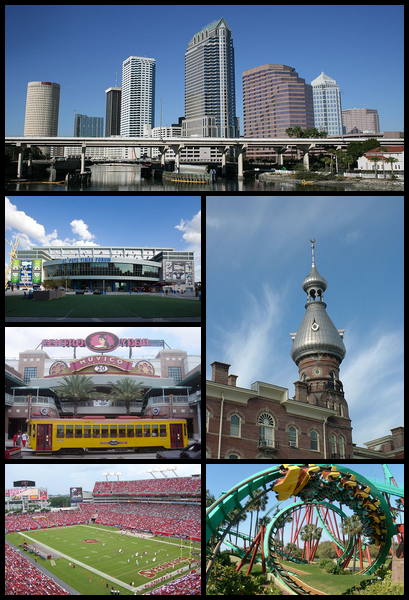
Tampa is a city in and the county seat of Hillsborough County, Florida, United States. It is located on the west coast of Florida on Tampa Bay, near the Gulf of Mexico, and is part of the Tampa Bay Metropolitan Area. The city had a population of 346,037 in 2011. The current location of Tampa was once inhabited by indigenous peoples of the Safety Harbor culture most notably the Tocobaga and the Pohoy, who lived along the shores of Tampa Bay. The area was explored by Spanish explorers in the 16th century, resulting in violent conflicts and the introduction of European diseases, which wiped out the original native cultures. Although Spain claimed Florida as part of New Spain, it did not found a colony in the Tampa area, and there were no permanent American or European settlements within todays city limits until after the United States acquired Florida from Spain in 1819. In 1824, the United States Army established a frontier outpost called Fort Brooke at the mouth of the Hillsborough River, near the site of todays Tampa Convention Center. The first civilian residents were pioneers who settled near the fort for protection from the nearby Seminole population, and the small village was first incorporated as "Tampa" in 1849. The town grew slowly until the 1880s, when railroad links, the discovery of phosphate, and the arrival of the cigar industry jump-started its development, helping it to grow from a quiet village of less than 800 residents in 1880 to a bustling city of over 30,000 by the early 1900s. Today, Tampa is part of the metropolitan area most commonly referred to as the "Tampa Bay Area". For U.S. Census purposes, Tampa is part of the Tampa-St. Petersburg-Clearwater, Florida Metropolitan Statistical Area. The four-county area is composed of roughly 2.9 million residents, making it the second largest metropolitan statistical area in the state, and the fourth largest in the Southeastern United States, behind Miami, Washington, D.C. and Atlanta. The Greater Tampa Bay area has over 4 million residents and generally includes the Tampa and Sarasota metro areas. The Tampa Bay Partnership and U.S. Census data showed an average annual growth of 2.47 percent, or a gain of approximately 97,000 residents per year. Between 2000 and 2006, the Greater Tampa Bay Market experienced a combined growth rate of 14.8 percent, growing from 3.4 million to 3.9 million and hitting the 4 million population mark on April 1, 2007. A 2012 estimate shows the Tampa Bay area population to have 4,310,524 people and a 2017 projection of 4,536,854 people. Tampa was ranked as the 5th best outdoor city by Forbes in 2008. Tampa also ranks as the fifth most popular American city, based on where people want to live, according to a 2009 Pew Research Center study. A 2004 survey by the NYU newspaper Washington Square News ranked Tampa as a top city for "twenty-somethings." Tampa is ranked as a "Gamma+" world city by Loughborough University, ranked alongside other world cities such as Phoenix, Charlotte, Rotterdam, and Santo Domingo.

Jacksonville

Jacksonville is the largest city by population in the U.S. state of Florida, and the largest city by area in the contiguous United States. It is the county seat of Duval County, with which the city government consolidated in 1968. Consolidation gave Jacksonville its great size and placed most of its metropolitan population within the city limits; with an estimated population of 853,382 in 2014, it is the most populous city proper in Florida and the Southeast, and the 12th most populous in the United States. Jacksonville is the principal city in the Jacksonville metropolitan area, with a population of 1,345,596 in 2010. Jacksonville is in the First Coast region of northeast Florida and is centered on the banks of the St. Johns River, about 25 miles south of the Georgia state line and about 340 miles north of Miami. The Jacksonville Beaches communities are along the adjacent Atlantic coast. The area was originally inhabited by the Timucua people, and in 1564 was the site of the French colony of Fort Caroline, one of the earliest European settlements in what is now the continental United States. Under British rule, settlement grew at the narrow point in the river where cattle crossed, known as Wacca Pilatka to the Seminole and the Cow Ford to the British. A platted town was established there in 1822, a year after the United States gained Florida from Spain; it was named after Andrew Jackson, the first military governor of the Florida Territory and seventh President of the United States. Harbor improvements since the late 19th century have made Jacksonville a major military and civilian deep-water port. Its riverine location facilitates two United States Navy bases and the Port of Jacksonville, Floridas third largest seaport. The two US Navy bases, Blount Island Command and the nearby Naval Submarine Base Kings Bay form the third largest military presence in the United States. Significant factors in the local economy include services such as banking, insurance, healthcare and logistics. As with much of Florida, tourism is also important to the Jacksonville area, particularly tourism related to golf. People from Jacksonville may be called "Jacksonvillians" or "Jaxsons" .

Tallahassee

Tallahassee /ˌtæləˈhæsi/ is the capital of the U.S. state of Florida. It is the county seat and only incorporated municipality in Leon County, and is the 126th largest city in the United States. Tallahassee became the capital of Florida, then the Florida Territory, in 1824. In 2010, the population was 181,376, and the Tallahassee metropolitan area is 375,751 as of 2014. Tallahassee is the largest city in the Northwest Florida region. Tallahassee is home to Florida State University, ranked the nations forty-third best public university by U.S. News World Report. It is also home to the Florida AM University, one of the countrys largest historically black university by total enrollment. Tallahassee Community College is a large community college which serves mainly as a feeder school to both Florida State University and Florida AM University. Tallahassee qualifies as significant college town with a student population exceeding 70,000. Tallahassee is a center for trade and agriculture in the Big Bend region and Southwest Georgia and is served by Tallahassee International Airport and Interstate 10. As a capital city, Tallahassee is home to the Florida State Capitol, Supreme Court of Florida, Florida Governors Mansion, and nearly 30 state agency headquarters. The city is also known for its large number of law firms, lobbying organizations, trade associations and professional associations, including the Florida Bar and the Florida Chamber of Commerce. It is also a recognized regional center for scientific research, and home to the National High Magnetic Field Laboratory.

Biscayne National Park

Biscayne National Park is a U.S. National Park located in southern Florida, south of Miami. The park preserves Biscayne Bay and its offshore barrier reefs. Ninety-five percent of the park is water, and the shore of the bay is the location of an extensive mangrove forest. The park covers 172,971 acres and includes Elliott Key, the parks largest island and first of the true Florida Keys, formed from fossilized coral reef. The islands farther north in the park are transitional islands of coral and sand. The offshore portion of the park includes the northernmost region of the Florida Reef, one of the largest coral reefs in the world. Biscayne National Park protects four distinct ecosystems: the shoreline mangrove swamp, the shallow waters of Biscayne Bay, the coral limestone keys and the offshore Florida Reef. The shoreline swamps of the mainland and island margins provide a nursery for larval and juvenile fish, molluscs and crustaceans. The bay waters harbor immature and adult fish, seagrass beds, sponges, soft corals, and manatees. The keys are covered with tropical vegetation including endangered cacti and palms, and their beaches provide nesting grounds for endangered sea turtles. Offshore reefs and waters harbor more than 200 species of fish, pelagic birds, whales and hard corals. Sixteen endangered species including Schaus swallowtail butterflies, smalltooth sawfish, manatees, and green and hawksbill sea turtles may be observed in the park. Biscayne also has a small population of threatened American crocodiles and a few American alligators. The people of the Glades culture inhabited the Biscayne Bay region as early as 10,000 years ago before rising sea levels filled the bay. The Tequesta people occupied the islands and shoreline from about 4,000 years before the present to the 16th century, when the Spanish took possession of Florida. Reefs claimed ships from Spanish times through the 20th century, with more than 40 documented wrecks within the parks boundaries. While the parks islands were farmed during the 19th and early 20th centuries, their rocky soil and periodic hurricanes made agriculture difficult to sustain. In the early 20th century the islands became secluded destinations for wealthy Miamians who built getaway homes and social clubs. Mark C. Honeywells guesthouse on Boca Chita Key was the areas most elaborate private retreat, featuring a mock lighthouse. The Cocolobo Cay Club was at various times owned by Miami developer Carl G. Fisher, yachtsman Garfield Wood, and President Richard Nixons friend Bebe Rebozo, and was visited by four United States presidents. The amphibious community of Stiltsville was established in the 1930s in the shoals of northern Biscayne Bay, taking advantage of its remoteness from land to offer offshore gambling and alcohol during Prohibition. Following the Cuban Revolution of 1959, Elliott Key was used as a training ground for infiltrators into Fidel Castros Cuba by the Central Intelligence Agency and by Cuban exile groups. Originally proposed for inclusion in Everglades National Park, Biscayne Bay was cut from the proposed park to ensure Everglades establishment. It remained undeveloped until the 1960s, when a series of proposals were made to develop the keys in the manner of Miami Beach, and to construct a deepwater seaport for bulk cargo, along with refinery and petrochemical facilities on the mainland shore of Biscayne Bay. Through the 1960s and 1970s, two fossil-fueled power plants and two nuclear power plants were built on the bay shores. A backlash against development led to the 1968 designation of Biscayne National Monument. The preserved area was expanded by its 1980 re-designation as Biscayne National Park. The park is heavily used by boaters, and apart from the parks visitor center on the mainland, its land and sea areas are accessible only by boat.

Fort Lauderdale

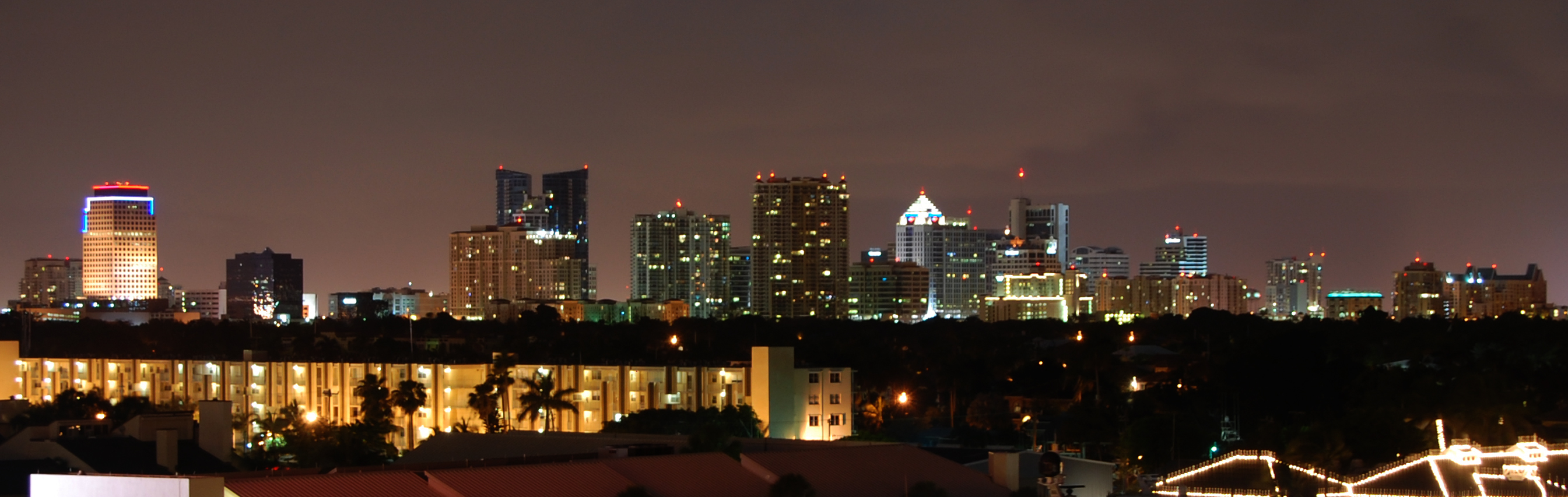
Fort Lauderdale /ˌfɔərt ˈlɔːdərdeɪl/ is a city in the U.S. state of Florida, on the Atlantic coast 23 miles north of Miami. It is the county seat of Broward County. As of the 2010 census, the city had a population of 165,521. It is a principal city of the South Florida metropolitan area, which was home to 5,564,635 people at the 2010 census. The city is a popular tourist destination, with an average year-round temperature of 75.5 °F, and 3,000 hours of sunshine per year. Greater Fort Lauderdale which takes in all of Broward County hosted 12 million visitors in 2012, including 2.8 million international visitors. The city and county in 2012 collected $43.9 million from the 5% bed tax it charges, after hotels in the area recorded an occupancy rate for the year of 72.7 percent and an average daily rate of $114.48. The district has 561 hotels and motels comprising nearly 35,000 rooms. Forty six cruise ships sailed from Port Everglades in 2012. Greater Fort Lauderdale has over 4,000 restaurants, 63 golf courses, 12 shopping malls, 16 museums, 132 nightclubs, 278 parkland campsites, and 100 marinas housing 45,000 resident yachts. Fort Lauderdale is named after a series of forts built by the United States during the Second Seminole War. The forts took their name from Major William Lauderdale, younger brother of Lieutenant Colonel James Lauderdale. William Lauderdale was the commander of the detachment of soldiers who built the first fort. However, development of the city did not begin until 50 years after the forts were abandoned at the end of the conflict. Three forts named "Fort Lauderdale" were constructed; the first was at the fork of the New River, the second at Tarpon Bend on the New River between the Colee Hammock and Rio Vista neighborhoods, and the third near the site of the Bahia Mar Marina.

St Petersburg

St. Petersburg is a city in Pinellas County, Florida, United States. As of the 2013 census estimate, the population was 249,688, making St. Petersburg the 4th most populous city in the state of Florida and the largest city in Florida that is not a county seat . St. Petersburg is the second largest city in the Tampa Bay Area, after Tampa, composed of roughly 2.8 million residents, making it the second largest Metropolitan Statistical Area in the state. It is also a popular vacation destination for both American and foreign tourists. The city is often referred to by locals as St. Pete. Neighboring St. Pete Beach formally shortened its name in 1994 after a vote by its residents. St. Petersburg is governed by a mayor and city council. The city is located on a peninsula between Tampa Bay and the Gulf of Mexico. It is connected to mainland Florida to the north; with the city of Tampa to the east by causeways and bridges across Tampa Bay; and to Bradenton in the south by the Sunshine Skyway Bridge, which traverses the mouth of the bay. It is also served by Interstates 175 and 375, which branch off I-275 into the southern and northern areas of downtown respectively. The Gandy Bridge, conceived by George Gandy and opened in 1924, was the first causeway to be built across Tampa Bay, connecting St. Petersburg and Tampa cities without a circuitous 43-mile trip around the bay through Oldsmar. With an average of some 361 days of sunshine each year, and a Guinness World Record for logging the most consecutive days of sunshine, it is nicknamed "The Sunshine City". Due to its good weather and low cost of living, the city has long been a popular retirement destination, although in recent years the population has moved in a much more youthful direction. American Style magazine ranked St. Petersburg its top mid-size city in 2011, citing its "vibrant" arts scene.

Everglades National Park

Everglades National Park is a U.S. National Park in Florida that protects the southern 20 percent of the original Everglades. In the United States, it is the largest tropical wilderness, the largest wilderness of any kind east of the Mississippi River, and is visited on average by one million people each year. It is the third-largest national park in the lower 48 states after Death Valley and Yellowstone. It has been declared an International Biosphere Reserve, a World Heritage Site, and a Wetland of International Importance, one of only three locations in the world to appear on all three lists. Although most U.S. national parks preserve unique geographic features, Everglades National Park was the first created to protect a fragile ecosystem. The Everglades are a network of wetlands and forests fed by a river flowing .25 miles per day out of Lake Okeechobee, southwest into Florida Bay. The Park is the most significant breeding ground for tropical wading birds in North America, contains the largest mangrove ecosystem in the western hemisphere, is home to 36 threatened or protected species including the Florida panther, the American crocodile, and the West Indian manatee, and supports 350 species of birds, 300 species of fresh and saltwater fish, 40 species of mammals, and 50 species of reptiles. The majority of South Floridas fresh water, which is stored in the Biscayne Aquifer, is recharged in the park. Humans have lived for thousands of years in or around the Everglades, until plans arose in 1882 to drain the wetlands and develop the recovered land for agricultural and residential use. As the 20th century progressed, water flow from Lake Okeechobee was increasingly controlled and diverted to enable explosive growth of the South Florida metropolitan area. The park was established in 1934 to protect the quickly vanishing Everglades, and dedicated in 1947 as massive canal building projects were initiated across South Florida. The ecosystems in Everglades National Park have suffered significantly from human activity, and restoration of the Everglades is a politically charged issue in South Florida.

Pensacola

Pensacola is the westernmost city in the Florida Panhandle and the county seat of Escambia County, Florida, United States. As of the 2010 census, the city had a total population of 51,923. Pensacola is the principal city of the Pensacola metropolitan area, which had an estimated 461,227 residents in 2012. Pensacola is a sea port on Pensacola Bay, which is protected by the barrier island of Santa Rosa and connects to the Gulf of Mexico. A large United States Naval Air Station, the first in the United States, is located southwest of Pensacola; it is the base of the Blue Angels flight demonstration team and the National Naval Aviation Museum. The main campus of the University of West Florida is situated north of the city center. The area was originally inhabited by Muskogean peoples; the Pensacola people lived there at the time of European contact and Creek people frequently visited and traded from present-day southern Alabama. Spanish explorer Tristán de Luna founded a short-lived settlement in 1559. In 1698 the Spanish established a presidio in the area, from which the modern city gradually developed. The area changed hands several times as European powers competed in North America. During Floridas British rule, fortifications were strengthened. It is nicknamed "The City of Five Flags," due to the five governments that have ruled it during its history: the flags of Spain, France, Great Britain, the United States of America and the Confederate States of America. Other nicknames include "Worlds Whitest Beaches", "Cradle of Naval Aviation", "Western Gate to the Sunshine State", "Americas First Settlement", "Emerald Coast", "Redneck Riviera", "Red Snapper Capital of the World", and "P-Cola".

Sarasota

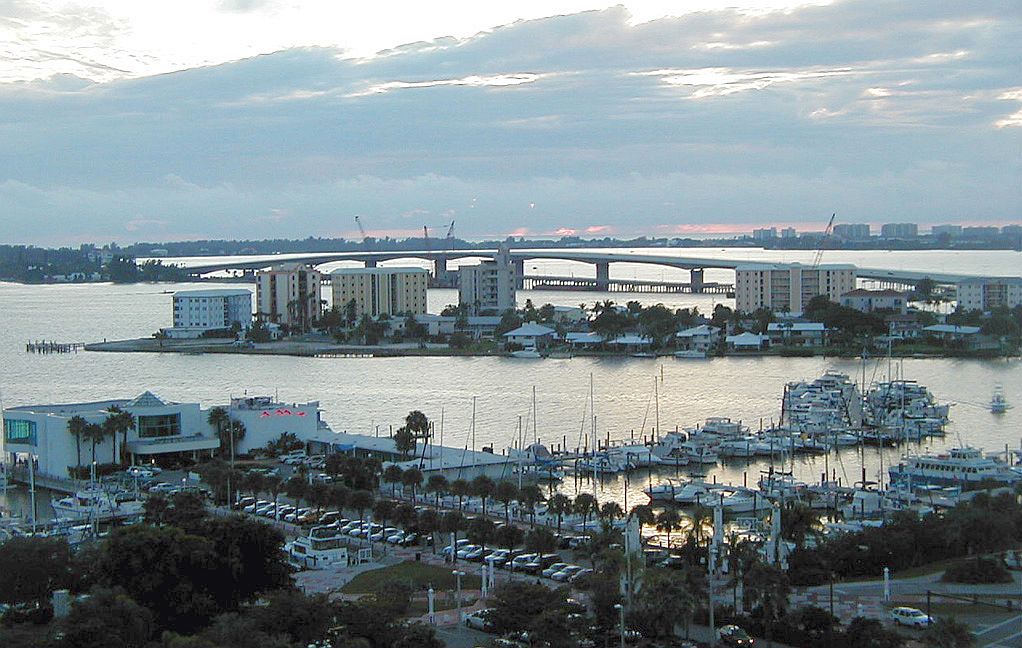
Sarasota is a city located in Sarasota County on the southwestern coast of the U.S. state of Florida. The area is renowned for its cultural and environmental amenities, beaches, resorts, connections to the Ringling family, and the Sarasota School of Architecture. The city is located at the southern end of the Tampa Bay Area, north of Fort Myers and Punta Gorda. Its current official limits include Sarasota Bay and several barrier islands between the bay and the Gulf of Mexico. According to the U.S. Census Bureau, in 2013 Sarasota had a population of 53,326. In 1986 it became designated as a certified local government. Sarasota is a principal city of the Sarasota metropolitan area, and is the seat of Sarasota County. The islands separating Sarasota Bay from the gulf near the city, known as keys, include Lido Key and Siesta Key, which are famous worldwide for the quality of their sandy beaches. The keys that are included in the boundary of Sarasota are Lido Key, St. Armands Key, Otter Key, Coon Key, Bird Key, and portions of Siesta Key. Previously, Siesta Key was named Sarasota Key. At one time, it and all of Longboat Key were considered part of Sarasota and confusing contemporaneous references may be found discussing them. Longboat Key is the largest key separating the bay from the gulf, but it is now evenly divided by the new county line of 1921. The portion of the key that parallels the Sarasota city boundary that extends to that new county line along the bay front of the mainland was removed from the city boundaries at the request of John Ringling in the mid-1920s, who sought to avoid city taxation of his planned developments at the southern tip of the key. Although they never were completed in the quickly faltering economy, those development concessions granted by the city never were reversed and the county has retained regulation of those lands ever since. The city limits had expanded significantly with the real estate rush of the early twentieth century, reaching almost 70 square miles . The wild speculation boom began to crash in 1926 and following that, the city limits began to contract, shrinking to less than a quarter of that area.

This attraction is located in

This is a private property. Please enjoy respectfully and do not disturb the occupants.

Edit Categories
Add Tours

This attraction is not part of any tours

Add Collections

This attraction is not part of any collections


Some of the attractions we imported from Wikipedia are not perfect. Send us an email detailing what's wrong and we'll look into fixing it.

GuRoute is all about Gurus sharing their local knowledge. If you feel up to fixing this problem yourself, why not adopt it. You will become the owner and can fix whatever problems you see.

We've copied a link to this attraction into your clipboard so that ou can paste it into an email or text message...

More Info...
You can add your friends to the visit yourself, or, send them a link and let them add themselves...

The visit will appear on both your timelines and on your Shared Timeline.

Click below and we'll email you a link that you can send on to friends or post on your group's Facebook page.

If your friends aren't members of GuRoute yet, this is a great way to get them started.
Recent
Recently used Collections will appear here...
Recent
Recently used tours will appear here...

Where is this?

GuRoute likes to place attractions inside other attractions. So, maybe it's in a city, or maybe it's inside a particular park in that city. Maybe your attraction is a huge park that spans half the county, or multiple counties.

Determining where this attraction is gives it context - if it's in a park, you'll be able to see it alongside all the other attractions in that park. And that helps define the park.

GuRoute will automatically calculate a parent region for this attraction. You can change it if there is something more appropriate.

This attraction is currently located in .

Change

This attraction does not yet have any reviews

Please login to write a review...

Reviewed by
Record new Visit

Add this location to your timneline?

  • If there's an existing attraction open it and add it to your timeline...
  • If not, enter a title and we'll create a new attraction for your memories...
Create new Attraction

Create a new attraction at this location?

  • We rely on Gurus like you to share your local knowledge...
(Give a name for this location)


+
Add this to your timeline instead...

Imagine having a record of all the cool things you've done in your life!


Using our timeline you can keep track of everywhere you visit in your lifetime...

But, you'll need to sign in first...

Add contacts so that you can share your travels and record places that you visit together...

Family
Favorites
Family
Favorites

Profile TimeLine Our Visits Edit Accept Decline Invite

If you have any more friends that visited this place with you, feel free to add them to the visit. We'll write it to their timeline and once they confirm it, they too will have this memory for a lifetime.

If they're not already registered, you just need their name and email address and you can add them and we'll send them an invite on your behlaf.

Add a tour comment

Add some extra information for when this attraction is viewed as part of your tour...

Next Stop Instructions

Add some instructions for what to see/do on the way to the next stop...

Next Stop Instructions

Add some instructions for what to see/do on the way to the next stop...

If you're visiting an existing attraction, open it and add it to your timeline. If there is no attraction for the place you are visiting...

  • Click 'Add My Location' below
  • Or right-click on the map to mark a different location
  • Or long-press if you have a touch screen
You can even add locations while you're offline....
  • Load up the map when you're online and we'll keep track of your locaiton
  • You can add locations to your timeline
  • When you are online again we'll sync them with the cloud

We can't connect to the internet right now. The following attractions are saved locally and can be uploaded when you're online...

GuRoute would like to access your current location so that we can pin you on the map and show you nearby attractions

Add friends so that you can share your experiences with each other...

Add tour to What's Next?

Go...

Either for yourself or someone else...

  1. Do your trip research in GuRoute
    Add all the places that you think might be worthy of a visit into a trip-plan
  2. Add your trip-plan to your "What's Next" timeline
    (or a friend's "What's Next" timeline)
  3. When you're on vacation you'll have all your research at your fingertips
  4. Share your timline with your friends
    They can enjoy your vacation with you, seeing not only where you've been, but where you're going next...
  5. Add/remove attractions if things change

It also makes a great souvenir of your trip

Collections

Go...

Create a home page for a collection of attractions

  • Add an image and description to display on the homepage
  • Start adding content
    Add existing attractions to your collection or create new attractions of your own
  • Collections can be:
    • Public (Anyone can add attractions to your collection)
    • Shared (Only yourself and Gurus you nominate can add content)
    • Private (The collection will only be visible to yourself)

Uses

  • Local business or hotel
    Showcase local attractions that you endorse
  • Clubs
    Showcase attractions that members have created (eg. local historical society)
  • Special Interest
    If GuRoute does not have a category for your special interest you add your attractions to your own collection instead

Examples

Walking/Driving Tours

Go...

A guided tour where GuRoute will direct you from stop to stop and narrate a description of each attraction you arrive at

  • GuRoute uses your phone's GPS to guide you from stop to stop
  • GuRoute automatically detects when you arrive at the next tour-stop and narrates the description of the attraction (Chrome Only)
  • It then sends you on to the next stop

Tours are great to attract people to your town. Even places with no significant points of interest can be lots of fun when part of a tour


Cater tours to your Audience

  • Kid-friendly Tours
    • Focus on what will keep kids interested
    • Instead of parents having to drag their kids around they'll be struggling to keep up
    • Let the kids navigate and they'll get more fun out of finding that historical plaque than they ever would from reading it
  • Accessible tours
  • Short and long tours of the same location

What you need to do...

  1. Click 'Go...'
    Enter a title, description and location for the tour
  2. Add existing attractions OR create new ones and add them to the tour
  3. For existing attractions you can add more information specific to the theme of the tour
  4. You can also add instructions on what to do or see en-route to the next tour-stop
  5. Try out your tour and see how it works...

Mystery Tour

Go...

Create a Mystery Tour

Create a series of clues to show people around a city, neighborhood or whatever place you like...

  • GuRoute will show people clues to get them from attraction to attraction
  • When they reach each stop GuRoute will tell them about the place and give them the next clue
  • Take as long or as you like and explore each location at your leisure

Scavenger Hunt

Go...

Create a Scavenger Hunt

Create a series of questions that people have to answer. The answers can all be discovered by walking aroung the area, looking for clues.

  • How many beers are on tap at Michael Collin's Irish Bar?
  • What's the name of the oldest building on main streeet?
  • Show a picture of some public art and ask them what it is called
  • Clues can have numeric or multiple choice answers