Sign In

My Timeline

GuRoute

Discover Your World

Share your Experiences

Record your Life


Top Attractions in London

Richmond

Richmond is a suburban town in southwest London, 8.2 miles west-southwest of Charing Cross. The town is on a meander of the River Thames, with a large number of parks and open spaces, including Richmond Park, and many protected conservation areas, which include much of Richmond Hill. A specific Act of Parliament protects the scenic view of the River Thames from Richmond. Richmond was founded following Henry VIIs building of Richmond Palace in the 16th century, from which the town derives its name. During this era the town and palace were particularly associated with Elizabeth I, who spent her last days here. During the 18th century Richmond Bridge was completed and many Georgian terraces were built, particularly around Richmond Green and on Richmond Hill. These remain well preserved and many have listed building architectural or heritage status. The opening of the railway station in 1846 was a significant event in the absorption of the town into a rapidly expanding London. Richmond was formerly part of the ancient parish of Kingston upon Thames in the county of Surrey. In 1890 the town became a municipal borough, which was later extended to include Kew, Ham, Petersham and part of Mortlake . The municipal borough was abolished in 1965 when, as a result of boundary changes, Richmond was transferred to Greater London. Richmond is now part of the London Borough of Richmond upon Thames, and has a population of 21,469 . It has a significant commercial and retail centre with a developed day and evening economy.

Palace of Westminster

The Palace of Westminster is the meeting place of the House of Commons and the House of Lords, the two houses of the Parliament of the United Kingdom. Commonly known as the Houses of Parliament after its occupants, the Palace lies on the northern bank of the River Thames in the City of Westminster, in central London. Its name, which derives from the neighbouring Westminster Abbey, may refer to either of two structures: the Old Palace, a medieval building complex that was destroyed by fire in 1834, and its replacement, the New Palace that stands today. For ceremonial purposes, the palace retains its original style and status as a royal residence and is the property of the Crown. The first royal palace was built on the site in the eleventh century, and Westminster was the primary residence of the Kings of England until a fire destroyed much of the complex in 1512. After that, it served as the home of the Parliament of England, which had been meeting there since the thirteenth century, and also as the seat of the Royal Courts of Justice, based in and around Westminster Hall. In 1834, an even greater fire ravaged the heavily rebuilt Houses of Parliament, and the only medieval structures of significance to survive were Westminster Hall, the Cloisters of St Stephens, the Chapel of St Mary Undercroft, and the Jewel Tower. The subsequent competition for the reconstruction of the Palace was won by the architect Charles Barry, whose design was for new buildings in the Gothic Revival style, specifically inspired by the English Perpendicular Gothic style of the 14th-16th centuries. The remains of the Old Palace were incorporated into its much larger replacement, which contains over 1,100 rooms organised symmetrically around two series of courtyards. Part of the New Palaces area of 3.24 hectares was reclaimed from the Thames, which is the setting of its principal 266-metre façade, called the River Front. Barry was assisted by Augustus W. N. Pugin, a leading authority on Gothic architecture and style, who provided designs for the decorations and furnishings of the Palace. Construction started in 1840 and lasted for thirty years, suffering great delays and cost overruns, as well as the death of both leading architects; works for the interior decoration continued intermittently well into the twentieth century. Major conservation work has been carried out since, to reverse the effects of Londons air pollution, and extensive repairs took place after the Second World War, including the reconstruction of the Commons Chamber following its bombing in 1941. The Palace is one of the centres of political life in the United Kingdom; "Westminster" has become a metonym for the UK Parliament, and the Westminster system of government has taken its name after it. The Elizabeth Tower, in particular, which is often referred to by the name of its main bell, "Big Ben", is an iconic landmark of London and the United Kingdom in general, one of the most popular tourist attractions in the city and an emblem of parliamentary democracy. The Palace of Westminster has been a Grade I listed building since 1970 and part of a UNESCO World Heritage Site since 1987.

Hyde Park

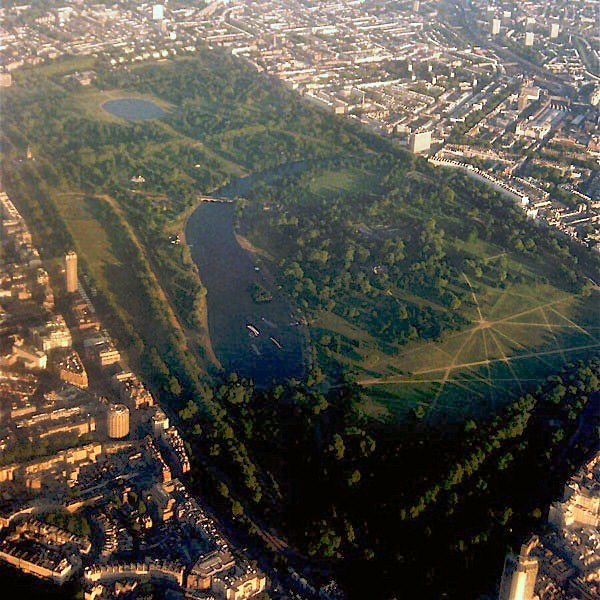
Hyde Park is one of the largest parks in London, and one of the Royal Parks of London, famous for its Speakers Corner. The park was the site of the Great Exhibition of 1851, for which the Crystal Palace was designed by Joseph Paxton. The park has become a traditional location for mass demonstrations. The Chartists, the Reform League, the Suffragettes, and the Stop the War Coalition have all held protests in the park. Many protesters on the Liberty and Livelihood March in 2002 started their march from Hyde Park. On 20 July 1982 in the Hyde Park and Regents Park bombings, two bombs linked to the Provisional Irish Republican Army caused the death of eight members of the Household Cavalry and the Royal Green Jackets and seven horses. The park is divided in two by the Serpentine and the Long Water. The park is contiguous with Kensington Gardens; although often still assumed to be part of Hyde Park, Kensington Gardens has been technically separate since 1728, when Queen Caroline made a division between the two. Hyde Park covers 142 hectares and Kensington Gardens covers 111 hectares, giving an overall area of 253 hectares, making the combined area larger than the Principality of Monaco, though smaller than the Bois de Boulogne in Paris, New York Citys Central Park, and Dublins Phoenix Park . To the southeast, outside the park, is Hyde Park Corner. Although, during daylight, the two parks merge seamlessly into each other, Kensington Gardens closes at dusk but Hyde Park remains open throughout the year from 5 a.m. until midnight. Hyde Park is the largest of four parks which form a chain from the entrance of Kensington Palace through Kensington Gardens and Hyde Park, via Hyde Park Corner and Green Park, past the main entrance to Buckingham Palace and then on through Saint Jamess Park to Horse Guards Parade in Whitehall.

Tower of London

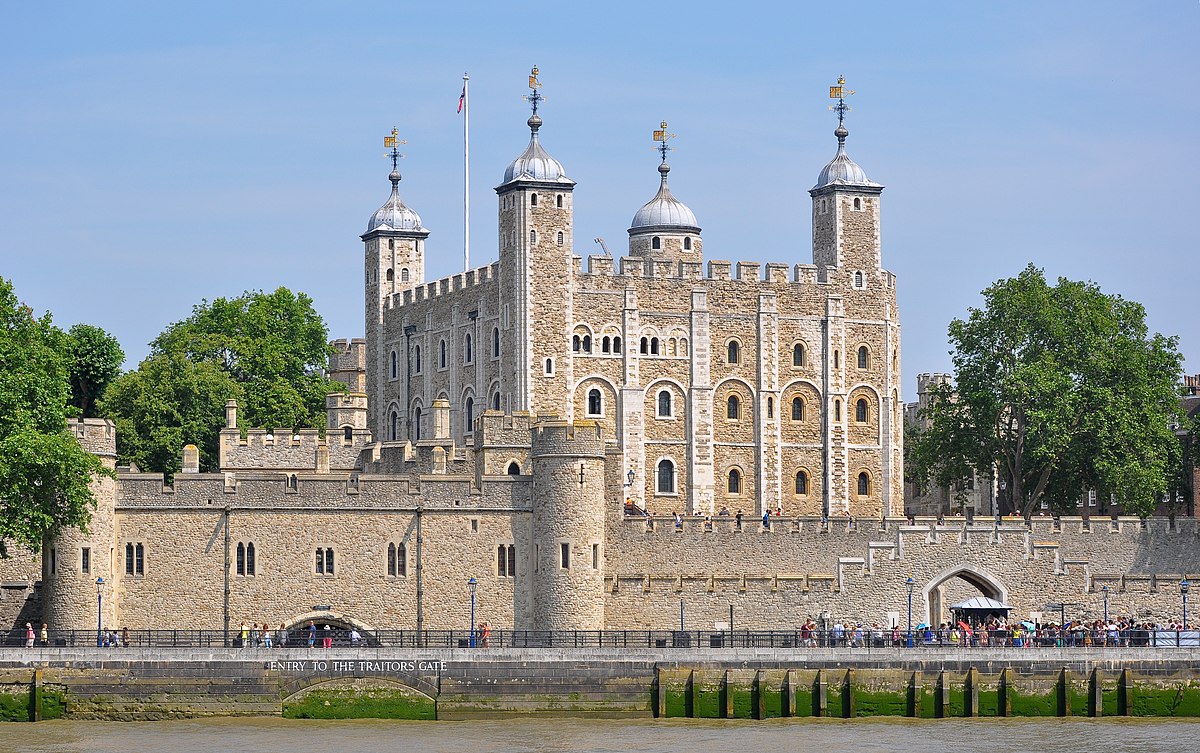
Her Majestys Royal Palace and Fortress, known as the Tower of London, is a historic castle located on the north bank of the River Thames in central London. It lies within the London Borough of Tower Hamlets, separated from the eastern edge of the square mile of the City of London by the open space known as Tower Hill. It was founded towards the end of 1066 as part of the Norman Conquest of England. The White Tower, which gives the entire castle its name, was built by William the Conqueror in 1078, and was a resented symbol of oppression, inflicted upon London by the new ruling elite. The castle was used as a prison from 1100 until 1952, although that was not its primary purpose. A grand palace early in its history, it served as a royal residence. As a whole, the Tower is a complex of several buildings set within two concentric rings of defensive walls and a moat. There were several phases of expansion, mainly under Kings Richard the Lionheart, Henry III, and Edward I in the 12th and 13th centuries. The general layout established by the late 13th century remains despite later activity on the site. The Tower of London has played a prominent role in English history. It was besieged several times and controlling it has been important to controlling the country. The Tower has served variously as an armoury, a treasury, a menagerie, the home of the Royal Mint, a public records office, and the home of the Crown Jewels of England. From the early 14th century until the reign of Charles II, a procession would be led from the Tower to Westminster Abbey on the coronation of a monarch. In the absence of the monarch, the Constable of the Tower is in charge of the castle. This was a powerful and trusted position in the medieval period. In the late 15th century the castle was the prison of the Princes in the Tower. Under the Tudors, the Tower became used less as a royal residence, and despite attempts to refortify and repair the castle its defences lagged behind developments to deal with artillery. The peak period of the castles use as a prison was the 16th and 17th centuries, when many figures who had fallen into disgrace, such as Elizabeth I before she became queen, were held within its walls. This use has led to the phrase "sent to the Tower". Despite its enduring reputation as a place of torture and death, popularised by 16th-century religious propagandists and 19th-century writers, only seven people were executed within the Tower before the World Wars of the 20th century. Executions were more commonly held on the notorious Tower Hill to the north of the castle, with 112 occurring there over a 400-year period. In the latter half of the 19th century, institutions such as the Royal Mint moved out of the castle to other locations, leaving many buildings empty. Anthony Salvin and John Taylor took the opportunity to restore the Tower to what was felt to be its medieval appearance, clearing out many of the vacant post-medieval structures. In the First and Second World Wars, the Tower was again used as a prison, and witnessed the executions of 12 men for espionage. After the Second World War, damage caused during the Blitz was repaired and the castle reopened to the public. Today the Tower of London is one of the countrys most popular tourist attractions. Under the ceremonial charge of the Constable of the Tower, it is cared for by the charity Historic Royal Palaces and is protected as a World Heritage Site.

Chessington World of Adventures

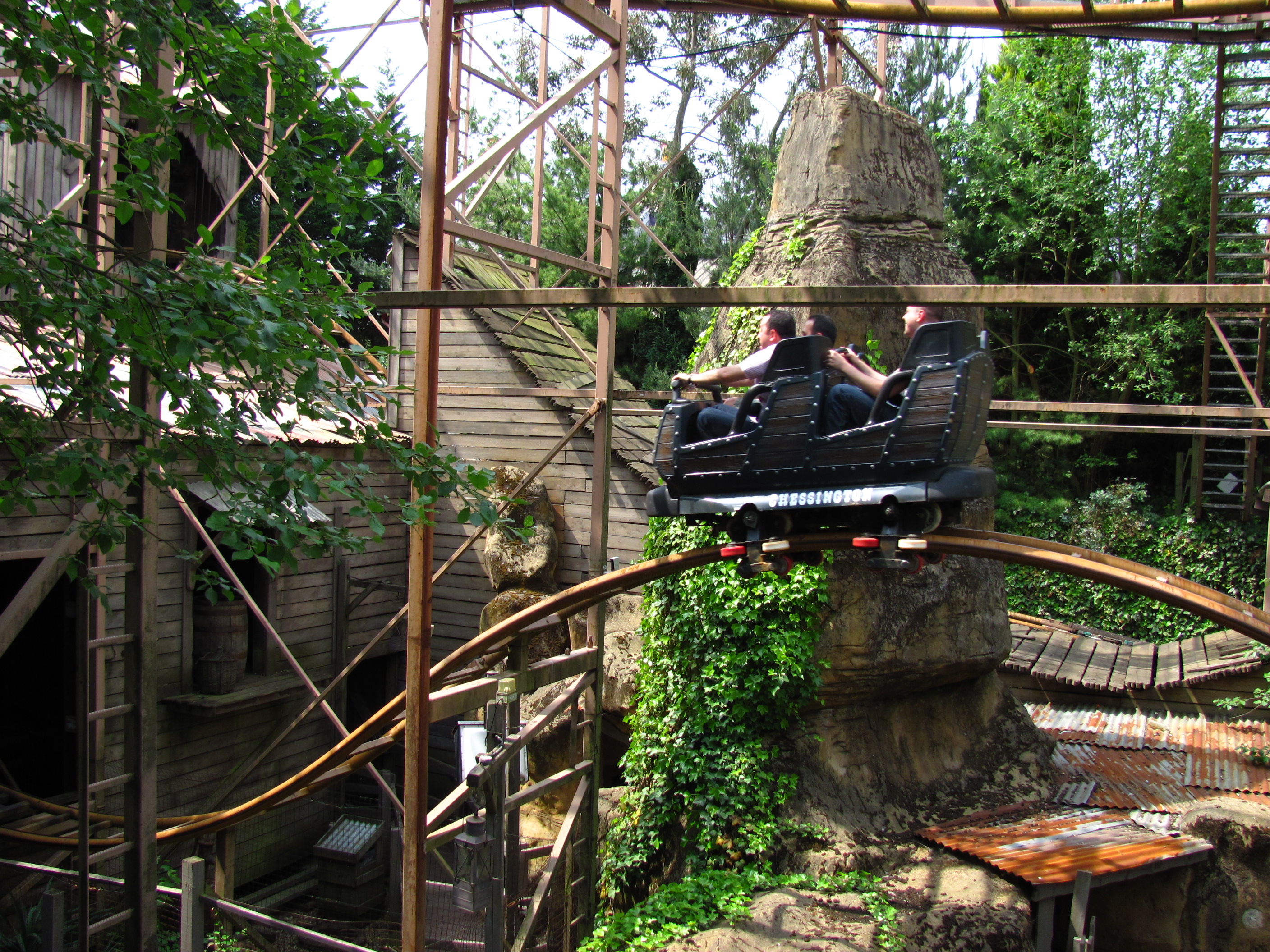
Chessington World of Adventures Resort is a theme park, zoo and hotel complex that lies 12 miles southwest of Central London, England in the Chessington area of the Kingston upon Thames borough. Historically opened as Chessington Zoo in 1931, a theme park was developed alongside the zoo, opening in 1987, making it the first themed amusement park in Britain. Owned and operated by Merlin Entertainments since 2007. Chessington has two on-site resort hotels, the Safari Hotel opened in 2007, and was followed by the opening of the Azteca Hotel in mid 2014. Chessington Zoo has over 1,000 animals, including western lowland gorillas, sea lions, and Sumatran tigers. It is split up into several areas: Trail of the Kings, Creepy Caves, Sealion Bay, Childrens Zoo, Amazu, Penguin Bay and the Wanyama Village Reserve as well as a Sea Life Centre. Chessington World of Adventures theme park centres around immersive areas and high quality themes from around the world. It currently has ten areas including the Market Square, Mystic East, Mexicana, Pirates Cove, Transylvania, and Forbidden Kingdom. Land of the Dragons opened in 2004 for children although it includes the intense spinning coaster Dragons Fury, and in 2010 Wild Asia replaced the area known as Beanoland. In 2012 Africa replaced ToyTown, and following this Chessington introduced the new area ZUFARI in 2013. Major attractions include: Vampire, Bubbleworks, KOBRA, Zufari: Ride into Africa and Scorpion Express.

Croydon

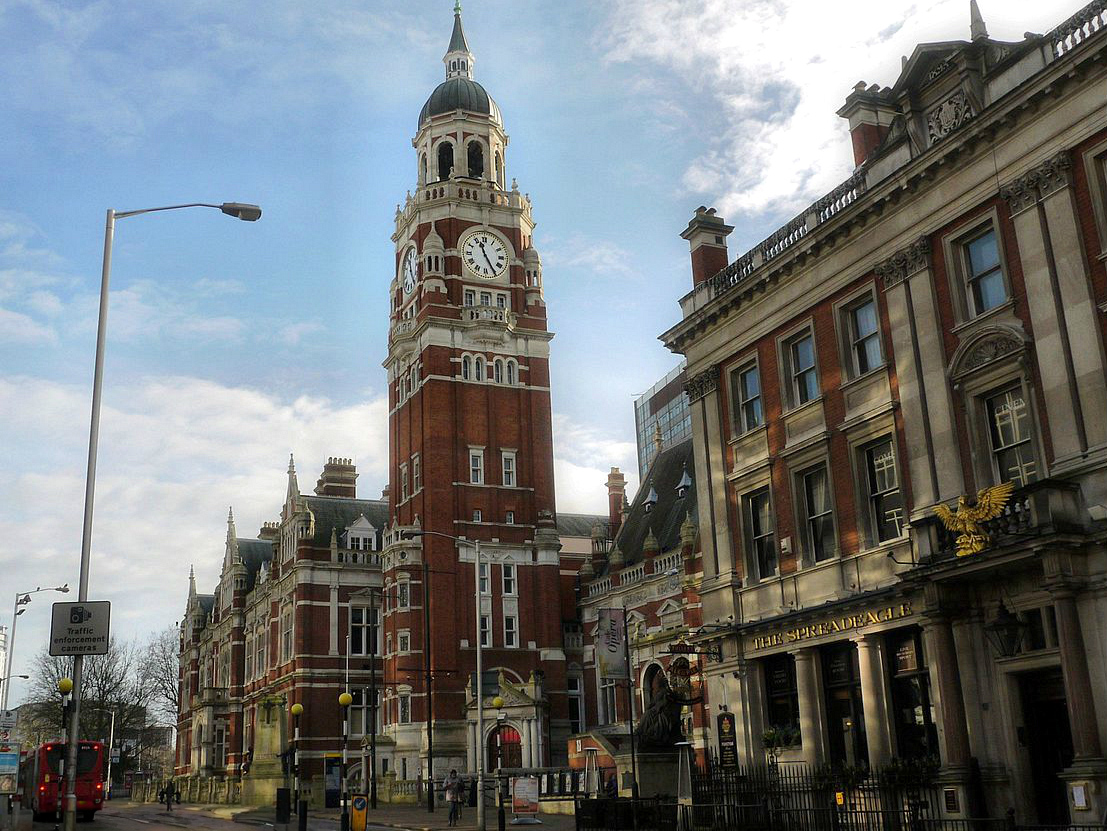
Croydon is a large town in South London, England, the principal settlement of the London Borough of Croydon. It is located 9.5 miles south of Charing Cross. It is one of the largest commercial districts outside of Central London, bearing one of the largest shopping districts and a developed night-time economy. It is identified in the London Plan as one of 11 metropolitan centres in Greater London. It has a population of 52,104 in the 2011 census, comprising the Addiscombe, Broad Green and Fairfield wards. Historically a part of Surrey, at the time of the Norman conquest of England, Croydon had a church, a mill, and around 365 inhabitants, as recorded in the Domesday Book of 1086. Croydon expanded during the Middle Ages as a market town and a centre for charcoal production, leather tanning and brewing. The Surrey Iron Railway from Croydon to Wandsworth opened in 1803 and was the worlds first public railway. Later nineteenth century railway building facilitated Croydons growth as a commuter town for London . By the early 20th century, Croydon was an important industrial area, known for car manufacture, metal working and its airport. In the mid 20th century these sectors were replaced by retailing and the service economy, brought about by massive redevelopment which saw the rise of office blocks and the Whitgift Centre, for many decades the largest shopping centre in London until 2008. Croydon was amalgamated into Greater London in 1965. Croydon lies on a transport corridor between central London and the south coast of England, to the north of two gaps in the North Downs, one followed by the A23 Brighton Road through Purley and Merstham and the main railway line and the other by the A22 from Purley to the M25 Godstone interchange. Road traffic is diverted away from a largely pedestrianised town centre, mostly consisting of the North End. Its main railway station, East Croydon, is a major hub of the national railway transport system, with frequent fast services to central London among other destinations such as Brighton. The town is unique in Greater London for its Tramlink light rail transport system.

Sutton

Sutton is the principal town of the London Borough of Sutton in South London, England. It lies on the lower slopes of the North Downs, and has the administrative headquarters of the borough. It is located 10.4 miles south-south west of Charing Cross, and is one of the eleven metropolitan centres identified in the London Plan. An ancient parish in the county of Surrey, Sutton is recorded in the Domesday Book of 1086 as having two churches and two acres of meadow at that time. Sutton's location on the London to Brighton turnpike from 1755 led to the establishment of coaching inns, spurring its further development as a village. When it was connected to central London by rail in 1847, the village began to grow into a town, and there was significant Victorian-era expansion, both commercially and residentially. Sutton's expansion and increase in population accelerated in the 20th century as part of the suburban growth of London. It became a municipal borough with neighbouring Cheam in 1934, and has formed part of Greater London since 1965. Sutton has a theatre, the largest library in the borough, several works of public art, four conservation areas and a park and green at either end of the high street. It contains a civic and retail district, a business sector, including a number of large international companies, and the sixth most important shopping area in London, centred on Sutton High Street. Sutton mainline railway station is the largest in the borough, with frequent services to central London among other destinations. Along with Wimbledon Studios, Sutton is a hub for filming in south-west London. Sutton is home to the Royal Marsden Hospital and the Institute of Cancer Research; there are plans to create the world's second biggest cancer research campus on the site. The town has among the lowest levels of crime in Greater London. Sutton is home to a significant number of the borough's schools, within a borough which is among the top performing authorities for education in the country. In 2011 Sutton was the top performing borough for GCSE results in England.

This attraction is located in

This is a private property. Please enjoy respectfully and do not disturb the occupants.

Edit Categories
Add Tours

This attraction is not part of any tours

Add Collections

This attraction is not part of any collections


Some of the attractions we imported from Wikipedia are not perfect. Send us an email detailing what's wrong and we'll look into fixing it.

GuRoute is all about Gurus sharing their local knowledge. If you feel up to fixing this problem yourself, why not adopt it. You will become the owner and can fix whatever problems you see.

We've copied a link to this attraction into your clipboard so that ou can paste it into an email or text message...

More Info...
You can add your friends to the visit yourself, or, send them a link and let them add themselves...

The visit will appear on both your timelines and on your Shared Timeline.

Click below and we'll email you a link that you can send on to friends or post on your group's Facebook page.

If your friends aren't members of GuRoute yet, this is a great way to get them started.
Recent
Recently used Collections will appear here...
Recent
Recently used tours will appear here...

Where is this?

GuRoute likes to place attractions inside other attractions. So, maybe it's in a city, or maybe it's inside a particular park in that city. Maybe your attraction is a huge park that spans half the county, or multiple counties.

Determining where this attraction is gives it context - if it's in a park, you'll be able to see it alongside all the other attractions in that park. And that helps define the park.

GuRoute will automatically calculate a parent region for this attraction. You can change it if there is something more appropriate.

This attraction is currently located in .

Change

This attraction does not yet have any reviews

Please login to write a review...

Reviewed by
Record new Visit

Add this location to your timneline?

  • If there's an existing attraction open it and add it to your timeline...
  • If not, enter a title and we'll create a new attraction for your memories...
Create new Attraction

Create a new attraction at this location?

  • We rely on Gurus like you to share your local knowledge...
(Give a name for this location)


+
Add this to your timeline instead...

Imagine having a record of all the cool things you've done in your life!


Using our timeline you can keep track of everywhere you visit in your lifetime...

But, you'll need to sign in first...

Add contacts so that you can share your travels and record places that you visit together...

Family
Favorites
Family
Favorites

Profile TimeLine Our Visits Edit Accept Decline Invite

If you have any more friends that visited this place with you, feel free to add them to the visit. We'll write it to their timeline and once they confirm it, they too will have this memory for a lifetime.

If they're not already registered, you just need their name and email address and you can add them and we'll send them an invite on your behlaf.

Add a tour comment

Add some extra information for when this attraction is viewed as part of your tour...

Next Stop Instructions

Add some instructions for what to see/do on the way to the next stop...

Next Stop Instructions

Add some instructions for what to see/do on the way to the next stop...

If you're visiting an existing attraction, open it and add it to your timeline. If there is no attraction for the place you are visiting...

  • Click 'Add My Location' below
  • Or right-click on the map to mark a different location
  • Or long-press if you have a touch screen
You can even add locations while you're offline....
  • Load up the map when you're online and we'll keep track of your locaiton
  • You can add locations to your timeline
  • When you are online again we'll sync them with the cloud

We can't connect to the internet right now. The following attractions are saved locally and can be uploaded when you're online...

GuRoute would like to access your current location so that we can pin you on the map and show you nearby attractions

Add friends so that you can share your experiences with each other...

Add tour to What's Next?

Go...

Either for yourself or someone else...

  1. Do your trip research in GuRoute
    Add all the places that you think might be worthy of a visit into a trip-plan
  2. Add your trip-plan to your "What's Next" timeline
    (or a friend's "What's Next" timeline)
  3. When you're on vacation you'll have all your research at your fingertips
  4. Share your timline with your friends
    They can enjoy your vacation with you, seeing not only where you've been, but where you're going next...
  5. Add/remove attractions if things change

It also makes a great souvenir of your trip

Collections

Go...

Create a home page for a collection of attractions

  • Add an image and description to display on the homepage
  • Start adding content
    Add existing attractions to your collection or create new attractions of your own
  • Collections can be:
    • Public (Anyone can add attractions to your collection)
    • Shared (Only yourself and Gurus you nominate can add content)
    • Private (The collection will only be visible to yourself)

Uses

  • Local business or hotel
    Showcase local attractions that you endorse
  • Clubs
    Showcase attractions that members have created (eg. local historical society)
  • Special Interest
    If GuRoute does not have a category for your special interest you add your attractions to your own collection instead

Examples

Walking/Driving Tours

Go...

A guided tour where GuRoute will direct you from stop to stop and narrate a description of each attraction you arrive at

  • GuRoute uses your phone's GPS to guide you from stop to stop
  • GuRoute automatically detects when you arrive at the next tour-stop and narrates the description of the attraction (Chrome Only)
  • It then sends you on to the next stop

Tours are great to attract people to your town. Even places with no significant points of interest can be lots of fun when part of a tour


Cater tours to your Audience

  • Kid-friendly Tours
    • Focus on what will keep kids interested
    • Instead of parents having to drag their kids around they'll be struggling to keep up
    • Let the kids navigate and they'll get more fun out of finding that historical plaque than they ever would from reading it
  • Accessible tours
  • Short and long tours of the same location

What you need to do...

  1. Click 'Go...'
    Enter a title, description and location for the tour
  2. Add existing attractions OR create new ones and add them to the tour
  3. For existing attractions you can add more information specific to the theme of the tour
  4. You can also add instructions on what to do or see en-route to the next tour-stop
  5. Try out your tour and see how it works...

Mystery Tour

Go...

Create a Mystery Tour

Create a series of clues to show people around a city, neighborhood or whatever place you like...

  • GuRoute will show people clues to get them from attraction to attraction
  • When they reach each stop GuRoute will tell them about the place and give them the next clue
  • Take as long or as you like and explore each location at your leisure

Scavenger Hunt

Go...

Create a Scavenger Hunt

Create a series of questions that people have to answer. The answers can all be discovered by walking aroung the area, looking for clues.

  • How many beers are on tap at Michael Collin's Irish Bar?
  • What's the name of the oldest building on main streeet?
  • Show a picture of some public art and ask them what it is called
  • Clues can have numeric or multiple choice answers