Sign In

My Timeline

GuRoute

Discover Your World

Share your Experiences

Record your Life


Top Attractions in Gujarat

Palitana

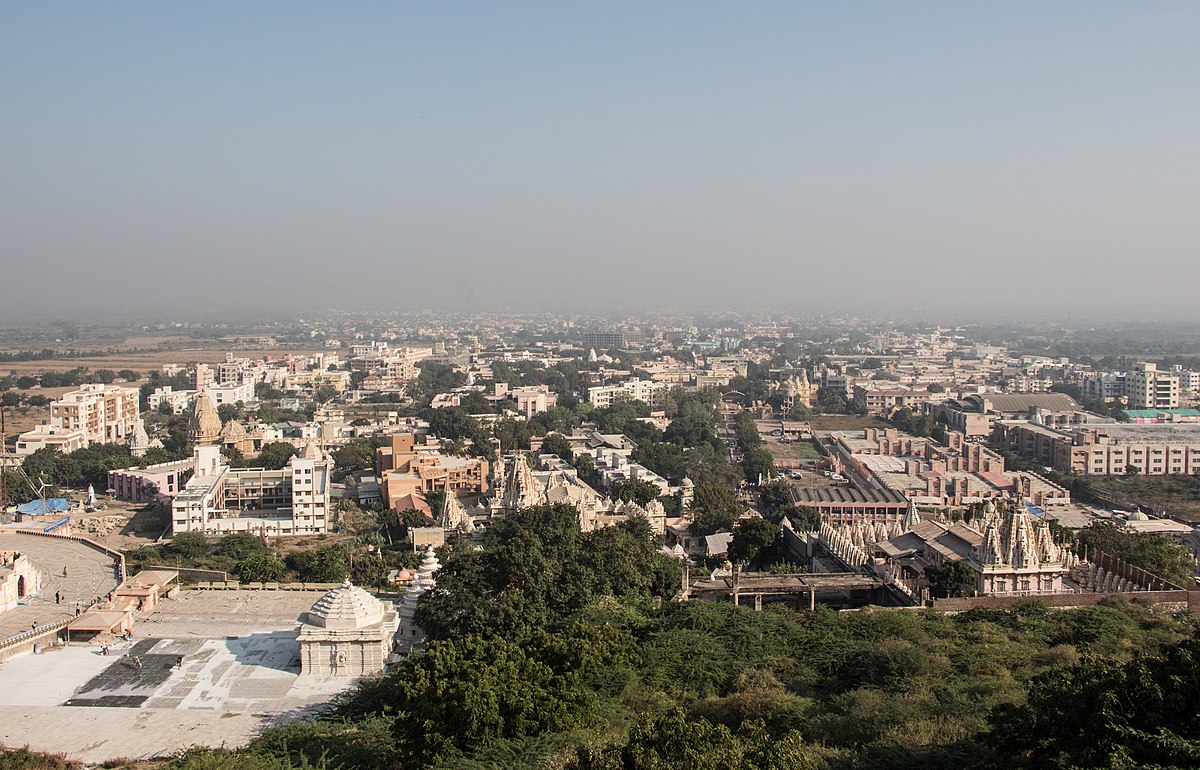
Palitana is a city in Bhavnagar district, Gujarat, India. It is located 50 km southwest of Bhavnagar city and is a major pilgrimage centre for Jains. Palitana is associated with Jain legends and history. Adinath, the first of the Jain tirthankaras, is said to have meditated on the Shatrunjaya hill, where the Palitana temples were later constructed. The Palitana State was a princely state, founded in 1194. It was one of the major states in Saurashtra, covering 777 km². In 1921 it had 58,000 inhabitants in 91 villages, generating a 744,416 Rs revenue. In 1656, Shah Jahan's son Murad Baksh (the then Governor of Gujarat) granted the village of Palitana to the prominent Jain merchant Shantidas Jhaveri. The management of the temples was assigned to the Anandji Kalyanji Trust in 1730. During the British Raj, Palitana was a princely state in the Kathiawar Agency of the Bombay presidency. Gross revenue, £42,000; tribute jointly to the Gaekwar of Baroda and the Nawab of Junagadh, £700. The capital of the state was the Palitana town (population 12,800). It was ruled by a Gohil Rajput, with the title of Thakore sahib (also spelled Thakor Saheb or Thakur Sahib), enjoying a 9-guns salute, of the Hindu Gohel dynasty, which received a privy purse of 180,000 r.upees at the state's accession to independent India on 15 February 1948. Palitana is the world’s only mountain that has more than 900 temples. The Palitana temples and whole mountain are considered the most sacred pilgrimage place (tirtha) by the Jain community, and is the world's largest Temple Complex. There are more than 3000 temples located on the Shatrunjaya hills, exquisitely carved in marble. The main temple on top of the hill, is dedicated to 1st tirthankar lord Adinath (Rishabdeva). On the top the Shatrunjai Hill is a cluster of Jain temples, built by generations of Jains over a period of 900 years, from the 11th century onwards. The temples are managed by the Anandji Kalyanji Trust associated with the Kasturbhai Lalbhai group. From the foot of the hill to the top there are 3,800 and odd stone steps cut to facilitate climbing. The temples are exquisitely carved in marble, veritable prayers in stone. To an observer, these appear to be ivory miniatures when seen from a distance. Created by master craftsmen, the most important temple is that of the first teerthankara, Shri Adishwar. It has ornate architectural motifs, though in its overall plan it is simpler than the Choumukh. Other notable temples are those of Kumarpal, Vimalshah and Sampriti Raja. Kumarpal Solanki, a great Jain patron, probably built the earliest temple. The temple has a fabulous collection of jewels, and these can be seen with special permission. The temples date from 11th to the 20th century. Belief Every devout Jain aspires to climb to the top of the mountain at least once in his lifetime, because of its sanctity. Not just the temples on the Hill are sacred, but as per Jain Scriptures entire Hill is sacred right from top to bottom. The journey is arduous. The walk up the stone stairway hewn into the mountain face takes about an hour and a half. For those unable or unaccustomed to the strain, sling-chairs are available at a bargain. The code for the climbers is stringent, in keeping with the rigours of the Jain faith. Food must neither be eaten nor carried on the way. The descent must begin before it is evening, for no soul can remain atop the sacred mountain during the night. While atop one can also visit a Muslim shrine of Angar Pir. The childless women seek the Pir's blessings to be blessed with children. They offer miniature cradles to the Pir and the shrine is strewn with such cradles. In 2014, Palitana became the first city in the world to be legally vegetarian. It has outlawed, or made illegal, the buying and selling of meat, fish and eggs, and also related jobs or work, such as fishing and penning 'food animals'.

Champaner

Champaner is a historical city in the state of Gujarat, in western India. It is located in Panchmahal district, 47 kilometres from the city of Vadodara. The city was briefly the capital of Gujarat. It was founded by Vanraj Chavda, the most prominent king of the Chavda Dynasty, in the 8th century. He named it after the name of his friend and general Champa, also known later as Champaraj. By the later 15th century, the Khichi Chauhan Rajputs held Pavagadh fort above the town of Champaner. The young Sultan of Gujarat, Mahmud Begada, deciding to attack Champaner, started towards it with his army on 4 December 1482. After defeating the Champaner army, Mahmud captured the town and besieged Pavagadh, the well-known hill-fortress, above Champaner, where king Jayasimha had taken refuge. He captured the Pavagadh fort on 21 November 1484, after a siege of 20 months. He then spent 23 years rebuilding and embellishing Champaner, which he renamed Muhammadabad, after which he moved the capital there from Ahmedabad. In 1535, after chasing away Bahadur Shah, Humayun personally led some 300 Mughals to scale the fort on spikes driven into rock and stonework in a remote and unguarded part of the citadel built over a precipitous hillside on Pavagadh Hill. Large heaps of gold, silver and jewels were the war booty even though Bahadur Shah had managed to escape with a lot to Diu Champaner is today the site of the Champaner-Pavagadh Archaeological Park, which UNESCO designated a World Heritage Site in 2004. Sultan Begada also built a magnificent Jama Masjid in Champaner, which ranks amongst the finest architectural edifices in Gujarat. It is an imposing structure on a high plinth, with a central dome, two minarets 30 meters in height, 172 pillars, seven mihrabs, and carved entrance gates with fine latticed windows called "jalis"

Lothal

Lothal is one of the most prominent cities of the ancient Indus valley civilisation, located in the Bhāl region of the modern state of Gujarāt and dating from 3700 BCE. Discovered in 1954, Lothal was excavated from 13 February 1955 to 19 May 1960 by the Archaeological Survey of India, the official Indian government agency for the preservation of ancient monuments. Lothals dock—the worlds earliest known—connected the city to an ancient course of the Sabarmati river on the trade route between Harappan cities in Sindh and the peninsula of Saurashtra when the surrounding Kutch desert of today was a part of the Arabian Sea. It was a vital and thriving trade centre in ancient times, with its trade of beads, gems and valuable ornaments reaching the far corners of West Asia and Africa. The techniques and tools they pioneered for bead-making and in metallurgy have stood the test of time for over 4000 years. Lothal is situated near the village of Saragwala in the Dholka Taluka of Ahmedabad district. It is six kilometres south-east of the Lothal-Bhurkhi railway station on the Ahmedabad-Bhavnagar railway line. It is also connected by all-weather roads to the cities of Ahmedabad, Bhavnagar, Rajkot and Dholka. The nearest cities are Dholka and Bagodara. Resuming excavation in 1961, archaeologists unearthed trenches sunk on the northern, eastern and western flanks of the mound, bringing to light the inlet channels and nullah connecting the dock with the river. The findings consist of a mound, a township, a marketplace, and the dock. Adjacent to the excavated areas stands the Archaeological Museum, where some of the most prominent collections of Indus-era antiquities in India are displayed.

Khambhalida Caves

Khambhalida Caves are located in Rajkot district of the Indian state of Gujarat near Gondal. The group has three caves containing chaitya and stupa. The chaitya gate includes figures of Bodhisattva Padmapani and Vajrapani on right and left respectively. These caves come under the jurisdiction of the Archaeology Department. Khambhalida Caves are said to be the oldest such caves in Rajkot and it’s an architectural wonder of the country. The caves are set amidst a beautiful environs. They are situated at the foot of small hillocks on the banks of a spring. The caves have a majestic structure carved out of limestone. There are three caves here, where the central one is named Chaitya Grih. It has a stupa and two sculptures with intricate designs. The cave on the right is named Bodhisatvas-Padmapani and the one on the left is named Vajjrapani. The Vajjrapani sculpture is considered one of the most ancient ones in India, second such idol came up in Ellora Caves. Another contemporary Padmapani idol appears in Patan, Nepal. There are 15 small caves situated near the Khambhalida Caves. The cave on the left hand side is huge and is open in the front. It goes deep inside. During the daytime tourists see a lot of light and air. It is believed that Buddhist monks must have meditated in the ancient times inside these caves, leaving behind spiritual vibrations that can be felt even today. It is also said that many Buddha Saints from Junagadh came to these caves for meditation thanks to an underground route between them. There is an inscription on a stone here that states Ashoka existed. The caves are believed to have come into existence in the 4th or 5th century AD. It is said that they were carved in the limestone rocks by Saint of Dinyan branch of Buddha tradition. Shri P. P. Pandya, a prominent archeologist, discovered the Buddhist Cave in 1958. A modern large Buddhist temple complex is coming up near by. It is said that for centuries Gir Forest extended till Khambhalida Village.

Dwarka

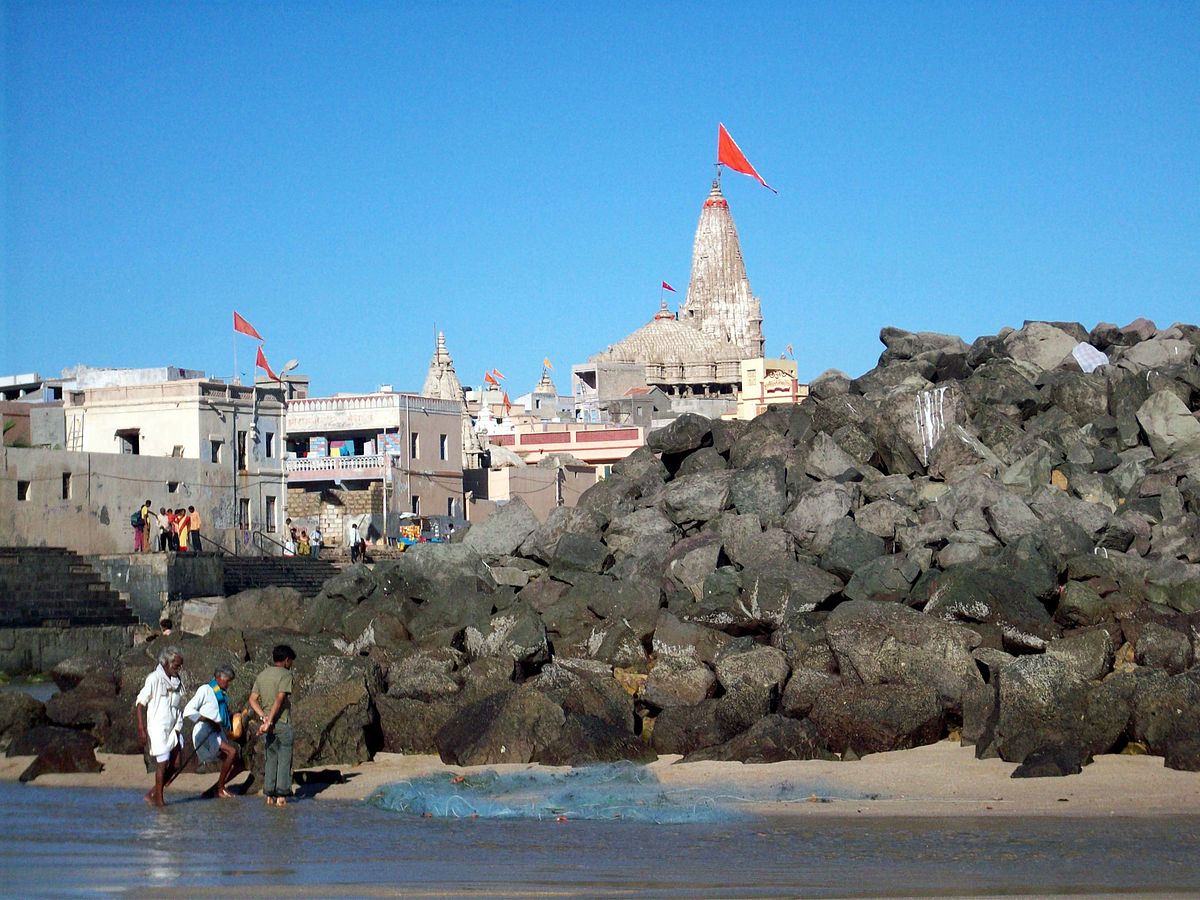
Dwarka is a small city and a municipality of Devbhoomi Dwarka district in the state of Gujarat in northwestern India. It is located on the western shore of the Okhamandal Peninsula on the right bank of the Gomti River. In 2011 it had a population of 38,873. Dwarka is one of the foremost Chardhams, four sacred Hindu pilgrimage sites, and is one of the Sapta Puri, the seven most ancient religious cities in the country. Dwarka is often identified with the Dwarka Kingdom, the ancient kingdom of Krishna, and is believed to have been the first capital of Gujarat. The city's Dwarkadhish Temple dedicated to Krishna was originally built around 2,500 years ago, but was destroyed by Mahmud Begada rulers and subsequently rebuilt in the 16th century. The temple is also the location of Dwaraka maţha, also called Sharada Matha/Peeth and "western peeth", one of the four peeths established by Adi Shankaracharya. As an important pilgrimage center for Hindus, Dwarka has several notable temples, including Rukmini Devi Temple, Gomti Ghat, and Bet Dwarka. There is also a lighthouse at the land end point of Dwarka. Dwarka's economy relies heavily on pilgrims and tourism but is supplemented by the production of millets, ghee , oilseeds, and salt, which are transported from its port. A long-term development plan was proposed in 2011 by the Government of Gujarat, with investment of ₹830 million to refurbish the city of Dwarka and build a bridge connecting the city with Okha and Bet Dwarka. Janmashtami is the main festival that is celebrated during August and September. Sharda Peeth Vidya Sabha is an educational society sponsored by the Sharda Peeth, Dwarka which runs an arts college in Dwarka. Dwarka was selected as a heritage city by the Indian government's Heritage City Development and Augmentation Yojana initiative.

Dhank Caves

The Dhank Caves are located in Rajkot district of the Indian state of Gujarat at a location called Dhank. They were chiseled out of a calcareous sandstone outcropping during Kshatrapa's regime. The caves are influenced by Buddhist and Jain cultures. The Buddhist cave include figures of Bodhisattva and the Jain cave includes figures of Adinath, Shantinath and Pārśva. This caves were carved in the 7th century A.D. and have a plain style of carving. This is one of the earliest rock cut cave of modern Gujarat state renowned as Dhank Jain cave situated in Rajkot district. This place is also known as Dhankgiri and about 48 km of Junagarh in north west direction. on western side of the hill there are three niches. One niche is facing the door and another two are situated on either side of it. The door facing niche contains some Jain Images in kayotsarga and meditation posture.Most of Savior sculpture do not contain a clear cognizance or lanchana but according to H. D. Sanklia this image represents Rishabhnatha.On either side of Jina two whisk bearers are depicted and Jina is sitting on a lion throne or Simhasan. There are two another mediation posture images of Jina saviors containing two whisk bearers on either side with serenity and tranquility on face.Triple canopies were depicted over the head of Jina. Fortunately, one of these image is depicted with Deer cognizance attributed to 16th Lord Shantinatha.One well preserved image of Lord parshwanatha is depicted in kayotsarga posture with long limbs parallel to body and cobra hood canopied. An image of Jaina yakshi ambika is also carved here who contains an infant in her arm and another with mango bud. from the ongoing discussion it is clearly evident that Dhank caves are attributed to Jainism and dwellers of these caves were Jain. Burgess did not say anything about the date of the Dhank caves but according to scholar H.D. Sanklia these caves could be hailed from 3rd Century AD after examining the Jaina sculpture's Style and Iconography. This cave is attributed to Digambara Jain.

Kirti Mandir

Kirti Mandir, or Temple of Fame, is the cenotaph of the Gaekwads, located in the city of Vadodara. It was built by Maharaja Sayajirao Gaekwad III of the Gaekwad dynasty of the Marathasto perpetuate the glorious memory of his beloved ancestors. The sun, the moon and the earth in bronze with the undivided map of India adorn the shikhara of Kirti Mandir. It was built in 1936 as part of the Diamond Jubilee celebrations of Maharaja Sayajirao Gaekwad III. The temple houses five wall paintings by artist Raja Ravi Varma showing various phases of battle of Mahabharata.The city of Vadodara, also popularly known as Baroda, used to be the seat of the Gaekwad or Gaikwad monarchs. It was formerly called by many names. The city was referred to as Chandravati, then Viravati, and Vadpatra due to the great quantity of banyan trees on the River banks of Vishwamitri. Kirti Mandir is situated in the city of Vadodara .It is a collection of temples built by Sayajirao Maharajah near the Vishwamitra Bridge of the city. It is believed that Sayajirao Maharaja built this Kirti Mandir in the memory of deceased members of the royal Gaekwad family and the edifice is dedicated to Lord Mahadev. Today it is a major tourist attraction in the city. The outstanding stone building is constructed in the shape of a letter “E” with terraces, balconies, domes and a central shikhara that rises to approximately 35 metres. The interiors of the Kirti Mandir are marble treated and brilliantly decorated with intricately carved murals. The walls of the central hall are adorned with many impressive murals such as the Gangavataran, Life of Meera, battle of Mahabharat and Natir Poojan which are all very well preserved works from the renowned Bengali artist Nandalal Bose. Statues as well as precious photographs of eminent members of the Gaekwad family are also displayed for public viewing. According to annals of history, the golden era in the Maratha rule of Baroda commenced when Sayajirao Maharaja came into power in 1875. He is well remembered by people even today for his work to establish necessary primary education, a university, a library system, tile factories and model textile and thereby modernize Baroda, which resulted in building the image of Baroda as a modern industrial hub. In addition to the Kirti Mandir, Vadodara has a number of diverse attractions such as palaces, buildings, monuments, gardens, museums as well as modern entertainment. For the tourist there are endless possibilities to indulge in sightseeing. Though the town is lesser known compared to other major tourist attractions in India. Vadodara’s one of the tourist attraction is Kirti Mandir situated on the north of the statue of Prince Fatehsinhrao Gaekwad near the Vishwamitri Bridge. With a cluster of shiva temples it was built to commemorate the cremation of the members of the Gaekwad family. This “E” shaped large magnificent stone building with domes, terraces, balconies and central shikhara rising to about 33 metres. According to Sayajirao Gaekwad it was built to commemorate the benefactors of his state irrespective of their race, caste or creed. The Kirti Mandir of Baroda was built at the cost of Rs.50,000, it preserves in its various rooms the statues and photographs of the members of the royal family. The interior of this elegant structure is marble finished and on the walls of the central hall are the murals Gangavataran, battle of Mahabharat, Life of Meera and Natir Pooja-executed by the famous Bengali artist Nandalal Bose. . The Kirti Mandir in Vadodara is actually a cluster of temples dedicated to Lord Shiva. The temples were constructed by His Highness Maharaj Sayajirao Gaekwad in 1936, on the occasion of the Diamond Jubilee celebrations. Also known as the Temple of Fame, it is situated near the picturesque Vishwamitra Bridge of the city, in the memory of deceased members of the royal Gaekwad family. The marble treated interiors of the Kirti Mandir is wonderfully decorated with intricately carved murals.The characteristic ‘shikhara’ of this statuesque monument represents the sun, the moon and the earth in bronze with the undivided map of India.

This attraction is located in

This is a private property. Please enjoy respectfully and do not disturb the occupants.

Edit Categories
Add Tours

This attraction is not part of any tours

Add Collections

This attraction is not part of any collections


Some of the attractions we imported from Wikipedia are not perfect. Send us an email detailing what's wrong and we'll look into fixing it.

GuRoute is all about Gurus sharing their local knowledge. If you feel up to fixing this problem yourself, why not adopt it. You will become the owner and can fix whatever problems you see.

We've copied a link to this attraction into your clipboard so that ou can paste it into an email or text message...

More Info...
You can add your friends to the visit yourself, or, send them a link and let them add themselves...

The visit will appear on both your timelines and on your Shared Timeline.

Click below and we'll email you a link that you can send on to friends or post on your group's Facebook page.

If your friends aren't members of GuRoute yet, this is a great way to get them started.
Recent
Recently used Collections will appear here...
Recent
Recently used tours will appear here...

Where is this?

GuRoute likes to place attractions inside other attractions. So, maybe it's in a city, or maybe it's inside a particular park in that city. Maybe your attraction is a huge park that spans half the county, or multiple counties.

Determining where this attraction is gives it context - if it's in a park, you'll be able to see it alongside all the other attractions in that park. And that helps define the park.

GuRoute will automatically calculate a parent region for this attraction. You can change it if there is something more appropriate.

This attraction is currently located in .

Change

This attraction does not yet have any reviews

Please login to write a review...

Reviewed by
Record new Visit

Add this location to your timneline?

  • If there's an existing attraction open it and add it to your timeline...
  • If not, enter a title and we'll create a new attraction for your memories...
Create new Attraction

Create a new attraction at this location?

  • We rely on Gurus like you to share your local knowledge...
(Give a name for this location)


+
Add this to your timeline instead...

Imagine having a record of all the cool things you've done in your life!


Using our timeline you can keep track of everywhere you visit in your lifetime...

But, you'll need to sign in first...

Add contacts so that you can share your travels and record places that you visit together...

Family
Favorites
Family
Favorites

Profile TimeLine Our Visits Edit Accept Decline Invite

If you have any more friends that visited this place with you, feel free to add them to the visit. We'll write it to their timeline and once they confirm it, they too will have this memory for a lifetime.

If they're not already registered, you just need their name and email address and you can add them and we'll send them an invite on your behlaf.

Add a tour comment

Add some extra information for when this attraction is viewed as part of your tour...

Next Stop Instructions

Add some instructions for what to see/do on the way to the next stop...

Next Stop Instructions

Add some instructions for what to see/do on the way to the next stop...

If you're visiting an existing attraction, open it and add it to your timeline. If there is no attraction for the place you are visiting...

  • Click 'Add My Location' below
  • Or right-click on the map to mark a different location
  • Or long-press if you have a touch screen
You can even add locations while you're offline....
  • Load up the map when you're online and we'll keep track of your locaiton
  • You can add locations to your timeline
  • When you are online again we'll sync them with the cloud

We can't connect to the internet right now. The following attractions are saved locally and can be uploaded when you're online...

GuRoute would like to access your current location so that we can pin you on the map and show you nearby attractions

Add friends so that you can share your experiences with each other...

Add tour to What's Next?

Go...

Either for yourself or someone else...

  1. Do your trip research in GuRoute
    Add all the places that you think might be worthy of a visit into a trip-plan
  2. Add your trip-plan to your "What's Next" timeline
    (or a friend's "What's Next" timeline)
  3. When you're on vacation you'll have all your research at your fingertips
  4. Share your timline with your friends
    They can enjoy your vacation with you, seeing not only where you've been, but where you're going next...
  5. Add/remove attractions if things change

It also makes a great souvenir of your trip

Collections

Go...

Create a home page for a collection of attractions

  • Add an image and description to display on the homepage
  • Start adding content
    Add existing attractions to your collection or create new attractions of your own
  • Collections can be:
    • Public (Anyone can add attractions to your collection)
    • Shared (Only yourself and Gurus you nominate can add content)
    • Private (The collection will only be visible to yourself)

Uses

  • Local business or hotel
    Showcase local attractions that you endorse
  • Clubs
    Showcase attractions that members have created (eg. local historical society)
  • Special Interest
    If GuRoute does not have a category for your special interest you add your attractions to your own collection instead

Examples

Walking/Driving Tours

Go...

A guided tour where GuRoute will direct you from stop to stop and narrate a description of each attraction you arrive at

  • GuRoute uses your phone's GPS to guide you from stop to stop
  • GuRoute automatically detects when you arrive at the next tour-stop and narrates the description of the attraction (Chrome Only)
  • It then sends you on to the next stop

Tours are great to attract people to your town. Even places with no significant points of interest can be lots of fun when part of a tour


Cater tours to your Audience

  • Kid-friendly Tours
    • Focus on what will keep kids interested
    • Instead of parents having to drag their kids around they'll be struggling to keep up
    • Let the kids navigate and they'll get more fun out of finding that historical plaque than they ever would from reading it
  • Accessible tours
  • Short and long tours of the same location

What you need to do...

  1. Click 'Go...'
    Enter a title, description and location for the tour
  2. Add existing attractions OR create new ones and add them to the tour
  3. For existing attractions you can add more information specific to the theme of the tour
  4. You can also add instructions on what to do or see en-route to the next tour-stop
  5. Try out your tour and see how it works...

Mystery Tour

Go...

Create a Mystery Tour

Create a series of clues to show people around a city, neighborhood or whatever place you like...

  • GuRoute will show people clues to get them from attraction to attraction
  • When they reach each stop GuRoute will tell them about the place and give them the next clue
  • Take as long or as you like and explore each location at your leisure

Scavenger Hunt

Go...

Create a Scavenger Hunt

Create a series of questions that people have to answer. The answers can all be discovered by walking aroung the area, looking for clues.

  • How many beers are on tap at Michael Collin's Irish Bar?
  • What's the name of the oldest building on main streeet?
  • Show a picture of some public art and ask them what it is called
  • Clues can have numeric or multiple choice answers