Sign In

My Timeline

GuRoute

Discover Your World

Share your Experiences

Record your Life


Top Attractions in Montana

Glacier National Park

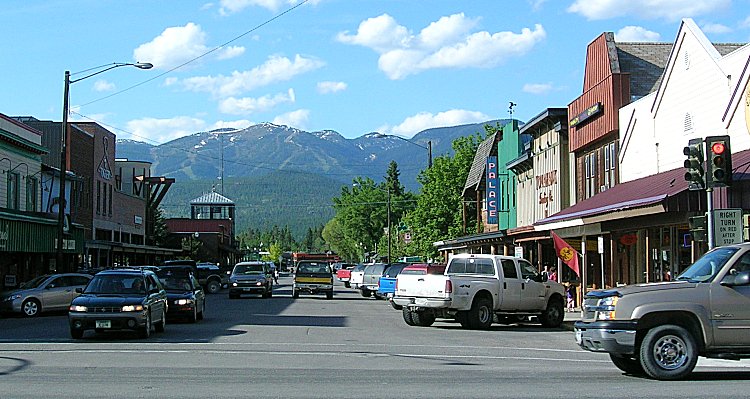
Glacier National Park is a national park located in the U.S. state of Montana, on the Canada–United States border with the Canadian provinces of Alberta and British Columbia. The park encompasses over 1 million acres and includes parts of two mountain ranges, over 130 named lakes, more than 1,000 different species of plants, and hundreds of species of animals. This vast pristine ecosystem is the centerpiece of what has been referred to as the "Crown of the Continent Ecosystem", a region of protected land encompassing 16,000 square miles . The region that became Glacier National Park was first inhabited by Native Americans. Upon the arrival of European explorers, it was dominated by the Blackfeet in the east and the Flathead in the western regions. Soon after the establishment of the park on May 11, 1910, a number of hotels and chalets were constructed by the Great Northern Railway. These historic hotels and chalets are listed as National Historic Landmarks and a total of 350 locations are on the National Register of Historic Places. By 1932 work was completed on the Going-to-the-Sun Road, later designated a National Historic Civil Engineering Landmark, which provided greater accessibility for automobiles into the heart of the park. The mountains of Glacier National Park began forming 170 million years ago when ancient rocks were forced eastward up and over much younger rock strata. Known as the Lewis Overthrust, these sedimentary rocks are considered to have some of the finest fossilized examples of extremely early life found anywhere on Earth. The current shapes of the Lewis and Livingston mountain ranges and positioning and size of the lakes show the telltale evidence of massive glacial action, which carved U-shaped valleys and left behind moraines which impounded water, creating lakes. Of the estimated 150 glaciers which existed in the park in the mid-19th century, only 25 active glaciers remained by 2010. Scientists studying the glaciers in the park have estimated that all the glaciers may disappear by 2030 if the current climate patterns persist. Glacier National Park has almost all its original native plant and animal species. Large mammals such as the grizzly, moose, and mountain goat, as well as rare or endangered species like the wolverine and Canadian lynx, inhabit the park. Hundreds of species of birds, more than a dozen fish species, and a few reptile and amphibian species have been documented. The park has numerous ecosystems ranging from prairie to tundra. Notably, the easternmost forests of western redcedar and hemlock grow in the southwest portion of the park. Large forest fires are uncommon in the park. However, in 2003 over 13% of the park burned. Glacier National Park borders Waterton Lakes National Park in Canada—the two parks are known as the Waterton-Glacier International Peace Park and were designated as the worlds first International Peace Park in 1932. Both parks were designated by the United Nations as Biosphere Reserves in 1976, and in 1995 as World Heritage sites.

Missoula

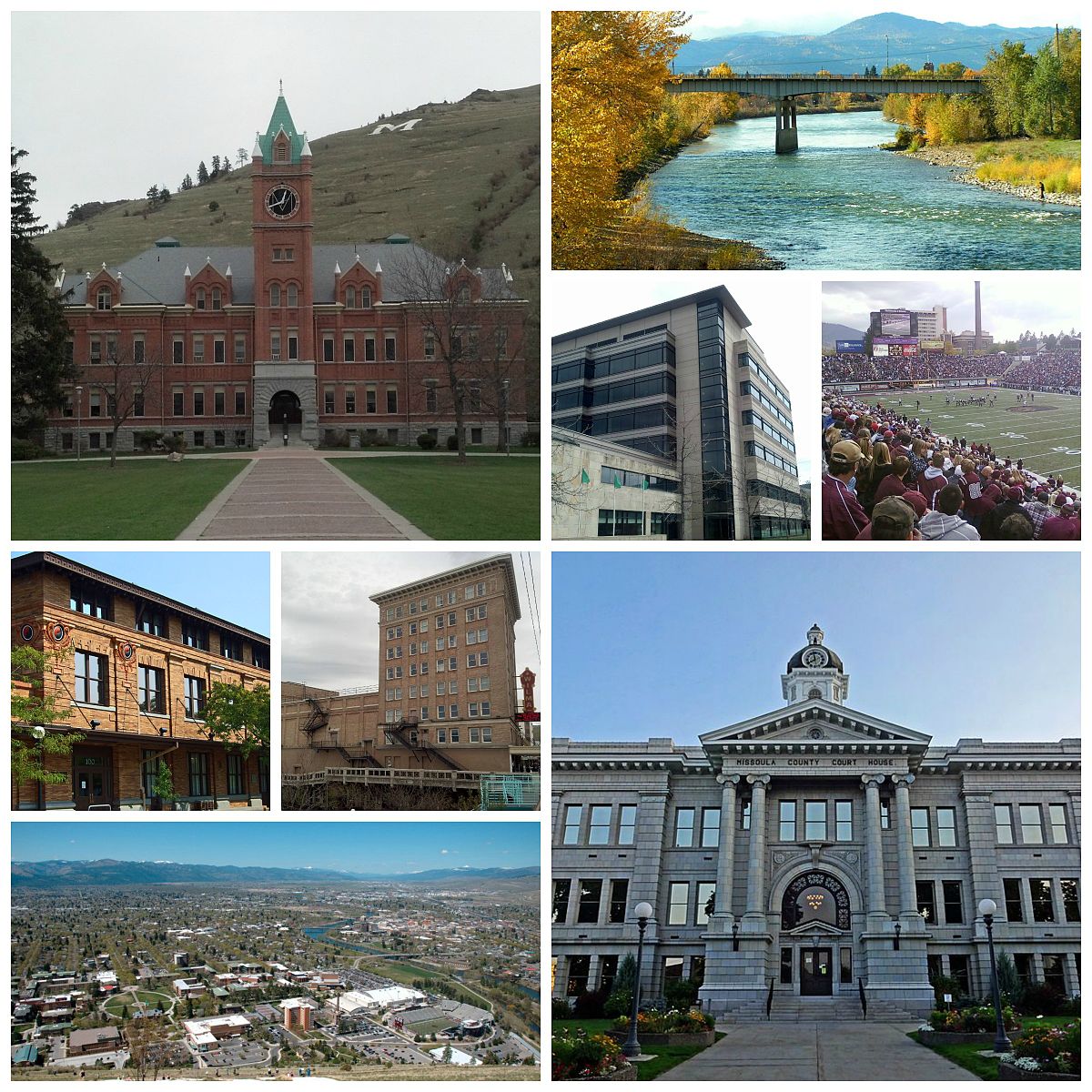
Missoula is a city in the U.S. state of Montana and is the county seat of Missoula County. It is located along the Clark Fork River near its confluences with the Bitterroot and Blackfoot Rivers in western Montana and at the convergence of five mountain ranges, thus is often described as the "hub of five valleys". In 2014, the United States Census Bureau estimated the citys population at 69,821 and the population of the Missoula Metropolitan Area at 112,684. Since 2000, Missoula has been the second most populous city in Montana. Missoula is home to the University of Montana, a public research university. Missoula was founded in 1860 as Hellgate Trading Post while still part of Washington Territory. By 1866, the settlement had moved east, 5 miles upstream, and renamed Missoula Mills, later shortened to Missoula. The mills provided supplies to western settlers traveling along the Mullan Road. The establishment of Fort Missoula in 1877 to protect settlers further stabilized the economy. The arrival of the Northern Pacific Railway in 1883 brought rapid growth and the maturation of the local lumber industry. In 1893 the Montana Legislature chose the city as the site for the states first university. Along with the U.S. Forest Service headquarters founded in 1908, lumber and the university would remain staples of the local economy for the next hundred years. By the 1990s, Missoulas lumber industry had gradually disappeared, and as of 2009 the citys largest employers are the University of Montana, Missoula County Public Schools, and Missoulas two hospitals. The city is governed by a mayor–council government with twelve city council members, two from each of the six wards. In and around Missoula are 400 acres of parkland, 22 miles of trails, and nearly 5,000 acres of open-space conservation land with adjacent Mount Jumbo home to grazing elk and mule deer during the winter months. The city is also home to both Montanas largest and its oldest active breweries as well as the Montana Grizzlies, one of the strongest college football programs in the Division I Football Championship Subdivision of the National Collegiate Athletic Association . Notable residents include the first woman in the U.S. Congress, Jeannette Rankin, and the United States longest-serving Senate Majority Leader, Mike Mansfield.

Billings

Billings is the largest city in the State of Montana, and is the principal city of the Billings Metropolitan Area with a population of 166,855. It has a trade area of over half a million people. Billings is located in the south-central portion of the state and is the county seat of Yellowstone County, which had a 2014 population of 155,634 The 2013 Census estimates put the Billings population at 109,059 the only city in Montana to surpass 100,000 people. The city is experiencing rapid growth and a strong economy; it has had and is continuing to have the largest growth of any city in Montana. Parts of the metro area are seeing hyper growth. From 2000 to 2010 Lockwood, an eastern suburb of the city, saw growth of 57.8%, the largest growth rate of any community in Montana. Billings has avoided the economic downturn that affected most of the nation 2008–2012 as well as avoiding the housing bust. With the Bakken oil play in eastern Montana and western North Dakota, the largest oil discovery in U.S. history, as well as the Heath shale oil play just north of Billings, the citys already rapid growth rate is escalating. Billings was nicknamed the Magic City because of its rapid growth from its founding as a railroad town in March 1882. The city is named for Frederick H. Billings, a former president of the Northern Pacific Railroad. With one of the largest trade areas in the United States, Billings is the trade and distribution center for most of Montana, Northern Wyoming, and western portions of North Dakota and South Dakota. Billings is also the retail destination for much of the same area. With more hotel accommodations than any area within a five-state region, the city hosts a variety of conventions, concerts, sporting events, and other rallies. Area attractions include Pompeys Pillar, Pictograph Cave, Chief Plenty Coups State Park, Zoo Montana, and Yellowstone Art Museum. Within 100 miles are Little Bighorn Battlefield National Monument, Bighorn Canyon National Recreation Area, Red Lodge Mountain Resort, and the Beartooth Highway, which links Red Lodge to Yellowstone National Park.

Butte

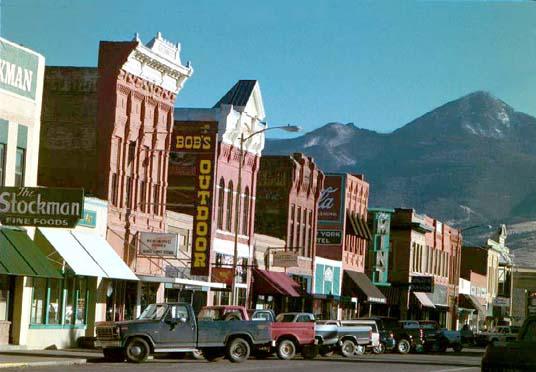
Butte is a city and the county seat of Silver Bow County, Montana. In 1977, the city and county governments consolidated to form the sole entity of Butte-Silver Bow. As of the 2010 census, Buttes population was approximately 34,200. Butte is Montanas fifth largest city. In the 19th and 20th centuries, Butte experienced every stage of development of a mining town, from camp to boomtown to mature city to center for historic preservation and environmental cleanup. Unlike most such towns, Buttes urban landscape includes mining operations set within residential areas, making the environmental consequences of the extraction economy all the more apparent. Despite the dominance of the Anaconda Company, Butte was never a company town. It prided itself on architectural diversity and a civic ethos of rough-and-tumble individualism. In the 21st century, efforts at interpreting and preserving Buttes heritage are addressing both the towns historical significance and the continuing importance of mining to its economy and culture. Butte was one of the largest cities in the Rocky Mountains in the late 1800s and early 1900s. Silver Bow County had 24,000 people in 1890, and peaked at 100,000 in 1920. The population steadily declined with falling copper prices after World War I, eventually dropping to 34,000 in 1990 and stabilized. In 2013, the population remains at 34,200. In its heyday between the late 19th century and about 1920, it was one of the largest and most notorious copper boomtowns in the American West, home to hundreds of saloons and a famous red-light district. The documentary Butte, America, depicts its history as a copper producer and the issues of labor unionism, economic rise and decline, and environmental degradation that resulted from the activity. The city is served by Bert Mooney Airport with airport code BTM.

Deer Lodge

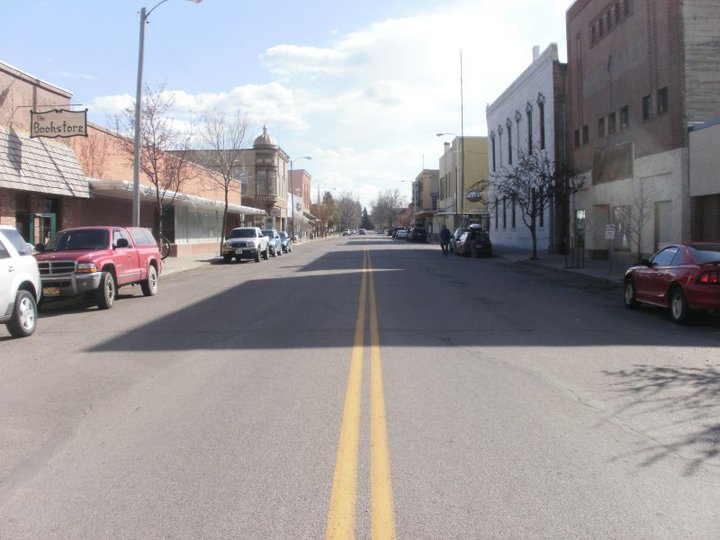
Deer Lodge is a city in and the county seat of Powell County, Montana, United States. The population was 3,111 at the 2010 census. The city is perhaps best known as the home of the Montana State Prison, a major local employer. The Montana State Hospital in Warm Springs, and former state tuberculosis sanitarium is in nearby Galen are the result of the power the western part of the state held over Montana at statehood due to the copper and mineral wealth in that area. Deer Lodge was also once an important railroad town, serving as a division headquarters for the Chicago, Milwaukee, St. Paul and Pacific Railroad before the railroads local abandonment in 1980. The current Montana State Prison occupies a campus 3.5 miles west of town. The former prison site, at the south end of Deer Lodges Main Street, is now the Old Prison Museum. In addition to a former cellblock building, the museum complex includes a theater, antique and automobile museums, and a former Milwaukee Road "Little Joe" electric locomotive. Deer Lodge is also the location of Grant-Kohrs Ranch National Historic Site, dedicated to the interpretation of the frontier cattle ranching era. This site was the home of Conrad Kohrs, one of the famous "Cattle Kings" of Montana whose land holdings once stretched over a million acres of Montana, Wyoming, and Alberta, Canada. The Grant-Kohrs ranch was built in 1862 by Johnny Grant, a ScottishMetis fur-trader and trapper who encouraged his people to settle in Deer Lodge because of its pleasant climate and large areas of bunch grass prairie, ideal for raising cattle and horses. The citys name derives from a geological formation known as Warm Springs Mound which contained natural saline that made for a natural salt lick for the local deer population, the protected valley in which Deer Lodge is located was where most of the local wildlife would winter as the temperatures lowered in the high country. Deer Lodge was the site of the College of Montana, the first institution of higher learning in the state.

This attraction is located in

This is a private property. Please enjoy respectfully and do not disturb the occupants.

Edit Categories
Add Tours

This attraction is not part of any tours

Add Collections

This attraction is not part of any collections


Some of the attractions we imported from Wikipedia are not perfect. Send us an email detailing what's wrong and we'll look into fixing it.

GuRoute is all about Gurus sharing their local knowledge. If you feel up to fixing this problem yourself, why not adopt it. You will become the owner and can fix whatever problems you see.

We've copied a link to this attraction into your clipboard so that ou can paste it into an email or text message...

More Info...
You can add your friends to the visit yourself, or, send them a link and let them add themselves...

The visit will appear on both your timelines and on your Shared Timeline.

Click below and we'll email you a link that you can send on to friends or post on your group's Facebook page.

If your friends aren't members of GuRoute yet, this is a great way to get them started.
Recent
Recently used Collections will appear here...
Recent
Recently used tours will appear here...

Where is this?

GuRoute likes to place attractions inside other attractions. So, maybe it's in a city, or maybe it's inside a particular park in that city. Maybe your attraction is a huge park that spans half the county, or multiple counties.

Determining where this attraction is gives it context - if it's in a park, you'll be able to see it alongside all the other attractions in that park. And that helps define the park.

GuRoute will automatically calculate a parent region for this attraction. You can change it if there is something more appropriate.

This attraction is currently located in .

Change

This attraction does not yet have any reviews

Please login to write a review...

Reviewed by
Record new Visit

Add this location to your timneline?

  • If there's an existing attraction open it and add it to your timeline...
  • If not, enter a title and we'll create a new attraction for your memories...
Create new Attraction

Create a new attraction at this location?

  • We rely on Gurus like you to share your local knowledge...
(Give a name for this location)


+
Add this to your timeline instead...

Imagine having a record of all the cool things you've done in your life!


Using our timeline you can keep track of everywhere you visit in your lifetime...

But, you'll need to sign in first...

Add contacts so that you can share your travels and record places that you visit together...

Family
Favorites
Family
Favorites

Profile TimeLine Our Visits Edit Accept Decline Invite

If you have any more friends that visited this place with you, feel free to add them to the visit. We'll write it to their timeline and once they confirm it, they too will have this memory for a lifetime.

If they're not already registered, you just need their name and email address and you can add them and we'll send them an invite on your behlaf.

Add a tour comment

Add some extra information for when this attraction is viewed as part of your tour...

Next Stop Instructions

Add some instructions for what to see/do on the way to the next stop...

Next Stop Instructions

Add some instructions for what to see/do on the way to the next stop...

If you're visiting an existing attraction, open it and add it to your timeline. If there is no attraction for the place you are visiting...

  • Click 'Add My Location' below
  • Or right-click on the map to mark a different location
  • Or long-press if you have a touch screen
You can even add locations while you're offline....
  • Load up the map when you're online and we'll keep track of your locaiton
  • You can add locations to your timeline
  • When you are online again we'll sync them with the cloud

We can't connect to the internet right now. The following attractions are saved locally and can be uploaded when you're online...

GuRoute would like to access your current location so that we can pin you on the map and show you nearby attractions

Add friends so that you can share your experiences with each other...

Add tour to What's Next?

Go...

Either for yourself or someone else...

  1. Do your trip research in GuRoute
    Add all the places that you think might be worthy of a visit into a trip-plan
  2. Add your trip-plan to your "What's Next" timeline
    (or a friend's "What's Next" timeline)
  3. When you're on vacation you'll have all your research at your fingertips
  4. Share your timline with your friends
    They can enjoy your vacation with you, seeing not only where you've been, but where you're going next...
  5. Add/remove attractions if things change

It also makes a great souvenir of your trip

Collections

Go...

Create a home page for a collection of attractions

  • Add an image and description to display on the homepage
  • Start adding content
    Add existing attractions to your collection or create new attractions of your own
  • Collections can be:
    • Public (Anyone can add attractions to your collection)
    • Shared (Only yourself and Gurus you nominate can add content)
    • Private (The collection will only be visible to yourself)

Uses

  • Local business or hotel
    Showcase local attractions that you endorse
  • Clubs
    Showcase attractions that members have created (eg. local historical society)
  • Special Interest
    If GuRoute does not have a category for your special interest you add your attractions to your own collection instead

Examples

Walking/Driving Tours

Go...

A guided tour where GuRoute will direct you from stop to stop and narrate a description of each attraction you arrive at

  • GuRoute uses your phone's GPS to guide you from stop to stop
  • GuRoute automatically detects when you arrive at the next tour-stop and narrates the description of the attraction (Chrome Only)
  • It then sends you on to the next stop

Tours are great to attract people to your town. Even places with no significant points of interest can be lots of fun when part of a tour


Cater tours to your Audience

  • Kid-friendly Tours
    • Focus on what will keep kids interested
    • Instead of parents having to drag their kids around they'll be struggling to keep up
    • Let the kids navigate and they'll get more fun out of finding that historical plaque than they ever would from reading it
  • Accessible tours
  • Short and long tours of the same location

What you need to do...

  1. Click 'Go...'
    Enter a title, description and location for the tour
  2. Add existing attractions OR create new ones and add them to the tour
  3. For existing attractions you can add more information specific to the theme of the tour
  4. You can also add instructions on what to do or see en-route to the next tour-stop
  5. Try out your tour and see how it works...

Mystery Tour

Go...

Create a Mystery Tour

Create a series of clues to show people around a city, neighborhood or whatever place you like...

  • GuRoute will show people clues to get them from attraction to attraction
  • When they reach each stop GuRoute will tell them about the place and give them the next clue
  • Take as long or as you like and explore each location at your leisure

Scavenger Hunt

Go...

Create a Scavenger Hunt

Create a series of questions that people have to answer. The answers can all be discovered by walking aroung the area, looking for clues.

  • How many beers are on tap at Michael Collin's Irish Bar?
  • What's the name of the oldest building on main streeet?
  • Show a picture of some public art and ask them what it is called
  • Clues can have numeric or multiple choice answers