Sign In

My Timeline

GuRoute

Discover Your World

Share your Experiences

Record your Life


Top Attractions in Washington, DC

White House

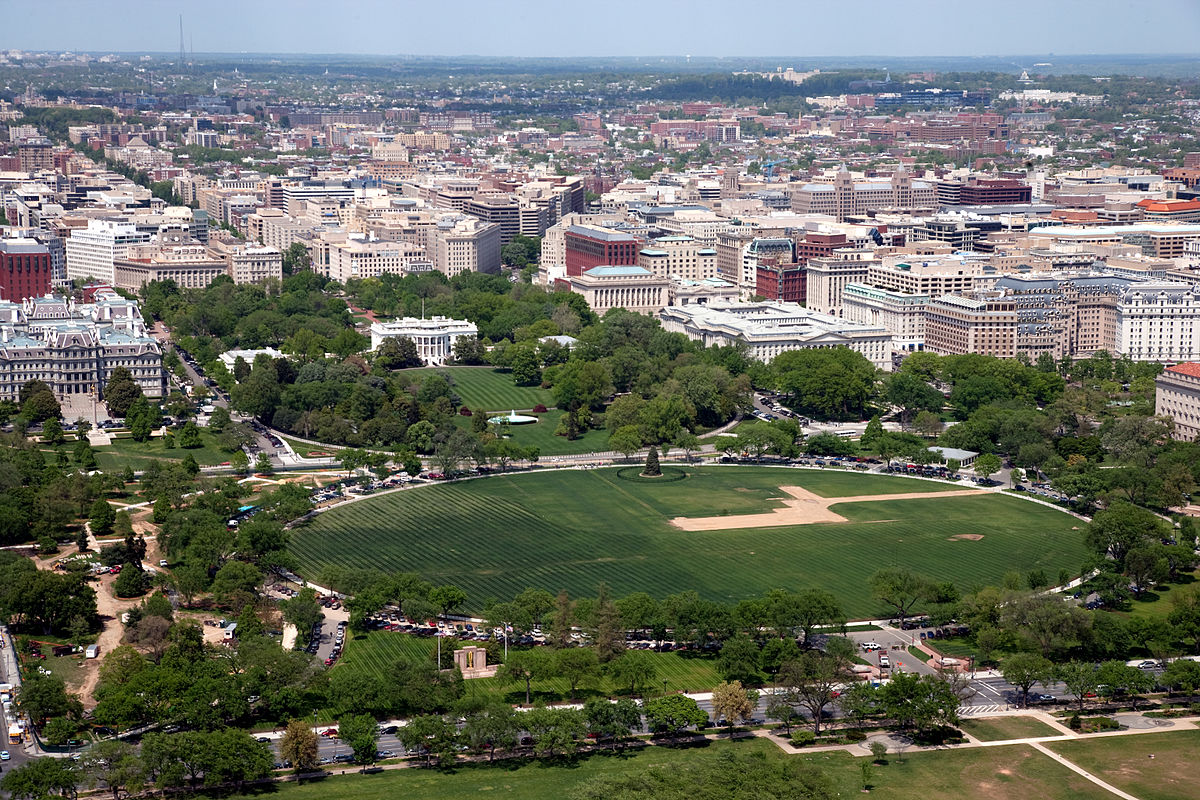
The White House is the official residence and principal workplace of the President of the United States, located at 1600 Pennsylvania Avenue NW in Washington, D.C. It has been the residence of every U.S. president since John Adams in 1800. The house was designed by Irish-born James Hoban and built between 1792 and 1800 of white-painted Aquia Creek sandstone in the Neoclassical style. When Thomas Jefferson moved into the house in 1801, he expanded the building outward, creating two colonnades that were meant to conceal stables and storage. However, in 1814, during the War of 1812, the mansion was set ablaze by the British Army in the Burning of Washington, destroying the interior and charring much of the exterior. Reconstruction began almost immediately, and President James Monroe moved into the partially reconstructed Executive Residence in October 1817. Construction continued with the addition of the South Portico in 1824 and the North in 1829. Because of crowding within the executive mansion itself, President Theodore Roosevelt had all work offices relocated to the newly constructed West Wing in 1901. Eight years later, President William Howard Taft expanded the West Wing and created the first Oval Office which was eventually moved as the section was expanded. In the main mansion, the third-floor attic was converted to living quarters in 1927 by augmenting the existing hip roof with long shed dormers. A newly constructed East Wing was used as a reception area for social events; Jeffersons colonnades connected the new wings. East Wing alterations were completed in 1946, creating additional office space. By 1948, the houses load-bearing exterior walls and internal wood beams were found to be close to failure. Under Harry S. Truman, the interior rooms were completely dismantled and a new internal load-bearing steel frame constructed inside the walls. Once this work was completed, the interior rooms were rebuilt. The modern-day White House complex includes the Executive Residence, West Wing, East Wing, the Eisenhower Executive Office Building—the former State Department, which now houses offices for the Presidents staff and the Vice President—and Blair House, a guest residence. The Executive Residence is made up of six stories—the Ground Floor, State Floor, Second Floor, and Third Floor, as well as a two-story basement. The term White House is often used as a metonym for the Executive Office of the President of the United States and for the presidents administration and advisers in general, as in "The White House has decided that....". The property is a National Heritage Site owned by the National Park Service and is part of the Presidents Park. In 2007, it was ranked second on the American Institute of Architects list of "Americas Favorite Architecture".

Basilica of the National Shrine of the Immaculate Conception

The Basilica of the National Shrine of the Immaculate Conception is a prominent Roman Rite Catholic basilica located in Washington, D.C., United States of America, honoring the Blessed Virgin Mary as Our Lady of the Immaculate Conception, the principal Patroness of the USA. The shrine is the largest Catholic church in the United States, and the tallest habitable building in Washington, D.C. Construction of this church, notable for its Neo-Byzantine architecture, began in 1920 under Philadelphia contractor John McShain. It opened unfinished in 1959. An estimated one million pilgrims visit the basilica each year. The basilica is designated both as the national and patronal Catholic Church of the United States, honoring the Virgin Mary, under the title Immaculate Conception, by which Pope Pius XI donated a mosaic of the same image in 1923. It is not the cathedral church of the Archdiocese of Washington, which is the Cathedral of St. Matthew the Apostle. The shrine was visited by Popes John Paul II, who designated the National Shrine as a Minor Basilica on October 12, 1990, and Benedict XVI, who bestowed the honor of a Golden Rose on the basilica. Pope Francis plans to visit the shrine this fall in late September, where he will say a mass on the mall of The Catholic University of America. The basilica does not have its own parish community, but serves the adjacent Catholic University of America which donated the land for its construction, the United States Conference of Catholic Bishops, and hosts numerous Masses for various organizations of the Church from across the United States. The basilica is on Michigan Avenue in the northeast quadrant of Washington. It is served by Brookland-CUA Metro Station on the Red Line, roughly 1640/500m away. As of 2014 the rector of the shrine was the Monsignor Walter R. Rossi, who holds a Licentiate of Canon Law.

Pennsylvania Avenue National Historic Site

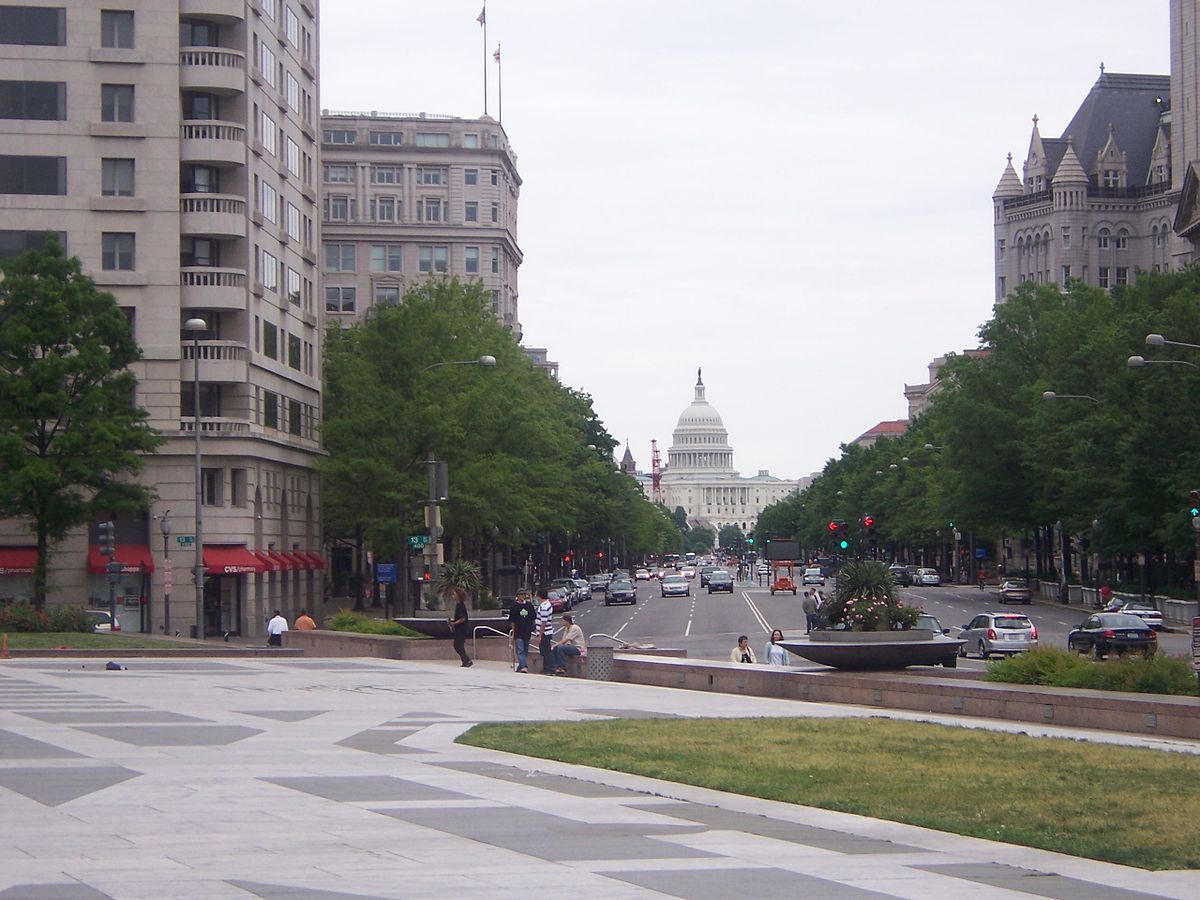
Pennsylvania Avenue National Historic Site is a National Historic Site in the city of Washington, D.C. Established on September 30, 1965, the site is roughly bounded by Constitution Avenue, 15th Street NW, F Street NW, and 3rd Street NW. The historic district includes a number of culturally, aesthetically, and historically significant structures and places, including Pennsylvania Avenue NW from the White House to the United States Capitol, the Treasury Building, Freedom Plaza, Federal Triangle, Ford's Theatre, the Old Patent Office Building, the Old Pension Office Building (which now houses the National Building Museum), Judiciary Square, and the Peace Monument. Pennsylvania Avenue, the heart of the historic site, is recognized by many as "America's Main Street." The avenue plays a significant part in American political culture as well. "Since its creation in the head of L'Enfant, from the time Jefferson planted Lombardy poplars along its edge, this has been the most important avenue in Washington," noted author Jeffrey F. Meyer. "It is the corridor of power, linking the legislative, judicial, and executive branches." Professor of architecture Michael J. Bednar, commenting on the role the avenue plays in the nation's political life, has written, "A march down Pennsylvania Avenue...brings high visibility and prestige to a group and its cause." Historian Lucy G. Barber, who has studied the site's political meaning, has called it one of the "central and most potent national spaces of the nation." The American Planning Association said in 2014 that a "march down Pennsylvania Avenue holds great symbolic meaning and has played a role in the fight for workers' rights, women's suffrage, and civil rights."

Washington National Cathedral

The Cathedral Church of Saint Peter and Saint Paul in the City and Diocese of Washington, operated under the more familiar name of Washington National Cathedral, is a cathedral of the Episcopal Church located in Washington, D.C., the capital of the United States. Of Neo-Gothic design closely modeled on English Gothic style of the late fourteenth century, it is the sixth-largest cathedral in the world, the second-largest in the United States, and the highest as well as the fourth-tallest structure in Washington, D.C. The cathedral is the seat of both the Presiding Bishop of the Episcopal Church, Michael Bruce Curry, and the Bishop of the Diocese of Washington, Mariann Edgar Budde. In 2009, nearly 400,000 visitors toured the structure. Average attendance at Sunday services in 2009 was 1,667, the highest of all domestic parishes in the Episcopal Church that year. The Protestant Episcopal Cathedral Foundation, under the first seven Bishops of Washington, erected the cathedral under a charter passed by the United States Congress on January 6, 1893. Construction began on September 29, 1907, when the foundation stone was laid in the presence of President Theodore Roosevelt and a crowd of more than 20,000, and ended 83 years later when the "final finial" was placed in the presence of President George H. W. Bush in 1990. Decorative work, such as carvings and statuary, is ongoing as of 2011. The Foundation is the legal entity of which all institutions on the Cathedral Close are a part; its corporate staff provides services for the institutions to help enable their missions, conducts work of the Foundation itself that is not done by the other entities, and serves as staff for the Board of Trustees. The Cathedral stands at Massachusetts and Wisconsin Avenues in the northwest quadrant of Washington. It is an associate member of the recently organized inter-denominational Washington Theological Consortium. It is listed on the National Register of Historic Places. In 2007, it was ranked third on the List of America's Favorite Architecture by the American Institute of Architects.

Robert A. Taft Memorial

The Robert A. Taft Memorial and Carillon is a carillon dedicated as a memorial to U.S. Senator Robert Alphonso Taft, son of President William Howard Taft. The memorial is located north of the Capitol, on Constitution Avenue between New Jersey Avenue and First Street, N.W. Designed by architect Douglas W. Orr, the memorial consists of a Tennessee marble tower and a 10-foot bronze statue of Senator Taft sculpted by Wheeler Williams. The shaft of the tower measures 100 feet high, 11 feet deep, and 32 feet wide. Above the statue is inscribed, "This Memorial to Robert A. Taft, presented by the people to the Congress of the United States, stands as a tribute to the honesty, indomitable courage, and high principles of free government symbolized by his life." The base of the memorial measures 55 by 45 feet and stands approximately 15 feet high. Jets of water flow into a basin that rings the base. The twenty-seven bells in the upper part of the tower were cast in the Paccard Foundry in Annecy-le-Vieux, France. The largest, or bourdon bell, weighs 7 tons . At the dedication ceremony on April 14, 1959, former President Herbert Hoover stated, "When these great bells ring out, it will be a summons to integrity and courage." The large central bell strikes on the hour, while the smaller fixed bells chime on the quarter-hour. By resolution of Congress, they play "The Star-Spangled Banner" at 2 p.m. on the Fourth of July. Construction of the memorial was authorized by S. Con. Res. 44, which was passed by the Senate and the House of Representatives in July 1955. It was funded by popular subscription from every state in the nation. More than a million dollars were collected.

Laogai Museum

The Laogai Museum is a museum in Dupont Circle, Washington, D.C. which showcases human rights in the Peoples Republic of China, focusing particularly on the laogai, the Chinese prison system. The creation of the museum was spearheaded by Harry Wu, a well-known Chinese dissident who himself served 19 years in laogai prisons; it was supported by the Yahoo! Human Rights Fund. It opened to the public on 12 November 2008, and Wus non-profit research organization calls it the first museum in the United States to directly address the issue of human rights in China. The Chinese penal system includes numerous components such as prisons, re-education through labor or laojiao camps, ankang mental health facilities, and juvenile detention centers. The Laogai Museum focuses mainly on the laogai component, which Wus non-profit research organization calls "the most extensive system of forced labor camps in the world.". Prisoners in these camps are said to undergo forced labor and thought reform, and the system has attracted widespread criticism from the international community. In 1994, the government abandoned the term laogai and renamed the facilities "prisons", but the Laogai Research Foundation and others claim that forced labor continues and prison conditions have not improved. The purpose of the Laogai Museum, according to Wu, is both to educate the public about the laogai and to memorialize the victims of the laogai. The museum documents the "history and structure of the laogai," and displays laogai-related materials such as uniforms, photographs, government documents, and products manufactured by prisoners—including such items as Christmas lights, tea bags, and plastic flowers; many of the items were donated by laogai survivors, and others come from Wus own archives. The museum also has a large archive of prison-made products, victims testimonies, and Chinese government documents. The museum was funded in part by the Yahoo! Human Rights Fund, a fund established by Yahoo! after the company attracted criticism for helping Chinese police locate and detain internet dissidents. The fund, headed by Yahoo! co-founder Jerry Yang was part of Yahoo!s apology, and funding the museum was one of its first public projects. A spokesman of the Chinese embassy has criticized the museum, calling it an attack on Chinas reputation and suggesting that Wus motivation behind opening the museum was "to vilify the Chinese legal system and mislead the American public."

Cathedral of St. Matthew the Apostle

The Cathedral of St. Matthew the Apostle in Washington D.C., most commonly known as St. Matthew's Cathedral, is the seat of the Archbishop of the Roman Catholic Archdiocese of Washington. As St. Matthew's Cathedral and Rectory, it was listed on the National Register of Historic Places in 1974. The cathedral is in downtown Washington at 1725 Rhode Island Avenue NW between Connecticut Avenue and 17th Street. The closest Metrorail station is Farragut North, on the Red Line. It is seven blocks north and a two blocks west of the White House. St. Matthew's is dedicated to the Apostle Matthew, who among other things is patron saint of civil servants, having himself been a tax collector. It was established 175 years ago in 1840 as the fourth Catholic parish in the District of Columbia. Originally located at 15th and H Streets, construction of the current church began in 1893, with the first Mass being celebrated June 2, 1895. Construction continued until 1913 when the church was dedicated. In 1939, it became the cathedral for the newly established Archdiocese of Washington. The structure is constructed of red brick with sandstone and terra cotta trim in the Romanesque Revival style with Byzantine elements. Designed by architect C. Grant La Farge, it is in the shape of a Latin cross measuring 155 ft × 136 ft and seats about 1,200 persons. The interior is richly decorated in marble and semiprecious stones, notably a 35 ft mosaic of Matthew behind the main altar by Edwin Blashfield. The cathedral is capped by an octagonal dome that extends 190 ft above the nave and is capped by a cupola and crucifix that brings the total height to 200 ft . Both structural and decorative elements underwent extensive restoration between 2000 and September 21, 2003, the Feast day of St. Matthew.

This attraction is located in

This is a private property. Please enjoy respectfully and do not disturb the occupants.

Edit Categories
Add Tours

This attraction is not part of any tours

Add Collections

This attraction is not part of any collections


Some of the attractions we imported from Wikipedia are not perfect. Send us an email detailing what's wrong and we'll look into fixing it.

GuRoute is all about Gurus sharing their local knowledge. If you feel up to fixing this problem yourself, why not adopt it. You will become the owner and can fix whatever problems you see.

We've copied a link to this attraction into your clipboard so that ou can paste it into an email or text message...

More Info...
You can add your friends to the visit yourself, or, send them a link and let them add themselves...

The visit will appear on both your timelines and on your Shared Timeline.

Click below and we'll email you a link that you can send on to friends or post on your group's Facebook page.

If your friends aren't members of GuRoute yet, this is a great way to get them started.
Recent
Recently used Collections will appear here...
Recent
Recently used tours will appear here...

Where is this?

GuRoute likes to place attractions inside other attractions. So, maybe it's in a city, or maybe it's inside a particular park in that city. Maybe your attraction is a huge park that spans half the county, or multiple counties.

Determining where this attraction is gives it context - if it's in a park, you'll be able to see it alongside all the other attractions in that park. And that helps define the park.

GuRoute will automatically calculate a parent region for this attraction. You can change it if there is something more appropriate.

This attraction is currently located in .

Change

This attraction does not yet have any reviews

Please login to write a review...

Reviewed by
Record new Visit

Add this location to your timneline?

  • If there's an existing attraction open it and add it to your timeline...
  • If not, enter a title and we'll create a new attraction for your memories...
Create new Attraction

Create a new attraction at this location?

  • We rely on Gurus like you to share your local knowledge...
(Give a name for this location)


+
Add this to your timeline instead...

Imagine having a record of all the cool things you've done in your life!


Using our timeline you can keep track of everywhere you visit in your lifetime...

But, you'll need to sign in first...

Add contacts so that you can share your travels and record places that you visit together...

Family
Favorites
Family
Favorites

Profile TimeLine Our Visits Edit Accept Decline Invite

If you have any more friends that visited this place with you, feel free to add them to the visit. We'll write it to their timeline and once they confirm it, they too will have this memory for a lifetime.

If they're not already registered, you just need their name and email address and you can add them and we'll send them an invite on your behlaf.

Add a tour comment

Add some extra information for when this attraction is viewed as part of your tour...

Next Stop Instructions

Add some instructions for what to see/do on the way to the next stop...

Next Stop Instructions

Add some instructions for what to see/do on the way to the next stop...

If you're visiting an existing attraction, open it and add it to your timeline. If there is no attraction for the place you are visiting...

  • Click 'Add My Location' below
  • Or right-click on the map to mark a different location
  • Or long-press if you have a touch screen
You can even add locations while you're offline....
  • Load up the map when you're online and we'll keep track of your locaiton
  • You can add locations to your timeline
  • When you are online again we'll sync them with the cloud

We can't connect to the internet right now. The following attractions are saved locally and can be uploaded when you're online...

GuRoute would like to access your current location so that we can pin you on the map and show you nearby attractions

Add friends so that you can share your experiences with each other...

Add tour to What's Next?

Go...

Either for yourself or someone else...

  1. Do your trip research in GuRoute
    Add all the places that you think might be worthy of a visit into a trip-plan
  2. Add your trip-plan to your "What's Next" timeline
    (or a friend's "What's Next" timeline)
  3. When you're on vacation you'll have all your research at your fingertips
  4. Share your timline with your friends
    They can enjoy your vacation with you, seeing not only where you've been, but where you're going next...
  5. Add/remove attractions if things change

It also makes a great souvenir of your trip

Collections

Go...

Create a home page for a collection of attractions

  • Add an image and description to display on the homepage
  • Start adding content
    Add existing attractions to your collection or create new attractions of your own
  • Collections can be:
    • Public (Anyone can add attractions to your collection)
    • Shared (Only yourself and Gurus you nominate can add content)
    • Private (The collection will only be visible to yourself)

Uses

  • Local business or hotel
    Showcase local attractions that you endorse
  • Clubs
    Showcase attractions that members have created (eg. local historical society)
  • Special Interest
    If GuRoute does not have a category for your special interest you add your attractions to your own collection instead

Examples

Walking/Driving Tours

Go...

A guided tour where GuRoute will direct you from stop to stop and narrate a description of each attraction you arrive at

  • GuRoute uses your phone's GPS to guide you from stop to stop
  • GuRoute automatically detects when you arrive at the next tour-stop and narrates the description of the attraction (Chrome Only)
  • It then sends you on to the next stop

Tours are great to attract people to your town. Even places with no significant points of interest can be lots of fun when part of a tour


Cater tours to your Audience

  • Kid-friendly Tours
    • Focus on what will keep kids interested
    • Instead of parents having to drag their kids around they'll be struggling to keep up
    • Let the kids navigate and they'll get more fun out of finding that historical plaque than they ever would from reading it
  • Accessible tours
  • Short and long tours of the same location

What you need to do...

  1. Click 'Go...'
    Enter a title, description and location for the tour
  2. Add existing attractions OR create new ones and add them to the tour
  3. For existing attractions you can add more information specific to the theme of the tour
  4. You can also add instructions on what to do or see en-route to the next tour-stop
  5. Try out your tour and see how it works...

Mystery Tour

Go...

Create a Mystery Tour

Create a series of clues to show people around a city, neighborhood or whatever place you like...

  • GuRoute will show people clues to get them from attraction to attraction
  • When they reach each stop GuRoute will tell them about the place and give them the next clue
  • Take as long or as you like and explore each location at your leisure

Scavenger Hunt

Go...

Create a Scavenger Hunt

Create a series of questions that people have to answer. The answers can all be discovered by walking aroung the area, looking for clues.

  • How many beers are on tap at Michael Collin's Irish Bar?
  • What's the name of the oldest building on main streeet?
  • Show a picture of some public art and ask them what it is called
  • Clues can have numeric or multiple choice answers