Sign In

My Timeline

GuRoute

Discover Your World

Share your Experiences

Record your Life


Top Attractions in Wrangell–St. Elias National Park and Preserve

Malaspina Glacier

The Malaspina Glacier in southeastern Alaska is the largest piedmont glacier in the world. Situated at the head of the Alaska Panhandle, it is about 65 km wide and 45 km long, with an area of some 3,900 km2 . It is named in honor of Alessandro Malaspina, an Italian explorer in the service of the Spanish Navy, who visited the region in 1791. In 1874, W.H. Dall, of what is now the U.S. National Geodetic Survey, bestowed the name "Malaspina Plateau" on it, not realizing its true geological character. It arises where several valley glaciers, primarily the Seward Glacier and Agassiz Glacier, spill out from the Saint Elias Mountains onto the coastal plain facing the Gulf of Alaska between Icy Bay and Yakutat Bay. Although it fills the plain, nowhere does it actually reach the water and so does not qualify as a tidewater glacier. The Malaspina is up to 600 metres thick in places, with the elevation of its bottom being estimated to be as much as 300 metres below sea level. There are two lakes on its margins: Oily Lake to the northwest, at the foot of the Samovar Hills between the Agassiz and Seward glaciers, and Malaspina Lake to the southeast, close to Yakutat Bay. Radar data and aerial photographs dating back to 1972 provide evidence that the Malaspina-Seward glacier system lost about 20 m of its thickness between 1980 and 2000; because the glacier is so large, that amount of shrinkage was sufficient to contribute 1/2 of one percent of the rise in the global sea level. Nearly all of the glacier is encompassed by the southeast lobe of the Wrangell-St. Elias National Park and Preserve. In October 1969, the glacier became a National Natural Landmark.

Mount Blackburn

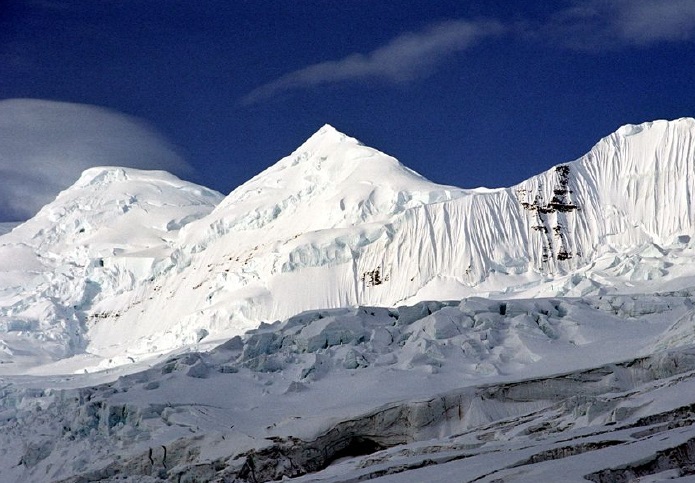
Mount Blackburn is the highest peak in the Wrangell Mountains of Alaska in the United States. It is the fifth highest peak in the United States and the twelfth highest peak in North America. The mountain is an old, eroded shield volcano, the second highest volcano in the United States behind Mount Bona and the fifth highest in North America. It was named in 1885 by Lt. Henry T. Allen of the U.S. Army after Joseph Clay Stiles Blackburn, a U.S. senator from Kentucky. It is located in the heart of Wrangell – St. Elias National Park, the largest national park in the country. The mountains massif is covered almost entirely by icefields and glaciers, and is the principal source of ice for the Kennicott Glacier, which flows southeast over 20 miles to just above the town of McCarthy. The mountain also contributes a large volume of ice to the north-flowing Nabesna Glacier and the Kuskulana Glacier system. Mount Blackburn is a large, dramatic peak, with great local relief and independence from higher peaks. Its west face drops over 11,000 ft to the Kuskulana Glacier in less than 4 horizontal miles . Its other faces drop 8,000–10,000 ft, all in less than 8 miles. The toe of the Kuskulana Glacier, less than 12 miles from the summit, lies at an elevation of 2,400 ft, giving a rise of 14,000 ft . While these figures speak to the peaks relief, one measure of its independence is that it is the 50th most topographically prominent peak in the world. The western of Blackburn’s two summits is the mountain’s highpoint, a fact that was not understood until the 1960s when the then new USGS maps were published. The first ascent of the west peak, and hence Mount Blackburn, was done on May 30, 1958 by Bruce Gilbert, Dick Wahlstrom, Hans Gmoser, Adolf Bitterlich, and Leon Blumer via the North Ridge. This team made the first ascent of Blackburn, but did not even know it at the time due to the incorrect identification of the highpoint. In fact Blumer’s article in the 1959 American Alpine Journal is titled “Mount Blackburn – Second Ascent.”

Nabesna Glacier

Nabesna Glacier is a glacier in the U.S. state of Alaska. Fed by deep snowfall in the Wrangell Mountains, the 53 mile long Nabesna is the longest valley glacier in North America and the worlds longest interior valley glacier. The glacier flows from an extensive icefield which covers the northern flanks of 14,163 feet Mount Wrangell, a large shield volcano. It heads initially east past other volcanic peaks including Mount Blackburn and Atna Peaks and then turns north to its terminus near 3,000 ft elevation, about 15 mi south of the old mining settlement of Nabesna at the end of the Nabesna Road. The vast expanse and length of the Nabesna is fed by approximately 40 tributary glaciers. Melting ice at its terminus forms the Nabesna River, which flows northward through Tetlin National Wildlife Refuge and into the Tanana River. The glacier was named for the Nabesna River in 1902 by F. C. Schrader of the U.S. Geological Survey. It provides the normal route of access into the heart of the eastern Wrangell Mountains, for ski mountaineers, climbers, and scientists. Ski-equipped bush planes can typically land between 6,000 and 7,000 ft on the central portion of the glacier when the ice and crevasses are covered by winter snow. "Dynamic Behavior of the Bering Glacier-Bagley Icefield System During a Surge". European Space Agency. Retrieved 2010-06-14.  "Nabesna Glacier ". Retrieved 2007-03-08.  "Glaciers ". Retrieved 2007-03-08.  "USGS GNIS: Nabesna Glacier". Retrieved 2007-03-08.

Wrangell–Saint Elias Wilderness

Wrangell-Saint Elias Wilderness is a wilderness area in Alaska, United States. At 9,078,675 acres , it is the largest designated U.S. Wilderness Area, and lies within Wrangell–St. Elias National Park and Preserve, the largest national park in the United States. It is a land of remote valleys, wild rivers, and a fabulous wildlife population that includes Dall sheep, grizzly bears, black bears, coyotes, bison, caribou, wolverines, moose, beavers, mountain goats, gray wolves, red foxes, and marmots. In the north the glaciated peaks drop to tundra and boreal forested uplands. In the south massive glaciers spread from the mountains almost to the Gulf of Alaska. Several trails provide foot or horse access, but large braided rivers often stop progress unless a packraft is used. The classic route across the wilderness links the gold-rush era settlement of Chisana with the copper-mining era community of McCarthy, via 100 miles of tundra, trails and gravel bars. Unmaintained trails lead through spruce forests near Chisana, across high tundra plains to the White River, below 16,000-foot mountains over Skolai Pass, and into the Chitistone Gorge and Canyon with waterfalls to 1,500 feet high. Mosquitoes are thick in the low country during the summer, and enough snow accumulates in the high country to make avalanches a year-round danger. On the Canadian side of the border lies Kluane National Park, and together these two areas house some of the continent's most spectacular mountain landscapes.

Copper River and Northwestern Railway

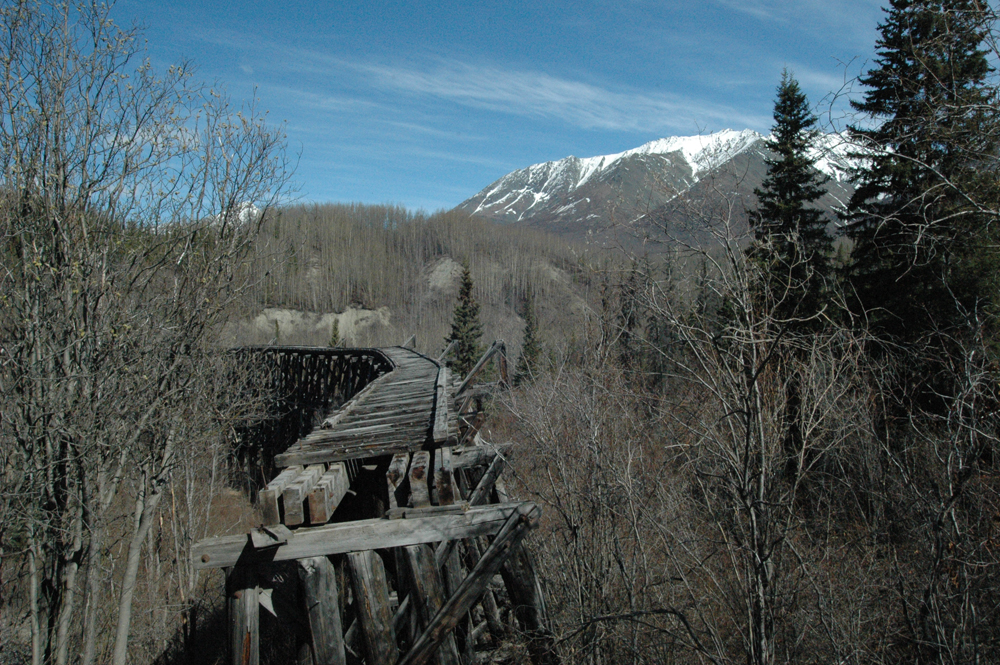
The Copper River and Northwestern Railway, CR&NW, was a railroad, now defunct, built by the Kennecott Corporation between 1908 and 1911 to take copper ore from Kennicott, Alaska to Cordova, Alaska, a distance of 315 km . Michael James Heney had secured the right-of-way up the Copper River in 1904. He started building the railway from Cordova, Alaska in 1906. The town of Cordova, Alaska, was actually named by Heney on March 13, 1906, based on the original name given by Salvador Fidalgo. By Oct. 1906, Heney decided to sell his Copper River right-of-way to the Alaska Syndicate. Heney then retired, but returned to work for Daniel Guggenheim on the railway in 1907 after the Katalla facilities were destroyed in a storm and Guggenheim decided Cordova was a better starting point. The competing railroad that bought the Close Brothers-Heney interests, was the CR&NW, owned by the Alaska Syndicate. The syndicate included investment by J.P. Morgan. He had earlier bought John Rosene's Northwestern Commercial Company, an empire of mercantile companies, shipping interests, and railroad. The syndicate started construction from Cordova, the Bonanza mine site at Kennecott, and at a point midway where the Nizina River merged with the Copper River. Challenges includes bridging the Kuskulana River canyon and the Copper River with the Million Dollar Bridge. "The completion of the Million Dollar Bridge in the summer of 1910 effectively guaranteed the success of the rail project and the shipment of the first load of Kennecott ore in early 1911." Heney had traveled to New York in 1909 to meet with Daniel Guggenheim and other board member about the railroad progress. On his return journey, he departed Seattle on 23 Aug. 1909 aboard the steamship Ohio. On 25 Aug., the Ohio struck an uncharted rock and sank. Heney finally made it to Cordova on 18 Sept. On 30 Nov. 1909 the railroad reached the Tiekel River, completing the first phase of the contract. Heney made another trip to New York to turn over that portion of the railroad to the Katalla Company. On the return trip he spent the winter in Seattle. His health failing, Heney finally succumbed to pulmonary tuberculosis on 4 Oct. 1910. The last spike in the construction, a "copper spike", was driven on 29 March 1911, by Chief Engineer E. C. Hawkins and Superintendent Samuel Murchison at Kennicott. The cost of the railway at $25 million was justified because the mines produced $200 million worth of copper ore during their operation of which at least 50 percent was profit. There were 129 bridges constructed between Cordova and Chitina. The good ore in the mines ran out and the last train ran on 11 Nov. 1938. In 1941, the Kennecott Corporation donated the railroad right-of-way to the United States "for use as a publichighway". In 1953 conversion was started. The Alaska Dept. of Highways had extended the Copper River Highway to Mile 59, from Cordova to the Million Dollar Bridge, by 1964. However, the damage to 28 bridges after the Good Friday earthquake delayed further construction. By 1972 the highway extended to Mile 72 and south 20 miles from Chitina. The bridge has recently been repaired. The roadbed from Chitina to McCarthy now forms the McCarthy Road. The railroad's nickname was "Can't Run and Never Will".

Bremner Historic Mining District

The Bremner Historic Mining District is a mining camp in Wrangell-St. Elias National Park and Preserve in Alaska. It is named after John Bremner, who in 1884-1885 was the first non-native person to live in the area and who prospected for gold along the Bremner River. Located just to the north of the Bremner River, it was the scene of an important placer gold discovery in 1902, and played a key role in the history of the Copper River Basin. Only a few miners struck it rich, but the resulting demand for materials and supplies helped establish regional transportation networks, encouraged supporting industries, and hastened the exploration and settlement of the entire region. While small-scale placer mining continued for over forty years, lode development was largely confined to the period between 1934 and 1941, the district's most significant era. The Bremner Historic Mining District embodies its period of twentieth-century mining, illustrating both its mining process and its evolutionary sequence. Unusually complete, it retains virtually all of its historic components, including an important placer site, a camp, four discrete lode mines, a mill, and an associated transportation network. The Golconda Mining Company site, which contains a campsite, an elaborate ditch, and extensive piles of hand-stacked cobble, provides an example of an early placer mining system. The Goldconda complex includes two airstrips dating to the 1930s. The Yellow Band mining camp is one of the region’s most complete, not only containing the typical housing and office facilities, but a sophisticated hydroelectric system. This camp is also significant for its association with Asa C. Baldwin, a distinguished regional explorer, surveyor, and mining engineer. While working for the U.S. Geodetic Survey, Baldwin completed the first American marine survey of Kodiak and the Aleutian Islands in 1909. From 1910-13, he served as a field officer with the U.S.-Canadian International Boundary Survey. Over the years, Baldwin worked locally as a consulting engineer, where, among other activities, he advised the Kennecott Copper Company and the Copper River and Northwestern Railway. Baldwin began prospecting in the Bremner District in the early 1930s, and from 1936 to 1940, was president of the Yellow Band Mining Company. He acquired the Bremner Gold Mining Company holdings in 1939. Lucky Girl, Grand Prize, Sheriff, and Yellow Band Mines are examples of remote underground mining operations. With each containing a variety of buildings and structures. While Lucky Girl mill is now ruinous due to repeated avalanche strikes, its operating machinery remains intact and in most cases in situ. In addition to Baldwin, the Bremner district is associated with aviator Merle "Mudhole" Smith, who started flying supplies for the Cordova Air Service in the 1930s, and who became stuck on the upper Golconda strip. Smith operated Cordova Air Service until 1968, when it merged with Alaska Airlines.

This attraction is located in

This is a private property. Please enjoy respectfully and do not disturb the occupants.

Edit Categories
Add Tours

This attraction is not part of any tours

Add Collections

This attraction is not part of any collections


Some of the attractions we imported from Wikipedia are not perfect. Send us an email detailing what's wrong and we'll look into fixing it.

GuRoute is all about Gurus sharing their local knowledge. If you feel up to fixing this problem yourself, why not adopt it. You will become the owner and can fix whatever problems you see.

We've copied a link to this attraction into your clipboard so that ou can paste it into an email or text message...

More Info...
You can add your friends to the visit yourself, or, send them a link and let them add themselves...

The visit will appear on both your timelines and on your Shared Timeline.

Click below and we'll email you a link that you can send on to friends or post on your group's Facebook page.

If your friends aren't members of GuRoute yet, this is a great way to get them started.
Recent
Recently used Collections will appear here...
Recent
Recently used tours will appear here...

Where is this?

GuRoute likes to place attractions inside other attractions. So, maybe it's in a city, or maybe it's inside a particular park in that city. Maybe your attraction is a huge park that spans half the county, or multiple counties.

Determining where this attraction is gives it context - if it's in a park, you'll be able to see it alongside all the other attractions in that park. And that helps define the park.

GuRoute will automatically calculate a parent region for this attraction. You can change it if there is something more appropriate.

This attraction is currently located in .

Change

This attraction does not yet have any reviews

Please login to write a review...

Reviewed by
Record new Visit

Add this location to your timneline?

  • If there's an existing attraction open it and add it to your timeline...
  • If not, enter a title and we'll create a new attraction for your memories...
Create new Attraction

Create a new attraction at this location?

  • We rely on Gurus like you to share your local knowledge...
(Give a name for this location)


+
Add this to your timeline instead...

Imagine having a record of all the cool things you've done in your life!


Using our timeline you can keep track of everywhere you visit in your lifetime...

But, you'll need to sign in first...

Add contacts so that you can share your travels and record places that you visit together...

Family
Favorites
Family
Favorites

Profile TimeLine Our Visits Edit Accept Decline Invite

If you have any more friends that visited this place with you, feel free to add them to the visit. We'll write it to their timeline and once they confirm it, they too will have this memory for a lifetime.

If they're not already registered, you just need their name and email address and you can add them and we'll send them an invite on your behlaf.

Add a tour comment

Add some extra information for when this attraction is viewed as part of your tour...

Next Stop Instructions

Add some instructions for what to see/do on the way to the next stop...

Next Stop Instructions

Add some instructions for what to see/do on the way to the next stop...

If you're visiting an existing attraction, open it and add it to your timeline. If there is no attraction for the place you are visiting...

  • Click 'Add My Location' below
  • Or right-click on the map to mark a different location
  • Or long-press if you have a touch screen
You can even add locations while you're offline....
  • Load up the map when you're online and we'll keep track of your locaiton
  • You can add locations to your timeline
  • When you are online again we'll sync them with the cloud

We can't connect to the internet right now. The following attractions are saved locally and can be uploaded when you're online...

GuRoute would like to access your current location so that we can pin you on the map and show you nearby attractions

Add friends so that you can share your experiences with each other...

Add tour to What's Next?

Go...

Either for yourself or someone else...

  1. Do your trip research in GuRoute
    Add all the places that you think might be worthy of a visit into a trip-plan
  2. Add your trip-plan to your "What's Next" timeline
    (or a friend's "What's Next" timeline)
  3. When you're on vacation you'll have all your research at your fingertips
  4. Share your timline with your friends
    They can enjoy your vacation with you, seeing not only where you've been, but where you're going next...
  5. Add/remove attractions if things change

It also makes a great souvenir of your trip

Collections

Go...

Create a home page for a collection of attractions

  • Add an image and description to display on the homepage
  • Start adding content
    Add existing attractions to your collection or create new attractions of your own
  • Collections can be:
    • Public (Anyone can add attractions to your collection)
    • Shared (Only yourself and Gurus you nominate can add content)
    • Private (The collection will only be visible to yourself)

Uses

  • Local business or hotel
    Showcase local attractions that you endorse
  • Clubs
    Showcase attractions that members have created (eg. local historical society)
  • Special Interest
    If GuRoute does not have a category for your special interest you add your attractions to your own collection instead

Examples

Walking/Driving Tours

Go...

A guided tour where GuRoute will direct you from stop to stop and narrate a description of each attraction you arrive at

  • GuRoute uses your phone's GPS to guide you from stop to stop
  • GuRoute automatically detects when you arrive at the next tour-stop and narrates the description of the attraction (Chrome Only)
  • It then sends you on to the next stop

Tours are great to attract people to your town. Even places with no significant points of interest can be lots of fun when part of a tour


Cater tours to your Audience

  • Kid-friendly Tours
    • Focus on what will keep kids interested
    • Instead of parents having to drag their kids around they'll be struggling to keep up
    • Let the kids navigate and they'll get more fun out of finding that historical plaque than they ever would from reading it
  • Accessible tours
  • Short and long tours of the same location

What you need to do...

  1. Click 'Go...'
    Enter a title, description and location for the tour
  2. Add existing attractions OR create new ones and add them to the tour
  3. For existing attractions you can add more information specific to the theme of the tour
  4. You can also add instructions on what to do or see en-route to the next tour-stop
  5. Try out your tour and see how it works...

Mystery Tour

Go...

Create a Mystery Tour

Create a series of clues to show people around a city, neighborhood or whatever place you like...

  • GuRoute will show people clues to get them from attraction to attraction
  • When they reach each stop GuRoute will tell them about the place and give them the next clue
  • Take as long or as you like and explore each location at your leisure

Scavenger Hunt

Go...

Create a Scavenger Hunt

Create a series of questions that people have to answer. The answers can all be discovered by walking aroung the area, looking for clues.

  • How many beers are on tap at Michael Collin's Irish Bar?
  • What's the name of the oldest building on main streeet?
  • Show a picture of some public art and ask them what it is called
  • Clues can have numeric or multiple choice answers