Sign In

My Timeline

GuRoute

Discover Your World

Share your Experiences

Record your Life


Top Attractions in Oborishte

National Opera and Ballet of Bulgaria

The National Opera and Ballet is a national cultural institution in Bulgaria that covers opera and ballet. It is based in an imposing building in Sofia, the capital of Bulgaria. The first opera company in Bulgaria was founded in 1890 as part of the Capital Opera and Drama Company. The two sections split in 1891 to form the Salza i Smyah theatrical company and the Capital Bulgarian Opera. It was, however, disbanded the next year due to lack of government funding and financial difficulties. The Bulgarian Opera Society was established in 1908 and staged its first test performance. The first full opera was performed in 1909 — Pagliacci by Leoncavallo. The first Bulgarian opera works were also presented in the period, including Siromahkinya by Emanuil Manolov, Kamen i Tsena by Ivan Ivanov and Václav Kaucký, Borislav by Georgi Atanasov and Tahir Begovitsa by Dimitar Hadzhigeorgiev. As the company evolved under the ensemble system and style, the permanent troupe of soloists, choir, orchestra, ballet, technical and production teams produced up to 10 opera and ballet premieres a year, in addition to concert programs. Gradually, the basic repertory of world opera classics was established at the same time as the theatre began to attract Bulgarian composers who created new national works. 20th Century performers such as Nicolai Ghiaurov, Nicola Ghiuselev, and Ghena Dimitrova began their careers within the structure of the National Opera, as did later singers such as Irena Petkova. The institution became a national one in 1922 and changed its name to National Opera. A ballet company was established and gave its first performance in 1928. The opera ceased its activity for a while after the 1944 bombing of Sofia, but was restored shortly afterward with a significant increase of government funding. The National Opera and Ballets building was designed in 1921 and built for the most part between 1947 and its opening in 1953. In 2000, the company co-organized the Boris Christoff Twelfth International Competition for Young Opera Singers with the idea of attracting a younger audience and supporting young and upcoming singers.

TZUM

TZUM-Sofia is an upmarket department store in the centre of Sofia, the capital of Bulgaria, officially opened in 1957 and situated in a monumental edifice on one of the citys main boulevards. The stores construction began in 1955 and ended in the end of 1956, when the first customers entered TZUM. It was officially opened with a ceremony in 1957. The edifice was designed by architect Kosta Nikolov and has an area of 20,570 m². It features a covered inner yard taking up the centre of five of the buildings seven floors. TZUM underwent major reconstruction in 1986 under the direction of architect Atanas Nikolov. Two years later, 120,000 people daily went through the store, which sold 123,000 items a day. After the democratic changes in 1989, the store remained public property until sold to Hong Kong fund manager, Regent Pacific Group, for the price of DM 30 million . Regent then invested $10.2 million in 1999–2000 to redevelop the property into a mixed-use office and retail building. TZUM was transformed to become a place for expensive boutiques rather than a store for the people, with the daily number of customers falling to 7,000. Plovdiv businessman Georgi Gergov acquired TZUM on 19 October 2004. As of 2005, world brands like Laura Ashley, Timberland, Nautica, Fila, Fred Perry, Adidas, Mexx, Tommy Hilfiger, Swarovski, Miss Sixty, Nike, Bagatt, Altınbaş and Rossignol have stores in TZUM. The rent levels are one of the highest in Bulgaria, only competing with the neighbouring Vitosha Boulevard. According to the manager Tsvetomir Gergov, 12,000 people visit the store per day.

Sofia Central Mineral Baths

The Central Mineral Baths is a landmark in the centre of Sofia, the capital of Bulgaria, a city known for the mineral springs in the area. It was built in the early 20th century near the former Turkish bath and was used as the city's public baths until 1986. Public baths have existed in Sofia since at least the 16th century. During his visit to Sofia in 1553-1555, Bohemian traveller Hans Dernschwam noted the presence of 1 large bath and 2 smaller baths on either side of the city. Dernschwam described the baths as follows: The current Central Mineral Baths building was designed in the Vienna Secession style, but integrating typically Bulgarian, Byzantine and Eastern Orthodox ornamental elements, by the architects Petko Momchilov and Friedrich Grünanger in 1904-1905 and approved on 30 January 1906, as projects by an Austrian and a French architect were declined. The raw construction was finished in 1908 and a Bulgarian company constructed the complex roof and the mineral water conduit. The baths opened on 13 May 1913, but the building was completely finished after 2 more years and a garden was arranged in front of the baths. Artists Haralampi Tachev and St. Dimitrov designed the building's ceramic majolica decoration. The north wing was damaged during the bombing of Sofia in World War II, but was restored several years later. The baths continued to work as public baths until 1986, when the building was closed due to its bad condition and the possible collapse of the roof. It was subsequently partially reconstructed and thoroughly cleaned and is planned to accommodate the Museum of Sofia and a healing centre in 2014.

National Opera and Ballet

The National Opera and Ballet is a national cultural institution in Bulgaria that covers opera and ballet. It is based in an imposing building in Sofia, the capital of Bulgaria. The first opera company in Bulgaria was founded in 1890 as part of the Capital Opera and Drama Company. The two sections split in 1891 to form the Salza i Smyah theatrical company and the Capital Bulgarian Opera. It was, however, disbanded the next year due to lack of government funding and financial difficulties. The Bulgarian Opera Society was established in 1908 and staged its first test performance. The first full opera was performed in 1909 — Pagliacci by Leoncavallo. The first Bulgarian opera works were also presented in the period, including Siromahkinya by Emanuil Manolov, Kamen i Tsena by Ivan Ivanov and Václav Kaucký, Borislav by Georgi Atanasov and Tahir Begovitsa by Dimitar Hadzhigeorgiev. As the company evolved under the ensemble system and style, the permanent troupe of soloists, choir, orchestra, ballet, technical and production teams produced up to 10 opera and ballet premieres a year, in addition to concert programs. Gradually, the basic repertory of world opera classics was established at the same time as the theatre began to attract Bulgarian composers who created new national works. 20th Century performers such as Nicolai Ghiaurov, Nicola Ghiuselev, and Ghena Dimitrova began their careers within the structure of the National Opera, as did later singers such as Irena Petkova and Kiril Manolov. The institution became a national one in 1922 and changed its name to National Opera. A ballet company was established and gave its first performance in 1928. The opera ceased its activity for a while after the 1944 bombing of Sofia, but was restored shortly afterward with a significant increase of government funding. The National Opera and Ballet's building was designed in 1921 and built for the most part between 1947 and its opening in 1953. In 2000, the company co-organized the Boris Christoff Twelfth International Competition for Young Opera Singers with the idea of attracting a younger audience and supporting young and upcoming singers.

Church of St Petka of the Saddlers

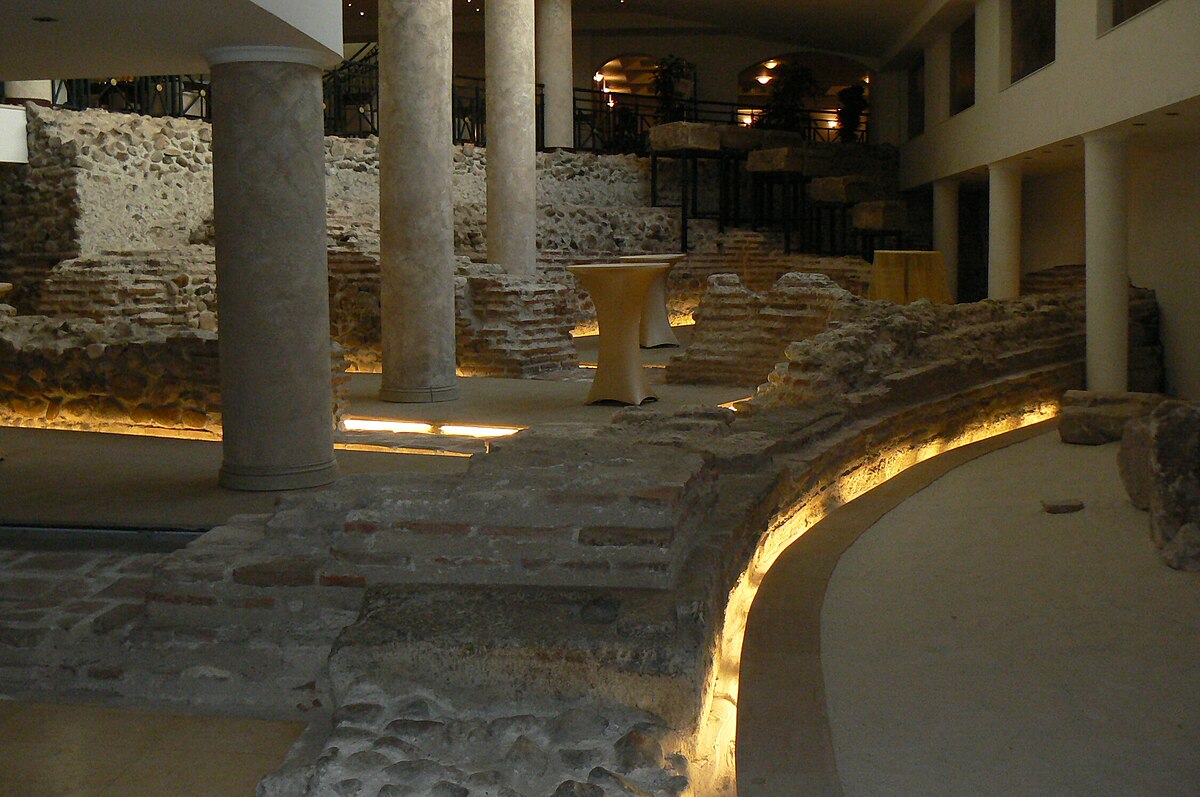
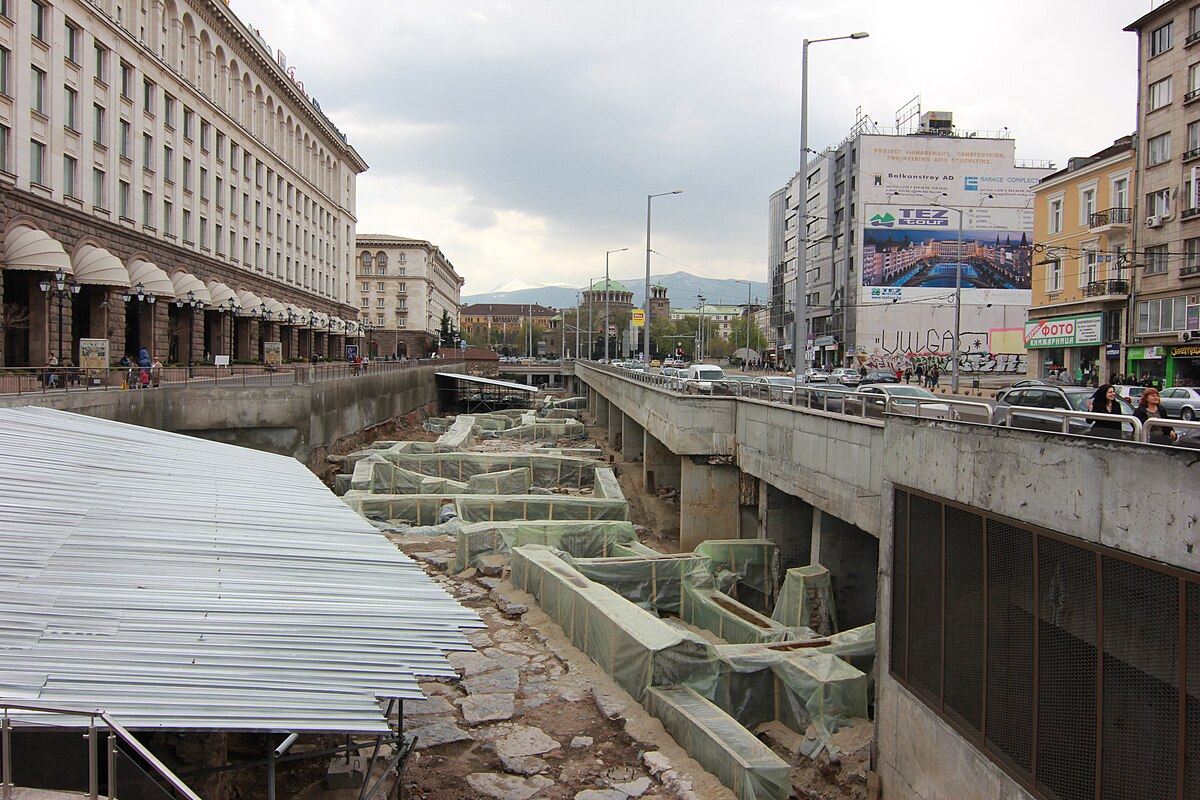
The Church of St Petka of the Saddlers is a medieval Bulgarian Orthodox church in Sofia, the capital of Bulgaria. It is a small one-naved building partially dug into the ground located in the very centre of both the modern and the antique city, in the TZUM subway. The church features a semi-cylindrical vault, a hemispherical apse, and a crypt discovered during excavations after the Second World War. The walls are 1 m thick and made from brick and stone. The church was first mentioned in the 16th century and was constructed at the place of a former Roman religious building. It is today a monument of culture known for its mural paintings from the 14th, 15th, 17th and 19th century depicting biblical scenes. The church is dedicated to St Petka, an 11th-century Bulgarian saint. The Church of Saint Petka acquired its present name due to it being a patron of the saddlers in the Middle Ages, who performed their rituals in the church. According to one theory, Bulgarian national hero Vasil Levski is buried in the church. The theory was supported by the noted research worker of Levski Nikolay Haytov and to an extent backed by the 1956 excavations that discovered several skeletons in the crypt, as well as by press reports from 1937 retelling the stories of those who carried out the burial. The Bulgarian Academy of Sciences Institute of Archaeology, however, does not support the view, which led to a harsh controversy in the 1980s that did not end with a conclusive decision.

Monument to the Unknown Soldier

The Monument to the Unknown Soldier is a monument in the centre of Sofia, the capital of Bulgaria, located just next to the 6th-century Church of St Sophia, on 2 Paris Street. The monument commemorates the hundreds of thousands of Bulgarian soldiers who died in wars defending their homeland. Ceremonies involving the President of Bulgaria and foreign state leaders are often performed here. The monument was designed by architect Nikola Nikolov and opened on September 22, 1981, the 1300th anniversary of establishment of the Bulgarian state. The Monument to the Unknown Soldier features an eternal flame, turf from Stara Zagora and Shipka Pass, sites of two of the most important battles of the Russo-Turkish War of Liberation, a sculpture of a lion by the noted sculptor Andrey Nikolov, as well as a stone inscription of a stanza by the national writer Ivan Vazov: After the end of the First World War, a group of Bulgarians proposed building the monument. However, strong opposition to the building of this monument arose. Some Bulgarian intellectuals argued that a monument of an unknown soldier is unacceptable since it would imply that the names of the soldiers have been forgotten. "Not a single soldier shall be forgotten who gave his life in this war and in all other wars for the freedom of Bulgaria!". The monument was designed but was not displayed because of the above mentioned arguments. The lion itself was considered an abuse for a long time because it was sitting. The pose was considered a metaphor of surrender to the national ideas.

This attraction is located in

This is a private property. Please enjoy respectfully and do not disturb the occupants.

Edit Categories
Add Tours

This attraction is not part of any tours

Add Collections

This attraction is not part of any collections


Some of the attractions we imported from Wikipedia are not perfect. Send us an email detailing what's wrong and we'll look into fixing it.

GuRoute is all about Gurus sharing their local knowledge. If you feel up to fixing this problem yourself, why not adopt it. You will become the owner and can fix whatever problems you see.

We've copied a link to this attraction into your clipboard so that ou can paste it into an email or text message...

More Info...
You can add your friends to the visit yourself, or, send them a link and let them add themselves...

The visit will appear on both your timelines and on your Shared Timeline.

Click below and we'll email you a link that you can send on to friends or post on your group's Facebook page.

If your friends aren't members of GuRoute yet, this is a great way to get them started.
Recent
Recently used Collections will appear here...
Recent
Recently used tours will appear here...

Where is this?

GuRoute likes to place attractions inside other attractions. So, maybe it's in a city, or maybe it's inside a particular park in that city. Maybe your attraction is a huge park that spans half the county, or multiple counties.

Determining where this attraction is gives it context - if it's in a park, you'll be able to see it alongside all the other attractions in that park. And that helps define the park.

GuRoute will automatically calculate a parent region for this attraction. You can change it if there is something more appropriate.

This attraction is currently located in .

Change

This attraction does not yet have any reviews

Please login to write a review...

Reviewed by
Record new Visit

Add this location to your timneline?

  • If there's an existing attraction open it and add it to your timeline...
  • If not, enter a title and we'll create a new attraction for your memories...
Create new Attraction

Create a new attraction at this location?

  • We rely on Gurus like you to share your local knowledge...
(Give a name for this location)


+
Add this to your timeline instead...

Imagine having a record of all the cool things you've done in your life!


Using our timeline you can keep track of everywhere you visit in your lifetime...

But, you'll need to sign in first...

Add contacts so that you can share your travels and record places that you visit together...

Family
Favorites
Family
Favorites

Profile TimeLine Our Visits Edit Accept Decline Invite

If you have any more friends that visited this place with you, feel free to add them to the visit. We'll write it to their timeline and once they confirm it, they too will have this memory for a lifetime.

If they're not already registered, you just need their name and email address and you can add them and we'll send them an invite on your behlaf.

Add a tour comment

Add some extra information for when this attraction is viewed as part of your tour...

Next Stop Instructions

Add some instructions for what to see/do on the way to the next stop...

Next Stop Instructions

Add some instructions for what to see/do on the way to the next stop...

If you're visiting an existing attraction, open it and add it to your timeline. If there is no attraction for the place you are visiting...

  • Click 'Add My Location' below
  • Or right-click on the map to mark a different location
  • Or long-press if you have a touch screen
You can even add locations while you're offline....
  • Load up the map when you're online and we'll keep track of your locaiton
  • You can add locations to your timeline
  • When you are online again we'll sync them with the cloud

We can't connect to the internet right now. The following attractions are saved locally and can be uploaded when you're online...

GuRoute would like to access your current location so that we can pin you on the map and show you nearby attractions

Add friends so that you can share your experiences with each other...

Add tour to What's Next?

Go...

Either for yourself or someone else...

  1. Do your trip research in GuRoute
    Add all the places that you think might be worthy of a visit into a trip-plan
  2. Add your trip-plan to your "What's Next" timeline
    (or a friend's "What's Next" timeline)
  3. When you're on vacation you'll have all your research at your fingertips
  4. Share your timline with your friends
    They can enjoy your vacation with you, seeing not only where you've been, but where you're going next...
  5. Add/remove attractions if things change

It also makes a great souvenir of your trip

Collections

Go...

Create a home page for a collection of attractions

  • Add an image and description to display on the homepage
  • Start adding content
    Add existing attractions to your collection or create new attractions of your own
  • Collections can be:
    • Public (Anyone can add attractions to your collection)
    • Shared (Only yourself and Gurus you nominate can add content)
    • Private (The collection will only be visible to yourself)

Uses

  • Local business or hotel
    Showcase local attractions that you endorse
  • Clubs
    Showcase attractions that members have created (eg. local historical society)
  • Special Interest
    If GuRoute does not have a category for your special interest you add your attractions to your own collection instead

Examples

Walking/Driving Tours

Go...

A guided tour where GuRoute will direct you from stop to stop and narrate a description of each attraction you arrive at

  • GuRoute uses your phone's GPS to guide you from stop to stop
  • GuRoute automatically detects when you arrive at the next tour-stop and narrates the description of the attraction (Chrome Only)
  • It then sends you on to the next stop

Tours are great to attract people to your town. Even places with no significant points of interest can be lots of fun when part of a tour


Cater tours to your Audience

  • Kid-friendly Tours
    • Focus on what will keep kids interested
    • Instead of parents having to drag their kids around they'll be struggling to keep up
    • Let the kids navigate and they'll get more fun out of finding that historical plaque than they ever would from reading it
  • Accessible tours
  • Short and long tours of the same location

What you need to do...

  1. Click 'Go...'
    Enter a title, description and location for the tour
  2. Add existing attractions OR create new ones and add them to the tour
  3. For existing attractions you can add more information specific to the theme of the tour
  4. You can also add instructions on what to do or see en-route to the next tour-stop
  5. Try out your tour and see how it works...

Mystery Tour

Go...

Create a Mystery Tour

Create a series of clues to show people around a city, neighborhood or whatever place you like...

  • GuRoute will show people clues to get them from attraction to attraction
  • When they reach each stop GuRoute will tell them about the place and give them the next clue
  • Take as long or as you like and explore each location at your leisure

Scavenger Hunt

Go...

Create a Scavenger Hunt

Create a series of questions that people have to answer. The answers can all be discovered by walking aroung the area, looking for clues.

  • How many beers are on tap at Michael Collin's Irish Bar?
  • What's the name of the oldest building on main streeet?
  • Show a picture of some public art and ask them what it is called
  • Clues can have numeric or multiple choice answers