Barra
Barra is an island in the Outer Hebrides in Scotland. Barra is the second southernmost inhabited island of the Outer Hebrides after the adjacent island of Vatersay, to which it is connected by a causeway. In 2011 the population was 1,174, almost 100 higher than the 1,078 counted at the time of the 2001 census.
According to the 2011 Census, there are 761 Gaelic speakers on Barra.
The area of Barra is roughly 60 square kilometres , the main village being Castlebay .
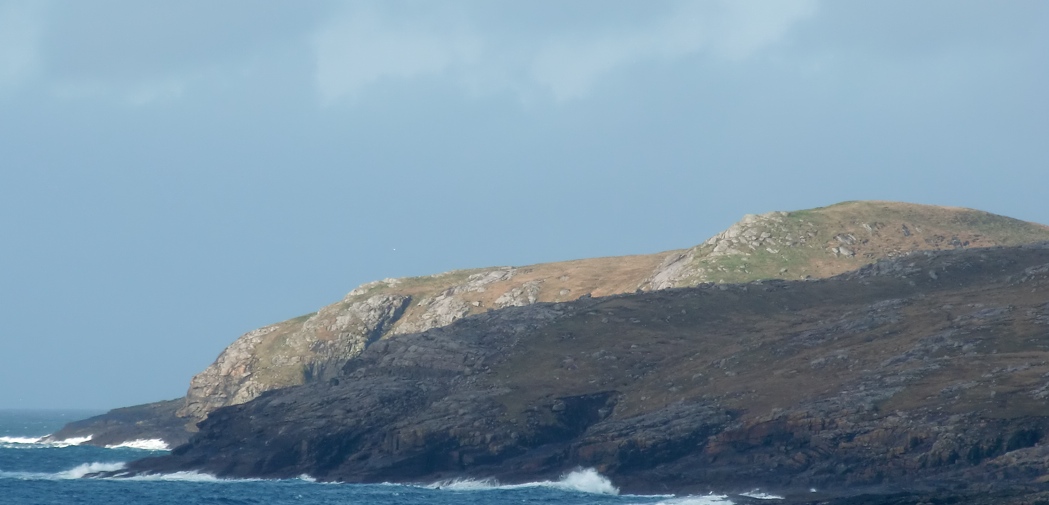
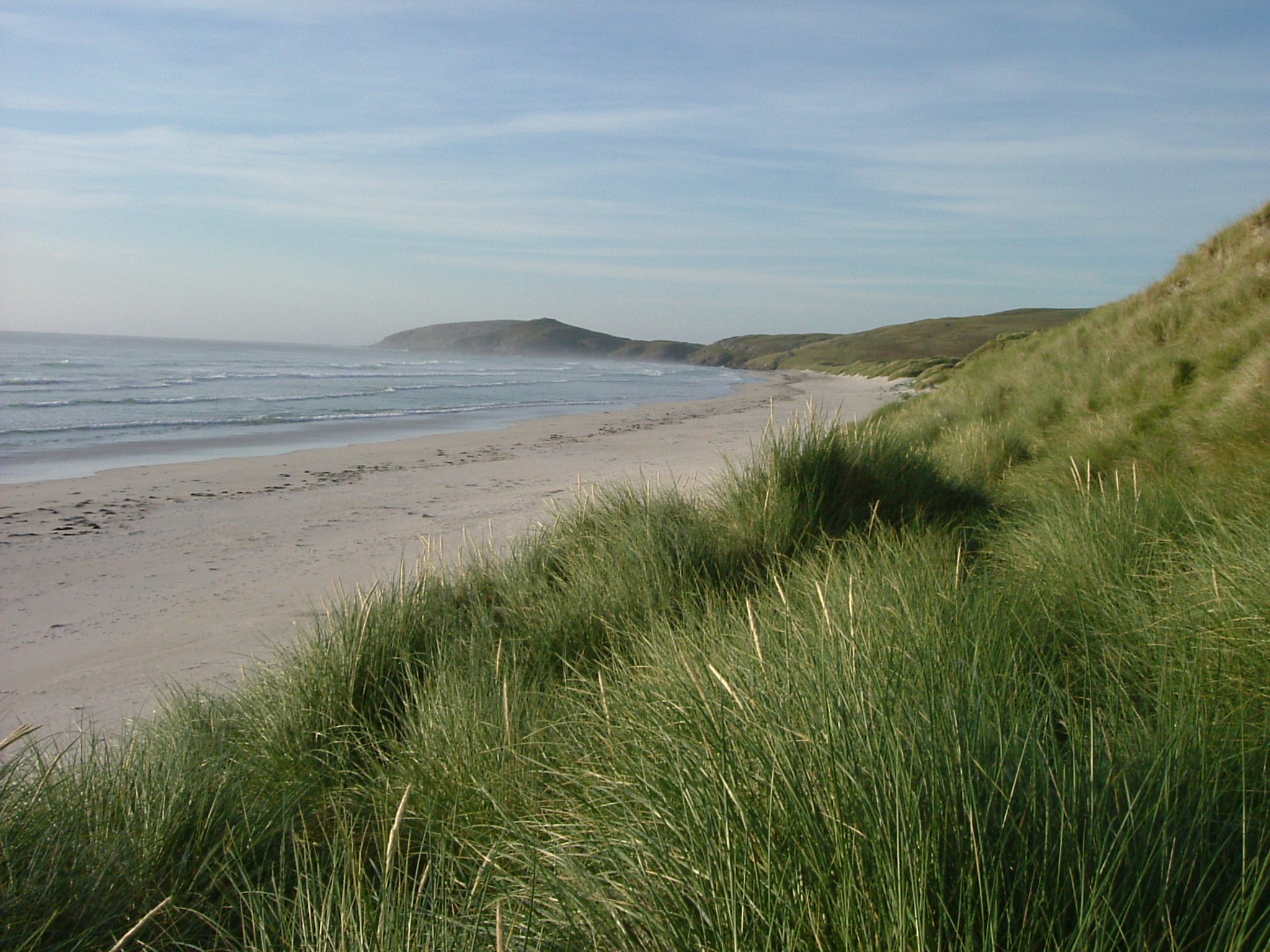
The west of the island has white sandy beaches backed by shell-sand, machair and the east has numerous rocky inlets.
Kisimul Castle at Castlebay is located on a rock in the bay, so giving the village its name. A smaller castle can be found in the middle of Loch St Clare on the west side of the Island in Tangasdale.
The highest elevation on the island is Heaval, halfway up which is located a prominent white marble statue of the Madonna and Child, called "Our Lady of the Sea", which was erected during the of 1954. The predominant faith on the island is Catholicism and the Catholic church dedicated to Our Lady of the Sea is immediately apparent to all who arrive into Castlebay.
Other places of interest on the island include a ruined church and museum at Cille Bharra, a number of Iron Age brochs such as those at Dùn Chuidhir and An Dùn Bàn and a range of other Iron Age and later structures which have recently been excavated and recorded.
The island's place name is derived from two elements: Barr and Old Norse ey . It is possible that Barr represents the Gaelic personal name Finnbarr. Other possibilities are that it instead represents the Old Norse elements berr or barr , or perhaps the Celtic element *barr .
Barra once formed part of the Kingdom of the Isles. In the middle part of the twelfth century, this realm was partitioned between the Crovan dynasty and Clann Somhairle, and it is uncertain which family controlled the island during this period. In 1293, years after the collapse of the realm and its incorporation into the Kingdom of Scotland, the island formed part of the Sheriffdom of Skye, which could be evidence that it had indeed formed part of the territories previously controlled by the Crovan dynasty like other parts of the sheriffdom. By this period the island appears to have formed part of the extensive Clann Ruaidhrí lordship. Early in the reign of Robert I, King of Scotland, the island was included in the king's confirmation of Clann Ruaidhrí territories to Ruaidhrí Mac Ruaidhrí. Later in 1343, Barra is again recorded in a royal charter to Raghnall Mac Ruaidhrí. Following the latter's assassination in 1346, the Clann Ruaidhrí territories passed into the possession of Eóin Mac Domhnaill, and formed part of the Clann Domhnaill Lordship of the Isles.
In 1427, Alexander, Lord of the Isles granted the island to Giolla Adhamhnáin Mac Neill, a member of Clan MacNeil. The clan held the island until 1838, when Roderick MacNeil, sold the island to Colonel Gordon of Cluny. Gordon expelled most of the inhabitants in order to make way for sheep farming. The displaced islanders variously went to the Scottish mainland, Australia, New Zealand, the United States of America and Canada. Barra was restored to MacNeil ownership in 1937 when the Barra estate, which encompassed most of the island, was bought by Robert Lister Macneil.
In 2003, the ownership of the Barra Estate was passed by the owner, Ian Roderick Macneil, to the Scottish Government. The estate can be transferred to the inhabitants in the future, at their request. Macneil had previously transferred Kisimul Castle to Historic Scotland in 2000.
In May 2007 Channel 4's Time Team came to the hamlet of Allasdale to investigate the exposed remains of Bronze Age burials and Iron Age roundhouses in sand dunes that had been previously uncovered by storms. The programme was broadcast on 20 January 2008.
The Dualchas Heritage and Cultural Centre is located in Castlebay, next to Castlebay Community School. It has various exhibitions annually, and is open throughout the year.
The 1949 Ealing Studios comedy Whisky Galore! was filmed on Barra. The film is based on the novel Whisky Galore by Sir Compton Mackenzie, itself a fictionalised telling of the story of the SS Politician, which ran aground with a cargo of some 50,000 cases of whisky on board in 1941. Mackenzie, who lived near the airport and died in 1972, is buried in a grave marked by a simple cross at Cille Bharra cemetery, which is situated a little way up the hillside overlooking Eoligarry jetty. The sequel movie Rockets Galore! was also filmed in and around the island.
In the sitcom Dad's Army, Private Frazer claims to be from Barra, which he often describes as "a wild and lonely place".
Barra was also featured in the 2006 Channel 5 documentary Extraordinary people: The Boy Who Lived Before, where a young boy named Cameron, who lived in Glasgow, claimed to have memories of a past life on the island. The island was the location for the fifth and sixth series of the BBC Two documentary An Island Parish. and is regularly featured in various television programmes on the new Gaelic channel BBC Alba.
In 2008 the Barra RNLI Life Boat, Edna Windsor was featured on a series of stamps. The first class stamp shows the 17 metres Severn class lifeboat in action in the Sound of Berneray 20 kilometres south west of Barra in 3.5 metres swell with 30 kilometres per hour of wind.
Barra hosts an annual half-marathon called the Barrathon, which is part of the Western Isles Half Marathon series. This is accompanied by a shorter fun-run for families, and younger children. A number of fund-raising events are held around this, including ceilidhs and dances.
There is also an annual hill race, where participants run up Heaval before returning to Castlebay Square. The fastest recorded time, set in 1987, is 26.25 minutes.
The Barra community holds an annual games on the island. The island golf club, Comunn Goilf Bharraidh, has a 9-hole course that is claimed to be the furthest west in the United Kingdom. However, this title may in fact be held by one of the courses near Enniskillen in Northern Ireland.
Tourists can also go sea kayaking or power kiting, and ample opportunities are available for keen anglers. Pony trekking is also an option, on the rare, native Eriskay Ponies.
Barra's tiny airport, near Northbay, uses the beach called An Tràigh Mhòr as a runway. Planes can only land and take off at low tide meaning that the timetable varies. Voted the world's most stunning landing spot, Barra's airport is the only airport in the world to have scheduled flights landing on a beach. The aircraft currently in operation on Barra is the de Havilland Canada DHC-6 Twin Otter, flown by Loganair on services to Glasgow. There are usually flights every day of the week in the summer. The beach is also a source of cockles.
Ferries to Oban, Lochboisdale, Tiree and Eriskay are run by Caledonian MacBrayne. Castlebay is the main port from which ferries sail to Oban on the Scottish mainland, Tiree and Lochboisdale in South Uist. The mainland crossing takes about 5 hours. A vehicular ferry travels between Ardmore and Ceann a' Gharaidh in Eriskay . The crossing takes around 40 minutes.
The fish factory, Barratlantic, in Northbay is a major contributor to the island's economy and the Hebridean Toffee Factory in Castlebay is one of the few manufacturers on Barra.
Tourism provides the main income for the majority of islanders, the high season lasting from May to September. Thousands of people visit the island every year, the busiest times being during Fèis Bharraigh & BarraFest in July. In 2010 camping on the machair at the airport was banned due to erosion, this prompted crofters to provide areas on their crofts for visiting tourists. Boat trips to the neighbouring island of Mingulay are available during the summer season and island hopping plane trips are also available.
There is a planned Distillery to be built in Borve, on the west side of the island. The Isle of Barra Distillery (trading as Uisge Betha nan Eilean Ltd) has now installed four Proven 6 kW wind turbines next to the reservoir Loch Uisge which originally supplied the drinking water to Castlebay. It is proposed that as much of the necessary resources to produce the whisky should come from the Barra or the surrounding islands, with only the bare minimum necessary being imported from outside the island's economy.