Sign In

My Timeline

GuRoute

Discover Your World

Share your Experiences

Record your Life


Top Attractions in Pittsburgh

University of Pittsburgh

The University of Pittsburgh is a state-related research university located in Pittsburgh, Pennsylvania. In 1787 after the American Revolutionary War, it was founded on the edge of the American frontier as the Pittsburgh Academy. It developed and was renamed as Western University of Pennsylvania by a change to its charter in 1819. After surviving two devastating fires and various relocations within the area, the school moved to its current location in the Oakland neighborhood of the city; it was renamed as the University of Pittsburgh in 1908. For most of its history, Pitt was a private institution, until 1966 when it became part of the Commonwealth System of Higher Education. The university is composed of 17 undergraduate and graduate schools and colleges located at its urban Pittsburgh campus, home to the universitys central administration and 28,766 undergraduate, graduate, and professional students. The university also includes four undergraduate schools located at campuses within Western Pennsylvania: Bradford, Greensburg, Johnstown, and Titusville. The 132-acre Pittsburgh campus has multiple contributing historic buildings of the Schenley Farms Historic District, most notably its 42-story Gothic revival centerpiece, the Cathedral of Learning. The campus is situated adjacent to the flagship medical facilities of its closely affiliated University of Pittsburgh Medical Centeras well as the Carnegie Museums of Pittsburgh, Schenley Park, and Carnegie Mellon University. The university has an annual operating budget of approximately $2 billion, which includes nearly $900 million in research and development expenditures. A member of the Association of American Universities, Pitt is the sixth-largest recipient of federally sponsored research funding among U.S. universities in 2013, and it is a major recipient of research funding from the National Institutes of Health. It is the second-largest non-government employer in the Pittsburgh region behind UPMC. Pitt is ranked among the top public universities in the United States in both domestic and international rankings, and has been listed as a "best value" in higher education by multiple publications. Pitt students have access to various arts programs throughout the campus and city, and can participate in approximately 350 student organizations. Pitts varsity athletic teams, collectively known as the Pittsburgh Panthers, compete in Division I of the NCAA, primarily as members of the Atlantic Coast Conference.

Luna Park

Luna Park was an amusement park in Pittsburgh, Pennsylvania, USA, from 1905 to 1909. Constructed and owned by Frederick Ingersoll, the park occupied a 16 acre hilly site bounded by Baum Boulevard, North Craig Street, and Centre Avenue, and included roller coasters, picnic pavilions, carousels, a fun house, a Ferris wheel, a roller rink, a shoot-the-chutes ride, a concert shell, a dance hall, bumper cars, and a baby incubator exhibit. In its brief existence, the park featured regular performances of bands, acrobatic acts, animal acts, horse riders, and aerial acts. Pittsburghs Luna Park was the first Ingersoll park of that nameand the first amusement park to be covered with electrical lighting . The park cost $375,000 to construct; re-creating it from scratch would cost approximately $8,500,000. The Pittsburgh and Cleveland Luna Parks were the beginnings of the worlds first amusement park chain: by 1929, 44 Luna Parks were constructed around the world. Remnants of the entertainment empire remain, from Mexico City to Melbourne to Athens . The cost of upgrading and maintaining his amusement parks proved too much for Ingersoll as he was forced to declare bankruptcy in 1908. Several of the Luna Parks were sold to others; Pittsburghs park was closed in 1909 in the face of competition of a second trolley park nearby, the older Kennywood Park . Ironically, when Kennywood expanded its fairgrounds in 1995, its new Lost Kennywood section was patterned after its former competitor, centered on a shoot-the-chutes ride and having a one-third-scale replica of the Luna Park entrance as a "gateway" to the park.

Eldora Park

Eldora Park was an amusement park that opened in 1901 in Eldora, Pennsylvania. It survived for three decades before closing from poor economics and declining attendance. Eldora Park was located in the Black Diamond area of Carroll Township between Charleroi, Donora and Monongahela in Washington County. It was on the Pittsburgh Railways Companys interurban trolley that ran from Roscoe to Pittsburgh. It was a popular location for outings for mine worker unions, schools, community associations, and for family reunions. The park had a merry-go-round, roller coaster, motion picture tent called the Electric Theatre, slides, swings, picnic tables, a restaurant, and a dance pavilion. The parks Figure Eight roller coaster is believed to have been designed by Frederick Ingersoll, a native Pittsburgher who designed, built, and operated a roller coaster at Kennywood Park called the Figure Eight and opened Luna Park, Pittsburgh in 1905. The popularity of Eldora Parks amusement park declined in the 1920s, while the dance hall continued to host big bands through the 1930s. Lawrence Welk, Frank Lombardo, and The Golden Gate Five were among the headliners. Steve Woodward, Guy Moffitt and Tom Sloan were financial backers credited with building the park on property formerly owned by the Wickerham family, one of the pioneer families in the area. The Depression, World War II, declining ridership on the trolley, and interest in other forms of entertainment, are all credited with the parks demise. The dance hall was used as a roller skating rink before the park closed in the 1940s. The park was chartered to the Charleroi Girl Scouts in the mid 40s and used as a day camp called Camp Charwood into the 1970s.

Cathedral of Hope

East Liberty Presbyterian Church, also known as the Cathedral of Hope, is in the East Liberty neighborhood of the East End of Pittsburgh, Pennsylvania, United States. The current building is the fifth church building to occupy the site; the first was in 1819. The church, built in the Gothic style, was built between 1932 and 1935 with a donation from Richard Beatty Mellon and his wife, Jennie King Mellon, as a memorial to their mothers, Sarah Jane Negley Mellon and Sarah Cordelia Smith King, who were active members of the church. The principal architect was Ralph Adams Cram . Among the distinctions of the Cathedral of Hope are the representation of distinctly Reformed themes in statuary created by John Angel and Charles Connick designed stained glass (among nine other stained glass artists and studios). Notably, one stained glass window contains an image of Confederate General Thomas J. "Stonewall" Jackson, an ardent Presbyterian. Angel did the Last Supper group in marble. The pipe organ in the church was also a gift of Richard Mellon, and it was built as Opus # 884 by the Boston firm of Æolian-Skinner. The organ was very large for its time, but not for East Liberty Presbyterian Church. The organ comprised eight divisions, including a six-rank string organ. The Indianapolis organ building firm of Goulding & Wood, Inc. completed an extensive renovation of the organ, completing the work in October 2007. The instrument now contains 120 ranks, with restoration work still to be done on the two antiphonal divisions in the rear gallery. In addition to the main sanctuary, the church's campus includes an architecturally simpler chapel, a garth used for church services during summer months, extensive administrative offices, a large music rehearsal suite, a basketball court, and four duck-pin bowling alleys. The congregation formerly sponsored a men's shelter, providing temporary shelter, meals, and job training through the East End Cooperative Ministry. However, when EECM built a new building elsewhere in East Liberty, ELPC no longer housed any of these projects.

Saint Nicholas Greek Orthodox Cathedral

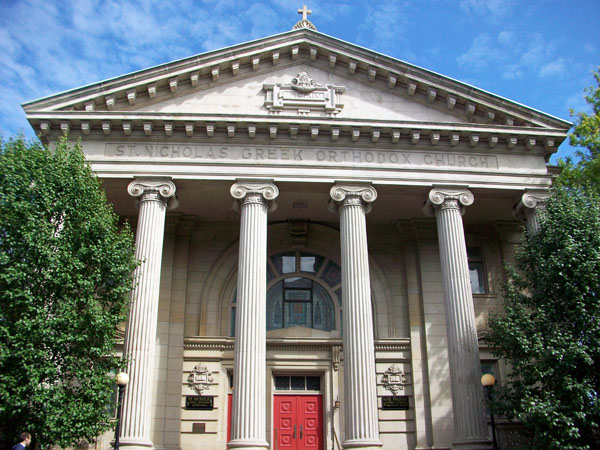
Saint Nicholas Greek Orthodox Cathedral located at 419 South Dithridge Street in the Oakland neighborhood of Pittsburgh, Pennsylvania, was designed by architect Thomas Hannah and built in 1904. The First Congregational Church built the structure and used it until 1921, but it has been a Greek Orthodox Church since 1923. Currently, it is part of the Greek Orthodox Archdiocese of America, and seat of the Greek Orthodox Metropolis of Pittsburgh. This Classical Revival style church building was added to the List of Pittsburgh History and Landmarks Foundation Historic Landmarks in 1982. Architecturally, the cathedral is described by Walter C. Kidney in his book Landmark Architecture: Pittsburgh and Allegheny County as: A Grecian Ionic portico, executed in sandstone, is the grand and appropriate introduction to a church that has belonged to the Greek Orthodox Church since 1923. The exterior, with its big round-arched windows, is not otherwise specifically symbolic, but the interior is rich with paintings and mosaics. Notable inside are the painting in the dome of Christ the Pantocrator , with is background of gold leaf, and the iconostasis of metal and mosaic, with peacocks finely depicted on the Royal Doors. Further art is to be found within the sanctuary, including a painting of the Mother and Child and a fresco of the Last Supper." Franklin Toker describes the structure in his book Pittsburgh: A New Portrait as follows: "Originally the First Congregational Church, until 1921, this is an unusually vigorous design in yellow industrial brick preceded by a dramatic Ionic portico. The interior of St. Nicholas should not be missed as an architectural paradigm of America itself: a cool Protestant interior heated up by a blazing iconostasis."

Cathedral of Learning

The Cathedral of Learning, a Pittsburgh landmark listed in the National Register of Historic Places, is the centerpiece of the University of Pittsburgh's main campus in the Oakland neighborhood of Pittsburgh, Pennsylvania, United States. Standing at 535 feet , the 42-story Late Gothic Revival Cathedral is the tallest educational building in the Western hemisphere and the second tallest university building (fourth tallest educationally-purposed building) in the world. It is also the second tallest gothic-styled building in the world. The Cathedral of Learning was commissioned in 1921 and ground was broken in 1926. The first class was held in the building in 1931 and its exterior finished in October 1934, prior to its formal dedication in June 1937. Colloquially referred to as "Cathy" by Pitt students, the Cathedral of Learning is a steel frame structure overlaid with Indiana limestone and contains more than 2,000 rooms and windows. It functions as a primary classroom and administrative center of the university, and is home to the Dietrich School of Arts and Sciences and many of its departments, as well as the University Honors College. It served as home of the university's College of General Studies until its relocation to Posvar Hall in 2014. It houses many specialty spaces, including a studio theater, food court, study lounges, offices, computer and language labs, 30 Nationality Rooms, and a 1⁄2-acre (2,000 m2), 4-story-high, vaulted, gothic study and event hall. The building contains noted examples of stained glass, stone, wood, and iron work and is often used by the university in photographs, postcards, and other advertisements.

Three Sisters

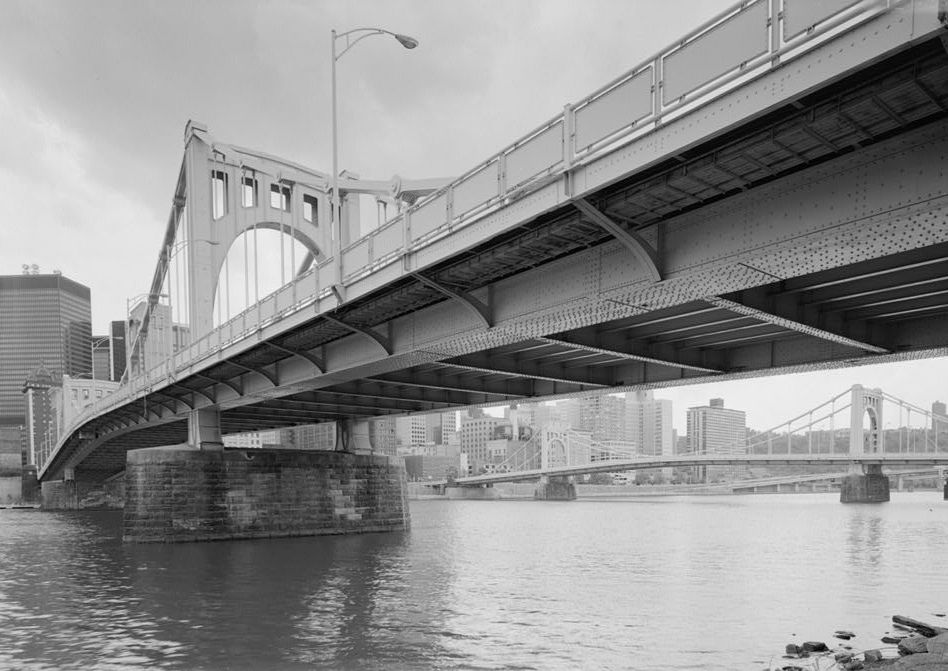
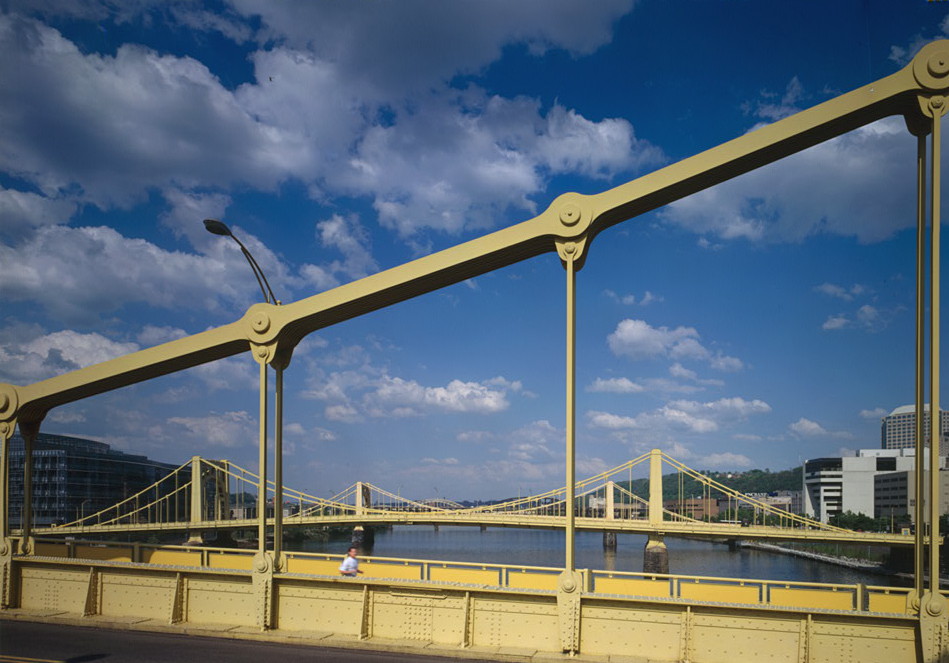
The Three Sisters are three very similar self-anchored suspension bridges spanning the Allegheny River in downtown Pittsburgh, Pennsylvania at 6th, 7th, and 9th streets, generally running north/south. The bridges have been given formal names to honor important Pittsburgh residents: Roberto Clemente Andy Warhol Rachel Carson Designed by the Allegheny County Department of Public Works, they were all built in a four-year period, from 1924 to 1928, by the American Bridge Company, replacing earlier bridges of various designs at the same sites. Their construction was mandated by the War Department, citing navigable river clearance concerns. They are constructed of steel, and use steel eyebars in lieu of cables. The Three Sisters are historically significant because they are the only trio of nearly identical bridges, as well as the first self-anchored suspension spans, built in the United States. They are among the only surviving examples of large eyebar chain suspension bridges in America, and furthermore, unusual for having been erected using cantilever methods. The bridges’ design was viewed as a creative response to the political, commercial, and aesthetic concerns of Pittsburgh in the 1920s. The bridges were designed under the auspices of the Allegheny Department of Public Works, by T. J. Wilkerson, consulting engineer; Vernon R. Covell, chief engineer; A. D. Nutter, design engineer; and Stanley L. Roush, architect. The American Bridge Company built the superstructure; while the Foundation Company built the substructure. All three bridges are owned by Allegheny County.

Soldiers and Sailors Memorial Hall and Museum

Soldiers and Sailors Memorial Hall and Museum is a National Register of Historic Places landmark in Pittsburgh, Pennsylvania, United States. It is the largest memorial in the United States dedicated solely to honoring all branches of military veterans and service personnel. It was conceived by the Grand Army of the Republic in the 1890s as a way for Pittsburgh and Allegheny County to honor the dwindling ranks of its American Civil War veterans. The Memorial today represents all branches of the service and honors both career and citizen soldiers who have served the United States throughout its history. Architect Henry Hornbostel designed the memorial in 1907. Dedicated in 1910, the building is in the Beaux-Arts style and is heroic in scale. It is located in the Oakland section of Pittsburgh at 4141 Fifth Avenue and adjacent to the University of Pittsburgh campus and its Cathedral of Learning. The building is set back from Fifth Avenue, featuring expansive and well-kept lawns dotted with large cannons and other war implements. Side streets flanking the building are Bigelow Boulevard and University Place; directly behind is OHara Street. The Memorial houses rare and one-of-a-kind exhibits that span the eras from the Civil War to the present day conflicts. Since 1963 it has operated the "Hall of Valor" to honor individual veterans from the region who went above and beyond the call of duty. Today the hall has over 600 honorees among them are Medal of Honor, The Kearny Cross, Distinguished Service Cross, Navy Cross, Air Force Cross, Silver Star and Distinguished Flying Cross winners. The building houses an auditorium seating 2,500, a banquet hall, and meeting rooms, in addition to its museum. The expansive lawn of the memorial sits on top of an underground parking garage operated under a long-term lease by the University of Pittsburgh. It has served as host for many city, civic, university, and business events including the April 25, 1978 Gulf Oil Corporation shareholders meeting.

This attraction is located in

This is a private property. Please enjoy respectfully and do not disturb the occupants.

Edit Categories
Add Tours

This attraction is not part of any tours

Add Collections

This attraction is not part of any collections


Some of the attractions we imported from Wikipedia are not perfect. Send us an email detailing what's wrong and we'll look into fixing it.

GuRoute is all about Gurus sharing their local knowledge. If you feel up to fixing this problem yourself, why not adopt it. You will become the owner and can fix whatever problems you see.

We've copied a link to this attraction into your clipboard so that ou can paste it into an email or text message...

More Info...
You can add your friends to the visit yourself, or, send them a link and let them add themselves...

The visit will appear on both your timelines and on your Shared Timeline.

Click below and we'll email you a link that you can send on to friends or post on your group's Facebook page.

If your friends aren't members of GuRoute yet, this is a great way to get them started.
Recent
Recently used Collections will appear here...
Recent
Recently used tours will appear here...

Where is this?

GuRoute likes to place attractions inside other attractions. So, maybe it's in a city, or maybe it's inside a particular park in that city. Maybe your attraction is a huge park that spans half the county, or multiple counties.

Determining where this attraction is gives it context - if it's in a park, you'll be able to see it alongside all the other attractions in that park. And that helps define the park.

GuRoute will automatically calculate a parent region for this attraction. You can change it if there is something more appropriate.

This attraction is currently located in .

Change

This attraction does not yet have any reviews

Please login to write a review...

Reviewed by
Record new Visit

Add this location to your timneline?

  • If there's an existing attraction open it and add it to your timeline...
  • If not, enter a title and we'll create a new attraction for your memories...
Create new Attraction

Create a new attraction at this location?

  • We rely on Gurus like you to share your local knowledge...
(Give a name for this location)


+
Add this to your timeline instead...

Imagine having a record of all the cool things you've done in your life!


Using our timeline you can keep track of everywhere you visit in your lifetime...

But, you'll need to sign in first...

Add contacts so that you can share your travels and record places that you visit together...

Family
Favorites
Family
Favorites

Profile TimeLine Our Visits Edit Accept Decline Invite

If you have any more friends that visited this place with you, feel free to add them to the visit. We'll write it to their timeline and once they confirm it, they too will have this memory for a lifetime.

If they're not already registered, you just need their name and email address and you can add them and we'll send them an invite on your behlaf.

Add a tour comment

Add some extra information for when this attraction is viewed as part of your tour...

Next Stop Instructions

Add some instructions for what to see/do on the way to the next stop...

Next Stop Instructions

Add some instructions for what to see/do on the way to the next stop...

If you're visiting an existing attraction, open it and add it to your timeline. If there is no attraction for the place you are visiting...

  • Click 'Add My Location' below
  • Or right-click on the map to mark a different location
  • Or long-press if you have a touch screen
You can even add locations while you're offline....
  • Load up the map when you're online and we'll keep track of your locaiton
  • You can add locations to your timeline
  • When you are online again we'll sync them with the cloud

We can't connect to the internet right now. The following attractions are saved locally and can be uploaded when you're online...

GuRoute would like to access your current location so that we can pin you on the map and show you nearby attractions

Add friends so that you can share your experiences with each other...

Add tour to What's Next?

Go...

Either for yourself or someone else...

  1. Do your trip research in GuRoute
    Add all the places that you think might be worthy of a visit into a trip-plan
  2. Add your trip-plan to your "What's Next" timeline
    (or a friend's "What's Next" timeline)
  3. When you're on vacation you'll have all your research at your fingertips
  4. Share your timline with your friends
    They can enjoy your vacation with you, seeing not only where you've been, but where you're going next...
  5. Add/remove attractions if things change

It also makes a great souvenir of your trip

Collections

Go...

Create a home page for a collection of attractions

  • Add an image and description to display on the homepage
  • Start adding content
    Add existing attractions to your collection or create new attractions of your own
  • Collections can be:
    • Public (Anyone can add attractions to your collection)
    • Shared (Only yourself and Gurus you nominate can add content)
    • Private (The collection will only be visible to yourself)

Uses

  • Local business or hotel
    Showcase local attractions that you endorse
  • Clubs
    Showcase attractions that members have created (eg. local historical society)
  • Special Interest
    If GuRoute does not have a category for your special interest you add your attractions to your own collection instead

Examples

Walking/Driving Tours

Go...

A guided tour where GuRoute will direct you from stop to stop and narrate a description of each attraction you arrive at

  • GuRoute uses your phone's GPS to guide you from stop to stop
  • GuRoute automatically detects when you arrive at the next tour-stop and narrates the description of the attraction (Chrome Only)
  • It then sends you on to the next stop

Tours are great to attract people to your town. Even places with no significant points of interest can be lots of fun when part of a tour


Cater tours to your Audience

  • Kid-friendly Tours
    • Focus on what will keep kids interested
    • Instead of parents having to drag their kids around they'll be struggling to keep up
    • Let the kids navigate and they'll get more fun out of finding that historical plaque than they ever would from reading it
  • Accessible tours
  • Short and long tours of the same location

What you need to do...

  1. Click 'Go...'
    Enter a title, description and location for the tour
  2. Add existing attractions OR create new ones and add them to the tour
  3. For existing attractions you can add more information specific to the theme of the tour
  4. You can also add instructions on what to do or see en-route to the next tour-stop
  5. Try out your tour and see how it works...

Mystery Tour

Go...

Create a Mystery Tour

Create a series of clues to show people around a city, neighborhood or whatever place you like...

  • GuRoute will show people clues to get them from attraction to attraction
  • When they reach each stop GuRoute will tell them about the place and give them the next clue
  • Take as long or as you like and explore each location at your leisure

Scavenger Hunt

Go...

Create a Scavenger Hunt

Create a series of questions that people have to answer. The answers can all be discovered by walking aroung the area, looking for clues.

  • How many beers are on tap at Michael Collin's Irish Bar?
  • What's the name of the oldest building on main streeet?
  • Show a picture of some public art and ask them what it is called
  • Clues can have numeric or multiple choice answers