Sign In

My Timeline

GuRoute

Discover Your World

Share your Experiences

Record your Life


Top Attractions in Somerset

Bath and North East Somerset

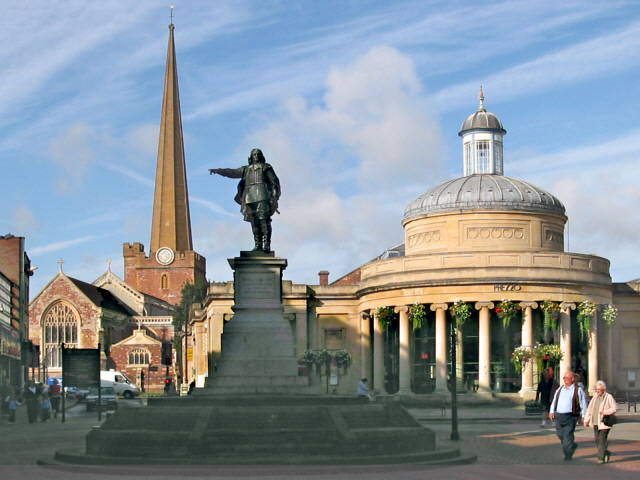
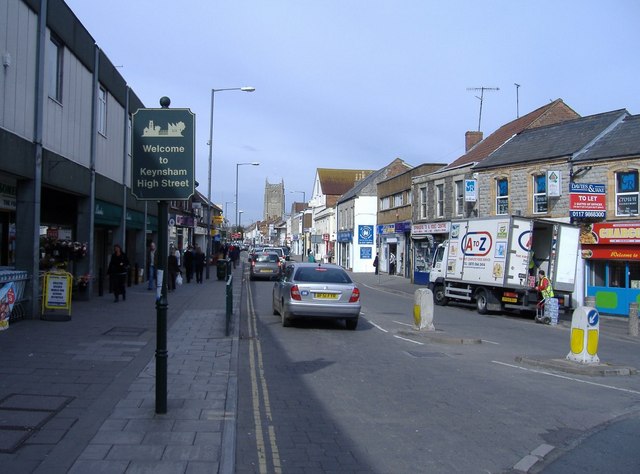
Bath and North East Somerset is the district of the unitary authority of Bath and North East Somerset Council that was created on 1 April 1996 following the abolition of the county of Avon. It is part of the ceremonial county of Somerset. The unitary authority provides a single tier of local government with responsibility for almost all local government functions within the district, including local planning and building control, local roads, council housing, environmental health, markets and fairs, refuse collection, recycling, cemeteries, crematoria, leisure services, parks, and tourism. It is also responsible for education, social services, libraries, main roads, public transport, trading standards, waste disposal and strategic planning, although fire, police and ambulance services are provided jointly with other authorities through the Avon Fire and Rescue Service, Avon and Somerset Constabulary and the Great Western Ambulance Service. Its administrative headquarters is in Bath. Bath and North East Somerset covers an area of 136 square miles, of which two thirds is green belt. It stretches from the outskirts of Bristol, south into the Mendip Hills and east to the southern Cotswold Hills and Wiltshire border. The city of Bath is the principal settlement in the district, but BANES also covers Keynsham, Midsomer Norton, Radstock, Westfield and the Chew Valley. The area has varied geography including river valleys and rolling hills. The history of human habitation is long but expanded massively during Roman times, and played significant roles in the Saxon era and English civil war. Industry developed from a largely agricultural basis to include coal mining with the coming of canals and railways. Bath developed as a spa resort in Georgian times and remains a major cultural tourism centre having gained World Heritage City status.

Bath

Bath is a city in the ceremonial county of Somerset, South West England, 97 miles west of London and 12 miles south-east of Bristol that is known for the curative Roman-built baths that still exist there. In 2011, its population was 88,859. It became part of Avon in 1974, and, following Avons abolition in 1996, has been the principal centre of Bath and North East Somerset. The city, in the valley of the River Avon, became a World Heritage Site in 1987. The city became a spa with the Latin name Aquae Sulis c. AD 60 when the Romans built baths and a temple in the valley of the River Avon although oral tradition suggests that the hot springs were known even before then. Bath Abbey was founded in the 7th century and became a religious centre; the building was rebuilt in the 12th and 16th centuries. In the 17th century, claims were made for the curative properties of the water from the springs, and Bath became popular as a spa town during the Georgian era, leaving a heritage of Georgian architecture crafted from Bath stone, including the Royal Crescent, Circus, Pump Room and Assembly Rooms where Beau Nash presided over the citys social life from 1705 until his death in 1761. Many of the streets and squares were laid out by John Wood, the Elder, and in the 18th century the city became fashionable and the population grew. Jane Austen lived in Bath in the early 19th century. Further building was undertaken in the 19th century and following the Bath Blitz in World War II. Manufacturing has been in decline in the city, but it has strong software, publishing and service-oriented industries. The citys theatres, museums, and other cultural and sporting venues have helped to make it a major centre for tourism with more than one million staying visitors and 3.8 million day visitors to the city each year. There are several museums including the Museum of Bath Architecture, Victoria Art Gallery, Museum of East Asian Art, and the Holburne Museum. The city has two universities: the University of Bath and Bath Spa University, with Bath College providing further education. Sporting clubs include Bath Rugby and Bath City F.C. while TeamBath is the umbrella name for all of the University of Bath sports teams.

Weston-super-Mare

Weston-super-Mare is a seaside resort, town and civil parish in Somerset, England. It is located on the Bristol Channel coast, 18 miles south west of Bristol, spanning the coast between the bounding high ground of Worlebury Hill and Bleadon Hill. It includes the suburbs of Oldmixon, West Wick and Worle. Its population according to the 2011 census was 76,143. Since 1983, Weston has been twinned with Hildesheim, Germany. Although there is evidence in the local area of occupation since the Iron Age, it was still a small village until the 19th century when it became a seaside resort, and was connected with local towns and cities by a railway, and two piers were built. The growth continued until the second half of the 20th century, when tourism declined and some local industries closed. During the 21st century a regeneration programme is being undertaken. Attractions include the Helicopter Museum, Weston-super-Mare Museum, a pier and an aquarium. The Paddle Steamer Waverley and MV Balmoral offer day sea trips from Knightstone Island to various destinations along the Bristol Channel and Severn Estuary. Cultural venues include The Playhouse, the Winter Gardens, The Blakehay Theatre Community Arts Centre, and Dismaland. Owing to the large tidal range in the Bristol Channel, the low tide mark in Weston Bay is about a mile from the seafront. Although the beach itself is sandy, low tide uncovers areas of thick mud, hence the colloquial name, Weston-super-Mud. These mudflats are very dangerous to walk in and are crossed by the mouth of the River Axe. Just to the north of the town is Sand Point which marks the lower limit of the Severn Estuary and the start of the Bristol Channel. It is also the site of the Middle Hope biological and geological Site of Special Scientific Interest . In the centre of the town is Ellenborough Park, another SSSI due to the range of plant species found there.

Yeovil

Yeovil is a town and civil parish in south Somerset, England with a population of 45,000. The town lies within the local district of South Somerset and the Yeovil parliamentary constituency, situated at the southern boundary of Somerset, 130 miles from London, 40 miles south of Bristol and 30 miles from Taunton. It has palaeolithic remains, was on an old Roman road and was recorded in the Domesday Book as the town of Givele or Ivle, and later became a centre for the glove-making industry. During the Middle Ages the population of the town suffered from the Black Death and several serious fires. In the 20th century it developed into a centre of the aircraft and defence industries, which made it a target for bombing in the Second World War, with one of the largest employers being Westland Aircraft. Additionally, the Fleet Air Arm has a station RNAS Yeovilton, the primary base of the Royal Navys Westland Lynx and Sea King helicopters, several miles north of the town and is a major local employer . Several other manufacturing and retail companies also have bases in the town. In the 21st century Yeovil became the first town in Britain to institute a system of biometric fingerprint scanning in nightclubs and the first English council to ban the childrens craze Heelys. Plans have been proposed for various regeneration projects in the town. Yeovil Country Park, which includes Ninesprings, is one of several open spaces in the town. There are a range of educational, cultural and sporting facilities. Religious sites include the 14th-century Church of St John the Baptist. It is on the A30 and A37 roads and has two railway stations on two separate railway lines. Yeovil Pen Mill is on the Bristol to Weymouth line served by First Great Western train operating company services, whilst Yeovil Junction is on the London Waterloo to Exeter line served by South West Trains. There is also a small railway museum.

Glastonbury

Glastonbury is a small town in Somerset, England, situated at a dry point on the low lying Somerset Levels, 23 miles south of Bristol. The town, which is in the Mendip district, had a population of 8,932 in the 2011 census. Glastonbury is less than 1 mile across the River Brue from Street, which is now larger than Glastonbury. Evidence from timber trackways such as the Sweet Track show that the town has been inhabited since Neolithic times. Glastonbury Lake Village was an Iron Age village, close to the old course of the River Brue and Sharpham Park approximately 2 miles west of Glastonbury, that dates back to the Bronze Age. Centwine was the first Saxon patron of Glastonbury Abbey, which dominated the town for the next 700 years. One of the most important abbeys in England, it was the site of Edmund Ironsides coronation as King of England in 1016. Many of the oldest surviving buildings in the town, including the Tribunal, George Hotel and Pilgrims Inn and the Somerset Rural Life Museum, which is based in an old tithe barn, are associated with the abbey. The Church of St John the Baptist dates from the 15th century. The town became a centre for commerce, which led to the construction of the market cross, Glastonbury Canal and the Glastonbury and Street railway station, the largest station on the original Somerset and Dorset Joint Railway. The Brue Valley Living Landscape is a conservation project managed by the Somerset Wildlife Trust and nearby is the Ham Wall National Nature Reserve. Glastonbury has been described as a New Age community which attracts people with New Age and Neopagan beliefs, and is notable for myths and legends often related to Glastonbury Tor, concerning Joseph of Arimathea, the Holy Grail and King Arthur. Joseph is said to have arrived in Glastonbury and stuck his staff into the ground, when it flowered miraculously into the Glastonbury Thorn. The presence of a landscape zodiac around the town has been suggested but no evidence has been discovered. The Glastonbury Festival, held in the nearby village of Pilton, takes its name from the town.

Dunster

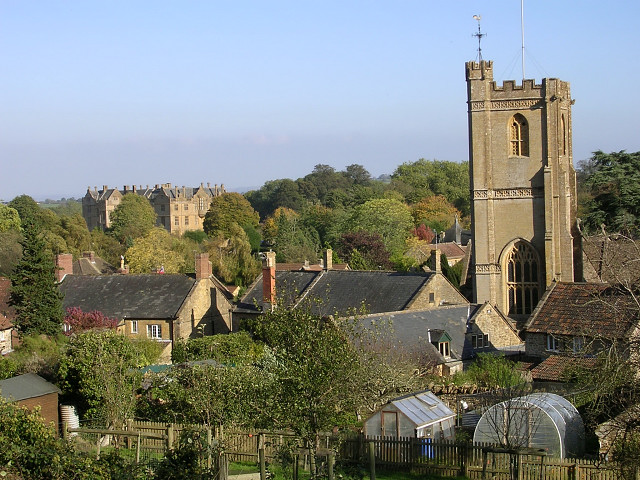
Dunster is a village, civil parish and former manor within the English county of Somerset, today just within the north-eastern boundary of the Exmoor National Park. It lies on the Bristol Channel coast 2.5 miles south-southeast of Minehead and 20 miles northwest of Taunton. The United Kingdom Census of 2011 recorded a parish population of 817. Iron Age hillforts testify to occupation of the area for thousands of years. The village grew up around Dunster Castle which was built on the Tor by the Norman warrior William I de Moyon shortly after the Norman Conquest of 1066. The Castle is mentioned in the Domesday Book of 1086. From that time it was the caput of the Feudal barony of Dunster. The Castle was remodelled on several occasions by the Luttrell family who were lords of the manor from the 14th to 20th centuries. The benedictine Dunster Priory was established in about 1100. The Priory Church of St George, dovecote and tithe barn are all relics from the Priory. The village became a centre for wool and cloth production and trade, of which the Yarn Market, built by George Luttrell , is a relic. There existed formerly a harbour, known as Dunster Haven, at the mouth of the River Avill, yet today the coast having receded is now about 0.5 miles from the village and no sign of the harbour can be seen on the low lying marshes between the village and the coast. Dunster has a range of heritage sites and cultural attractions which combine with the castle to make it a popular tourist destination with many visitors arriving on the West Somerset Railway, a heritage railway running from Minehad to Bishops Lydeard.

Clevedon

Clevedon is a town and civil parish in the unitary authority of North Somerset, which covers part of the ceremonial county of Somerset, England. The town has a population of 21,281 according to the United Kingdom Census 2011. The town is situated amongst a group of small hills including Church Hill, Wains Hill, Dial Hill, Strawberry Hill, Castle Hill, Hangstone Hill and Court Hill which is a Site of Special Scientific Interest along the Severn estuary. Clevedon was mentioned in the Domesday Book but grew in the Victorian era when it became a popular seaside resort. It was served by a short branch line from the main railway at Yatton, between 1847 and 1966. The Weston, Clevedon and Portishead Light Railway, which opened in 1897 and closed in 1940 also served the town, The seafront has ornamental gardens, a Victorian bandstand, and other visitor attractions. Salthouse Field has a light railway running round the perimeter and is used for donkey rides during the summer. The shore is a mixture of pebbled beaches and low rocky cliffs, with the old harbour at the western edge of the town at the mouth of the Land Yeo. The rocky beach has been designated as the Clevedon Shore geological Site of Special Scientific Interest. Clevedon Pier, opened in 1869, is one of the earliest surviving examples of a Victorian pier the United Kingdom. On October 17, 1970, two outward spans collapsed when the seventh set of legs from the shore failed during a routine insurance load test. After protracted considerations a trust was formed and the pier and its terminal buildings were restored and reopened on May 27, 1989, when the Waverley paddle steamer berthed and took on passengers. Other landmarks include Walton Castle, Clevedon Court the Clock Tower and the Curzon Cinema. Clevedons light industry is centred mainly in industrial estates including Hither Green Trading Estate near the M5 motorway junction. It is a dormitory town for Bristol. The town is home to educational, religious and cultural buildings and sporting clubs.

Wells

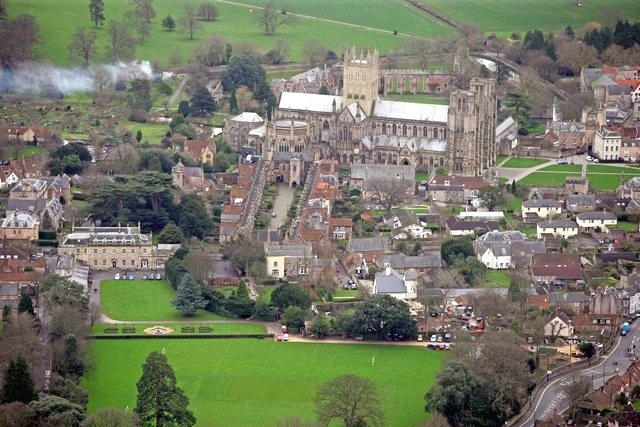
Wells is a cathedral city and civil parish in the Mendip district of Somerset, on the southern edge of the Mendip Hills. Although the population recorded in the 2011 census was only 10,536, it has had city status since medieval times, because of the presence of Wells Cathedral. Often described as Englands smallest city, it is second only to the City of London in area and population, though not part of a larger urban agglomeration. The name Wells comes from three wells dedicated to Saint Andrew, one in the market place and two within the grounds of the Bishops Palace and cathedral. A small Roman settlement surrounded them, which grew in importance and size under the Anglo-Saxons when King Ine of Wessex founded a minster church there in 704. The community became a trading centre based on cloth making and Wells is notable for its 17th century involvement in both the English Civil War and Monmouth Rebellion. In the 19th century, transport infrastructure improved with stations on three different railway lines. However, since 1964 the city has been without a railway link. The cathedral and the associated religious and architectural history have made Wells a tourist destination, which provides much of the employment. The city has a variety of sporting and cultural activities and houses several schools including The Blue School, a state coeducational comprehensive school originally founded in 1641 and the independent Wells Cathedral School, which was founded possibly as early as 909 and is one of the five established musical schools for school-age children in the United Kingdom. The historic architecture of the city has also been used as a location for several films and television programmes.

Chard

Chard is a town and a civil parish in the English county of Somerset. It lies on the A30 road near the Devon border, 15 miles south west of Yeovil. The parish has a population of approximately 13,000 and, at an elevation of 121 metres, it is the southernmost and highest town in Somerset. Administratively Chard forms part of the district of South Somerset. The name of the town was Cerden in 1065 and Cerdre in the Domesday Book of 1086. Before the Norman Conquest, Chard was held by the Bishop of Wells. The towns first charter was from King John in 1234. Most of the town was destroyed by fire in 1577, and it was further damaged during the English Civil War. A 1663 will by Richard Harvey of Exeter established Almshouses known as Harveys Hospital. In 1685 Chard was one of the towns in which Judge Jeffreys held some of the Bloody Assizes after the failure of the Monmouth Rebellion. Textile manufacture was important to the town during the Middle Ages. Chard is the birthplace of powered flight as in 1848 John Stringfellow first demonstrated that engine-powered flight was possible. Percy and Ernist Petter who formed Westland Aircraft Works bared witness to some of Stringfellows demonstrations in Chard and often asked for help in the formation of Westlands first aircraft development factory on the outskirts of Yeovil. AgustaWestland now holds the Henson and Stringfellow lecture yearly for the RAeS. James Gillingham developed articulated artificial limbs. Chard is a key point on the Taunton Stop Line, a World War II defensive line. The Chard Canal was a tub boat canal built between 1835 and 1842. Chard Branch Line was created in 1860 to connect the two London and South Western Railway and Bristol and Exeter Railway main lines and ran through Chard until 1965. Local folklore relates that the town has a very unusual and unique feature, a stream running along either side of Fore Street, one stream eventually flows into the Bristol Channel and the other eventually reaches the English Channel. Chard Reservoir, approximately a mile north east of the town, is a Local Nature Reserve, and Snowdon Hill Quarry a geological Site of Special Scientific Interest. Major employers in the town include Numatic International Limited and the Oscar Mayer food processing plant.There are a range of sporting and cultural facilities, with secondary education being provided at Holyrood Academy; religious sites including the Church of St Mary the Virgin which dates from the late 11th century.

This attraction is located in

This is a private property. Please enjoy respectfully and do not disturb the occupants.

Edit Categories
Add Tours

This attraction is not part of any tours

Add Collections

This attraction is not part of any collections


Some of the attractions we imported from Wikipedia are not perfect. Send us an email detailing what's wrong and we'll look into fixing it.

GuRoute is all about Gurus sharing their local knowledge. If you feel up to fixing this problem yourself, why not adopt it. You will become the owner and can fix whatever problems you see.

We've copied a link to this attraction into your clipboard so that ou can paste it into an email or text message...

More Info...
You can add your friends to the visit yourself, or, send them a link and let them add themselves...

The visit will appear on both your timelines and on your Shared Timeline.

Click below and we'll email you a link that you can send on to friends or post on your group's Facebook page.

If your friends aren't members of GuRoute yet, this is a great way to get them started.
Recent
Recently used Collections will appear here...
Recent
Recently used tours will appear here...

Where is this?

GuRoute likes to place attractions inside other attractions. So, maybe it's in a city, or maybe it's inside a particular park in that city. Maybe your attraction is a huge park that spans half the county, or multiple counties.

Determining where this attraction is gives it context - if it's in a park, you'll be able to see it alongside all the other attractions in that park. And that helps define the park.

GuRoute will automatically calculate a parent region for this attraction. You can change it if there is something more appropriate.

This attraction is currently located in .

Change

This attraction does not yet have any reviews

Please login to write a review...

Reviewed by
Record new Visit

Add this location to your timneline?

  • If there's an existing attraction open it and add it to your timeline...
  • If not, enter a title and we'll create a new attraction for your memories...
Create new Attraction

Create a new attraction at this location?

  • We rely on Gurus like you to share your local knowledge...
(Give a name for this location)


+
Add this to your timeline instead...

Imagine having a record of all the cool things you've done in your life!


Using our timeline you can keep track of everywhere you visit in your lifetime...

But, you'll need to sign in first...

Add contacts so that you can share your travels and record places that you visit together...

Family
Favorites
Family
Favorites

Profile TimeLine Our Visits Edit Accept Decline Invite

If you have any more friends that visited this place with you, feel free to add them to the visit. We'll write it to their timeline and once they confirm it, they too will have this memory for a lifetime.

If they're not already registered, you just need their name and email address and you can add them and we'll send them an invite on your behlaf.

Add a tour comment

Add some extra information for when this attraction is viewed as part of your tour...

Next Stop Instructions

Add some instructions for what to see/do on the way to the next stop...

Next Stop Instructions

Add some instructions for what to see/do on the way to the next stop...

If you're visiting an existing attraction, open it and add it to your timeline. If there is no attraction for the place you are visiting...

  • Click 'Add My Location' below
  • Or right-click on the map to mark a different location
  • Or long-press if you have a touch screen
You can even add locations while you're offline....
  • Load up the map when you're online and we'll keep track of your locaiton
  • You can add locations to your timeline
  • When you are online again we'll sync them with the cloud

We can't connect to the internet right now. The following attractions are saved locally and can be uploaded when you're online...

GuRoute would like to access your current location so that we can pin you on the map and show you nearby attractions

Add friends so that you can share your experiences with each other...

Add tour to What's Next?

Go...

Either for yourself or someone else...

  1. Do your trip research in GuRoute
    Add all the places that you think might be worthy of a visit into a trip-plan
  2. Add your trip-plan to your "What's Next" timeline
    (or a friend's "What's Next" timeline)
  3. When you're on vacation you'll have all your research at your fingertips
  4. Share your timline with your friends
    They can enjoy your vacation with you, seeing not only where you've been, but where you're going next...
  5. Add/remove attractions if things change

It also makes a great souvenir of your trip

Collections

Go...

Create a home page for a collection of attractions

  • Add an image and description to display on the homepage
  • Start adding content
    Add existing attractions to your collection or create new attractions of your own
  • Collections can be:
    • Public (Anyone can add attractions to your collection)
    • Shared (Only yourself and Gurus you nominate can add content)
    • Private (The collection will only be visible to yourself)

Uses

  • Local business or hotel
    Showcase local attractions that you endorse
  • Clubs
    Showcase attractions that members have created (eg. local historical society)
  • Special Interest
    If GuRoute does not have a category for your special interest you add your attractions to your own collection instead

Examples

Walking/Driving Tours

Go...

A guided tour where GuRoute will direct you from stop to stop and narrate a description of each attraction you arrive at

  • GuRoute uses your phone's GPS to guide you from stop to stop
  • GuRoute automatically detects when you arrive at the next tour-stop and narrates the description of the attraction (Chrome Only)
  • It then sends you on to the next stop

Tours are great to attract people to your town. Even places with no significant points of interest can be lots of fun when part of a tour


Cater tours to your Audience

  • Kid-friendly Tours
    • Focus on what will keep kids interested
    • Instead of parents having to drag their kids around they'll be struggling to keep up
    • Let the kids navigate and they'll get more fun out of finding that historical plaque than they ever would from reading it
  • Accessible tours
  • Short and long tours of the same location

What you need to do...

  1. Click 'Go...'
    Enter a title, description and location for the tour
  2. Add existing attractions OR create new ones and add them to the tour
  3. For existing attractions you can add more information specific to the theme of the tour
  4. You can also add instructions on what to do or see en-route to the next tour-stop
  5. Try out your tour and see how it works...

Mystery Tour

Go...

Create a Mystery Tour

Create a series of clues to show people around a city, neighborhood or whatever place you like...

  • GuRoute will show people clues to get them from attraction to attraction
  • When they reach each stop GuRoute will tell them about the place and give them the next clue
  • Take as long or as you like and explore each location at your leisure

Scavenger Hunt

Go...

Create a Scavenger Hunt

Create a series of questions that people have to answer. The answers can all be discovered by walking aroung the area, looking for clues.

  • How many beers are on tap at Michael Collin's Irish Bar?
  • What's the name of the oldest building on main streeet?
  • Show a picture of some public art and ask them what it is called
  • Clues can have numeric or multiple choice answers