Sign In

My Timeline

GuRoute

Discover Your World

Share your Experiences

Record your Life


Top Attractions in North Saint Paul

Omaha Road Bridge Number 15

Omaha Road Bridge Number 15 is a swing bridge that spans the Mississippi River in St. Paul, Minnesota, United States. It was built in 1915 by the Chicago, St. Paul, Minneapolis and Omaha Railway, though it, and the line from St. Paul to Mendota, was jointly owned with the Chicago, Milwaukee and St. Paul Railway. The bridge was designed by I.F. Stern of Chicago. It is unusually shaped, because the swing span is asymmetrical. According to local legend, the original bridge design had equal length spans on either side of the center pivot. Once the bridge was completed, the owner of the property on the south side of the river did not want the swing span crossing his land. In response, the owner removed most of the south end of the swing span and added a concrete counterweight to compensate for the lost material. Legends aside, the reason for the "bobtail" configuration of the bridge is that the section of the river deep enough for navigation at that point is not wide enough to accommodate a full-sized swing bridge. The counterweight is necessary to keep both ends of the bridge in balance over the center pier, which is near the right descending bank. While the legend may be an appealing one, it cannot withstand the fact that no qualified bridge engineer would lavish the material and effort required to build a swing span over land. The bridge forces barge traffic heading up river to cross over to their respective port shore of the river, while those heading downstream are able to maintain their normal traffic pattern. An earlier bridge in this location, built in 1869, was a wooden Howe truss design. This was one of the original 15 bridges spanning the Mississippi River. The first bridge was an 8-span drawbridge, but much of the superstructure had to be replaced in 1877 because of decay in the original pine chords.

Pike Island

Pike Island, Dakota name Wita Tanka, is an island at the confluence of the Mississippi and Minnesota Rivers in the southwestern part of St. Paul in the Twin Cities metropolitan area of Minnesota, USA. The island is now part of Fort Snelling State Park. It is a portion of the 100,000 acres of land purchased from the Mdewakanton Sioux Indians by Zebulon Pike in September 1805. Pike's Purchase was later to become Fort Snelling, Minneapolis, and St. Paul. The U.S. government wanted to build a fort to protect American interests in the fur trade in the region, and Pike negotiated the treaty. Pike valued the land at $200,000, but the U.S. Senate later agreed to pay only $2000. In 1819 Colonel Henry Leavenworth invited Jean-Baptiste Faribault, a French Canadian, and his family to settle on Pike Island near the new fort to help promote the fur trade. An 1821 treaty gave ownership of Pike Island to Elizabeth Pelagie Ferribault, a Dakota Indian, and wife of Jean-Baptiste Faribault. The six-week Dakota War of 1862 resulted in the deaths of hundreds of settlers and Indians. After the conflict more than 400 Dakotas were tried, and 302 men condemned to be executed at Mankato, Minnesota. President Lincoln eventually commuted the sentences of all but 38 Dakota, who were hanged in a mass execution on December 26, 1862. During this time more than 1600 Dakota women, children, and old men were held in an internment camp on Pike Island under the cannons of Fort Snelling. Winter living conditions were harsh, with little food and no shelter, and cholera struck the camp, killing more than three hundred. In May 1863, the survivors were forced aboard steamboats and relocated to Crow Creek in the southeastern Dakota Territory, a place stricken by drought at the time. The survivors of Crow Creek were moved three years later to the Santee Sioux Reservation in Nebraska.

Minnesota Governor's Residence

The Minnesota Governors Residence serves as the official home of the governor of Minnesota. The house, located at 1006 Summit Avenue in Saint Paul, is on 1.5 acres of land. The building is slightly more than 16,000 square feet in size. The house was designed by Minneapolis architect William Channing Whitney for Saint Paul lumber businessman Horace Hills Irvine and his family. The 20 room English Tudor house has nine bedrooms, eight bathrooms, and nine fireplaces. The Irvine family lived in the home from 1912 until 1965, when the Irvines youngest daughters, Clotilde Irvine Moles and Olivia Irvine Dodge, donated it to the people of Minnesota to serve as the official residence of the First Family. The Minnesota Legislature in 1965 passed a law accepting the donation and designating the house as the State Ceremonial Building for official public use for state ceremonial functions and as a governors residence. The law placed the house and its management under the jurisdiction of the Minnesota Department of Administration. From 1965 until 1980, governors were permitted to propose changes to the house. The Legislature provided renovation funds and the Department of Administration supervised the improvements. From 1965 to 1967, a committee assisted with furnishing the house, but the governor retained the authority to make changes. In 1974, the house was listed on the National Register of Historic Places. With this designation, any renovation to the exterior of the residence must be reviewed and approved by the State Historic Preservation Office of the Minnesota Historical Society. It is also a contributing property to the Historic Hill District. A giant Christmas tree, most often transported from Pine City, adorns the front lawn each holiday season.

Alexander Ramsey House

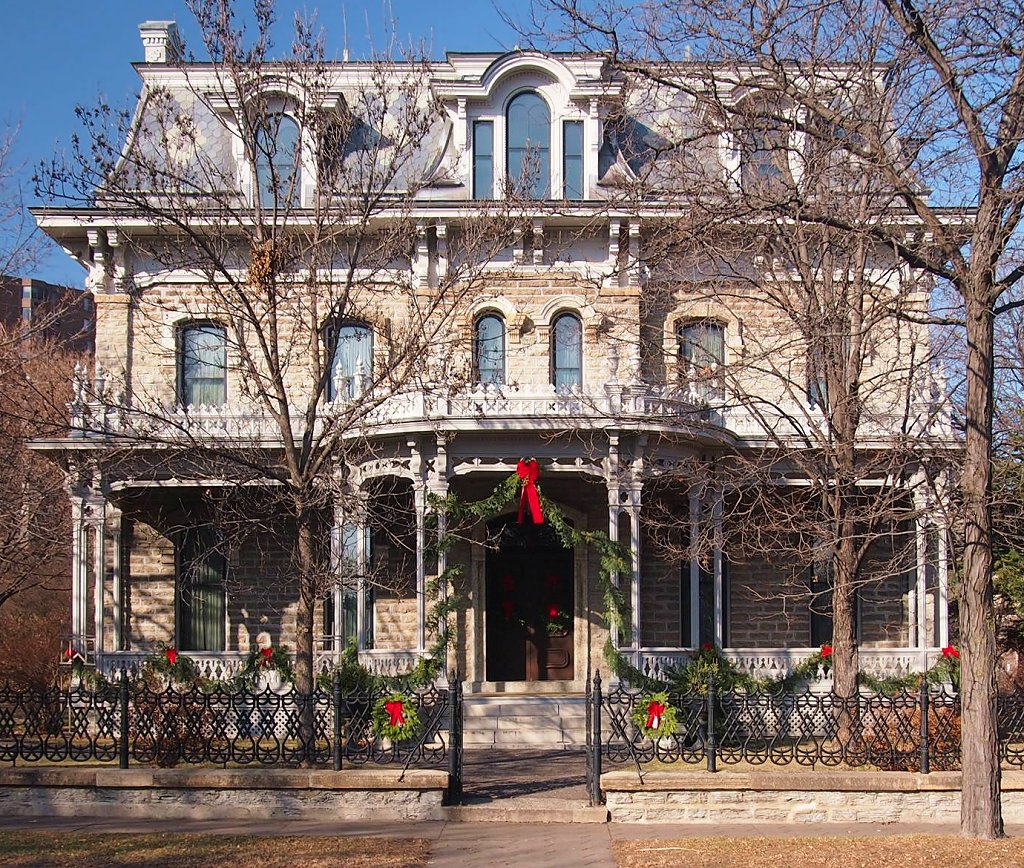
The Alexander Ramsey House is a historic house museum in Saint Paul, Minnesota, United States; the former residence of Alexander Ramsey, who served as the first governor of Minnesota Territory and the second governor of the state of Minnesota. It was listed on the National Register of Historic Places in 1969. It is also a contributing property to the Irvine Park Historic District. It is located at 265 Exchange St. S.in the Irvine Park area, which was one of the first trendy neighborhoods in Minnesota. Designed by noted early Minnesota architect Monroe Sheire, the house is one of the nations best-preserved Victorian homes, featuring carved walnut woodwork, marble fireplaces, crystal chandeliers and many original furnishings. The Ramsey family began building the house in 1868, including innovations like hot water radiators, gas lights and hot and cold running water, and when it was completed in 1872, the total cost of construction was nearly $41,000. To furnish the house, Ramseys wife Anna filled two boxcars with fashionable and expensive Renaissance-revival furniture from the A. T. Stewart Company Store in New York to bring home to Minnesota. The 15-room house remained in the Ramsey family until the death of Alexander Ramseys last surviving granddaughter Anita in 1964. It is now operated by the Minnesota Historical Society as a museum, with tours offered year-round. They offer special programs such as "Christmas at the Alexander Ramsey House" in which the house is decorated for the holidays and a costumed guide reenacts the role of their cook, Annie Robertson. Tours show the dining table set with the familys china and crystal, with a Christmas tree decorated with the familys own ornaments.

Summit Brewing Company

Summit Brewing Company is a regional craft brewery in Saint Paul, Minnesota, United States, that brews a wide selection of popular beers. It is sometimes mistakenly believed to be a microbrewery, even though Summits output is in the top 50 of breweries in the United States, approximately 240,000 barrels of beer per year. Their flagship beer, an English Pale Ale is especially popular in the Twin Cities area. The brewery was founded in 1986 by local brewer Mark Stutrud and a group of his friends in an old auto parts warehouse on St. Pauls University Avenue. Their beers quickly became local favorites, and the company began to grow rapidly. In 1987, the Great Northern Porter won a gold medal at the Great American Beer Festival and was featured on the cover of Michael Jacksons New World Guide to Beer . By 1998 the companys beer production had exceeded the capacity of the original University Avenue brewery, and a new brewery designed by architect Peter OBrien, was built on the west end of St. Paul, overlooking the Mississippi River. Having outgrown it, Summit sold its 1938-vintage brewing equipment to Mt. Shasta Brewing Company in Northern California. They then purchased a set of brewing equipment built in 1971 from the Hürnerbräu Brewery in Ansbach Germany. In 2009 Summit launched the Unchained Series. The brewery asks their brewers to brew any beer of their choice which they then bottle, keg and sell. Styles have included Kölsch, Belgian Golden Ale, Black Ale, Gold Sovereign Ale, Honeymoon Saison, Imperial Pumpkin Porter, Dunkle Weizen India Rye Ale. Unchained Batch 14, a Bière de Garde, was released in October 2013 As of 2007, Summit beers were available from distributors in 18 U.S. states . The brewery currently brews six year-round styles, a variety of seasonal, and a limited release beers. As of 2010, it was the second-largest brewery in Minnesota, after August Schell Brewing Company.

Landmark Center

St. Paul’s historic Landmark Center, completed in 1902, originally served as the United States Post Office, Courthouse, and Custom House for the state of Minnesota. It was designed by Willoughby J. Edbrooke, who served as Supervising Architect of the U.S. Treasury Department in 1891–92. Edbrooke designed a body of public architecture, much of which, like this structure, was completed after his 1896 death. Landmark Center stands at 75 West Fifth Street in Rice Park and is now an arts and culture center. The exterior is pink granite ashlar with a hipped red tile roof, steeply pitched to shed snow and adorned by numerous turrets, gables and dormers with steeply peaked roofs; cylindrical corner towers with conical turrets occupy almost every change of projection. There are two massive towers, one of which houses a clock. The exterior is almost devoid of carved detail. The interior features a five-story courtyard with skylight and rooms with 20-foot ceilings, appointed with marble and carved mahogany and oak finishes. Its Romanesque Revival architecture is similar to Edbrookes Old Post Office Building in Washington D.C. John Dillingers girlfriend Evelyn Frechette, Alvin "Creepy" Karpis, "Doc" Barker and other members of the Barker-Karpis gang were tried in the building when it served as a federal courthouse. Judges Walter Henry Sanborn and John B. Sanborn, Jr. kept their chambers here while serving on the Eighth Circuit Court of Appeals. U.S. Supreme Court Justice Harry Blackmun worked in the building as a law clerk to the younger Sanborn in 1932–33. In the 1970s, a citizens group saved the building from demolition and restored it to its previous grandeur. It was placed on the National Register of Historic Places and reopened to the public as Landmark Center in 1978. After its comprehensive 1972–78 renovation, the center became home to many prominent Twin Cities arts organizations, now including: American Association of Woodturners and the AAW Gallery of Wood Art Ramsey County Historical Society Gallery and Research Center – changing exhibits and research area for local history topics The Schubert Club Museum of musical instruments Landmark Gallery – permanent and temporary exhibits from its local history collection "Uncle Sam Worked Here" – a permanent interactive exhibit opened in 2007 about activities in Landmark Center over its history Exhibition space for music, dance, theater, and public forums. For a time the high school St. Paul Conservatory for Performing Artists also held classes on the fifth floor. It has since moved to 16 West 5th Street. The fifth floor now houses the offices of the American Composers Forum. Owned by Ramsey County, Landmark Center is managed by Minnesota Landmarks, a not-for-profit organization. Landmark Center also houses Anitas Cafe, Landmarket Gift Shop, and five galleries.

Robert Street Bridge

The Robert Street Bridge is a reinforced concrete multiple-arch bridge that spans the Mississippi River in downtown St. Paul, Minnesota. The bridge is notable for its complex design that was required to accommodate river traffic, the St. Paul Union Pacific Vertical-lift Rail Bridge crossing underneath it at an angle, and roadways on the downtown side of St. Paul. The bridge is also notable for a monumental reinforced concrete rainbow arch. The rainbow arch not only provides 62 feet of headroom above the river, but also provides a strong aesthetic focus. It was built in 1924-1926 by Fegles Construction Company, Ltd. and designed by Toltz, King Day. The bridge was added to the National Register of Historic Places in 1989. The bridge as well as Robert Street itself are named after Captain Louis Roberts, a notable French Canadian river boat captain, businessman and early settler of Saint Paul, MN. The bridge was commissioned in the early 1920s to replace a wrought-iron span, originally built in 1884-1885, that had become obsolete due to increasing traffic. The engineers who designed the bridge had several obstacles to work around. The tracks of the Chicago, St. Paul, Minneapolis and Omaha Railway, St. Paul Union Depot, and the Chicago Great Western Railway mainline were factors. The engineers also had to provide adequate clearance above the river, as defined by the United States War Department at the time. Finally, the bridge had to clear Second Street in downtown St. Paul and work through a busy manufacturing district at the south end. The location of nearly every pier was dictated by these requirements. As a result, the bridge was designed with a combination of barrel-arch and rib-arch flanking spans and a rainbow arch for the central span. One of the members of the crew building the bridge was Warren Burger, future Chief Justice of the United States.

Gangelhoff Center

Gangelhoff Center is a 3,200-seat multi-purpose arena on the campus of Concordia University in Saint Paul, Minnesota, United States. It opened in 1993. It is the home to Concordia University Golden Bears volleyball and basketball teams and was home to the Minnesota Ripknees during their one season in the American Basketball Association. The Gangelhoff Center is one of the busiest venues in the Twin Cities. The home court for the volleyball and basketball teams, Gangelhoff has 1,200 permanent seats but can expand its capacity to handle 4,000 fans for an event. One of those times was March 2001 when Concordia hosted the Slam Dunk/Three Point competition that was televised nationally by ESPN. A full house was on hand to see the best shooters and dunkers in college basketball partake in intense competition. In December 2008 the Gangelhoff Center hosted the 2008 NCAA Division II Womens Volleyball Championships. The Tournament featured eight teams including host and defending National Champion Concordia University Saint Paul. The tournament was won in dramatic fashion as the #1 Concordia University Golden Bears beat #2 Cal State San Bernardino 3–2. The Gangelhoff Center has served as the venue of several NCAA Regional tournaments and the semifinals and finals of the NSIC basketball and volleyball tournaments over the last three years, In addition to the college volleyball and basketball played here, the Gangelhoff has hosted high school basketball regular season and sectional games, the Minnesota State High School Badminton Tournament, concerts as well as school graduation ceremonies. Several of Concordias athletic teams practice here when the weather is inclement. In addition, intramural volleyball and basketball is also played here.

St. Catherine University

St. Catherine University is a private Catholic liberal arts university, located in St. Paul and Minneapolis, Minnesota, United States. Prior to attaining university status, the school was known as the College of St. Catherine. Known for years as "the Nations Largest College for Women," today St. Catherine offers baccalaureate programs for women plus graduate and associate programs for women and men. St. Catherine is the first Catholic college or university in the world to be granted a Phi Beta Kappa chapter, in October 1937. St. Kates graduates have earned advanced degrees at renowned institutions. This tradition dates back to the first president who regularly dispatched instructors for a term, a summer or an academic year to pursue graduate studies. St. Kate’s has produced Fulbright Scholars as well. St. Kate’s ranks 14th in the "Best Value Regional Universities " category of the U.S. News World Reports college rankings. The University retains its ranking 13th among Midwest Regional Universities — in the 2013 “American’s Best Colleges” guide by U.S. News World Report. St. Kate’s placed second among Minnesota institutions in its category. The University enrolls more than 5,000 students. It is a leader in recruiting and enrolling minority students and nontraditional-aged students. St. Catherines Weekend College — now Evening, Weekend, Online Program — was the second such program in the nation and the first in the Upper Midwest. St. Kate’s was also the first private college in the nation to launch an effort to attract, welcome and retain Hmong students — making it home to one of the largest populations of Hmong scholars in the nation.

This attraction is located in

This is a private property. Please enjoy respectfully and do not disturb the occupants.

Edit Categories
Add Tours

This attraction is not part of any tours

Add Collections

This attraction is not part of any collections


Some of the attractions we imported from Wikipedia are not perfect. Send us an email detailing what's wrong and we'll look into fixing it.

GuRoute is all about Gurus sharing their local knowledge. If you feel up to fixing this problem yourself, why not adopt it. You will become the owner and can fix whatever problems you see.

We've copied a link to this attraction into your clipboard so that ou can paste it into an email or text message...

More Info...
You can add your friends to the visit yourself, or, send them a link and let them add themselves...

The visit will appear on both your timelines and on your Shared Timeline.

Click below and we'll email you a link that you can send on to friends or post on your group's Facebook page.

If your friends aren't members of GuRoute yet, this is a great way to get them started.
Recent
Recently used Collections will appear here...
Recent
Recently used tours will appear here...

Where is this?

GuRoute likes to place attractions inside other attractions. So, maybe it's in a city, or maybe it's inside a particular park in that city. Maybe your attraction is a huge park that spans half the county, or multiple counties.

Determining where this attraction is gives it context - if it's in a park, you'll be able to see it alongside all the other attractions in that park. And that helps define the park.

GuRoute will automatically calculate a parent region for this attraction. You can change it if there is something more appropriate.

This attraction is currently located in .

Change

This attraction does not yet have any reviews

Please login to write a review...

Reviewed by
Record new Visit

Add this location to your timneline?

  • If there's an existing attraction open it and add it to your timeline...
  • If not, enter a title and we'll create a new attraction for your memories...
Create new Attraction

Create a new attraction at this location?

  • We rely on Gurus like you to share your local knowledge...
(Give a name for this location)


+
Add this to your timeline instead...

Imagine having a record of all the cool things you've done in your life!


Using our timeline you can keep track of everywhere you visit in your lifetime...

But, you'll need to sign in first...

Add contacts so that you can share your travels and record places that you visit together...

Family
Favorites
Family
Favorites

Profile TimeLine Our Visits Edit Accept Decline Invite

If you have any more friends that visited this place with you, feel free to add them to the visit. We'll write it to their timeline and once they confirm it, they too will have this memory for a lifetime.

If they're not already registered, you just need their name and email address and you can add them and we'll send them an invite on your behlaf.

Add a tour comment

Add some extra information for when this attraction is viewed as part of your tour...

Next Stop Instructions

Add some instructions for what to see/do on the way to the next stop...

Next Stop Instructions

Add some instructions for what to see/do on the way to the next stop...

If you're visiting an existing attraction, open it and add it to your timeline. If there is no attraction for the place you are visiting...

  • Click 'Add My Location' below
  • Or right-click on the map to mark a different location
  • Or long-press if you have a touch screen
You can even add locations while you're offline....
  • Load up the map when you're online and we'll keep track of your locaiton
  • You can add locations to your timeline
  • When you are online again we'll sync them with the cloud

We can't connect to the internet right now. The following attractions are saved locally and can be uploaded when you're online...

GuRoute would like to access your current location so that we can pin you on the map and show you nearby attractions

Add friends so that you can share your experiences with each other...

Add tour to What's Next?

Go...

Either for yourself or someone else...

  1. Do your trip research in GuRoute
    Add all the places that you think might be worthy of a visit into a trip-plan
  2. Add your trip-plan to your "What's Next" timeline
    (or a friend's "What's Next" timeline)
  3. When you're on vacation you'll have all your research at your fingertips
  4. Share your timline with your friends
    They can enjoy your vacation with you, seeing not only where you've been, but where you're going next...
  5. Add/remove attractions if things change

It also makes a great souvenir of your trip

Collections

Go...

Create a home page for a collection of attractions

  • Add an image and description to display on the homepage
  • Start adding content
    Add existing attractions to your collection or create new attractions of your own
  • Collections can be:
    • Public (Anyone can add attractions to your collection)
    • Shared (Only yourself and Gurus you nominate can add content)
    • Private (The collection will only be visible to yourself)

Uses

  • Local business or hotel
    Showcase local attractions that you endorse
  • Clubs
    Showcase attractions that members have created (eg. local historical society)
  • Special Interest
    If GuRoute does not have a category for your special interest you add your attractions to your own collection instead

Examples

Walking/Driving Tours

Go...

A guided tour where GuRoute will direct you from stop to stop and narrate a description of each attraction you arrive at

  • GuRoute uses your phone's GPS to guide you from stop to stop
  • GuRoute automatically detects when you arrive at the next tour-stop and narrates the description of the attraction (Chrome Only)
  • It then sends you on to the next stop

Tours are great to attract people to your town. Even places with no significant points of interest can be lots of fun when part of a tour


Cater tours to your Audience

  • Kid-friendly Tours
    • Focus on what will keep kids interested
    • Instead of parents having to drag their kids around they'll be struggling to keep up
    • Let the kids navigate and they'll get more fun out of finding that historical plaque than they ever would from reading it
  • Accessible tours
  • Short and long tours of the same location

What you need to do...

  1. Click 'Go...'
    Enter a title, description and location for the tour
  2. Add existing attractions OR create new ones and add them to the tour
  3. For existing attractions you can add more information specific to the theme of the tour
  4. You can also add instructions on what to do or see en-route to the next tour-stop
  5. Try out your tour and see how it works...

Mystery Tour

Go...

Create a Mystery Tour

Create a series of clues to show people around a city, neighborhood or whatever place you like...

  • GuRoute will show people clues to get them from attraction to attraction
  • When they reach each stop GuRoute will tell them about the place and give them the next clue
  • Take as long or as you like and explore each location at your leisure

Scavenger Hunt

Go...

Create a Scavenger Hunt

Create a series of questions that people have to answer. The answers can all be discovered by walking aroung the area, looking for clues.

  • How many beers are on tap at Michael Collin's Irish Bar?
  • What's the name of the oldest building on main streeet?
  • Show a picture of some public art and ask them what it is called
  • Clues can have numeric or multiple choice answers