Sign In

My Timeline

GuRoute

Discover Your World

Share your Experiences

Record your Life


Top Attractions in Skagway County

Margerie Glacier

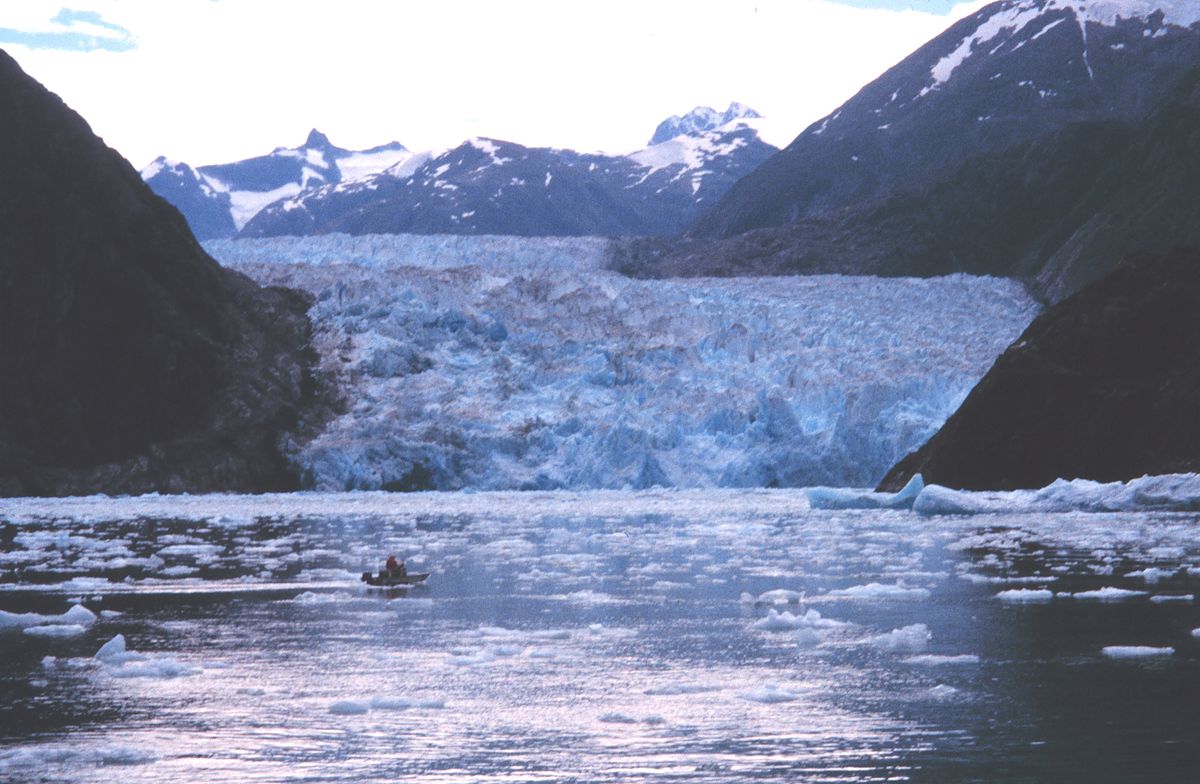
Margerie Glacier is a 21-mile-long tide water glacier in Glacier Bay in Alaska and is part of the Glacier Bay National Park and Preserve. It begins on the south slope of Mount Root, at the Alaska-Canada border in the Fairweather Range, and flows southeast and northeast to Tarr Inlet. It was named for the famed French geographer and geologist Emmanuel de Margerie, who visited the Glacier Bay in 1913. It is an integral part of the Glacier Bay, which was declared a National Monument on February 26, 1925, a National Park and Wild Life Preserve on December 2, 1980, a UNESCO declared World Biosphere Reserve in 1986 and a World Heritage Site in 1992. While most of the tidewater and terrestrial glaciers in the Park are stated to be thinning and receding over the last several decades, Margerie Glacier is said to be stable and Johns Hopkins Glacier is stated to be advancing, on the eastern face of the Fairweather Range. Located at the end of the Glacier Bay, Margerie Glacier extends over a width of about 1 mile and extends upstream for a length of 21 miles to its source on the southern slopes of the hill of Mount Root, at the Alaska-Canada border. Mount Root ), named Boundary Peak 165, is a mountain in Alaska and British Columbia, is part of the Fairweather Range of the Saint Elias Mountains. It is named after Elihu Root, who was among the diplomats involved in settling the Alaska boundary dispute between the United States and Canada. The Margerie Glacier starts from this range of mountains from Mount Root. Margerie Glacier at Mile 63 is perpendicular to the Grand Pacific Glacier at Mile 64 ). It flows in southeast and northeast direction to Tarr Inlet, one mile north of the terminus of Grand Pacific Glacier and 87 miles northwest of Hoonah. Glacier Bay provides excellent glacier experiences of both receding and advancing glaciers existing side by side. Tarr Inlet forms the northwestern part of the Glacier Bay named in 1912 for professor of geology Dr Ralph Tarr. The Glacier Bay region, which in 1750 was a mass of ice of a single glacier, has undergone a dynamic change and is now a 65-mile long fjord. Glacier Bay and the Margerie Glacier are approachable only by air and water. The steep dropoff of the Margerie Glacier cliff facilitates large cruise ships to park close to the glacier from where one gets incredible views of the glacier. In a study of the bed rock geology and mineral resources of the Glacial Bay, out of 17 areas classified as containing mineral deposits, Margerie Glacier has been identified as containing copper deposits.

Skagway Historic District and White Pass

The Skagway Historic District and White Pass is a National Historic Landmark District encompassing a significant portion of the area within the United States associated with the Klondike Gold Rush. It includes the historic portion of Skagway, Alaska, including the entire road grid of the 1897 town, as well as the entire valley on the United States side of White Pass all the way to the Canadian border. This area includes surviving fragments of three historic routes used during the Gold Rush, as well as the route of the White Pass and Yukon Railroad. Almost 100 buildings remain from the Gold Rush period. Portions of the district are preserved as part of Klondike Gold Rush National Historical Park. The Skagway portion of the district includes the historic heart of the town, a region 23 block long and varying in width from three to five blocks. Fourteen of these blocks were under National Park Service protection in 1999. Buildings in the district are generally wood frame structures with one or two stories, which have been brightly painted. Commercial buildings often have false fronts, commercial window displays, and recessed entries, and are sited directly against the sidewalk, while residences are set back. The district includes more than 350 buildings in Skagway, and only eight structures outside the city. The valley that rises steeply above Skagway was one of the main routes to the gold fields of the Yukon River. (The other, the Chilkoot Trail, is located west of Skagway, and is part of the National Historic Landmark Chilkoot Trail and Dyea Site historic district.) Two overland routes, the 1897 trail and the Brackett Wagon Road, worked their way up White Pass, as did a water-based route along the Skagway River, and the White Pass and Yukon Railroad, completed in 1900. Part of the valley now also carries the Klondike Highway. There are numerous areas along these historic routes (some of which have not been identified with precision, and may have followed variable routes during the rush) where camp sites and other remnants of the rush are to be found.

Pleasant Island

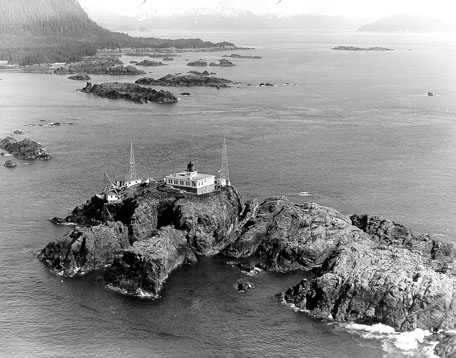
Pleasant Island is the largest island in the Icy Strait between northern Chichagof Island and the mainland of the Alaska Panhandle. It lies southeast of the mainland city of Gustavus and southwest of the mainland community of Excursion Inlet. Pleasant Island has a land area of 49.192 km², had no population at the 2000 census, and is reported to be uninhabited as of 2012. Location: The 23,151-acre PleasantInian Islands Wilderness is located in Icy Strait between Chichagof Island and the mainland on the north end of the Tongass National Forest. The Wilderness is made up of three large islands and a few small islands adjacent to them. Access: The wilderness is accessible by boat, kayak or float plane. Area Description: This grouping of relatively small islands is unique in that the three largest islands are very different in topography, use and character. Pleasant Island is fairly flat and has a mixture of old-growth forest and muskeg. The island has a couple of small lakes that can be hiked to from the shoreline. The island has many beaches friendly to small boats or kayaks and several areas that are used for camping. Pleasant Island is located just a couple of miles from Gustavus, Alaska, and Glacier Bay National Park. Many people kayaking to and from the park stop at Pleasant Island for lunch or a campover. Lemesurier Island, to the west of Pleasant, appears different because it rises out of Icy Strait to 2,180 feet above sea level. The top of the island is not forested like the rest, but is in the sub-alpine. There is one small lake on the south side of the island which can be hiked to from shoreline. There are half a dozen nice beaches around the south and north sides of the island where small boats or kayaks can approach and these coves are also good for camping. There are two small private parcels of land on the south side of this island. The lnian Islands are even further west and are nearest the Pacific Ocean. They receive the high energy seas on the west side, characteristic of the outer coast. This grouping of half a dozen small islands offers refuge to boats from the swells, winds, and tides between the open ocean and Icy Strait. Caution should be used in traveling through the narrow openings between islands. The notorious laundry chute is an appropriate name as your boat can be swiftly drawn through this pass at certain tides. There are also two small private parcels of land on the main island. Caution should be taken when traveling through this unique area in Icy Strait. The Strait is a passage way for a major portion of the water that travels through to the areas of Chatham Strait, Lynn Canal, and beyond. The higher the tides, the more the water moves through. Although this has a disadvantage in planning travel, it is also a key reason there is so much marine life in Icy Strait. This is an excellent place in southeast Alaska to watch for marine mammals. Humpback whales and Orca can be seen in abundance in Icy Strait as well as seals, Steller sea lions, sea otters, and porpoises. An abundance of sea and land birds can also be seen near the shores including murrelets, gulls, terns and bald eagles. The islands host brown bears, Sitka black-tailed deer, marten, mink, land otter, red squirrels, ptarmigan, gray squirrels, and grouse. The lnian Islands were used for fox farms in the 1920s and still provide harbor for commercial fishing vessels. Facilities: There are no public cabins, shelters or maintained trails on the islands

This attraction is located in

This is a private property. Please enjoy respectfully and do not disturb the occupants.

Edit Categories
Add Tours

This attraction is not part of any tours

Add Collections

This attraction is not part of any collections


Some of the attractions we imported from Wikipedia are not perfect. Send us an email detailing what's wrong and we'll look into fixing it.

GuRoute is all about Gurus sharing their local knowledge. If you feel up to fixing this problem yourself, why not adopt it. You will become the owner and can fix whatever problems you see.

We've copied a link to this attraction into your clipboard so that ou can paste it into an email or text message...

More Info...
You can add your friends to the visit yourself, or, send them a link and let them add themselves...

The visit will appear on both your timelines and on your Shared Timeline.

Click below and we'll email you a link that you can send on to friends or post on your group's Facebook page.

If your friends aren't members of GuRoute yet, this is a great way to get them started.
Recent
Recently used Collections will appear here...
Recent
Recently used tours will appear here...

Where is this?

GuRoute likes to place attractions inside other attractions. So, maybe it's in a city, or maybe it's inside a particular park in that city. Maybe your attraction is a huge park that spans half the county, or multiple counties.

Determining where this attraction is gives it context - if it's in a park, you'll be able to see it alongside all the other attractions in that park. And that helps define the park.

GuRoute will automatically calculate a parent region for this attraction. You can change it if there is something more appropriate.

This attraction is currently located in .

Change

This attraction does not yet have any reviews

Please login to write a review...

Reviewed by
Record new Visit

Add this location to your timneline?

  • If there's an existing attraction open it and add it to your timeline...
  • If not, enter a title and we'll create a new attraction for your memories...
Create new Attraction

Create a new attraction at this location?

  • We rely on Gurus like you to share your local knowledge...
(Give a name for this location)


+
Add this to your timeline instead...

Imagine having a record of all the cool things you've done in your life!


Using our timeline you can keep track of everywhere you visit in your lifetime...

But, you'll need to sign in first...

Add contacts so that you can share your travels and record places that you visit together...

Family
Favorites
Family
Favorites

Profile TimeLine Our Visits Edit Accept Decline Invite

If you have any more friends that visited this place with you, feel free to add them to the visit. We'll write it to their timeline and once they confirm it, they too will have this memory for a lifetime.

If they're not already registered, you just need their name and email address and you can add them and we'll send them an invite on your behlaf.

Add a tour comment

Add some extra information for when this attraction is viewed as part of your tour...

Next Stop Instructions

Add some instructions for what to see/do on the way to the next stop...

Next Stop Instructions

Add some instructions for what to see/do on the way to the next stop...

If you're visiting an existing attraction, open it and add it to your timeline. If there is no attraction for the place you are visiting...

  • Click 'Add My Location' below
  • Or right-click on the map to mark a different location
  • Or long-press if you have a touch screen
You can even add locations while you're offline....
  • Load up the map when you're online and we'll keep track of your locaiton
  • You can add locations to your timeline
  • When you are online again we'll sync them with the cloud

We can't connect to the internet right now. The following attractions are saved locally and can be uploaded when you're online...

GuRoute would like to access your current location so that we can pin you on the map and show you nearby attractions

Add friends so that you can share your experiences with each other...

Add tour to What's Next?

Go...

Either for yourself or someone else...

  1. Do your trip research in GuRoute
    Add all the places that you think might be worthy of a visit into a trip-plan
  2. Add your trip-plan to your "What's Next" timeline
    (or a friend's "What's Next" timeline)
  3. When you're on vacation you'll have all your research at your fingertips
  4. Share your timline with your friends
    They can enjoy your vacation with you, seeing not only where you've been, but where you're going next...
  5. Add/remove attractions if things change

It also makes a great souvenir of your trip

Collections

Go...

Create a home page for a collection of attractions

  • Add an image and description to display on the homepage
  • Start adding content
    Add existing attractions to your collection or create new attractions of your own
  • Collections can be:
    • Public (Anyone can add attractions to your collection)
    • Shared (Only yourself and Gurus you nominate can add content)
    • Private (The collection will only be visible to yourself)

Uses

  • Local business or hotel
    Showcase local attractions that you endorse
  • Clubs
    Showcase attractions that members have created (eg. local historical society)
  • Special Interest
    If GuRoute does not have a category for your special interest you add your attractions to your own collection instead

Examples

Walking/Driving Tours

Go...

A guided tour where GuRoute will direct you from stop to stop and narrate a description of each attraction you arrive at

  • GuRoute uses your phone's GPS to guide you from stop to stop
  • GuRoute automatically detects when you arrive at the next tour-stop and narrates the description of the attraction (Chrome Only)
  • It then sends you on to the next stop

Tours are great to attract people to your town. Even places with no significant points of interest can be lots of fun when part of a tour


Cater tours to your Audience

  • Kid-friendly Tours
    • Focus on what will keep kids interested
    • Instead of parents having to drag their kids around they'll be struggling to keep up
    • Let the kids navigate and they'll get more fun out of finding that historical plaque than they ever would from reading it
  • Accessible tours
  • Short and long tours of the same location

What you need to do...

  1. Click 'Go...'
    Enter a title, description and location for the tour
  2. Add existing attractions OR create new ones and add them to the tour
  3. For existing attractions you can add more information specific to the theme of the tour
  4. You can also add instructions on what to do or see en-route to the next tour-stop
  5. Try out your tour and see how it works...

Mystery Tour

Go...

Create a Mystery Tour

Create a series of clues to show people around a city, neighborhood or whatever place you like...

  • GuRoute will show people clues to get them from attraction to attraction
  • When they reach each stop GuRoute will tell them about the place and give them the next clue
  • Take as long or as you like and explore each location at your leisure

Scavenger Hunt

Go...

Create a Scavenger Hunt

Create a series of questions that people have to answer. The answers can all be discovered by walking aroung the area, looking for clues.

  • How many beers are on tap at Michael Collin's Irish Bar?
  • What's the name of the oldest building on main streeet?
  • Show a picture of some public art and ask them what it is called
  • Clues can have numeric or multiple choice answers