Sign In

My Timeline

GuRoute

Discover Your World

Share your Experiences

Record your Life


Top Attractions in Sredets

National Art Gallery

The National Art Gallery is Bulgarias national gallery and houses over 50,000 pieces of Bulgarian art. It is located on Battenberg Square in the capital city of Sofia, occupying most of the historic and imposing edifice of the former royal palace of Bulgaria, having been established in 1934 and moved to the palace in 1946, after the abolition of the monarchy. National Art Gallery is situated at an altitude of 556 m. The royal palace, a typical example of Second Empire architecture with chateauesque connotations, was constructed in two stages, the first lasting between 1880 and 1882 during the rule of Knyaz Alexander Battenberg, when Austro-Hungarian architects under Viktor Rumpelmayer worked on the building. It was inaugurated on 26 December 1882 and constituted the representative part of the palace, encompassing the administrative ground floor, the ballrooms above and the service third floor. The second stage, during Knyaz Ferdinand, saw the construction of the palaces east wing by Viennese architect Friedrich Grünanger, who incorporated elements of Viennese Neo-Baroque. The east wing was where the apartments of the royal family were located, but some service premises were also located there. Meanwhile, the National Archaeological Museum was established. It was the first national institution to have an art department in the country, which was founded in 1892. It collected examples of contemporary Bulgarian art. The department grew into the State Art Gallery in 1934 and was moved to a separate building. Among its exhibits were works by Bulgarian National Revival artists, foreign art and works of first-generation Bulgarian painters from after the Liberation of Bulgaria in 1878. After the abolition of the monarchy and the establishment of a Communist government in Bulgaria following World War II, most of the palace was given to the National Art Gallery since its building was destroyed by the bombing raids in 1943 and 1944. Fortunately, all of the paintings it had housed were preserved, and together with the royal art collection already exhibited in the palace formed the stock of the National Art Gallery. The medieval art department was formed in 1965 and occupies the crypt of the Alexander Nevsky Cathedral. In 1985 the foreign art section became independent as the National Gallery for Foreign Art and was moved to the former Royal Printing Office, an imposing Neoclassical building in Sofia. The National Art Gallery houses not only examples of contemporary and National Revival art, but also the countrys largest collection of medieval paintings, including more than four thousand icons, a collection comparable in quality and number only to that of the Benaki Museum according to the director of the gallery, Boris Danailov.

Largo

The Largo is an architectural ensemble of three Socialist Classicism edifices in central Sofia, the capital of Bulgaria, designed and built in the 1950s with the intention to become the citys new representative centre. Today it is regarded as one of the prime examples of Socialist Classicism architecture in Southeastern Europe, as well as one of the main landmarks of Sofia. The ensemble consists of the former Party House, now used as administrative offices by the National Assembly of Bulgaria, in the centre, and two side edifices: one today accommodating the TZUM department store and the Council of Ministers of Bulgaria and another that is today occupied by the Presidents Office, the Sofia Hotel Balkan and the Ministry of Education. A Council of Ministers of Bulgaria decree was published in 1951 regarding the construction of the Largo. The lot in the centre of the city, damaged by the bombing of Sofia in World War II, was cleared in the autumn of 1952, so that the construction of the new buildings could begin in the following years. The Party House building, once crowned by a red star on a pole, was designed by a team under architect Petso Zlatev and completed in 1955. The Ministry of Electrification office, later occupied by the State Council and today by the Presidents Office, the work of Petso Zlatev, Petar Zagorski and other architects, was finished the following year, while the TZUM part of the edifice, designed by a team under Kosta Nikolov, followed in 1957. The fountain between the Presidents Office and the older National Archaeological Museum, was shaped in 1958. The Largo also once featured a statue of Vladimir Lenin, which was later removed and replaced by the one of St. Sophia in 2000. The yellow-cobblestoned square around which the ensemble is centred is called Nezavisimost Square. It consists of two lanes with a lawn in the middle, where today the flags of all NATO member states stand. Nezavisimost Square is formed by the Knyaz Aleksandar Dondukov Boulevard and Tsar Osvoboditel Boulevard merging from the east to continue as Todor Aleksandrov Boulevard west of the Largo. Following the democratic changes after 1989, the symbols of communism in the decoration of the Largo were removed, with the most symbolic act being the removing of the red star on a pole atop the former Party House using a helicopter and its substitution by the flag of Bulgaria. In the 1990s there have been suggestions to reshape the former Party House, sometimes regarded as an imposing remnant of a past ideology, by introducing more modern architectural elements. According to the new architectural plan of Sofia, Nezavisimost Square is as of 2006 being reorganized. The lawn and the flags in the centre are to be substituted by a glass lid on the floor, so that the ruins of the ancient Thracian and Roman city of Serdica can be exposed in an impressive way, thus becoming a tourist attraction. The two underpasses, the one in front of the former Party House and the one with the medieval Church of St Petka, are also planned to be connected, and could be repurporsed as entrance ponts to the nearby metro stations.

Georgi Dimitrov Mausoleum

The Georgi Dimitrov Mausoleum in Sofia, Bulgaria was built in 1949 to hold the embalmed body of the Communist leader Georgi Dimitrov . The construction of the Mausoleum was begun right after the news of Dimitrovs death. It was built for a record time of just 6 days, the time it took for Dimitrovs body to return to Sofia from the USSR. The body of Bulgarias first Communist leader remained there until August 1990, when he was cremated, and buried in the citys Central Cemetery. The Mausoleum was destroyed by Ivan Kostovs UDF-led government in 1999 after heated nationwide debate. Destroyers of the mausoleum were accused of fascism, barbarism, and vandalism. The Prime-Minister and his party were claiming that the Mausoleum was inappropriate after the fall of Communism in 1989, because it was a monument which stood for what they claimed was Bulgarias repressive past. Within the government, there was much opposition to UDFs decision, and various propositions were given for what to do with the building — including turning it into a museum, or an even a gallery. These people felt that, though it was a symbol of the Communist government, it was not worth destroying a building of such stature and glamour, which contributed to the overall unique atmosphere of the capital citys center. Though an opinion poll showed that two-thirds of the population were against the demolishing of the prestigious white-marbled Mausoleum, the UDF-controlled government proceeded to take it down. It took the government four attempts to demolish the massive white marble building on Prince Alexander of Battenberg Square in August 1999. The first three attempts failed, as they relied on a single powerful blast to take down the Mausoleum. It did not budge even after the first two attempts, while the third one managed to make the building tilt slightly to one side. The fourth attempt was carried out using a number of consecutive less powerful detonations and bulldozers.

Ivan Vazov National Theatre

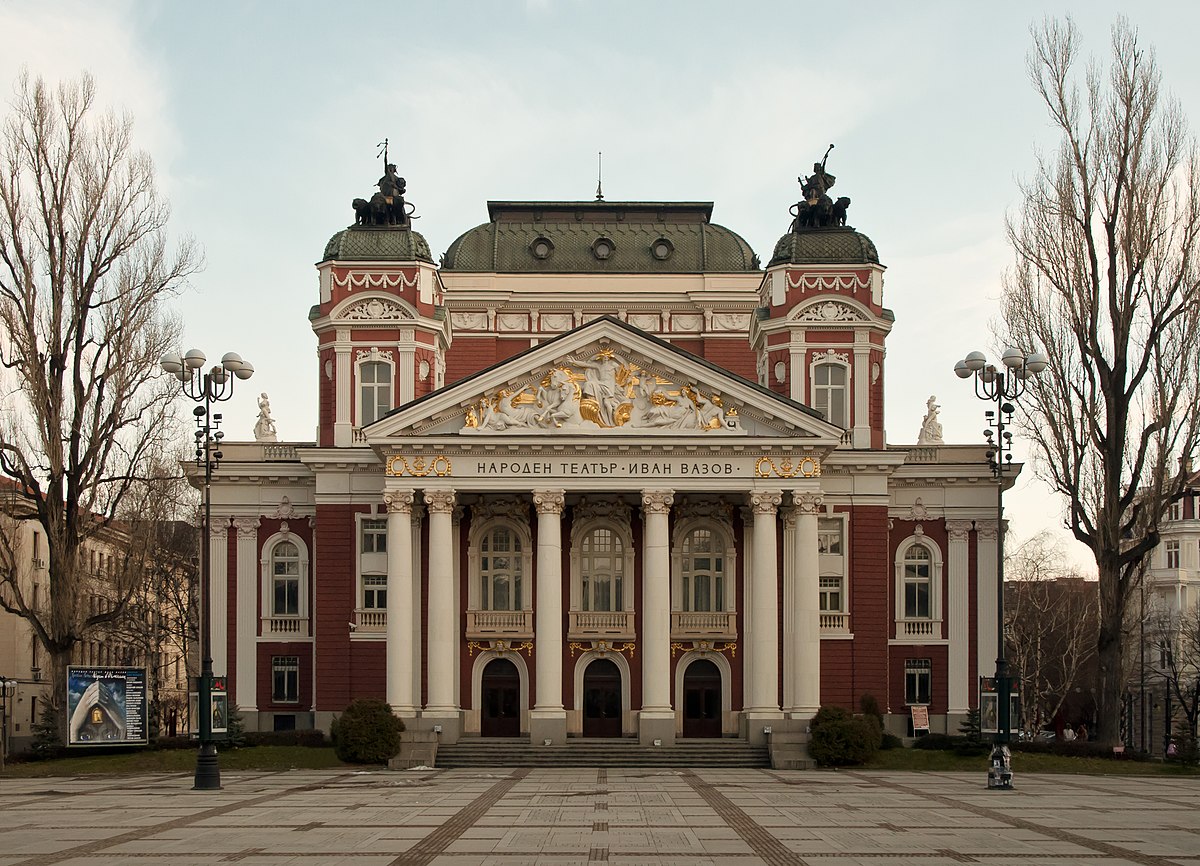
The Ivan Vazov National Theatre is Bulgarias national theatre, as well as the oldest and most authoritative theatre in the country and one of the important landmarks of Sofia, the capital of Bulgaria. It is located in the centre of the city, with the facade facing the City Garden. Founded in 1904 by the artists from the Salza i Smyah company, it was initially called simply the National Theatre, but before being named after the prominent writer Ivan Vazov it also bore the name of Krastyu Sarafov between 1952 and 1962. Incidentally Vazovs play, "The Outcasts" was the first to be performed at the theatre when it opened. The theatres Neoclassical building, designed by famous Viennese theatre architects Hermann Helmer and Ferdinand Fellner, was finished in 1906 and opened on 3 January 1907. The building was extensively damaged by a fire in 1923 during an anniversary celebration, but was reconstructed in 1929 by German architect Martin Dülfer. A theatrical school was established as part of the National Theatre in 1925. The bombing of Sofia in World War II caused considerable damage to the building, but it was reconstructed in 1945. Another reconstruction followed in 1971–1975, and a €100,000 restoration project was implemented in 2006. The Ivan Vazov National Theatre has a well-equipped main stage with 750 seats, a smaller 120-seat stage and an additional 70-seat one on the fourth floor. The buildings facade is depicted on the obverse of the Bulgarian 50 levs banknote, issued in 1999 and 2006. The theatre has been host to productions from notable theatre directors such as Lilia Abadjieva.

Sveti Sedmochislenitsi Church

The Sveti Sedmochislenitsi Church is a Bulgarian Orthodox church in Sofia, the capital of Bulgaria. It was created between 1901 and 1902 through the conversion of an abandoned Ottoman mosque, and was inaugurated on 27 July 1903. The church is named after Cyril and Methodius and their five disciples, known in the Orthodox Church collectively as the Sedmochislenitsi. The so-called Black Mosque was built in 1528 on the order of Suleiman the Magnificent with the intention to be more impressive and beautiful than the Christian churches in the city. The mosque is popularly attributed to the famous Ottoman architect Mimar Sinan, although this is uncertain. It was constructed at the place of a former nunnery of the Rila Monastery and an Early Christian temple from the 4th-5th century, the ruins of which were excavated in 1901. An even older construction, a pagan temple of Asclepius from Roman Serdica, was also discovered in the mosque's foundations. The 25 m-long mosque had a square shape and a large lead-covered dome. The mosque was initially known as the Koca Mehmed Pasha Mosque after Mehmed-paša Sokolović. Another name was the İmaret Mosque after the imaret, a kitchen for the poor located in the vicinity, the ruins of which were found in 1912. A madrasah, a Muslim religious school, was located in what is now the small garden between the modern church and the Count Ignatiev School. The madrasah was later used as a prison after the Liberation of Bulgaria. Other Ottoman constructions nearby included a caravanserai and a hammam. The mosque received its more popular name, the Black Mosque, after the dark granite from which its minaret was made. The minaret collapsed during an earthquake in the 19th century and the mosque was abandoned by the Ottomans after the Liberation of Bulgaria in 1878 to become used as a military warehouse and prison. The architect who suggested the conversion of the once Ottoman mosque into a Christian church was the Russian Alexander Pomerantsev, responsible for the Upper Trade Rows on Red Square, among other buildings. The Bulgarian architects Yordan Milanov and Petko Momchilov designed the dome, the narthex and the bell tower in a traditional Bulgarian style, inspired by the movement of Romanticism. Only the central hall and the dome of the former mosque were preserved, with four oval bays, a narthex and an altar section being added. The construction works took a year, between 27 May 1901 and 6 May 1902, but the complete inner decoration did not finish until 1996. Young artists painted the icons and among the first donors were Tsar Ferdinand and Ivan Evstratiev Geshov. Famous Bulgarian statesman Petko Karavelov also contributed significantly to the church's construction and was buried nearby in January 1903. The large candlesticks in front of the altar were cast in 1903 from obsolete police badges from Eastern Rumelia and the Principality of Bulgaria (i.e. before the Unification in 1885). An electric clock, still in use, was created by the noted watchmaker Georgi Hadzhinikolov and fit to the western façade in the 1930s. The small garden and the square close to the church were also built in the period. In the grounds of the Sveti Sedmochislenitsi is buried alongside his wife Petko Stoichev Karavelov (24 March 1843 24 January 1903) a leading Bulgarian liberal politician, who served as Prime Minister on four occasions.

Eagles' Bridge

Eagles Bridge is a bridge over the Perlovska River in downtown Sofia, capital of Bulgaria. The bridge and junction were it is located, sometimes referred to as Ploshtad Orlov Most are usually referred simply as Eagles Bridge . The name of the bridge itself comes from the four statues of eagles on it, which are, symbolically, its protectors and patrons. Eagles Bridge and the junction are located in the immediate proximity of the Vasil Levski National Stadium, the Monument to the Soviet Army, the Borisova gradina park and Lake Ariana, and near Sofia University. Two main boulevards cross there – Evlogi Georgiev Boulevard, which follows the Perlovska river, and Tsarigradsko Shose, and Tsar Ivan Asen II Street terminates there. For the traffic entering Sofia from the southeast by Tsarigrad Road, Eagles Bridge is the first junction and the point from where the city centre is accessed. The bridge was constructed in 1891 by Czech architect Václav Prošek, his brother Jozef and his cousins Bohdan and Jiří. They also designed together and built the Lions Bridge at the northern point of entry to central Sofia in 1889. The cost of the entire construction of the bridge was 80,000 golden leva. One of the bridges columns and bronze eagles are depicted on the reverse print of Bulgarian 20 levs banknote, issued in 1999 and 2007. Orlov Most was the focus of 2012 ecological protests against construction on Vitosha mountain and on the Dyuni nature spot on the Black Sea coast. The bridge was also a major focus of political protests in 2013, with scenes of violence during the winter protests, contrasted with massive but peaceful gatherings during the summer protests, when it would close every evening while protesters gathered there until late into the night. Since 2009, Eagles Bridge has been serviced by the Sofia University Metro Station of Sofia Metro Line 1, to which the squares subways are connected via travellators.

Monument to the Tsar Liberator

The Monument to the Tsar Liberator is an equestrian monument in the centre of Sofia, the capital of Bulgaria. It was erected in honour of Russian Emperor Alexander II who liberated Bulgaria of Ottoman rule during the Russo-Turkish War of 1877-78. The Neoclassical memorials author is Italian sculptor Arnoldo Zocchi, who won the project in competition with 31 other artists from 12 countries in the end of the 19th century. Bulgarian architect Nikola Lazarov participated in the monuments architectural design. The foundation stone was laid on 23 April 1901, St Georges Day, in the presence of Knyaz Ferdinand I of Bulgaria, and the monument was completed on 15 September 1903. Ferdinand also attended the monuments inauguration on 30 August 1907 together with his sons Boris and Kiril, Grand Duke Vladimir Alexandrovich of Russia, son of Alexander II, together with his wife and his son, as well as other notable figures. Erected of black polished granite from Vitosha, the Monument to the Tsar Liberator consists of a pedestal, a middle part with figures and a massive Neo-Renaissance cornice finished with the sculpture of the Russian Tsar on a horse. The bronze wreath at the foot was donated by Romania in memory of the Romanian soldiers that died during the war. The main bronze bas-relief in the middle part depicts a group of Russian and Bulgarian soldiers led by Nike, the Ancient Greek goddess of victory, who rises her sword high above. Portraits of Grand Duke Nicholas Nicolaievich, Count Ignatiev and the generals Joseph Vladimirovich Gourko and Mikhail Skobelev surround the group. Other bas-reliefs feature scenes from the Battle of Stara Zagora, the signing of the Treaty of San Stefano and the opening ceremony of the Constituent National Assembly in Veliko Tarnovo, as well as portraits of Petko Slaveykov, Stoyan Zaimov, Ivan Vazov, Stefan Stambolov and other prominent figures from the period. The Monument to the Tsar Liberator lies on Tsar Osvoboditel Boulevard, facing the National Assembly of Bulgaria and with the Radisson SAS hotel behind it.

City Garden

The City Garden is Sofia, the capital of Bulgarias oldest and most central public garden, in existence since 1872. It is located between Tsar Osvoboditel Boulevard to the north, Knyaz Alexander Battenberg Street to the west and Joseph Vladimirovich Gourko Street to the south, in the historical centre of the city. Originally arranged in the last years of the Ottoman rule of Bulgaria, it was radically transformed immediately after the Liberation of Bulgaria in 1878 and the choice of Sofia as the capital the following year under the city architect Antonín Kolář on the initiative of the temporary governor Pyotr Alabin. The alley network was reorganized, new plants were added, as well as a low wooden fence, a coffeehouse and a kiosk for musicians. The garden was initially named the Alexander II Garden in honour of Russian tsar Alexander II, who initiated the Russo-Turkish War of 1877-78, which led to the Liberation of Bulgaria. Until the end of the 19th century the City Garden was repeatedly reorganized and further developed. Among the noted gardeners that worked on it were Karl Betz, Daniel Neff and Iliya Todorov, who shaped the gardens appearance that it would retain until the Second World War. The construction of the now-demolished Georgi Dimitrov Mausoleum soon after the beginning of Communist rule of Bulgaria after the war was followed by multiple fundamental reorganizations, such as in 1951 and 1959 by Sugarev and R. Robev, 1976 and 1978 by A. Agura. These led to the orientation of the garden not towards the former royal palace as previously, but towards the Ivan Vazov National Theatre. The new composition was often in conflict with the initial planning and the City Garden lost territory and key architectural elements in the period. Today the City Garden is not only a popular retreat for the residents of the capital, but also a favoured place for amateur chess players, who can be regularly seen in the small garden in front of the National Theatre. It was also the place where a group of around 300 people gathered on 27 August 1895 to climb Cherni vrah in Vitosha led by the writer Aleko Konstantinov on what is regarded as the birth date of tourism in Bulgaria.

Yunak Stadium

Yunak Stadium , was a multi-use stadium in central Sofia, Bulgaria. It was located at the north-western corner of Knyaz Boris's Garden, on the southern bank of the Perlovska river. It was the largest stadium in Bulgaria until the middle of the 20th century, with a capacity of 35,000 spectators, and was initially used as the main stadium for Bulgaria national football team matches. The pitch was almost exactly square-shaped, with four straight rows of stands on all sides. The stadium is named after the Yunak sports societies which formed in Bulgaria in the late 19th century, themselves named after the word "yunak", meaning a strong young man. In the 1920s-30s, immediately to the northeast of Yunak stadium, was built the smaller Levski Field, the home ground of SK Levski. In the 1950s, the BCP decided to build a new, larger national stadium on the site of Levski Field. As the new stadium would infringe on the north-eastern stands of the Yunak stadium, this was also demolished in order to make way for the Vasil Levski National Stadium, opened 1953. Because of this, Dinamo Sofia were given a new home in the north-eastern suburbs of the capital, while in the place of Yunak was built the much smaller Druzhba stadium, which was used for many years as an ice rink. After the fall of communism, the disused ice rink regained the name of the original Yunak stadium, but was never again used as a sports facility and, as of the early 2000s, lies in ruins, which are visible between the national stadium and the Sofia Metro station that formerly bore the same name. The stadium has also been used for unorthodox "sports", such as live human chess during the reign of Tsar Boris.

This attraction is located in

This is a private property. Please enjoy respectfully and do not disturb the occupants.

Edit Categories
Add Tours

This attraction is not part of any tours

Add Collections

This attraction is not part of any collections


Some of the attractions we imported from Wikipedia are not perfect. Send us an email detailing what's wrong and we'll look into fixing it.

GuRoute is all about Gurus sharing their local knowledge. If you feel up to fixing this problem yourself, why not adopt it. You will become the owner and can fix whatever problems you see.

We've copied a link to this attraction into your clipboard so that ou can paste it into an email or text message...

More Info...
You can add your friends to the visit yourself, or, send them a link and let them add themselves...

The visit will appear on both your timelines and on your Shared Timeline.

Click below and we'll email you a link that you can send on to friends or post on your group's Facebook page.

If your friends aren't members of GuRoute yet, this is a great way to get them started.
Recent
Recently used Collections will appear here...
Recent
Recently used tours will appear here...

Where is this?

GuRoute likes to place attractions inside other attractions. So, maybe it's in a city, or maybe it's inside a particular park in that city. Maybe your attraction is a huge park that spans half the county, or multiple counties.

Determining where this attraction is gives it context - if it's in a park, you'll be able to see it alongside all the other attractions in that park. And that helps define the park.

GuRoute will automatically calculate a parent region for this attraction. You can change it if there is something more appropriate.

This attraction is currently located in .

Change

This attraction does not yet have any reviews

Please login to write a review...

Reviewed by
Record new Visit

Add this location to your timneline?

  • If there's an existing attraction open it and add it to your timeline...
  • If not, enter a title and we'll create a new attraction for your memories...
Create new Attraction

Create a new attraction at this location?

  • We rely on Gurus like you to share your local knowledge...
(Give a name for this location)


+
Add this to your timeline instead...

Imagine having a record of all the cool things you've done in your life!


Using our timeline you can keep track of everywhere you visit in your lifetime...

But, you'll need to sign in first...

Add contacts so that you can share your travels and record places that you visit together...

Family
Favorites
Family
Favorites

Profile TimeLine Our Visits Edit Accept Decline Invite

If you have any more friends that visited this place with you, feel free to add them to the visit. We'll write it to their timeline and once they confirm it, they too will have this memory for a lifetime.

If they're not already registered, you just need their name and email address and you can add them and we'll send them an invite on your behlaf.

Add a tour comment

Add some extra information for when this attraction is viewed as part of your tour...

Next Stop Instructions

Add some instructions for what to see/do on the way to the next stop...

Next Stop Instructions

Add some instructions for what to see/do on the way to the next stop...

If you're visiting an existing attraction, open it and add it to your timeline. If there is no attraction for the place you are visiting...

  • Click 'Add My Location' below
  • Or right-click on the map to mark a different location
  • Or long-press if you have a touch screen
You can even add locations while you're offline....
  • Load up the map when you're online and we'll keep track of your locaiton
  • You can add locations to your timeline
  • When you are online again we'll sync them with the cloud

We can't connect to the internet right now. The following attractions are saved locally and can be uploaded when you're online...

GuRoute would like to access your current location so that we can pin you on the map and show you nearby attractions

Add friends so that you can share your experiences with each other...

Add tour to What's Next?

Go...

Either for yourself or someone else...

  1. Do your trip research in GuRoute
    Add all the places that you think might be worthy of a visit into a trip-plan
  2. Add your trip-plan to your "What's Next" timeline
    (or a friend's "What's Next" timeline)
  3. When you're on vacation you'll have all your research at your fingertips
  4. Share your timline with your friends
    They can enjoy your vacation with you, seeing not only where you've been, but where you're going next...
  5. Add/remove attractions if things change

It also makes a great souvenir of your trip

Collections

Go...

Create a home page for a collection of attractions

  • Add an image and description to display on the homepage
  • Start adding content
    Add existing attractions to your collection or create new attractions of your own
  • Collections can be:
    • Public (Anyone can add attractions to your collection)
    • Shared (Only yourself and Gurus you nominate can add content)
    • Private (The collection will only be visible to yourself)

Uses

  • Local business or hotel
    Showcase local attractions that you endorse
  • Clubs
    Showcase attractions that members have created (eg. local historical society)
  • Special Interest
    If GuRoute does not have a category for your special interest you add your attractions to your own collection instead

Examples

Walking/Driving Tours

Go...

A guided tour where GuRoute will direct you from stop to stop and narrate a description of each attraction you arrive at

  • GuRoute uses your phone's GPS to guide you from stop to stop
  • GuRoute automatically detects when you arrive at the next tour-stop and narrates the description of the attraction (Chrome Only)
  • It then sends you on to the next stop

Tours are great to attract people to your town. Even places with no significant points of interest can be lots of fun when part of a tour


Cater tours to your Audience

  • Kid-friendly Tours
    • Focus on what will keep kids interested
    • Instead of parents having to drag their kids around they'll be struggling to keep up
    • Let the kids navigate and they'll get more fun out of finding that historical plaque than they ever would from reading it
  • Accessible tours
  • Short and long tours of the same location

What you need to do...

  1. Click 'Go...'
    Enter a title, description and location for the tour
  2. Add existing attractions OR create new ones and add them to the tour
  3. For existing attractions you can add more information specific to the theme of the tour
  4. You can also add instructions on what to do or see en-route to the next tour-stop
  5. Try out your tour and see how it works...

Mystery Tour

Go...

Create a Mystery Tour

Create a series of clues to show people around a city, neighborhood or whatever place you like...

  • GuRoute will show people clues to get them from attraction to attraction
  • When they reach each stop GuRoute will tell them about the place and give them the next clue
  • Take as long or as you like and explore each location at your leisure

Scavenger Hunt

Go...

Create a Scavenger Hunt

Create a series of questions that people have to answer. The answers can all be discovered by walking aroung the area, looking for clues.

  • How many beers are on tap at Michael Collin's Irish Bar?
  • What's the name of the oldest building on main streeet?
  • Show a picture of some public art and ask them what it is called
  • Clues can have numeric or multiple choice answers