Sign In

My Timeline

GuRoute

Discover Your World

Share your Experiences

Record your Life


Top Attractions in Stirling

Airthrey Castle

Airthrey Castle is a historic building and estate which now forms part of the buildings and grounds of the University of Stirling in central Scotland. There are two suggested origins of the name "Airthrey" a corruption of Ard-rhedadie, or from the Gaelic "Aithrin" "a sharp point" or "conflict". This could refer to a battle fought near the site of the Castle in 839, when the Picts were defeated by the Scots under Kenneth McAlpine. The name appears in a charter of King David I, thought to be from before 1146. In 1370, the estate was granted to Sir John Herice, Keeper of the nearby Stirling Castle. Then the land passed to William Graham, 3rd Lord Graham, for gallantry he displayed in the Battle of Sauchieburn in 1488 . He was made Earl of Montrose in 1504 but died at the Battle of Flodden in 1513. The estate remained in the ownership of the Clan Graham down to James Graham, 1st Marquess of Montrose, who fought a campaign in support of King Charles I from 1644 to 1650. By this time, the Airthrey Estate was in the ownership of a minor branch of the Grahams. In 1678, the estate was purchased by John Hope of Hopetoun who was succeeded by Charles Hope, 1st Earl of Hopetoun who was elevated to the House of Lords in 1703 with the titles of Viscount Airthire, Baron Hope and Earl of Hopetoun. In 1759, the estate was sold to Captain Robert Haldane of Plean. The 363-acre grounds and man-made loch were designed by Thomas White for the Haldane family in the late 18th century. In 1791, Captain Haldanes great-nephew, Robert Haldane, commissioned the design by the eminent architect Robert Adam, which is the basis of Airthrey Castle today. Despite the development, he sold it to Sir Robert Abercrombie in 1798. The castle and estate remained in the ownership of the Abercrombie family until 1889 when Donald Graham bought it and made a large addition to the castle in 1889-91. During the Second World War it became a maternity hospital and was used as such until 1969, supplementing the needs of Stirling Royal Infirmary. Then in the 1960s, as a result of the Robbins Report, the estate was selected as the site of the first completely new Scottish University since the University of Edinburgh was established in 1582. The University of Stirling opened in 1967. Its campus is located in 60 acres of woodland, 300 acres of mature landscaped parkland, a loch with an abundance of wildlife and incorporates Airthrey Castle, where the School of Law is based as well as the Universitys student radio station, Air3. Airthrey Castle retains many original features, as well as housing the Universitys Moot Courtroom. From September 2014 the castle will also become home to the Universitys new international study centre operated in partnership with INTO University Partnerships.

Cambuskenneth Abbey

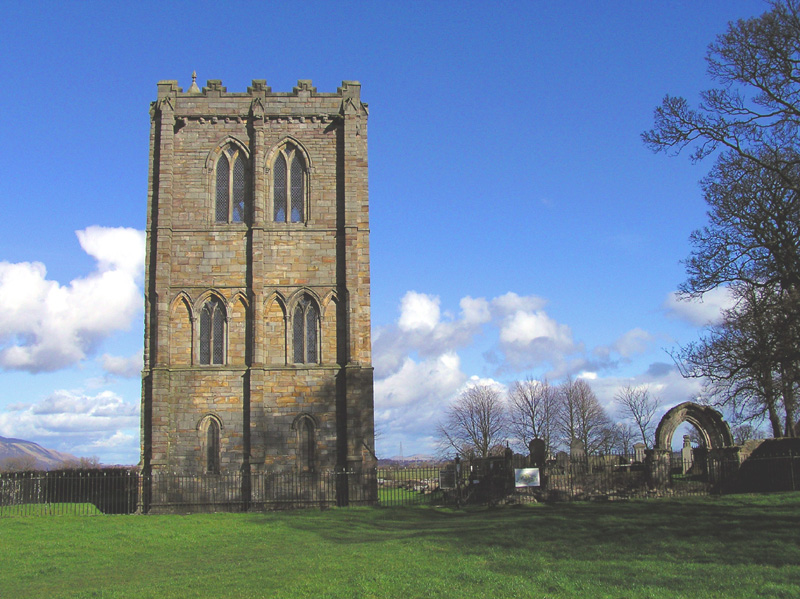
Cambuskenneth Abbey is a ruined Augustinian monastery located on an area of land enclosed by a meander of the River Forth near Stirling in Scotland. The abbey is largely reduced to its foundations. The neighbouring modern village of Cambuskenneth is named after it. Cambuskenneth Abbey was founded by order of David I around the year 1140. Dedicated to the Virgin Mary, it was initially known as the Abbey of St Mary of Stirling and sometimes simply as Stirling Abbey. The major street leading down the castle hill from the royal residences in Stirling Castle to the abbey was called St. Marys Wynd, a name it retains. Cambuskenneth was one of the more important abbeys in Scotland, due in part to its proximity to the Royal Burgh of Stirling, a leading urban centre of the country and sometime capital. Its status as a royal abbey in the neighbourhood of a major national stronghold may be compared to that of Holyrood Abbey vis à vis Edinburgh. Royalty, including Edward Longshanks and later Robert the Bruce, prayed regularly at the abbey. Bruce held his parliament there in 1326 to confirm the succession of his son David II. In 1486 Margaret of Denmark died at Stirling Castle and was buried at the abbey. In 1488 her husband James III was murdered at the Battle of Sauchieburn and his body was brought to Cambuskenneth Abbey for burial. The elaborate marker of his grave, which was funded by Queen Victoria, is still visible at one end of the church. The abbey fell into disuse during the Scottish Reformation. By 1559 there were few monks remaining there, and the abbey was closed and most of the buildings looted and burned. The abbey was placed under the jurisdiction of the military governor of Stirling Castle, who had much of the stonework removed and used in construction projects in the castle. Of the once wealthy abbey, mostly only knee-high ruins and exposed foundations remain. Only the 13th century campanile is intact, following an extensive renovation in 1859. The abbey was acquired by the crown in 1908, and it is managed by Historic Scotland. The abbey is open to visitors during the summer months. Visitors can enter the base room of the campanile; the stairs to the upper floors are locked, but are opened for visitors on occasion.

Stirling Sill

The Stirling Sill is an outcropping of a large quartz-dolerite intrusion or sill that underlies a large part of central Scotland, and may be contiguous at great depth. The sill is of very late Carboniferous age or more probably Permian, as it penetrates the coal measures, often in bedding planes between the various strata. In places, it rises through fractures in the strata to a new level, forming features that, at the surface, would be called dikes. At its outcrop on the west, the sill generally lies towards the base of the Carboniferous sequence, and just above the calciferous sandstone deposits and lavas, as can be seen in the upper part of the valley of the Bannock Burn. However, to the consternation of miners, it occupies a higher position amongst the useful strata towards the east, and in places has destroyed the coal, while in others the effect of the sill has been to convert the coal to more valuable anthracite. The slope of the Abbey Craig, or the Stirling Castle rock, gives a general idea of the angle of dip of the coal measures at the extremity or the coalfield, and the thickness of the sill can also be seen, which is approximately 100 metres. Geologists have had various theories about the formation of anthracite, as the coal has been most effectively baked near the Ochil Fault, however the theories are not necessarily incompatible. The source of the sill, where the molten rock rose from below, is not known; however it is known that there are risers in the Ochil Fault, although these are inconsistent with the overall structure. The main origin of the sill may be in the region of the eruptive centre that formed the Ochil Hills in a much earlier period, which geologist postulate is somewhere to the east of Stirling, possibly in the region of Kincardine. This ties in with subsidence following the first round of eruptive activity that lead to the formation of the coal basins, with a much later outbreak of intrusive activity from the same magma feeders, however the truth will remain unknown because it would take very many deep bores in hard rock to probe the depths and find the necessary evidence. The western extremities of the sill can be seen at the Abbey Craig, Stirling Castle, Kings Park, Gillies Hill, Sauchieburn and various points to the south. The quartz-dolerite was once quarried at several places including Cambusbarron and Murrayshall, but is quarried today at Northfield, primarily for roadstone.

This attraction is located in

This is a private property. Please enjoy respectfully and do not disturb the occupants.

Edit Categories
Add Tours

This attraction is not part of any tours

Add Collections

This attraction is not part of any collections


Some of the attractions we imported from Wikipedia are not perfect. Send us an email detailing what's wrong and we'll look into fixing it.

GuRoute is all about Gurus sharing their local knowledge. If you feel up to fixing this problem yourself, why not adopt it. You will become the owner and can fix whatever problems you see.

We've copied a link to this attraction into your clipboard so that ou can paste it into an email or text message...

More Info...
You can add your friends to the visit yourself, or, send them a link and let them add themselves...

The visit will appear on both your timelines and on your Shared Timeline.

Click below and we'll email you a link that you can send on to friends or post on your group's Facebook page.

If your friends aren't members of GuRoute yet, this is a great way to get them started.
Recent
Recently used Collections will appear here...
Recent
Recently used tours will appear here...

Where is this?

GuRoute likes to place attractions inside other attractions. So, maybe it's in a city, or maybe it's inside a particular park in that city. Maybe your attraction is a huge park that spans half the county, or multiple counties.

Determining where this attraction is gives it context - if it's in a park, you'll be able to see it alongside all the other attractions in that park. And that helps define the park.

GuRoute will automatically calculate a parent region for this attraction. You can change it if there is something more appropriate.

This attraction is currently located in .

Change

This attraction does not yet have any reviews

Please login to write a review...

Reviewed by
Record new Visit

Add this location to your timneline?

  • If there's an existing attraction open it and add it to your timeline...
  • If not, enter a title and we'll create a new attraction for your memories...
Create new Attraction

Create a new attraction at this location?

  • We rely on Gurus like you to share your local knowledge...
(Give a name for this location)


+
Add this to your timeline instead...

Imagine having a record of all the cool things you've done in your life!


Using our timeline you can keep track of everywhere you visit in your lifetime...

But, you'll need to sign in first...

Add contacts so that you can share your travels and record places that you visit together...

Family
Favorites
Family
Favorites

Profile TimeLine Our Visits Edit Accept Decline Invite

If you have any more friends that visited this place with you, feel free to add them to the visit. We'll write it to their timeline and once they confirm it, they too will have this memory for a lifetime.

If they're not already registered, you just need their name and email address and you can add them and we'll send them an invite on your behlaf.

Add a tour comment

Add some extra information for when this attraction is viewed as part of your tour...

Next Stop Instructions

Add some instructions for what to see/do on the way to the next stop...

Next Stop Instructions

Add some instructions for what to see/do on the way to the next stop...

If you're visiting an existing attraction, open it and add it to your timeline. If there is no attraction for the place you are visiting...

  • Click 'Add My Location' below
  • Or right-click on the map to mark a different location
  • Or long-press if you have a touch screen
You can even add locations while you're offline....
  • Load up the map when you're online and we'll keep track of your locaiton
  • You can add locations to your timeline
  • When you are online again we'll sync them with the cloud

We can't connect to the internet right now. The following attractions are saved locally and can be uploaded when you're online...

GuRoute would like to access your current location so that we can pin you on the map and show you nearby attractions

Add friends so that you can share your experiences with each other...

Add tour to What's Next?

Go...

Either for yourself or someone else...

  1. Do your trip research in GuRoute
    Add all the places that you think might be worthy of a visit into a trip-plan
  2. Add your trip-plan to your "What's Next" timeline
    (or a friend's "What's Next" timeline)
  3. When you're on vacation you'll have all your research at your fingertips
  4. Share your timline with your friends
    They can enjoy your vacation with you, seeing not only where you've been, but where you're going next...
  5. Add/remove attractions if things change

It also makes a great souvenir of your trip

Collections

Go...

Create a home page for a collection of attractions

  • Add an image and description to display on the homepage
  • Start adding content
    Add existing attractions to your collection or create new attractions of your own
  • Collections can be:
    • Public (Anyone can add attractions to your collection)
    • Shared (Only yourself and Gurus you nominate can add content)
    • Private (The collection will only be visible to yourself)

Uses

  • Local business or hotel
    Showcase local attractions that you endorse
  • Clubs
    Showcase attractions that members have created (eg. local historical society)
  • Special Interest
    If GuRoute does not have a category for your special interest you add your attractions to your own collection instead

Examples

Walking/Driving Tours

Go...

A guided tour where GuRoute will direct you from stop to stop and narrate a description of each attraction you arrive at

  • GuRoute uses your phone's GPS to guide you from stop to stop
  • GuRoute automatically detects when you arrive at the next tour-stop and narrates the description of the attraction (Chrome Only)
  • It then sends you on to the next stop

Tours are great to attract people to your town. Even places with no significant points of interest can be lots of fun when part of a tour


Cater tours to your Audience

  • Kid-friendly Tours
    • Focus on what will keep kids interested
    • Instead of parents having to drag their kids around they'll be struggling to keep up
    • Let the kids navigate and they'll get more fun out of finding that historical plaque than they ever would from reading it
  • Accessible tours
  • Short and long tours of the same location

What you need to do...

  1. Click 'Go...'
    Enter a title, description and location for the tour
  2. Add existing attractions OR create new ones and add them to the tour
  3. For existing attractions you can add more information specific to the theme of the tour
  4. You can also add instructions on what to do or see en-route to the next tour-stop
  5. Try out your tour and see how it works...

Mystery Tour

Go...

Create a Mystery Tour

Create a series of clues to show people around a city, neighborhood or whatever place you like...

  • GuRoute will show people clues to get them from attraction to attraction
  • When they reach each stop GuRoute will tell them about the place and give them the next clue
  • Take as long or as you like and explore each location at your leisure

Scavenger Hunt

Go...

Create a Scavenger Hunt

Create a series of questions that people have to answer. The answers can all be discovered by walking aroung the area, looking for clues.

  • How many beers are on tap at Michael Collin's Irish Bar?
  • What's the name of the oldest building on main streeet?
  • Show a picture of some public art and ask them what it is called
  • Clues can have numeric or multiple choice answers