Sign In

My Timeline

GuRoute

Discover Your World

Share your Experiences

Record your Life


Top Attractions in Shrewsbury

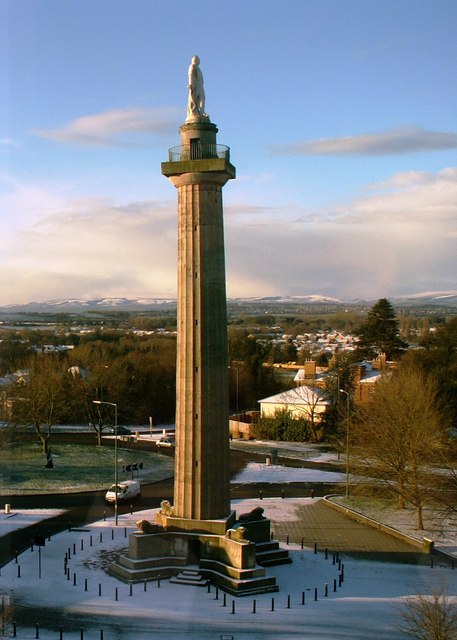
Lord Hill's Column

Lord Hills Column, outside the Shirehall, is one of the most notable landmarks of the town of Shrewsbury, Shropshire, England. The tallest Doric column in England, standing at 133 ft 6 in, it commemorates Rowland Hill, 1st Viscount Hill, with a 17 ft tall statue standing on the top of the column the column is shorter than the 44.5m Monument to British Liberty at Gibside, but the overall height of the column and statue is higher in total. The column was built between 1814 and 1816; its diameter is 2 ft wider than Nelsons Column, and, not including the pedestal, is 15 ft higher. The architect was Edward Haycock Snr, with modifications mainly to the pedestal by Thomas Harrison. The pedestal is square with a pier of buttress at each angle, on which are placed recumbent lions, worked of Grinshill stone by John Carline of Shrewsbury. The statue of Lord Hill was modelled in Lithodipyra by Joseph Panzetta who worked for Eleanor Coade. The first stone was laid on 27 December 1814 by the Salopian Lodge of Free Masons assisted by deputies from adjoining lodges, on the festival of St. John the Evangelist. The last stone was laid on 18 June 1816, the first anniversary of the Battle of Waterloo. The total expense was 5,972 pounds, 13 shillings and 2 pence . The structure once stood at the centre of the crossroads there, but the junction is now set aside from the column. The column also gives its name to a borough ward, which is simply "Column" ward. It is possible to climb within the column using steps to reach the top. The column has been listed by English Heritage as a Grade II* structure. As of May 2013, the Shropshire Council is seeking the best solution to falling debris from the statue caused by heavy winds. The statue has been cordoned off for passersby protection. It is a landmark and its preservation and restoration is said by some people to be of paramount importance. The column is to be open to the public during the summer and autumn of 2015 as part of the bicentenary of the Battle of Waterloo.

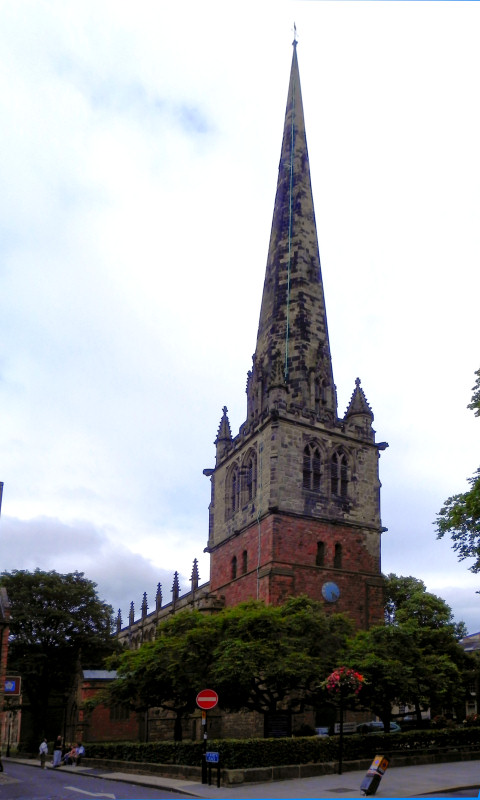
St Chad's Church

St Chad's Church, Shrewsbury occupies a prominent position in the county town of Shropshire. The current church building was built in 1792, and with its distinctive round shape and high tower it is a well-known landmark in the town. It faces The Quarry area of parkland, which slopes down to the River Severn. The church is a Grade I listed building. The motto of the church is "open doors, open hearts, and open minds". This indicates the aspiration of the church to be a welcoming church, involved in the community, and on a collective journey seeking after God. Music is a strong tradition at St Chad's. The church has a robed choir which leads the music at many of the services. The church organ is a large three-manual pipe organ, built by Norman and Beard in 1904 and restored by Nicholsons in 1963 and Harrison & Harrison in 1985 and more recently in 2011. The church hosts lunchtime organ recitals and other concerts. Charles Darwin was baptised in St Chad's church in 1809, and as a young boy attended the church with his mother Susannah. The headstone prop of Ebenezer Scrooge that was used in the 1984 film A Christmas Carol is still present in the now-disused churchyard. According to the Shrewsbury Town Crier, Martin Wood, the headstone is not a "prop" but an actual period headstone, on which the original inscription had deteriorated to the point that the movie production people asked the church if they could use it and inscribe the "Ebenezer Scrooge" words on it. You can still see some of the original inscription on the bottom part of the stone. Among those actually buried in the churchyard was Shrewsbury architect Edward Haycock, Sr. In 2010, the church became a member of the Greater Churches Group.

Breidden Hill

Breidden Hill is an extinct volcanic hill, located west of the border between Shropshire, England and Powys, Wales, near the town of Welshpool. It is immediately surrounded by the villages of Trewern, Criggion, Crew Green and Llandrinio. The peak of the hill reaches to 367 metres . Footpaths which lead up to the summit provide excellent 360 degree views over the Shropshire Plain and Mid-Wales. Breidden Hill is one of five peaks with neighbouring Moel y Golfa, which is the highest at 403 metres, which is a "Marilyn", with a prominence of 261 metres . The three others are Cefn y Castellm, Kempsters Hill and Bausley Hill high) with its Iron Age galleried fortification. The five hills are sometimes collectively known as the Breidden Hills, and form a northern extension of the Long Mountain. There are remains of a British Iron Age hillfort en route which may have been the site of the last stand of Caractacus. Rodneys Pillar at the top was built by the gentlemen of Montgomeryshire who supplied oak wood from the area and shipped it down the River Severn to Bristol where Admiral Rodneys naval fleet was built. Rodneys Pillar is increasingly being used as a navigational aid by helicopter pilots in this area, due to its visibility from large areas of Wales. Beginning around 1789, for many years members of the Breidden Society, founded by John Dovaston, met near Rodneys Pillar for an annual festival of food, drink, poetry, and song; records of their meetings for 1809-15 are preserved at the Houghton Library of Harvard University . There is a large quarry on the western and northern sides of Breidden Hill. The rock is a thick gabbroic-dolerite laccolith, which is a source of roadstone.

Christ Church

The parish of Christ Church, Shelton and Oxon lies within the Diocese of Lichfield, in the county of Shropshire, England. The parish church was built in 1854 by Edward Haycock Snr in Early English style with many lancet features. It is located on Welshpool Road in what is now suburban Shrewsbury, and is a Grade II listed building. The exterior has rubble walls with ashlar dressings. There is a bellcote and a gabled porch. The interior has a scissor-braced roof, an elaborate ashlar reredos (begun in 1886 and not completed until 1904), an ashlar pulpit with a pelican motif, an octagonal ashlar font, and stained glass windows (from 1884, 1948, and 1967). A new stained glass window was placed above the chancel arch to celebrate the new millennium in 2001 The churchyard contains the war graves of two airmen and a Herefordshire Regiment soldier of World War II. The parish has a population of about 8500 whilst the church has seating for 150. The church was built to cater for those cut off by flooding of the River Severn, on an area of land called the "Windmill Field." The parish was formed from that of St Chad's Church, Shrewsbury, and includes the former townships of Crowmeole, Woodcote and Horton, Bicton Heath, and Copthorne. Parish boundaries were adjusted in 1957. The boundaries were redrawn in the early 21st century to reflect population growth. In 2004 the church celebrated 150 years by planting a new Oxon Oak. The church is linked to the Oxon Church of England Primary School, which opened next to the church in 1860, but moved to nearby Racecourse Lane in 1959.

Shropshire County Show

The Shropshire County Show, formerly and to this day often called the West Mid Show (short for Shropshire and West Midlands Show), is an annual agricultural show held on the outskirts of Shrewsbury (at Coton Hill), England. It has its own showground - the Shropshire Agricultural Showground, which lies on the north bank of the River Severn in a rural setting (though it is less than a mile from Shrewsbury town centre). The showground is accessed via Berwick Road, the B5067. The show is held usually in May and has attracted as many as 40,000 people, from across the region. On 7 November 2009 the society which runs the show went into liquidation, all staff were made redundant with immediate effect. By the end of 2014 the debts had been reduced by two thirds and the trustees were therefore able to start investing in the infrastructure of the showground. With the support of newly appointed sponsors Greenhouse, a local company, there is a renewed confidence that the showground will continue. The society is now run by trustees with a recently appointed full-time Showground Director. Aside from the highly successful show in 2012, there are events at the Showground on most weekends, including a new separate Horse Show, The mid-Shropshire Vintage Club Show, November Bonfire, and The Shrewsbury Folk Festival. There are also regular, well-attended car boot sales that are held on Sunday mornings. The showground is also used for camping. It is the nearest camp site to the middle of Shrewsbury. Shropshire Council have taken over as organisers, and the event has been renamed the Shropshire County Show.

St George's Bridge

St Georges Bridge was a bridge over the River Severn in Shrewsbury, England; so named as it was close to St. Georges Hospital. It connected Frankwell, an old suburb of the town, to the town centre via Mardol. The gate on the town side was called Mardol Gate and is located where the Mardol Quay Gardens are. The gate on the other side was called Welsh Gate or St Georges Gate. The bridge, sometimes now known as the Old Welsh Bridge, was demolished in 1795 and was replaced with the Welsh Bridge. The bridges date of construction is believed to have been about 1262. In 1539 John Leland described it as follows: ... the greatest, fayrest and highest upon the streame is the Welsh Bridge having 6 great Arches of Stone, soe called because it is the Way out of the Towne into Walles. This Bridge standeth on the West Syde of the Towne, and hath at the one End of it a great Gate to enter by into the Towne, and at the other End towardes Wales a might strong Towre to prohibit Enimies to enter into the Bridge. The bridge was variously described as Walshebrugge, and Walshemannes brigge . A public convenience was built on it in about 1496 . One span was a timber drawbridge, while several shops had been built near the middle of the bridge. It is recorded that one tower was still in existence until late in the bridges life. Above the main tower was a statue of Richard Plantagenet , removed in 1791. The Welsh Bridge however was built about 80 yards further downstream, connecting Barker Street with Frankwell. This bridge remains to the day and still carries traffic over the Severn. The section of Barker Street which is on the bridge end has been called Bridge Street since the building of the new bridge. Only one dry arch of the old St Georges Bridge now remains, on the Frankwell side. The site where it is located is set to be developed into the new theatre being built by Shropshire Council. In 2004, the council installed an information board about the history of the bridge and Mardol, at the bottom of Mardol. Saint George is the patron saint of England. It is also given to the church in Frankwell, which is within walking distance of the Welsh Bridge/site of St Georges Bridge.

Ditherington Flax Mill

Ditherington Flax Mill, a Flax mill located in Ditherington, a suburb of Shrewsbury, England, is the oldest iron-framed building in the world. As such, it is seen as the world's first skyscraper described as "the grandfather of skyscrapers", despite being only as tall as a modern five-story building. Its importance was officially recognised in the 1950s, resulting in it becoming a Grade I listed building. It is also locally known as the "Maltings" from its later use. It is derelict, and is in the hands of English Heritage. Plans to transform the site into homes, offices and shops were given approval in October 2010. The Flax Mill's architect was Charles Bage, who designed the mill using an iron-framed structure, inspired by the work of William Strutt. The construction of the mill ran from 1796 to 1797, at a cost of £17000. The mill was built for John Marshall of Leeds, Thomas Benyon, and Benjamin Benyon. The architect, Bage, was also a partner in the venture. This partnership was dissolved in 1804, the mill being retained by John Marshall, who paid off his partners on the basis that it was worth £64000. Castlefields Mill was built by the other partners nearby. These two flax mills provided the 'chief manufacture' of Shrewsbury (according to an 1851 directory). The mill closed in 1886, and was sold for a mere £3000. The building was then converted to a maltings (hence its more commonly used local name), and as a consequence many windows were bricked up. Its design effectively overcame much of the problem of fire damage from flammable atmosphere, due to the air containing many fibres, by using a fireproof combination of cast iron columns and cast iron beams, a system which later developed into the modern steel frame which made skyscrapers possible. Along with the main Flax Mill, a number of other buildings in the group are listed for their architectural and historic value: the apprentice house (Grade II*); the dye house (Grade II*); the flax dressing building (Grade II*); the flax warehouse (Grade II); the stables (Grade II); and the workshops and offices (Grade II). The mill and buildings are on the Heritage at Risk Register.

Old Market Hall

The Old Market Hall is an Elizabethan building situated in the town centre of Shrewsbury, the county town of Shropshire, England. Built in 1596, the property is now in the ownership of Shropshire Council. In 2004 the building underwent a £1.7 million restoration, having been previously restored in 1904. The OMH is a scheduled monument. The Hall, an example of late Tudor influence with primarily Elizabethan architecture, had two storeys: the large upper room was originally used by the Shrewsbury drapers or dealers in cloth to sell Welsh wool and the lower floor was used by farmers to sell their corn. The Old Market Hall was one of the earliest forms of prefabricated buildings; it was erected in less than four months. It bears the Royal Coat of Arms of Queen Elizabeth I, with the date of 1596, and the English lion and the Welsh dragon as supporters. It is thought the OMH was designed by Walter Hancock. A previous Market House was built on the same site in the 1260s. This building was demolished to make way for the Market Hall. The OMH is made from Grinshill stone and was used by wool merchants as a place to sell their fleeces. The post holes where fleeces were hung can still be seen today. The top room of the old Market Hall was used as the town's magistrates court until 1995. The lower part of the structure has been used for many purposes, including as an air raid shelter during the Second World War. Above the main arch on the North side of the OMH there is a statue of a man in armour; he is thought to have been of Richard, Duke of York , which would be the only one of him in the whole nation. This sculpture was originally located on the Welsh Bridge and it was moved to its current location on the orders of the town mayor in 1771. Recently the Market Hall building has been refurbished as an arts venue and café, showcasing films and digital media. Since 2006, the Market Hall has been the venue for the annual Rainbow Film Festival Shropshire Lesbian and Gay Film Festival. The Old Market Hall falls under the administration of the Shropshire Council's Arts & Heritage Department.

This attraction is located in

This is a private property. Please enjoy respectfully and do not disturb the occupants.

Edit Categories
Add Tours

This attraction is not part of any tours

Add Collections

This attraction is not part of any collections


Some of the attractions we imported from Wikipedia are not perfect. Send us an email detailing what's wrong and we'll look into fixing it.

GuRoute is all about Gurus sharing their local knowledge. If you feel up to fixing this problem yourself, why not adopt it. You will become the owner and can fix whatever problems you see.

We've copied a link to this attraction into your clipboard so that ou can paste it into an email or text message...

More Info...
You can add your friends to the visit yourself, or, send them a link and let them add themselves...

The visit will appear on both your timelines and on your Shared Timeline.

Click below and we'll email you a link that you can send on to friends or post on your group's Facebook page.

If your friends aren't members of GuRoute yet, this is a great way to get them started.
Recent
Recently used Collections will appear here...
Recent
Recently used tours will appear here...

Where is this?

GuRoute likes to place attractions inside other attractions. So, maybe it's in a city, or maybe it's inside a particular park in that city. Maybe your attraction is a huge park that spans half the county, or multiple counties.

Determining where this attraction is gives it context - if it's in a park, you'll be able to see it alongside all the other attractions in that park. And that helps define the park.

GuRoute will automatically calculate a parent region for this attraction. You can change it if there is something more appropriate.

This attraction is currently located in .

Change

This attraction does not yet have any reviews

Please login to write a review...

Reviewed by
Record new Visit

Add this location to your timneline?

  • If there's an existing attraction open it and add it to your timeline...
  • If not, enter a title and we'll create a new attraction for your memories...
Create new Attraction

Create a new attraction at this location?

  • We rely on Gurus like you to share your local knowledge...
(Give a name for this location)


+
Add this to your timeline instead...

Imagine having a record of all the cool things you've done in your life!


Using our timeline you can keep track of everywhere you visit in your lifetime...

But, you'll need to sign in first...

Add contacts so that you can share your travels and record places that you visit together...

Family
Favorites
Family
Favorites

Profile TimeLine Our Visits Edit Accept Decline Invite

If you have any more friends that visited this place with you, feel free to add them to the visit. We'll write it to their timeline and once they confirm it, they too will have this memory for a lifetime.

If they're not already registered, you just need their name and email address and you can add them and we'll send them an invite on your behlaf.

Add a tour comment

Add some extra information for when this attraction is viewed as part of your tour...

Next Stop Instructions

Add some instructions for what to see/do on the way to the next stop...

Next Stop Instructions

Add some instructions for what to see/do on the way to the next stop...

If you're visiting an existing attraction, open it and add it to your timeline. If there is no attraction for the place you are visiting...

  • Click 'Add My Location' below
  • Or right-click on the map to mark a different location
  • Or long-press if you have a touch screen
You can even add locations while you're offline....
  • Load up the map when you're online and we'll keep track of your locaiton
  • You can add locations to your timeline
  • When you are online again we'll sync them with the cloud

We can't connect to the internet right now. The following attractions are saved locally and can be uploaded when you're online...

GuRoute would like to access your current location so that we can pin you on the map and show you nearby attractions

Add friends so that you can share your experiences with each other...

Add tour to What's Next?

Go...

Either for yourself or someone else...

  1. Do your trip research in GuRoute
    Add all the places that you think might be worthy of a visit into a trip-plan
  2. Add your trip-plan to your "What's Next" timeline
    (or a friend's "What's Next" timeline)
  3. When you're on vacation you'll have all your research at your fingertips
  4. Share your timline with your friends
    They can enjoy your vacation with you, seeing not only where you've been, but where you're going next...
  5. Add/remove attractions if things change

It also makes a great souvenir of your trip

Collections

Go...

Create a home page for a collection of attractions

  • Add an image and description to display on the homepage
  • Start adding content
    Add existing attractions to your collection or create new attractions of your own
  • Collections can be:
    • Public (Anyone can add attractions to your collection)
    • Shared (Only yourself and Gurus you nominate can add content)
    • Private (The collection will only be visible to yourself)

Uses

  • Local business or hotel
    Showcase local attractions that you endorse
  • Clubs
    Showcase attractions that members have created (eg. local historical society)
  • Special Interest
    If GuRoute does not have a category for your special interest you add your attractions to your own collection instead

Examples

Walking/Driving Tours

Go...

A guided tour where GuRoute will direct you from stop to stop and narrate a description of each attraction you arrive at

  • GuRoute uses your phone's GPS to guide you from stop to stop
  • GuRoute automatically detects when you arrive at the next tour-stop and narrates the description of the attraction (Chrome Only)
  • It then sends you on to the next stop

Tours are great to attract people to your town. Even places with no significant points of interest can be lots of fun when part of a tour


Cater tours to your Audience

  • Kid-friendly Tours
    • Focus on what will keep kids interested
    • Instead of parents having to drag their kids around they'll be struggling to keep up
    • Let the kids navigate and they'll get more fun out of finding that historical plaque than they ever would from reading it
  • Accessible tours
  • Short and long tours of the same location

What you need to do...

  1. Click 'Go...'
    Enter a title, description and location for the tour
  2. Add existing attractions OR create new ones and add them to the tour
  3. For existing attractions you can add more information specific to the theme of the tour
  4. You can also add instructions on what to do or see en-route to the next tour-stop
  5. Try out your tour and see how it works...

Mystery Tour

Go...

Create a Mystery Tour

Create a series of clues to show people around a city, neighborhood or whatever place you like...

  • GuRoute will show people clues to get them from attraction to attraction
  • When they reach each stop GuRoute will tell them about the place and give them the next clue
  • Take as long or as you like and explore each location at your leisure

Scavenger Hunt

Go...

Create a Scavenger Hunt

Create a series of questions that people have to answer. The answers can all be discovered by walking aroung the area, looking for clues.

  • How many beers are on tap at Michael Collin's Irish Bar?
  • What's the name of the oldest building on main streeet?
  • Show a picture of some public art and ask them what it is called
  • Clues can have numeric or multiple choice answers