Sign In

My Timeline

GuRoute

Discover Your World

Share your Experiences

Record your Life


Top Attractions in Newton

Capt. Edward Durant House

The Capt. Edward Durant House is a historic late First Period house at 286 Waverly Avenue in Newton Centre, Massachusetts, that is now a historic house museum. In 1732, Edward Durant II purchased 91 acres of land in Newton, Massachusetts and built a country house which was completed in 1734. In 1740, Edward Durant II died, leaving the property for his son, Edward Durant III, to inherit. Edward Durant III was a prominent member of the local community and played a key role in Newton during the events leading up to the American Revolution. In 1790, John Kenrick Esq. purchased the property, adding to his significant landholdings in Newton. Upon his fathers death, John A. Kenrick inherited the former Durant property in 1833. Along with his brother, William, John A. Kenrick started the Kenrick Nursery, one of the largest plant nurseries in New England at the time. The Kenrick Nursery encompassed much of the surrounding area, including Farlow Hill and the land that is now the Newton Commonwealth Golf Course. During the 1840s up until 1900, the Kenricks were involvedwith many land transactions, sometimes acquiring new property but increasingly selling off their large estate. Around 1900, Austin Holden purchased the remaining .6 acres of land and began to restore the house. In 1912, F. Clarke Durant, a descendent of the original builders, purchased the land. Eleven years later, Arthur Stone Dewing, also a Durant descendant, purchased the land and house in 1923. Dewing was a businessman and a Harvard professor with a passion for historic preservation. Arthur, his wife Frances, and their three daughters would spend their summers at the Durant-Kenrick property while maintaining a permanent residence in nearby Cambridge, Massachusetts during the rest of the year. In 1985, Arthur Dewings children established the Durant Homestead Foundation and opened the house to the public. In 2011 Historic Newton/ The Newton Historical Society received the house and property and undertook an extensive restoration and reinterpretation of the property. Finally, in January 2014, Durant-Kenrick House and Grounds opened to the public, offering an interactive museum depicting the history of three families that lived and worked on this property for a period of three hundred years. The house was listed in the National Register of Historic Places on June 13, 1976.

Gray Cliff Historic District

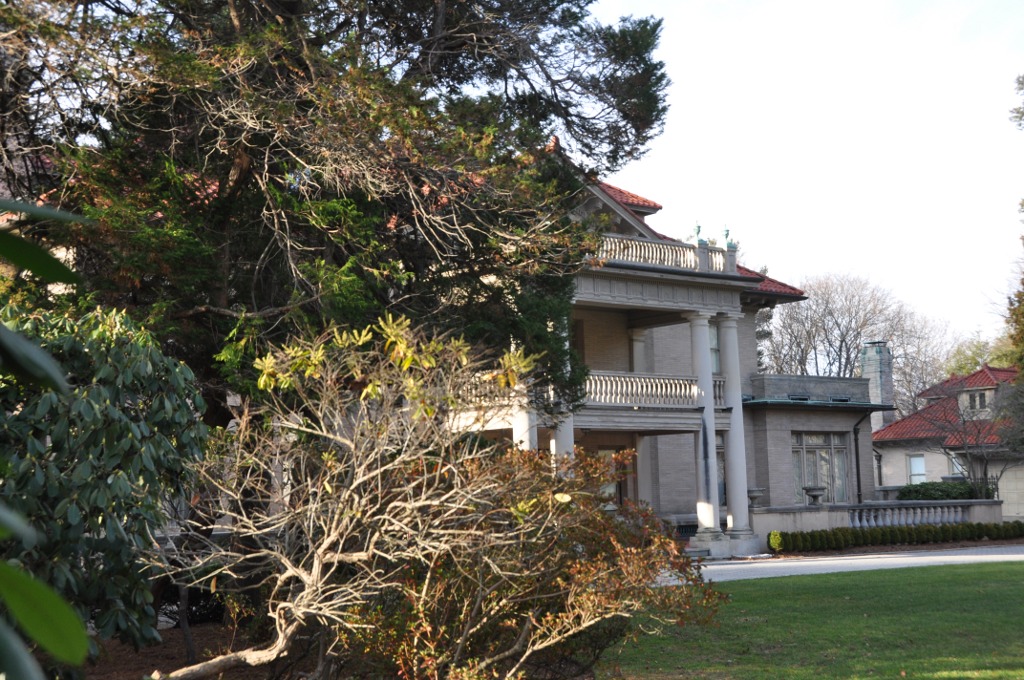
The Gray Cliff Historic District is a residential historic district encompassing a cluster of exceptionally high quality houses built in Newton, Massachusetts, between about 1890 and 1940. When first listed on the National Register of Historic Places in 1986, it included only the eight houses at 35, 39, 43, 53, 54, 64, 65, and 70 Gray Cliff Road, which were predominantly Shingle style house built before the turn of the 20th century. The district was expanded in 1990 to include an adjacent area known as The Ledges, where the houses were built between 1900 and 1940, and are mainly Colonial Revival and Tudor Revival in their styling. The Gray Cliff area was the estate of Massachusetts politician Robert Bishop before it was subdivided for development. The construction of Commonwealth Avenue increased development pressure, and his was one of many estates that was subdivided. The houses are large, and sited on well-proportioned lots that take advantage of the topography of the area, which features rocky outcrops and ledges. It is possible that the subdivision was laid out by a draftsman who once worked for Frederick Law Olmsted. The house at 53 Gray Cliff Road is one of Newton's finest Shingle style houses. The area of The Ledges was laid out between 1906 and 1912, and includes the original Bishop House at 40 The Ledges Road. This house was originally built in 1861, probably with Italianate styling, but was completely enlarged in the 1890s and restyled in the Colonial Revival style. Two of the houses in this area include two that were designed by architects for their own use: James Ritchie designed the Tudor style house at 10 The Ledges Road, and Henry J. Carlson designed the Colonial Revival house at 91 Bishopsgate Road for his own use; he also designed 131 Bishopsgate Road.

Farlow and Kendrick Parks Historic District

The Farlow and Kendrick Parks Historic District is a predominantly residential historic district in the Newton Corner area of Newton, Massachusetts. The district is roughly triangular in shape, and is bounded on the north by the Massachusetts Turnpike, Park Street to the east, and Franklin and Newtonville Avenues to the west. It is roughly bisected by Church Street, and is named for two parks that are significant focal elements of the district. Kendrick Park is a small lozenge-shaped park at the southern tip of the district designed by Alexander Wadsworth; it was laid out at the request of William Kendrick, a horticulturalist whose c. 1822 Federal style house was moved to the area after the park was completed. Farlow Park is a larger rectangular park in the district's northwest, which was established by a gift from John Farlow. It is landscaped in a manner similar to the Boston Public Garden, with specimen trees and an artificial pond with bridge. The distrct was one of the first major areas of suburban residential development in Newton, spurred by the railroad station at Newton Corner, and the development of streetcar lines. There was some early development in the 1840s, resulting in a number of Greek Revival and Italianate houses being built in the area, but major development occurred between 1870 and 1910, resulting in a significant number of Queen Anne and Colonial Revival houses. The district includes two significant churches: the 1885 Immanuel Baptist Church, designed by H. H. Richardson, and the 1897 Newton Methodist Episcopal Church by Cram, Wentworth and Goodhue. The district was listed on the National Register of Historic Places in 1982, and expanded in 1986, adding a section of Park Street near the southern tip of Kendrick Park.

Hyde Avenue Historic District

The Hyde Avenue Historic District is a residential historic district encompassing the stylistic range of houses being built in the Newton Corner area of Newton, Massachusetts in the 1880s. It includes the five houses at 36, 42, 52, 59, and 62 Hyde Avenue, The district was added to the National Register of Historic Places in 1986. Hyde Avenue is a residential side street on the south side of Newton Corner, connecting Centre Street and Sargent Street, with a ninety degree turn about one third of the way from Centre Street. At the point of this turn is a slightly enlarged loop around a small grassy area. Four of the five houses are on the east side of Hyde Avenue running south from this turn, while the fifth is at the southwest junction of Hyde Avenue and Garden Road, another minor residential street. The houses at 36 and 52 Hyde Avenue are Queen Anne in their styling, and were built in 1880 and c. 1893, respectively. The houses at 59 and 62 Hyde are Colonial Revival, and were built c. 1885 and c. 1897. The fifth house, 42 Hyde, is a Shingle style house built in 1885. The Hyde Avenue area was originally part of a 43-acre farm, which was subdivided and mostly sold off by George Hyde, a city assessor, selectman, and bank director. The house at 36 Hyde, while somewhat boxy, has a wealth of Queen Anne styling, including an asymmetrically sited entry, decorative wood shingling, and spindled friezes on its porch. 42 Hyde, the only Shingle style house, has an arcaded wraparound porch and conical dormers. The Colonial Revival house at 62 Hyde has a porch entry with clustered columns.

Newton Theological Institution Historic District

The Newton Theological Institution Historic District is an historic district in the village of Newton Centre in Newton, Massachusetts. It encompasses not only the campus of the Newton Theological Institution, now known as the Andover Newton Theological School, but also a cluster of fashionable 19th century houses north of the campus, on Herrick Road and Chase and Cypress Streets. The school was the first outside educational institution in Newton. The district was listed on the National Register of Historic Places in 1986. The Andover Newton Theological School, the nation's oldest interdenominational religious seminary, was founded in 1931 by the merger of two other religious schools: the Newton Theological School, founded in 1825 as the nation's first Baptist seminary, and the Andover Theological Seminary, a Congregational seminary founded in 1807. The property in Newton Centre was purchased in the 1820s by the Baptists, who built the school's oldest surviving building, Farwell Hall, in 1828. Originally Federal in style, it was raised with a mansard roof in 1857. Colby Hall, separately listed on the National Register, was builtin 1866 to accommodate a growing student population. Sturtevant Hall was followed by Burgess Gymnasium and Hills Library before the school merger took place. Just north of the campus is a small residential area with high-quality mid-to-late 19th century houses, some that have association with the school. The house at 70 Chase Street is probably Newton's finest example of Second Empire styling; it was built for John Sanborn, a Boston merchant and politician. The 1906 Colonial Revival house at 120 Herrick Street may have been built by the school to house visiting teachers. 102 Herrick Street, a Queen Anne/Stick style house built c. 1883 was home to a clergyman.

This attraction is located in

This is a private property. Please enjoy respectfully and do not disturb the occupants.

Edit Categories
Add Tours

This attraction is not part of any tours

Add Collections

This attraction is not part of any collections


Some of the attractions we imported from Wikipedia are not perfect. Send us an email detailing what's wrong and we'll look into fixing it.

GuRoute is all about Gurus sharing their local knowledge. If you feel up to fixing this problem yourself, why not adopt it. You will become the owner and can fix whatever problems you see.

We've copied a link to this attraction into your clipboard so that ou can paste it into an email or text message...

More Info...
You can add your friends to the visit yourself, or, send them a link and let them add themselves...

The visit will appear on both your timelines and on your Shared Timeline.

Click below and we'll email you a link that you can send on to friends or post on your group's Facebook page.

If your friends aren't members of GuRoute yet, this is a great way to get them started.
Recent
Recently used Collections will appear here...
Recent
Recently used tours will appear here...

Where is this?

GuRoute likes to place attractions inside other attractions. So, maybe it's in a city, or maybe it's inside a particular park in that city. Maybe your attraction is a huge park that spans half the county, or multiple counties.

Determining where this attraction is gives it context - if it's in a park, you'll be able to see it alongside all the other attractions in that park. And that helps define the park.

GuRoute will automatically calculate a parent region for this attraction. You can change it if there is something more appropriate.

This attraction is currently located in .

Change

This attraction does not yet have any reviews

Please login to write a review...

Reviewed by
Record new Visit

Add this location to your timneline?

  • If there's an existing attraction open it and add it to your timeline...
  • If not, enter a title and we'll create a new attraction for your memories...
Create new Attraction

Create a new attraction at this location?

  • We rely on Gurus like you to share your local knowledge...
(Give a name for this location)


+
Add this to your timeline instead...

Imagine having a record of all the cool things you've done in your life!


Using our timeline you can keep track of everywhere you visit in your lifetime...

But, you'll need to sign in first...

Add contacts so that you can share your travels and record places that you visit together...

Family
Favorites
Family
Favorites

Profile TimeLine Our Visits Edit Accept Decline Invite

If you have any more friends that visited this place with you, feel free to add them to the visit. We'll write it to their timeline and once they confirm it, they too will have this memory for a lifetime.

If they're not already registered, you just need their name and email address and you can add them and we'll send them an invite on your behlaf.

Add a tour comment

Add some extra information for when this attraction is viewed as part of your tour...

Next Stop Instructions

Add some instructions for what to see/do on the way to the next stop...

Next Stop Instructions

Add some instructions for what to see/do on the way to the next stop...

If you're visiting an existing attraction, open it and add it to your timeline. If there is no attraction for the place you are visiting...

  • Click 'Add My Location' below
  • Or right-click on the map to mark a different location
  • Or long-press if you have a touch screen
You can even add locations while you're offline....
  • Load up the map when you're online and we'll keep track of your locaiton
  • You can add locations to your timeline
  • When you are online again we'll sync them with the cloud

We can't connect to the internet right now. The following attractions are saved locally and can be uploaded when you're online...

GuRoute would like to access your current location so that we can pin you on the map and show you nearby attractions

Add friends so that you can share your experiences with each other...

Add tour to What's Next?

Go...

Either for yourself or someone else...

  1. Do your trip research in GuRoute
    Add all the places that you think might be worthy of a visit into a trip-plan
  2. Add your trip-plan to your "What's Next" timeline
    (or a friend's "What's Next" timeline)
  3. When you're on vacation you'll have all your research at your fingertips
  4. Share your timline with your friends
    They can enjoy your vacation with you, seeing not only where you've been, but where you're going next...
  5. Add/remove attractions if things change

It also makes a great souvenir of your trip

Collections

Go...

Create a home page for a collection of attractions

  • Add an image and description to display on the homepage
  • Start adding content
    Add existing attractions to your collection or create new attractions of your own
  • Collections can be:
    • Public (Anyone can add attractions to your collection)
    • Shared (Only yourself and Gurus you nominate can add content)
    • Private (The collection will only be visible to yourself)

Uses

  • Local business or hotel
    Showcase local attractions that you endorse
  • Clubs
    Showcase attractions that members have created (eg. local historical society)
  • Special Interest
    If GuRoute does not have a category for your special interest you add your attractions to your own collection instead

Examples

Walking/Driving Tours

Go...

A guided tour where GuRoute will direct you from stop to stop and narrate a description of each attraction you arrive at

  • GuRoute uses your phone's GPS to guide you from stop to stop
  • GuRoute automatically detects when you arrive at the next tour-stop and narrates the description of the attraction (Chrome Only)
  • It then sends you on to the next stop

Tours are great to attract people to your town. Even places with no significant points of interest can be lots of fun when part of a tour


Cater tours to your Audience

  • Kid-friendly Tours
    • Focus on what will keep kids interested
    • Instead of parents having to drag their kids around they'll be struggling to keep up
    • Let the kids navigate and they'll get more fun out of finding that historical plaque than they ever would from reading it
  • Accessible tours
  • Short and long tours of the same location

What you need to do...

  1. Click 'Go...'
    Enter a title, description and location for the tour
  2. Add existing attractions OR create new ones and add them to the tour
  3. For existing attractions you can add more information specific to the theme of the tour
  4. You can also add instructions on what to do or see en-route to the next tour-stop
  5. Try out your tour and see how it works...

Mystery Tour

Go...

Create a Mystery Tour

Create a series of clues to show people around a city, neighborhood or whatever place you like...

  • GuRoute will show people clues to get them from attraction to attraction
  • When they reach each stop GuRoute will tell them about the place and give them the next clue
  • Take as long or as you like and explore each location at your leisure

Scavenger Hunt

Go...

Create a Scavenger Hunt

Create a series of questions that people have to answer. The answers can all be discovered by walking aroung the area, looking for clues.

  • How many beers are on tap at Michael Collin's Irish Bar?
  • What's the name of the oldest building on main streeet?
  • Show a picture of some public art and ask them what it is called
  • Clues can have numeric or multiple choice answers