Sign In

My Timeline

GuRoute

Discover Your World

Share your Experiences

Record your Life


Top Attractions in Williamsburg

Colonial Williamsburg

Colonial Williamsburg is a living-history museum and private foundation presenting part of a historic district in the city of Williamsburg, Virginia, USA. Colonial Williamsburgs 301-acre Historic Area includes buildings from the eighteenth century, as well as 17th-century, 19th-century, Colonial Revival structures and more recent reconstructions. The Historic Area is an interpretation of a colonial American city, with exhibits of dozens of restored or re-created buildings related to its colonial and tangential American Revolutionary War history. In the late 1920s, the restoration and re-creation of colonial Williamsburg was championed by the Reverend Dr. W. A. R. Goodwin, other community leaders, such organizations as the Association for the Preservation of Virginia Antiquities, the Colonial Dames, the Daughters of the Confederacy, and the Chamber of Commerce as well as the scion of the Rockefeller family, John D. Rockefeller, Jr., and his wife, Abby Aldrich Rockefeller, to celebrate rebel patriots and the early history of the United States. In World War II it indoctrinated soldiers and sailors, during the Cold War it promoted anti-Communism and it purports today to advance citizenship. One of the largest history projects in the nation, it is a major tourist attraction for the Williamsburg area, and is part of the Historic Triangle of Virginia, which includes Jamestown and Yorktown, linked by the Colonial Parkway. The site has been used for conferences by world leaders and heads of state, including U.S. Presidents. Colonial Williamsburgs Historic Areas combination of restoration and re-creation of parts of the colonial towns three main thoroughfares and their connecting side streets attempts to suggest the atmosphere and the circumstances of 18th-century Americans. Colonial Williamsburgs motto has been "That the future may learn from the past". In 2014, the institutions president told staff that the late Mr. Rockefeller, who coined the motto, would be distressed to learn it was still used, and said it was under review. Costumed employees work and dress as people did in the era, sometimes using colonial grammar and diction . Prominent buildings include the Raleigh Tavern, the Capitol, the Governors Palace, as well as the Courthouse, the George Wythe House, the Peyton Randolph House, the Magazine, and independently owned and functioning Bruton Parish Church all . Colonial Williamsburgs portion of the Historic Area begins east of The College of William Marys College Yard.

Peyton Randolph House

Peyton Randolph House, also known as Randolph-Peachy House, is a home in Williamsburg, Virginia. It was the home of Peyton Randolph, first President of the Continental Congress. It is located within what is now known as Colonial Williamsburg. The large estate, reconstructed and comprised of three main connected houses and several outbuildings, is one of the oldest and most original colonial buildings in Williamsburg. The original west wing structure was built in 1715 by William Robertson. Sir John Randolph, the only colonial Virginian knighted by the British Monarchy, purchased the home in 1721. He later purchased the properties east lot on July 20, 1724 for £50, where he built a second home. Upon his death in 1737, Sir Randolph willed the property to his son, Peyton Randolph. Peyton connected the two structures to form one large estate, with the exception of the smaller east wing of the home that exists today, which can only be accessed through the outside. The Virginia Delegates to the Continental Congress, including Peyton Randolphs cousin Thomas Jefferson, met here before departing to Philadelphia. During the Revolutionary War, the home was used as French headquarters by General Jean-Baptiste-Donatien de Vimeur, comte de Rochambeau preceding the Battle of Yorktown in 1781. When Peytons wife Betty Randolph died in 1782, the house went up for auction and was sold in 1783 to Joseph Hornsby. The Peachy family purchased the home in the early 19th century, and they welcomed the former French General Marie-Joseph-Paul-Yves-Roch-Gilbert du Motier, marquis de Lafayette on October 20 and 21 of 1824. During the Civil War, the home was still owned by the Peachy Family and was used as a hospital for Union and Confederate troops wounded during the Battle of Williamsburg on May 5, 1862. The homes east wing also contained at least two Native American Indian burial sites and pottery. These graves were disturbed during the construction of the tunnel for the Colonial National Historic Parkway in 1941 and are featured prominently on the Williamsburg Ghost Tour, which has provided research into the Randolph Houses pre-restoration past. It was declared a National Historic Landmark in 1970.

Carter's Grove

Carters Grove, also known as Carters Grove Plantation, is a 750-acre plantation located on the north shore of the James River in the Grove Community of southeastern James City County in the Virginia Peninsula area of the Hampton Roads region of Virginia in the United States. The plantation was built for Carter Burwell, grandson of Robert "King" Carter, and was completed in 1755. It was probably named for both the prominent and wealthy Carter family and nearby Grove Creek. Carters Grove Plantation was built on the site of an earlier tract known as Martins Hundred which had first been settled by the English colonists around 1620. In 1976, an archaeological project discovered the site of Wolstenholme Towne, a small settlement downstream a few miles from Jamestown which had been developed in the first 15 years of the Colony of Virginia. The population of the settlement was decimated during the Indian Massacre of 1622. After hundreds of years of multiple owners and generations of families, and the death of the last resident in 1964, Carters Grove was added to Colonial Williamsburg Foundations properties through a gift from the Rockefeller Foundation in 1969. Carters Grove was open to tourists for many years but closed its doors to the public in 2003 while CW redefined its mission and role. Later that year, Hurricane Isabel seriously damaged Carters Grove Country Road, which had linked the estate directly to the Historic Area, a distance of 8 miles, bypassing commercial and public roadways. CW then shifted some of the interpretive programs to locations closer to the main Williamsburg Historic Area and announced in late 2006 that it would be offered for sale under specific restrictive conditions, including a conservation easement. In December 2007, CNET founder Halsey Minor acquired the Georgian style mansion and 476 acres for $15.3 million and announced plans to use it as his home and for a thoroughbred horse breeding program with the Phipps family. The Virginia Outdoors Foundation and the Virginia Department of Historic Resources co-hold the conservation easement on 400 of the 476 acres. However, Minor never lived in the property and filed for personal bankruptcy in 2013. The Colonial Williamsburg Foundation submitted the only bid on the auction held on May 21, 2014, for the outstanding mortgage amount, and announced that it planned to resell it, with a price increased because of significant costs related to the sale, including over $600,000 in necessary repairs.

Jamestown

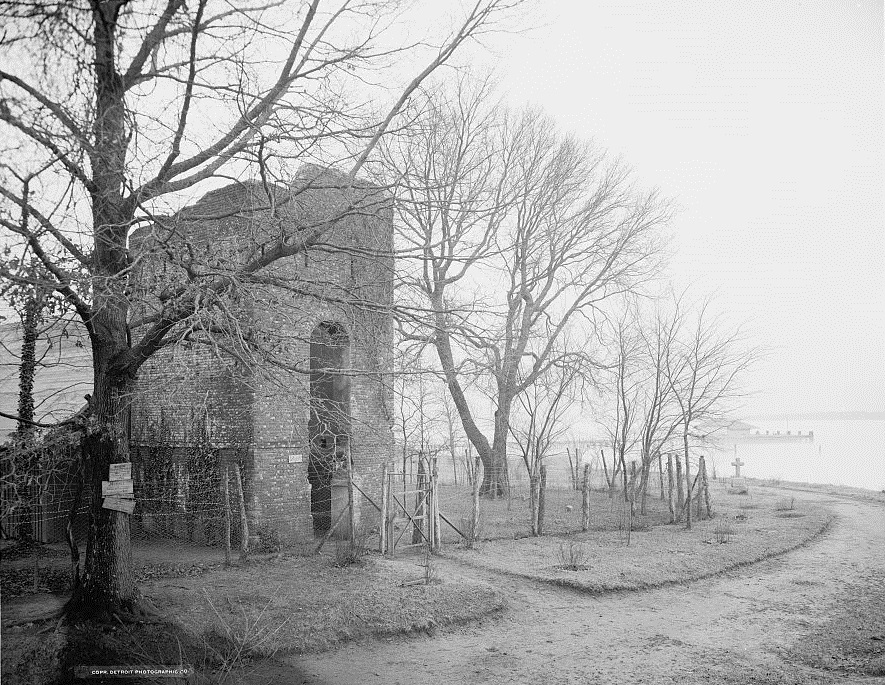
The Jamestown settlement in the Colony of Virginia was the first permanent English settlement in the Americas. William Kelso says Jamestown "is where the British Empire began ... this was the first colony in the British Empire." Established by the Virginia Company of London as "James Fort" on May 4, 1607 (O.S., May 14, 1607 N.S.), and considered permanent after brief abandonment in 1610, it followed several earlier failed attempts, including the Lost Colony of Roanoke. Jamestown served as the capital of the colony for 83 years, from 1616 until 1699. The settlement was located within the country of Tsenacommacah, which was administered by the Powhatan Confederacy, and specifically in that of the Paspahegh tribe. The natives initially welcomed and provided crucial provisions and support for the colonists, who were not agriculturally inclined. Relations with the newcomers soured fairly early on, leading to the total annihilation of the Paspahegh in warfare within 3 years. Mortality at Jamestown itself was very high due to disease and starvation, with over 80% of the colonists perishing in 1609-1610 in what became known as the "Starving Time". In 1608, in the Second Supply, the Virginia Company brought eight Polish and German colonists, of whom some built a small glass factory, although the Germans and a few others soon defected to the Powhatans with weapons and supplies from the settlement. The Second Supply also brought the first two European women to the settlement. In 1619, the first documented Africans—about 50 men, women and children—came to Jamestown aboard a Portuguese slave ship that had been captured in the West Indies and brought to the Jamestown region. They most likely worked in the tobacco fields as indentured servants initially. The modern conception of slavery in the future United States was formalized in 1640 and was fully entrenched in Virginia by 1660. The London Company's second settlement, Bermuda, claims to be the site of the oldest town in the English New World, as St. George's, Bermuda was officially established in 1612, whereas James Fort, in Virginia, was not to be converted into James Towne until 1619, and further did not survive into the present day. In 1676, the town was deliberately burned during Bacon's Rebellion, though it was quickly rebuilt. In 1699, the capital was relocated from Jamestown to what is today Williamsburg, after which Jamestown ceased to exist as a settlement, existing today only as an archaeological site. Today, Jamestown is one of three locations comprising the Historic Triangle of Colonial Virginia, along with Williamsburg and Yorktown, with two primary heritage sites. Historic Jamestowne, the archaeological site on Jamestown Island, is a cooperative effort by Jamestown National Historic Site (part of Colonial National Historical Park), and Preservation Virginia. Jamestown Settlement, a living history interpretive site, is operated by the Jamestown Yorktown Foundation in conjunction with the Commonwealth of Virginia.

Wren Building

The Wren Building is the signature building of the College of William Mary in Williamsburg, Virginia, USA. Along with the Brafferton and Presidents House, these buildings form the Colleges Ancient Campus. Construction of the first building on this site began August 8, 1695 and was completed by 1700. After several fires and rebuildings, the Wren Building was the first major building restored or reconstructed by John D. Rockefeller, Jr., after he and the Reverend Dr. W.A.R. Goodwin began Colonial Williamsburgs restoration in the late 1920s. Although the buildings current state dates to the 20th-century restoration by Boston architects Perry Shaw Hepburn, the College named the building in honor of the English architect Sir Christopher Wren, after the Reverend Hugh Jones, a William and Mary mathematics professor, wrote in 1724 that the College Building was “modeled by Sir Christopher Wren”. Perry Shaw and Hepburns restoration reflects the buildings historic appearance from its reconstruction in 1716 after a 1705 fire to 1859, when it burned again. The building is constructed out of red brick in the style of Flemish Bond, as was typical for official buildings in 17th- and 18th-century Williamsburg, including several walls remaining from previous structures, and it contains classrooms, offices, a refectory, kitchen, and a chapel . On the top of the building is a weather vane with the number 1693, the year the College was founded. In the early 1770s, plans were drawn up to complete the building as a quadrangle. Alumnus Thomas Jefferson drew up a floorplan submitted to Governor Dunmore and foundations were laid in 1774. The looming War of Independence halted further construction, however, and the fourth wing was never completed. The foundations, however, still exist.

This attraction is located in

This is a private property. Please enjoy respectfully and do not disturb the occupants.

Edit Categories
Add Tours

This attraction is not part of any tours

Add Collections

This attraction is not part of any collections


Some of the attractions we imported from Wikipedia are not perfect. Send us an email detailing what's wrong and we'll look into fixing it.

GuRoute is all about Gurus sharing their local knowledge. If you feel up to fixing this problem yourself, why not adopt it. You will become the owner and can fix whatever problems you see.

We've copied a link to this attraction into your clipboard so that ou can paste it into an email or text message...

More Info...
You can add your friends to the visit yourself, or, send them a link and let them add themselves...

The visit will appear on both your timelines and on your Shared Timeline.

Click below and we'll email you a link that you can send on to friends or post on your group's Facebook page.

If your friends aren't members of GuRoute yet, this is a great way to get them started.
Recent
Recently used Collections will appear here...
Recent
Recently used tours will appear here...

Where is this?

GuRoute likes to place attractions inside other attractions. So, maybe it's in a city, or maybe it's inside a particular park in that city. Maybe your attraction is a huge park that spans half the county, or multiple counties.

Determining where this attraction is gives it context - if it's in a park, you'll be able to see it alongside all the other attractions in that park. And that helps define the park.

GuRoute will automatically calculate a parent region for this attraction. You can change it if there is something more appropriate.

This attraction is currently located in .

Change

This attraction does not yet have any reviews

Please login to write a review...

Reviewed by
Record new Visit

Add this location to your timneline?

  • If there's an existing attraction open it and add it to your timeline...
  • If not, enter a title and we'll create a new attraction for your memories...
Create new Attraction

Create a new attraction at this location?

  • We rely on Gurus like you to share your local knowledge...
(Give a name for this location)


+
Add this to your timeline instead...

Imagine having a record of all the cool things you've done in your life!


Using our timeline you can keep track of everywhere you visit in your lifetime...

But, you'll need to sign in first...

Add contacts so that you can share your travels and record places that you visit together...

Family
Favorites
Family
Favorites

Profile TimeLine Our Visits Edit Accept Decline Invite

If you have any more friends that visited this place with you, feel free to add them to the visit. We'll write it to their timeline and once they confirm it, they too will have this memory for a lifetime.

If they're not already registered, you just need their name and email address and you can add them and we'll send them an invite on your behlaf.

Add a tour comment

Add some extra information for when this attraction is viewed as part of your tour...

Next Stop Instructions

Add some instructions for what to see/do on the way to the next stop...

Next Stop Instructions

Add some instructions for what to see/do on the way to the next stop...

If you're visiting an existing attraction, open it and add it to your timeline. If there is no attraction for the place you are visiting...

  • Click 'Add My Location' below
  • Or right-click on the map to mark a different location
  • Or long-press if you have a touch screen
You can even add locations while you're offline....
  • Load up the map when you're online and we'll keep track of your locaiton
  • You can add locations to your timeline
  • When you are online again we'll sync them with the cloud

We can't connect to the internet right now. The following attractions are saved locally and can be uploaded when you're online...

GuRoute would like to access your current location so that we can pin you on the map and show you nearby attractions

Add friends so that you can share your experiences with each other...

Add tour to What's Next?

Go...

Either for yourself or someone else...

  1. Do your trip research in GuRoute
    Add all the places that you think might be worthy of a visit into a trip-plan
  2. Add your trip-plan to your "What's Next" timeline
    (or a friend's "What's Next" timeline)
  3. When you're on vacation you'll have all your research at your fingertips
  4. Share your timline with your friends
    They can enjoy your vacation with you, seeing not only where you've been, but where you're going next...
  5. Add/remove attractions if things change

It also makes a great souvenir of your trip

Collections

Go...

Create a home page for a collection of attractions

  • Add an image and description to display on the homepage
  • Start adding content
    Add existing attractions to your collection or create new attractions of your own
  • Collections can be:
    • Public (Anyone can add attractions to your collection)
    • Shared (Only yourself and Gurus you nominate can add content)
    • Private (The collection will only be visible to yourself)

Uses

  • Local business or hotel
    Showcase local attractions that you endorse
  • Clubs
    Showcase attractions that members have created (eg. local historical society)
  • Special Interest
    If GuRoute does not have a category for your special interest you add your attractions to your own collection instead

Examples

Walking/Driving Tours

Go...

A guided tour where GuRoute will direct you from stop to stop and narrate a description of each attraction you arrive at

  • GuRoute uses your phone's GPS to guide you from stop to stop
  • GuRoute automatically detects when you arrive at the next tour-stop and narrates the description of the attraction (Chrome Only)
  • It then sends you on to the next stop

Tours are great to attract people to your town. Even places with no significant points of interest can be lots of fun when part of a tour


Cater tours to your Audience

  • Kid-friendly Tours
    • Focus on what will keep kids interested
    • Instead of parents having to drag their kids around they'll be struggling to keep up
    • Let the kids navigate and they'll get more fun out of finding that historical plaque than they ever would from reading it
  • Accessible tours
  • Short and long tours of the same location

What you need to do...

  1. Click 'Go...'
    Enter a title, description and location for the tour
  2. Add existing attractions OR create new ones and add them to the tour
  3. For existing attractions you can add more information specific to the theme of the tour
  4. You can also add instructions on what to do or see en-route to the next tour-stop
  5. Try out your tour and see how it works...

Mystery Tour

Go...

Create a Mystery Tour

Create a series of clues to show people around a city, neighborhood or whatever place you like...

  • GuRoute will show people clues to get them from attraction to attraction
  • When they reach each stop GuRoute will tell them about the place and give them the next clue
  • Take as long or as you like and explore each location at your leisure

Scavenger Hunt

Go...

Create a Scavenger Hunt

Create a series of questions that people have to answer. The answers can all be discovered by walking aroung the area, looking for clues.

  • How many beers are on tap at Michael Collin's Irish Bar?
  • What's the name of the oldest building on main streeet?
  • Show a picture of some public art and ask them what it is called
  • Clues can have numeric or multiple choice answers