Sign In

My Timeline

GuRoute

Discover Your World

Share your Experiences

Record your Life


Top Attractions in Fort Worth

Amon Carter Museum of American Art

The Amon Carter Museum of American Art is located in Fort Worth, Texas. It was established by Amon G. Carter to house his collection of paintings and sculpture by Frederic Remington and Charles M. Russell. Carters will provided a museum in Fort Worth devoted to American art. His daughter, Ruth Carter Stevenson, carried out his wishes and the museum opened to the public in January 1961. When the museum opened in the aforementioned year, its first director, Mitchell A. Wilder, sought a broader vision for its collection. Wilder believed that the grand story of American art could be interpreted as the history of many artists at different times working on "successive frontiers" in the great pageant of American history. As a result of this vision, the museums collections began to expand in many categories, from the first landscape painters of the 1830s to modern artists of the twentieth century. Today, the collection includes masterworks by such artists as Alexander Calder, Thomas Cole, Stuart Davis, Thomas Eakins, Winslow Homer, Georgia OKeeffe, John Singer Sargent, Charles Demuth, Martin Johnson Heade and Alfred Stieglitz. The museum also possesses one of the premier collections of American photography in the nation, comprising more than 30,000 exhibition prints by some 400 photographers. The photography collection also includes the work and archives of several notable American photographers, including Laura Gilpin, Eliot Porter, and Karl Struss. The museum continues to collect American art and produce related programs, publications, and exhibitions. Philip Johnson, the museums original architect, designed and completed the buildings most recent expansion in 2001.

Fort Worth Japanese Garden

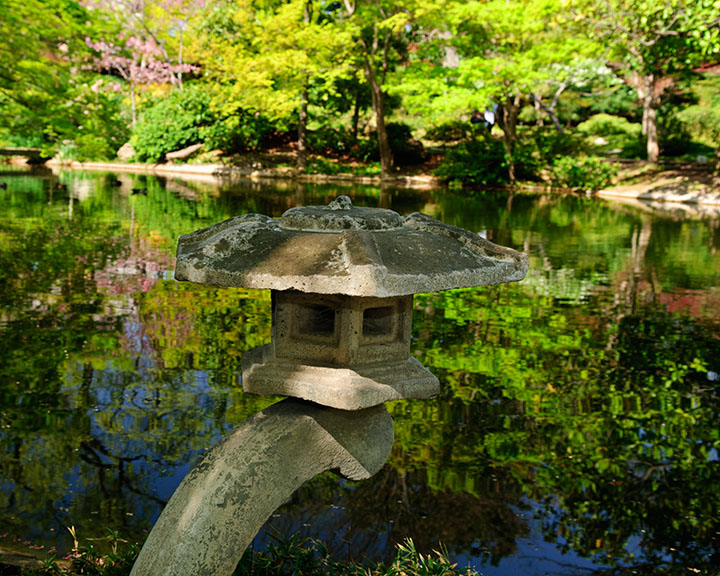
The Fort Worth Japanese Garden is a 7.5-acre Japanese Garden in the Fort Worth Botanic Garden. The garden was built in 1973 and many of the plants and construction materials were donated by Fort Worths sister city Nagaoka, Japan. Attractions at the garden include a zen garden, a moon viewing deck, waterfalls, cherry trees, Japanese maples, a pagoda, and fishfood dispensers to feed the hundreds of koi in the Japanese Gardens three ponds. The garden hosts two annual events, the Spring Festival and the Fall Festival, featuring demonstrations of Japanese art and culture. Scott Brooks, the Fort Worth Japanese Gardens senior gardener, reports: The Fort Worth Japanese Garden was originally constructed with materials donated from numerous individuals, businesses, and institutions in north Texas and elsewhere in the USA. In the 1990s, Fort Worths Japanese sister city, Nagaoka, donated an authentic Mikoshi to Fort Worth, which is currently housed within the gardens precincts. Several trees, including pines and flowering cherries, were similarly donated. Finally, Mr. Shigeichi Suzuki, a landscape architect from Nagaoka, donated plans for a karesansui-style addition to the Garden in 1997. The addition was completed in 2000, and is now called the Suzuki Garden. The Fort Worth Japanese Garden was built into a little valley, originally a gullied bluff, that opened onto the floodplain of the Trinity Rivers Clear Fork branch. Enlarged as a gravel quarry, the site also served at various times as a watering hole for cattle, a trash dump, and a squatters camp. Today, the secluded valley serves as a Japanese-style stroll garden . At the heart of the landscape is a system of ponds, surrounded by hills, and enclosed by a network of interconnected paths, pavilions, bridges, and decks. As the name implies, the garden unfolds as an ever-changing series of landscape perspectives to visitors who stroll along those thoroughfares. Built in the tradition of Edo-period stroll gardens, the Fort Worth Japanese Garden integrates several styles of garden design into a single landscape. Examples of the Hill-and-Pond, Dry Landscape, Tea Garden, and Enclosed-Garden, types are all expressed there. In addition, the garden features architectural elements derived from venues historically associated with Japanese gardening. These include Buddhist temples, Imperial villas, the estates of Samurai lords, and the townhouse gardens of wealthy merchants. Several unconventional architectural elements are exhibited in the Fort Worth Japanese garden. One of them, called the Pavilion, is derivative of a Shinto shrines main hall. It stands above the ground on posts, and features several gabled roofs with criss-crossed extensions . Another unusual garden element is the Mikoshi, an ornate palanquin donated to Fort Worth by the citizens of Nagaoka, Japan. Likewise, a taijitu, a graceful Indochinese Buddha, and three stone monkeys, are all atypical additions unique to this Fort Worth exhibit. The Karesansui Garden, is patterned after Kyotos famous Garden of the Abbots Quarters, at the Ryoanji temple complex. It is a classic fifteen-stone, Hira niwa composition, that has its own unique characteristics. One of them is an elevated and enclosed viewing veranda, evocative of a Japanese-style roofed bridge . It surrounds the flat garden, allowing it to be viewed from all sides. Another is the exclusion of plant material from the exhibits core. The fifteen boulders are surrounded by patterned gravel, enclosed within a stone retainer, and surrounded by black volcanic scoria. The only plants allowed to flourish within this composition are the fruticose lichens which have colonized the boulders surfaces. This minimalist exhibit stands as an exuisite metaphor of the famously sparse Zen aesthetic. The Fort Worth Japanese Gardens Moon-Viewing Deck is a creative adaptation of the Ginkakuji temples famous Kogetsudai sand cone. Fort Worths version is intended to be an interactive karesansui exhibit, in which visitors may ascend the flat-topped cone via steps, and view the composition from above. A Taijitu, lies embossed in exposed-aggregate concrete at the summit. This highly unusual addition to a Japanese garden is ultimately a cosmological symbol of Chinese origin. It also has other interpretations, including its most important contemporary association with Korean culture, and as a metaphor for oriental mysticism in American Pop culture. The exhibit also features an amphitheatre that is countersunk into the same platform as the cone. Together, they serve as a performance venue for the gardens two annual festivals, and as a moonlit chapel for weddings. Two karesansui exhibits at the Fort Worth Japanese Garden are evocative of rivers that originate in mountainous terrain. One of them begins adjacent the gardens Pavilion, and flows down a winding, boulder-lined channel, to a small lake or sea. Here, the water consists entirely of ornamental gravel, and can be viewed from several levels along its length. The other exhibit is near the gardens Moon-Viewing deck. Like the first, it begins in a group of boulders that are intended to suggest a craggy range of mountains. This river of mixed cobbles then descends along a terraced, boulder-lined channel, that is, in turn, surrounded by a berm of fine-textured turf. It disappears in the midst of several large boulders, like a river descending into a canyon. This creative departure from karesansui tradition was intended to suggest a purely American landmark. It is a garden metaphor of the Colorado River, which rises in the Rocky Mountains, flows across an elevated plateau, and descends into the depths of the Grand Canyon.

Fort Worth Water Gardens

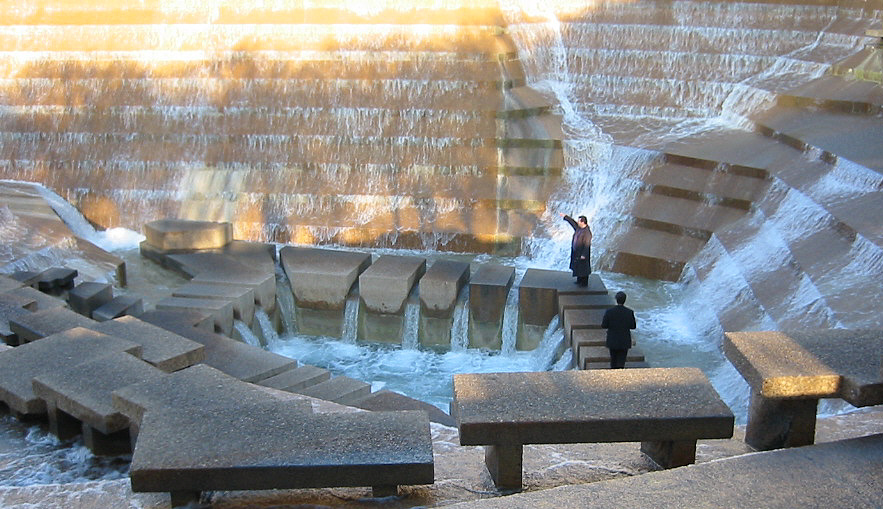
The Fort Worth Water Gardens, built in 1974, is located on the south end of downtown Fort Worth between Houston and Commerce Streets next to the Fort Worth Convention Center. The 4.3 acre Water Gardens were designed by noted New York architects Philip Johnson and John Burgee and were dedicated to the City of Fort Worth by the Amon G. Carter Foundation. The urban park is frequently billed as a "cooling oasis in the concrete jungle" of downtown. Its focal points are three pools of water and a terraced knoll, which helps to shield the park from the rest of the City. Interstate 30 was relocated from its former site immediately adjacent to the Water Gardens, making the south end of the park quieter. The park now sits adjacent to Lancaster Avenue, recently landscaped and prepared for redevelopment. The quiet, blue meditation pool is encircled with cypress trees and towering walls that are covered in thin plane of water that cascades almost 90 degrees down to the sunken blue water feature. The sound of the water on the walls evokes thoughts of a gentle rain shower. The aerating pool features multiple illuminated spray fountains under a canopy of large oak trees. The main attraction of the Water Gardens is the active pool which has water cascading 38 feet down terraces and steps into a small pool at the bottom. The active pool experience was built for people to walk down the terraced steps and experience the power, sounds and motion of water crashing around them. It was temporarily closed to the public after four people died there on June 16, 2004. Three children and one adult drowned after one of the children fell in the pool. The water was unusually deep due to a recirculating pump malfunction and heavy rains. The park was reopened on March 4, 2007 after being made safer by reducing the depth of the main pool from 9 ft to 2 ft . Part of the film Logans Run was filmed in the active pool at the Water Gardens in July 1975. The pool is also featured briefly at the end of the 1979 TV adaptation of The Lathe of Heaven.

Heritage Park Plaza

The Heritage Park Plaza, also known as Heritage Plaza or Heritage Park Overlook or Upper Heritage Park, in Fort Worth, Texas is a Modernist style park that was designed by Lawrence Halprin. The listed area is a 1/2 acre portion of the 112-acre Heritage Park. It is located at the northern edge of downtown Fort Worth and northwest of the Tarrant County Courthouse. The park lies at the original location where in the Spring of 1849, Major Ripley Arnold of the United States Army established a military post that became Fort Worth. The park opened on April 18, 1980. According to the National Park Service: Heritage Park Plaza is a public park in downtown Fort Worth, Texas designed by the internationally acclaimed architect Lawrence Halprin . The plaza design incorporates a set of interconnecting rooms constructed of concrete and activated throughout by flowing water walls, channels, and pools. Halprin later used this technique for the Franklin Delano Roosevelt Memorial in Washington, DC. This park represents one of Halprin's most significant projects and embodies his mature theories and philosophy of landscape design. The property was listed on the U.S. National Register of Historic Places on May 10, 2010. The listing was announced as the featured listing in the National Park Service's weekly list of May 21, 2010. The park has been closed because of safety concerns. The 2014 City of Fort Worth bond vote approved $1.5 million for repairs. Additional private funding has been secured. The plaza is expected to reopen in 2016.

Billy Bob's Texas

Billy Bob's Texas is a popular country & western nightclub in the Fort Worth Stockyards, Texas, United States. It promotes itself as "The World's Largest Honky Tonk" with 127,000 square feet . Billy Bob's opened April 1, 1981 to national attention with Larry Gatlin & the Gatlin Brothers as the first performers. Other artists who appeared that first week were Waylon Jennings, Janie Fricke and Willie Nelson. Since, artists such as Pat Green have carried on the tradition. In addition to several dance floors, musical stages, arcade games, and billiards tables, Billy Bob's is the home to a small indoor rodeo arena, in which they have weekend bullriding events. Built as a cattle barn in the early 1900s, the building was enclosed as a City of Fort Worth Centennial project in 1936. With sloped floors for easy cleaning due to the cattle pens, the building also had the perfect setting for a concert venue. That would have to wait nearly 40 years. During that gap, the building was used as an AT-10 airplane manufacturing plant and a department store. Clark’s Department Store was so large that the stock boys had to wear roller skates. But on April 1, 1981, Billy Bob Barnett opened what is now internationally known as “The World’s Largest Honky Tonk”. With a capacity over 6,000 people, over 20 bar stations, the best in entertainment and live bullriding, it was not long before Billy Bob’s Texas won the first of its five Academy of Country Music’s “Club of the Year” awards. BBT has also been awarded the Country Music Association’s “Club of the Year” twice. The nightclub quickly entered the public consciousness in the early 1980s with frequent references by the Ewing Clan on the soap opera Dallas. It was also featured prominently during CBS's New Year's Eve coverage, "Happy New Year America", during this period. Artists who were virtually unknown have received their big break at BBT, including George Strait, Alan Jackson, Reba McEntire and Travis Tritt. Many of them played in house bands, which perform every Wednesday through Saturday night on one of BBT’s two stages. And even though BBT is known for its hot, country music, they have also hosted some of the biggest acts around, including Bob Hope, B.B. King, James Brown, Men at Work, The Go-Go's, Styx, ZZ Top, Marvin Gaye, Tina Turner, Heart and Pat Benatar. Also on that list is Ted Nugent, who holds the one-day bar record at BBT. Hank Williams, Jr. holds the record for number of bottled beers sold with 16,000. BBT also features a Celebrity Wall, which shows concrete handprint impressions of the biggest stars ever to grace the stage there. Garth Brooks, Pat Green, Ringo Starr, George Thorogood, Peter Frampton, Conway Twitty, Johnny Cash, Waylon Jennings and Dottie West. Guests can also take home some of the best and brightest entertainers with the “Live at Billy Bob’s Texas” CD and DVD collection. Available in the gift store along with national retailers like Wal-Mart, Best Buy and others, artists include Willie Nelson, Merle Haggard, Pat Green, Cross Canadian Ragweed and more. Along with big-time concerts, BBT has live bull riding every Friday and Saturday night. There has never been a mechanical bull in Billy Bob’s but you will find some of the best up-and-coming riders in the country. These pro bull riders compete for cash prizes each weekend at 9pm and 10pm. Admission for each show is just $3.00.

Hotel Texas

The Hotel Texas is a historic hotel located in downtown Fort Worth, Texas. Designed by Sanguinet & Staats and Mauran, Russell, & Crowell, with Westlake Construction Co. as the contractor, it was constructed from 1920 to 1921. It is currently known as the Hilton Fort Worth On November 21, 1963 President and Mrs. John F. Kennedy stayed at the hotel in Room 850. The next morning, Kennedy gave what would be his last address in the Crystal Ballroom, just hours before he was assassinated in Dallas. An addition was constructed to the North in 1961, featuring a ballroom on the second level. A major renovation in 1968 that coincided with the opening of the Fort Worth Convention Center involved splitting the original two-storey lobby into two floors and the addition of a 49 m 13-floor annex across Commerce Street. The hotel operated as the Sheraton Fort Worth from 1968 until 1979. From 1979 to 1981, the hotel was restored by architects Jarvis, Putty, Jarvis. The restoration involved returning the "space" of the lobby to the original configuration, the creation of an all-new interior featuring an atrium between the wings of the "U" shaped tower, and the installation of new lighting on the upper levels to resemble the original lighting of the hotel. Following the restoration, the hotel began operating as the Hyatt Regency Fort Worth, and the original building and annex contained 502 guest rooms. The hotel changed management companies in 1995 operated as the Radisson Fort Worth until March 2006, under which the lights on the upper floors were turned off. From 2005 to 2006, the interiors of the hotel were upgraded, and on April 1, 2006, the hotel officially began operating as the Hilton Fort Worth. The annex tower was not converted and was left vacant. The Hilton Fort Worth currently contains 294 guest rooms. Part of the new work for the conversion included relighting the top of the building. The Hotel Texas was added to the National Register of Historic Places in July 3, 1979. A boundary increase was approved in November 2014 to include the annex as part of the listing.

This attraction is located in

This is a private property. Please enjoy respectfully and do not disturb the occupants.

Edit Categories
Add Tours

This attraction is not part of any tours

Add Collections

This attraction is not part of any collections


Some of the attractions we imported from Wikipedia are not perfect. Send us an email detailing what's wrong and we'll look into fixing it.

GuRoute is all about Gurus sharing their local knowledge. If you feel up to fixing this problem yourself, why not adopt it. You will become the owner and can fix whatever problems you see.

We've copied a link to this attraction into your clipboard so that ou can paste it into an email or text message...

More Info...
You can add your friends to the visit yourself, or, send them a link and let them add themselves...

The visit will appear on both your timelines and on your Shared Timeline.

Click below and we'll email you a link that you can send on to friends or post on your group's Facebook page.

If your friends aren't members of GuRoute yet, this is a great way to get them started.
Recent
Recently used Collections will appear here...
Recent
Recently used tours will appear here...

Where is this?

GuRoute likes to place attractions inside other attractions. So, maybe it's in a city, or maybe it's inside a particular park in that city. Maybe your attraction is a huge park that spans half the county, or multiple counties.

Determining where this attraction is gives it context - if it's in a park, you'll be able to see it alongside all the other attractions in that park. And that helps define the park.

GuRoute will automatically calculate a parent region for this attraction. You can change it if there is something more appropriate.

This attraction is currently located in .

Change

This attraction does not yet have any reviews

Please login to write a review...

Reviewed by
Record new Visit

Add this location to your timneline?

  • If there's an existing attraction open it and add it to your timeline...
  • If not, enter a title and we'll create a new attraction for your memories...
Create new Attraction

Create a new attraction at this location?

  • We rely on Gurus like you to share your local knowledge...
(Give a name for this location)


+
Add this to your timeline instead...

Imagine having a record of all the cool things you've done in your life!


Using our timeline you can keep track of everywhere you visit in your lifetime...

But, you'll need to sign in first...

Add contacts so that you can share your travels and record places that you visit together...

Family
Favorites
Family
Favorites

Profile TimeLine Our Visits Edit Accept Decline Invite

If you have any more friends that visited this place with you, feel free to add them to the visit. We'll write it to their timeline and once they confirm it, they too will have this memory for a lifetime.

If they're not already registered, you just need their name and email address and you can add them and we'll send them an invite on your behlaf.

Add a tour comment

Add some extra information for when this attraction is viewed as part of your tour...

Next Stop Instructions

Add some instructions for what to see/do on the way to the next stop...

Next Stop Instructions

Add some instructions for what to see/do on the way to the next stop...

If you're visiting an existing attraction, open it and add it to your timeline. If there is no attraction for the place you are visiting...

  • Click 'Add My Location' below
  • Or right-click on the map to mark a different location
  • Or long-press if you have a touch screen
You can even add locations while you're offline....
  • Load up the map when you're online and we'll keep track of your locaiton
  • You can add locations to your timeline
  • When you are online again we'll sync them with the cloud

We can't connect to the internet right now. The following attractions are saved locally and can be uploaded when you're online...

GuRoute would like to access your current location so that we can pin you on the map and show you nearby attractions

Add friends so that you can share your experiences with each other...

Add tour to What's Next?

Go...

Either for yourself or someone else...

  1. Do your trip research in GuRoute
    Add all the places that you think might be worthy of a visit into a trip-plan
  2. Add your trip-plan to your "What's Next" timeline
    (or a friend's "What's Next" timeline)
  3. When you're on vacation you'll have all your research at your fingertips
  4. Share your timline with your friends
    They can enjoy your vacation with you, seeing not only where you've been, but where you're going next...
  5. Add/remove attractions if things change

It also makes a great souvenir of your trip

Collections

Go...

Create a home page for a collection of attractions

  • Add an image and description to display on the homepage
  • Start adding content
    Add existing attractions to your collection or create new attractions of your own
  • Collections can be:
    • Public (Anyone can add attractions to your collection)
    • Shared (Only yourself and Gurus you nominate can add content)
    • Private (The collection will only be visible to yourself)

Uses

  • Local business or hotel
    Showcase local attractions that you endorse
  • Clubs
    Showcase attractions that members have created (eg. local historical society)
  • Special Interest
    If GuRoute does not have a category for your special interest you add your attractions to your own collection instead

Examples

Walking/Driving Tours

Go...

A guided tour where GuRoute will direct you from stop to stop and narrate a description of each attraction you arrive at

  • GuRoute uses your phone's GPS to guide you from stop to stop
  • GuRoute automatically detects when you arrive at the next tour-stop and narrates the description of the attraction (Chrome Only)
  • It then sends you on to the next stop

Tours are great to attract people to your town. Even places with no significant points of interest can be lots of fun when part of a tour


Cater tours to your Audience

  • Kid-friendly Tours
    • Focus on what will keep kids interested
    • Instead of parents having to drag their kids around they'll be struggling to keep up
    • Let the kids navigate and they'll get more fun out of finding that historical plaque than they ever would from reading it
  • Accessible tours
  • Short and long tours of the same location

What you need to do...

  1. Click 'Go...'
    Enter a title, description and location for the tour
  2. Add existing attractions OR create new ones and add them to the tour
  3. For existing attractions you can add more information specific to the theme of the tour
  4. You can also add instructions on what to do or see en-route to the next tour-stop
  5. Try out your tour and see how it works...

Mystery Tour

Go...

Create a Mystery Tour

Create a series of clues to show people around a city, neighborhood or whatever place you like...

  • GuRoute will show people clues to get them from attraction to attraction
  • When they reach each stop GuRoute will tell them about the place and give them the next clue
  • Take as long or as you like and explore each location at your leisure

Scavenger Hunt

Go...

Create a Scavenger Hunt

Create a series of questions that people have to answer. The answers can all be discovered by walking aroung the area, looking for clues.

  • How many beers are on tap at Michael Collin's Irish Bar?
  • What's the name of the oldest building on main streeet?
  • Show a picture of some public art and ask them what it is called
  • Clues can have numeric or multiple choice answers