Sign In

My Timeline

GuRoute

Discover Your World

Share your Experiences

Record your Life


Top Attractions in Dayton

SunWatch Indian Village

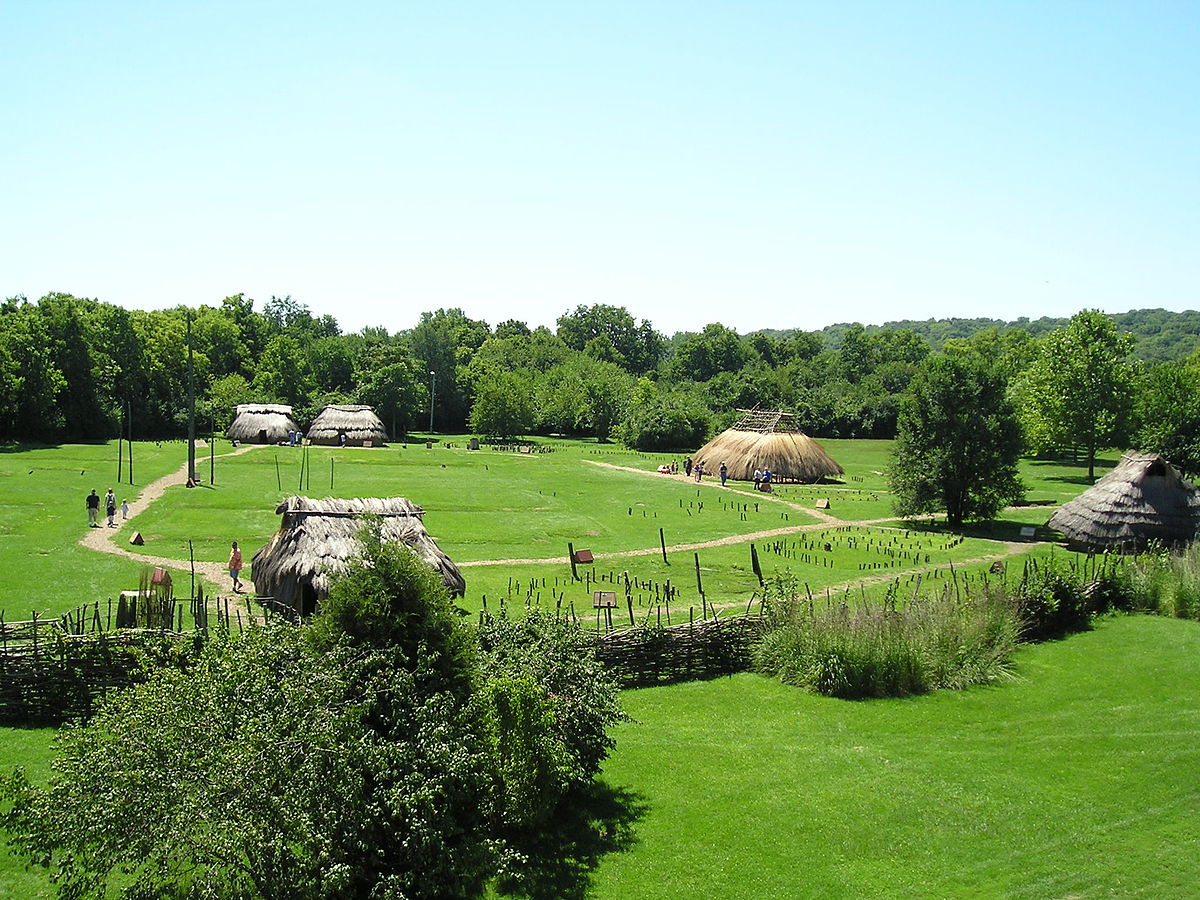
SunWatch Indian Village / Archaeological Park is a reconstructed Fort Ancient Native American village next to the Great Miami River in Dayton, Ohio. The dwellings and site plan of the 3-acre site are based on lengthy archeological excavations sponsored by the Dayton Society of Natural History, which owns and operates the site as an open-air museum. Amateurs had found some prehistoric materials at the site in the 1960s. Professional excavation began in 1971 as a salvage operation when the city planned a sewage treatment plant. With the discovery of significant artifacts and the remains of a stockaded village, the city changed its plans to preserve the site. Excavations continued through 1988 and are generally completed, although additional small studies have been done. The studies have revealed much about the original peoples dwellings, social organization, diets, burial practices and other aspects of their lives at the site. The circular village, surrounded by defensive palisades, was occupied for about 20 years, with a total population of about 250. They depended on farming and hunting. Scholars have named it Sun Watch because, since studies of the 1980s, they believe that a complex of posts in the plaza related to astronomical measurements. The Fort Ancient culture people, whose society was based on agriculture, would have planned rituals around a solar calendar. With reconstructed dwellings, a plaza and gardens, and an interpretive center, the village was opened in 1988 to the public as an open-air museum. Interpretive tours are offered as well as a variety of educational programs and special events developed in collaboration with Native American and other groups. Archaeological excavations are ongoing in the area, with special opportunities for school groups, graduate students, and adult learners. Additional artifacts and exhibits are held in the related Boonshoft Museum of Discovery in Dayton. These help interpret the history and culture of the people, and show more of the artifacts recovered at the site than can be displayed at SunWatch. Because of its archaeological value, the site was listed in 1974 on the National Register of Historic Places. Since that time, as the many years of archaeological research at the 3-acre site have led to important findings about the Fort Ancient culture, SunWatch Indian Village was designated in 1990 as a National Historic Landmark.

Woodland Cemetery and Arboretum

Woodland Cemetery and Arboretum, located at 118 Woodland Avenue, Dayton, Ohio, is one of the oldest "garden" cemeteries in the United States. Woodland was incorporated in 1842 by John Whitten Van Cleve, the first male child born in Dayton. He was the son of Benjamin Van Cleve and Mary Whitten Van Cleve. The cemetery began with 40 acres southeast of Dayton and has been enlarged to its present size of 200 acres . Over 3,000 trees and 165 specimens of native Midwestern trees and woody plants grace the rolling hills. Many of the trees are more than a century old and 9 have been designated "Ohio Champions." The highest point in Dayton is within the cemetery, and during the Great Dayton Flood of 1913, it became a place of refuge. The Romanesque gateway, chapel and office, completed in 1889, are on the National Register of Historic Places. The buildings were constructed of the stone from the original cemetery wall. The chapel has one of the finest original Tiffany windows in the country. A mausoleum, with a rock and bronze exterior, features twenty-two varieties of imported marble and twelve large stained glass windows inspired by famous literary works. It was added in 1970. The oldest original 105-acre section of the cemetery, known as "Victorian," received a second designation as a historic district on the National Register of Historic Places in 2011. A receiving vault large enough to contain 12 crypts was built in 1847 by Joseph Wuichert, who was said to be Dayton’s premier stonemason. Throughout the 19th century it was used for temporary storage when burials were delayed due to bad weather or for other reasons . Located near the main entrance to the cemetery and across from the mausoleum, it is constructed of giant limestone slabs and was designed as a replica of the Egyptian-style temple of Thebes and Karnak. It was unused for nearly 100 years but the exterior was restored in 2008 to its original condition.

Hawthorn Hill

Hawthorn Hill in Oakwood, Ohio, USA, was the post-1914 home of Orville, Milton, and Katharine Wright. Wilbur and Orville Wright intended for it to be their joint home, but Wilbur died in 1912, before the homes 1914 completion. The brothers hired the prominent Dayton architectural firm of Schenck and Williams to realize their plans. Orville and his father Milton and sister Katharine occupied the home in 1914. Though the property now comprises three acres, the mansion originally sat on 17 acres . The Wrights named the property after the hawthorn trees found on the property. There are at least 150 hawthorn trees on the site. Orville Wright designed some of the mechanical features of the house such as the water storage tank used to collect and recycle rainwater, and the central vacuum system; these features reflect his creative genius. For 34 years, this house was the gathering place for the greats and near-greats in the history of American aviation. The home was owned by the NCR Corporation after Orvilles death until August 18, 2006, when the company donated the historic home to the Wright Family Foundation in honor of Orvilles 135th birthday and National Aviation Day. NCR used it as a guesthouse for corporate VIPs and for corporate functions. On occasion they opened the home to the general public. In September 2007, Dayton History, in cooperation with the Wright Family Foundation, began offering scheduled public tours of Hawthorn Hill. NCR extensively redecorated the mansions interior after Orvilles death. Only Orvilles study approximates its pre-1948 appearance. However, Edward A. Deeds, then-chairman of the National Cash Register Company sent a photographer to the home immediately following Orvilles death to visually record the interior of the house at that time. The U.S. Secretary of the Interior designated Hawthorn Hill a National Historic Landmark in 1991 and added it to the U.S. World Heritage Tentative List in January 2008 as a part of the Dayton Aviation Sites listing. It is a component of the National Aviation Heritage Area.

Newcom Tavern

Newcom Tavern, also known as the "Old Cabin", is a historic structure in Dayton, Ohio. It was built in 1796 by Colonel George Newcom, one of the first settlers in Dayton after the Treaty of Greenville . It was established as the New Jersey Land Company, under the leadership of Jonathan Dayton, with partners General Wilkinson, General St. Clair and Colonel Ludlow, employed surveyors to lay out a town site between the two Miami rivers. The Newcom Tavern, built by Robert Edgar, was the first structure in the area. Edgar received seventy-five cents a day for its construction. The house originally consisted of two rooms: one upstairs and one downstairs, and was located at what became the southwest corner of Main and Water Streets, where "it stood there for almost a century." The size of the cabin was doubled two years after it was built and it served as Dayton's first school, first church, courthouse, council chamber and store. It was best known as a crossroads tavern in the Northwest Territory for all wagon men and drovers. In 1894 when architect Charles Insco Williams "tried to raze it to make way for an apartment building," the logs beneath the clapboards were found to be those of the old Newcom Tavern. In 1896 the Centennial Celebration Committee helped move the structure to Van Cleve Park on Monument Avenue and the Daughters of the American Revolution raised money to restore it. In 1896 it was opened as a public museum and held relics donated by Daytonians. The Tavern was moved once again in 1965 when it was relocated to Carillon Historical Park and became part of the Settlement Exhibit. The lower level of the tavern is open to the public, but the upper level is no longer open.

Apollo Observatory

Apollo Observatory is an astronomical observatory owned by Boonshoft Museum of Discovery and operated by the Miami Valley Astronomical Society at Boonshoft Museum of Discovery. The observatory is located at Boonshoft Museum of Discovery in Dayton, Ohio, United States. The observatory is named after Project Apollo and was dedicated in 1969. Because of its location in the vicinity of a major Air Force research and development arm at Wright-Patterson Air Force Base, the it has benefited from an infusion of top-notch technical talent. With funds raised by both the Museum and the Miami Valley Astronomical Society, a design by Richard Buchroeder was selected and built by members of the Society, many of whom worked in optics and engineering disciplines for the Air Force. Due to the selected design, the optical train was complex and turned out to be problematic to maintain. It was therefore later modified to a simpler Dall-Kirkham Cassegrainian design. The original building and the 50 cm telescope located in the dome were designed under the advice and guidance of MVAS members. The original building contained an optical laboratory complete with a shock-isolated optical test bench. It also contained space on the first floor where mirror grinding and polishing was performed. The remodeling of the Museum in 1991 resulted in the addition of a Digistar Planetarium at the expense of the MVAS optical shop areas. The second floor of the Apollo Observatory contains a large meeting room where monthly meetings and social gatherings are held. Adjacent to the meeting room is the MVAS library where members may check out most of the holdings for their use. The 50 cm telescope is also located on the second floor, just to the south of the meeting room. The MVAS claims that the 50 cm telescope is one of the largest telescopes available to the amateur astronomer in southwest Ohio, although increased light pollution combined with the thermal effects of the building limit its usefulness for serious amateur study.

Wright Cycle Company

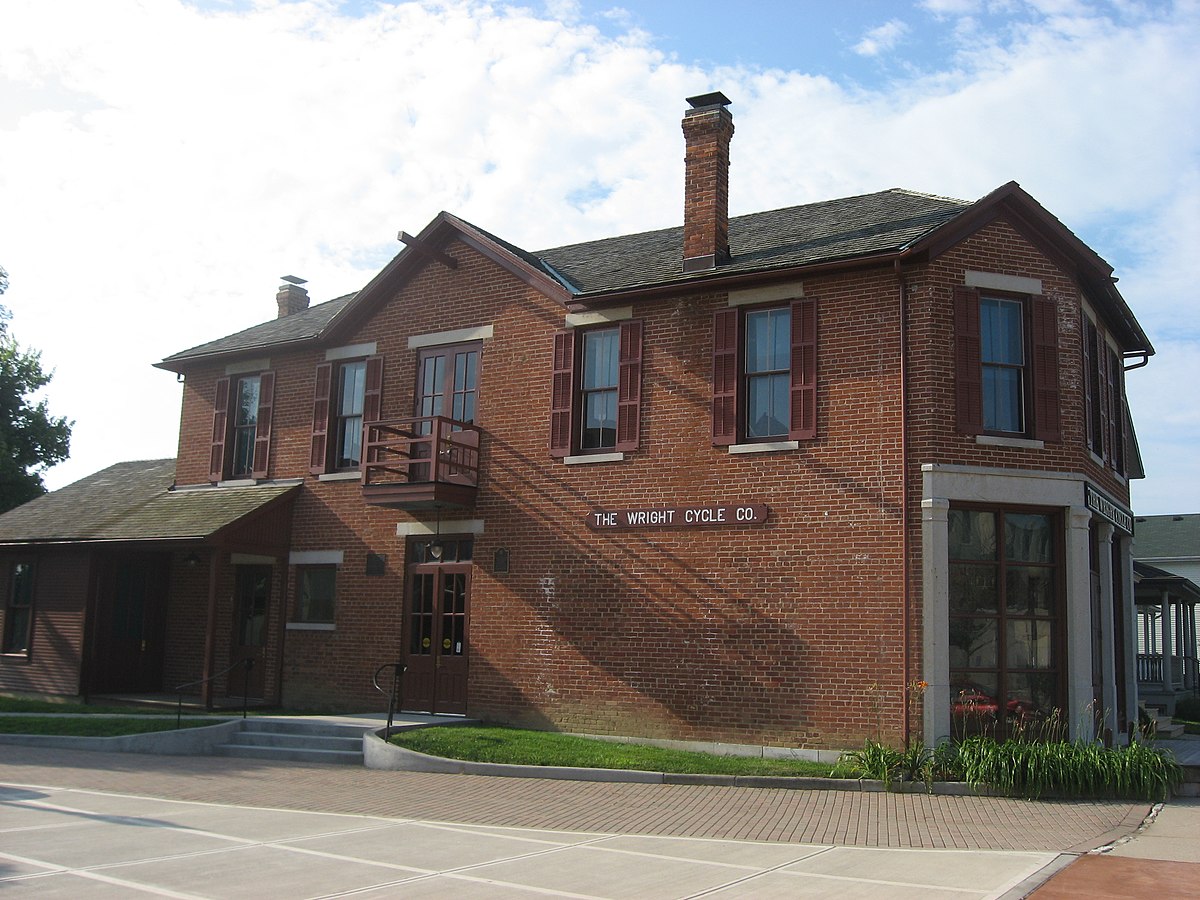
The bicycle business of the Wright brothers, the Wright Cycle Company successively occupied five different locations in Dayton, Ohio. Orville and Wilbur Wright began their bicycle repair, rental and sales business in 1892, while continuing to operate a print shop . In 1896 they began manufacturing and selling bicycles of their own design, the Van Cleve and St. Claire, named after their ancestors. They invented the self-oiling hub and the innovation of machining the crankarm and pedal on the left side of the bike with left-hand threads to prevent the pedal from coming unscrewed while cycling. The brick building at 22 South Williams St., where the Wrights worked from 1895 to 1897, is the only extant building on its original foundation and in its original location that housed a Wright bicycle shop. They ran their printing shop on the second-floor. The 22 South Williams Street building is part of Dayton Aviation Heritage National Historical Park and the National Aviation Heritage Area. The Wrights used the profits from the Wright Cycle Company to finance their aviation experiments. In 1901 they fitted a third bicycle wheel horizontally above the front wheel of one of their St. Claire bicycles and used the apparatus as a test platform to study airfoil design. They built a six-foot wind tunnel on the second floor of their bicycle shop at 1127 West Third St., the last location of their bicycle business, and from October to December they conducted pioneering tests in the tunnel of over 200 shapes of scale-model wings. In that same building they designed and constructed their gliders and first airplane, the Wright Flyer, which cost under $1,000 to build. The shop closed in 1909 and they started their aviation company. In 1937, with Orvilles cooperation, the building at 1127 West Third St. was moved to Greenfield Village, Dearborn, Michigan by Henry Ford.

Dayton Memorial Hall

The Dayton Memorial Hall is a historic meeting venue on First Street in downtown Dayton, Ohio, United States. Constructed shortly after the turn of the twentieth century, this Beaux-Arts structure is one of many memorial halls statewide from the same time period, and it has been named a historic site. The Memorial Hall is a brick building with a concrete foundation, a ceramic tile roof, and elements of stone and terracotta. Its central section, meant to hold the activities for which the building was constructed, is a two-story structure, while other sections vary in scale: a grand Neoclassical entrance, complete with paired columns in the Ionic order, sits atop a flight of steps in the middle of the facade, while lesser sections flank the entrance and compose the building's sides. Small towers are placed atop the sides, between the central auditorium and the surrounding land. Although the main entrance is only accessed via the flight of steps, side entrance may be gained by the use of a ramp. The building's entrance comprises the memorial itself, housing inscriptions honoring local Civil War soldiers and a sculpture honoring Spanish-American War soldiers; a World War I sculpture sits in the same area. Legislation enacted by the General Assembly in 1902 encouraged the construction of memorial buildings in communities statewide; for the first time, municipalities were permitted to float bonds in order to obtain money needed to construct such buildings. Designed by William Earl Russ, erected in 1907, and dedicated in 1910, Dayton's was typical of the numerous memorial buildings built soon after the law's passage, both architecturally and functionally. Throughout the century following, it served as a meeting place for community activities ranging from entertainment festivities to educational events to cultural activities. In 1988, the Memorial Hall was listed on the National Register of Historic Places, qualifying both because of its significant architecture and its important place in Dayton's history. Similar recognition has been awarded to other memorial halls in the Ohio cities of Cincinnati, Greenville, and Lima, all of which are Neoclassical structures completed soon after the 1902 legislation.

Isaac Pollack House

The Isaac Pollack House is a historic structure now located at 208 West Monument Avenue in Dayton, Ohio, United States. Built in 1876, this Second Empire house was originally home to the family of Isaac Pollack, a prominent Dayton businessman involved in the liquour trade. The walls are composed of a mixture of stone and brick with some wooden elements, resting on a stone foundation and covered with a slate roof. The house ceased to be used primarily as a residence in 1913. In that year, Fenton T. Bott purchased the house and began using it as the home of his Bott Dancing Academy, as well as his residence; he remained in business until 1941. Fifteen years later, the Montgomery County Board of Elections began a twenty-year period of using the property as their offices. In 1979, the house was moved from its previous location at 319 West Third Street to a new location at the intersection of Wilkinson Street and Monument Avenue. Its new location places it on the northern edge of downtown, just one block from the Great Miami River, across from McPherson Town, and near Interstate 75. On October 14, 2005, the structure became the home of the Dayton International Peace Museum. Two weeks before Christmas 1974, the Pollack House was listed on the National Register of Historic Places, qualifying both because of its architecture and because of its place as the residence of a prominent local citizen. It is one of approximately one hundred National Register-listed locations citywide and one of four on Monument Avenue, along with the old YMCA, the Engineers Club of Dayton, and the now-destroyed Hanitch-Huffman House.

James Brooks House

The James Brooks House is a historic house in downtown Dayton, Ohio, United States. Built in the 1830s and significantly modified later in the century, it was named a historic site in the 1970s. The Brooks House is a stone building with a brick foundation, an asphalt roof, and additional elements of stone and iron. Its basic plan is a simple rectangle, two stories tall, with an exposed basement. Additional rooms are created by a rear extension that was formed by walling up a large two-story veranda. The facade is three bays wide, with windows in the central and eastern bays of all three floors; the western bay is occupied by a window and the main entrance , while the western bay of the basement is blocked by a small staircase. Pilasters with Ionic capitals separate the second-story windows, while no comparable ornament is present below. A shallow hip roof covers the building, pierced by chimneys on either side, while its overhang permits room for a cornice composed of large bracket. The sides are noticeably plainer, with the most prominent element of the western side being a simple fire escape. The house's early history is rather enigmatic. It was built for English immigrant Thomas Clegg, a small-scale industrialist who owned Dayton's first iron and brass foundries, although the precise date is uncertain; a stone building was constructed on the present house's site in 1831, and while this may be the present house, it might not have been constructed until the following year. Montgomery County tax records are also inconclusive: they prove that Clegg never owned the property, nor paid taxes on it, but they fail to identify the owner of the property when the house was built. While the original design was clearly Greek Revival in style, renovations in the middle of the nineteenth century included modifications to the cornice and other changes that together produced an appearance typical of the earlier Victorian era. In 1975, the Brooks House was listed on the National Register of Historic Places, qualifying because of its historically significant architecture. Another building with the same designation, the Dr. Jefferson A. Walters House, lies in the same block of First Street.

Arnold Homestead

The Arnold Homestead is a historic homestead in the city of Huber Heights, a suburb of Dayton, Ohio, United States. Formed at the turn of the nineteenth century, it centers on an 1830s farmhouse that was built for an immigrant family from Virginia. Now part of a park, it has been named a historic site. A native of present-day West Virginia, Daniel Arnold sold his farm and brought his wife Catherine and five children to settle in present-day Huber Heights in the early nineteenth century. Members of the Dunkard Brethren Church, they typified the German immigrant church's gradual movement westward as it gradually integrated with American society. After renting land over their first winter, Arnold bought the present farmstead from Henry Harshberger and occupied it for the remnant of his life. The family used a log cabin during their first years at the site before significantly improving their lives by constructing the present house in 1835. Built of brick, the farmhouse rests on a stone foundation, is topped by an asphalt roof, and features additional elements of wood and asphalt. The basic plan is a simple two-story rectangle, wider than its length, with windowless ends that rise to chimney-topped gables. An extension, most of the width of the house, is attached to the rear, while a porch occupies the ell. Three windows pierce the second story on the facade, while the main entrance sits at the center of the first story between one window on either side. A small porch with a shed roof shelters the entrance. Besides the farmhouse, the complex includes a cemetery and six outbuildings, including the original log cabin and a bank barn. Today, the Arnold farmstead is the core of Carriage Hill MetroPark. The farmhouse is operated as a historic house museum, staffed by individuals costumed as nineteenth-century farmers, while other parts of the farmstead are operated for ancillary purposes. The complex was listed on the National Register of Historic Places in 1977, qualifying both because of its place in local history and because of Daniel Arnold's significance in the area's settlement. It is one of four Huber Heights locations on the Register, along with the Ausenbaugh-McElhenny House, the Taylorsville Canal Inn, and Lock Seventy on the Miami and Erie Canal.

Ausenbaugh-McElhenny House

The Ausenbaugh-McElhenny House is a historic house in the city of Huber Heights, a suburb of Dayton, Ohio, United States. Constructed in 1874, the Ausenbaugh-McElhenny House was originally home to one of the first men of Wayne Township, Joseph J. McElhenny, whose local prominence was demonstrated by his election to the office of justice of the peace. The house is one of the area's premier examples of 1870s architecture, due primarily to its Gothic Revival elements both on the exterior and the interior. It has been designated a historic site. Built of weatherboarded walls set on a stone foundation, the Ausenbaugh-McElhenny House is covered with an asphalt roof and features smaller elements of stone and wood. Decorative elements of the stonework include rusticated blocks on the exterior courses of the foundation, as well as the use of large stone blocks for the stairs from the ground to the entry porch, a large wooden structure. The overall plan resembles the letter "T" with some changes; including a one-story extension at the letter's base, as well as the presence of the shed-roofed porch in the side ell. Aside from the single-story extension, the house is a two-story building with walls that rise to gables. Both rounded and rectangular windows pierce the walls, while the porch-facing main entrance assumes the latter shape. Detailed Gothic-styled woodwork is placed at the peak of the gables, while a small chimney sits at the peak of the roof near the right end of the crosspiece of the "T". Inside, the design is simple but not ostentatious, its styling concentrating on the use of walnut-wood trim. The second story is accessed through an enclosed stairway with an ogive-shaped entryway located near the foyer. In 1975, the Ausenbaugh-McElhenny House was listed on the National Register of Historic Places, qualifying because of its historically significant architecture. The designation included two small structures, the house's privy and woodshed, as well as the main house. It is one of four Huber Heights locations on the Register, along with the Arnold Homestead, the Taylorsville Canal Inn, and Lock Seventy on the Miami and Erie Canal.

Samuel N. Brown House

The Samuel N. Brown House is a historic residence in southern Dayton, Ohio, United States. Constructed in the 1870s for a prominent industrialist, it has been used for commercial purposes since the 1920s, and it has been named a historic site. Samuel N. Brown, the original resident, was the owner of the Dayton-based firm of S.N. Brown and Company. Founded in 1847, it produced parts for horse-drawn carriages, such as wheel hubs, spokes, and entire wheels. Brown arranged in 1875 for the construction of the house, which was sold to a local hospital in 1920 and operated it until their bankruptcy in 1923. Much of its history has been spent as the location of an antique shop, although for a time in the 2000s it was used by Madisson House, a garment shop. The Brown House rests on a stone foundation and is covered with an asphalt roof; some sections of the walls are weatherboarded. Built in the shape of the letter "T", the house features components such as a tower at the left of the facade, a prominent mansard roof, and a veranda placed around the whole facade. Under the roof, the eaves feature a cornice composed of brackets with frieze. The house is a two-story structure with numerous dormer windows piercing the roof, most of them arched, while the first floor includes tall rectangular windows and some smaller square windows along with arches. Among the smaller details, yet still prominent, is the railing surrounding the top of the tower. Together, these elements produce the appearance of a Second Empire residence. In 1977, the Brown House was listed on the National Register of Historic Places, qualifying because of its historically significant architecture and because of its connection to Samuel Brown. Another National Register-listed property, the Westbrock Funeral Home, is located across the street.

Huffman Historic District

The Huffman Historic District is a historic neighborhood in eastern Dayton, Ohio, United States. Formed at the end of the nineteenth century primarily by a wealthy businessman, it has long been home to people of many different occupations and numerous places on the social ladder. After seeing very few changes throughout the twentieth century, it was named a historic site in the 1980s. William P. Huffman was both a banker and a real estate developer; although some of the land in the neighborhood had already been developed before Huffman became involved, he spurred development by arranging for the construction of a street railway on Third Street. The area's early residents occupied numerous places on the socioeconomic spectrum, ranging from laborers to merchants and artisans to executives. Their presence together in the neighborhood can still be seen in the built environment, most of which was built between 1870 and 1890. Several major architectural styles of the late nineteenth century appear in the district, including the Gothic Revival, Italianate, and Queen Anne. Although the district's peak period of growth ended by 1890, construction continued over the next decade, but virtually nothing was built after 1900. Minimal changes since that time have left the neighborhood resembling its appearance of over a century ago, preserving it as an example of late 19th-century developmental patterns. In mid-1982, the Huffman Historic District was officially declared and listed on the National Register of Historic Places, qualifying both because of the buildings' well preserved architecture and because of the entire district's connection to William P. Huffman. One of nineteen National Register-listed historic districts in the city, it is located immediately northeast of another, Saint Anne's Hill. The district comprises properties on sixteen streets in eastern Dayton, almost directly to the east of downtown. Its boundaries encompass 85 acres , more than ⅛ of a square mile. At the time the district was designated, it comprised 668 buildings, of which 663 were deemed contributing properties and 5 non-contributing; the ratio of contributing to non-contributing is far higher than in most historic districts in the United States, reflective of the lack of construction within the district since 1900.

Dr. Jefferson A. Walters House

Dr. Jefferson A. Walters House is a historic residence in downtown Dayton, Ohio, United States. Built in 1832 and one of the city's older houses, it was home to two prominent residents of early Dayton, and it has been named a historic site. Born in Fayette County in southwestern Pennsylvania, Jefferson Walters emigrated to Ohio in 1830 at the age of twenty. After studying medicine in Worthington, he practiced for three years in Perry County before moving to Dayton in 1837. During much of his life in the city, he distinguished himself as a successful pharmacist, operating a prosperous drugstore from 1841 until suffering a career-ending injury in an 1866 road accident. Although he ultimately regained his health, Walters chose not to return to the medical field, preferring instead a retirement full of philosophy and antiquarian research. Upon its completion in 1832, it was Dayton's first stone-faced brick residence. It was built for Thomas Clegg, owner of several factories and one of Dayton's most prominent early manufacturers. Built of brick with an asphalt roof, the house rests on a foundation of limestone and features additional elements of wood and limestone. The three-story facade features a main entrance on the first floor, framed by a post and lintel, and flanked by one window on either side, while three windows appear on the second and third stories. The present appearance mixes the Italianate style with elements of other Renaissance Revival styles, as a result of modifications performed in 1857. In 1974, Walters' house was listed on National Register of Historic Places, qualifying both because of its architecture and because of its prominent namesake resident. It is one of seven National Register-listed properties in a four-block stretch of First Street, along with First Lutheran Church at 138 W., the Biltmore Hotel and the Victoria Theatre at Main Street, the James Brooks House at 41 E., Antioch Temple at 107 E., and the Dayton Memorial Hall at 125 E.

Central Avenue Historic District

The Central Avenue Historic District is a small segment of the larger Grafton Hill neighborhood of Dayton, Ohio, United States. Composed of just two blocks near the border between Grafton Hill and Dayton View, the historic district comprises a cohesive collection of houses dating primarily from the turn of the 20th century, and it has been named a historic site. Central Avenue is a prominent example of Dayton's earliest suburbanizing trends, having been built for people who were leaving the original boundaries of the city in and around what is now downtown, along the Great Miami River. At this time, around the end of the 19th century and the beginning of the 20th, Dayton was undergoing rapid increases in population and commerce, due to unprecedented industrial growth. As a result, those who were leaving the older parts of the city and moving to Central Avenue were the nouveau riche, who were becoming rich for the first time as a result of wise investment in the city's booming industries. The historic district comprises nineteen buildings: eighteen contributing and one non-contributing. Primarily built as single-family houses, the buildings in the district lie along both sides of Central Avenue both north and south of its intersection with Federal Street, but in no direction does the district extend more than one block from the Federal-Central intersection: parts of Central in these two blocks, as well as all territory to the north, east, and south, comprise Grafton Hill's historic district, and a small non-historic strip is located along Salem Avenue, separating Grafton Hill from the larger Dayton View Historic District farther west. Its identity is not always kept separate from Grafton Hill; some community events, such as walking tours, lump these two blocks of Central Avenue with the surrounding neighborhood. Central Avenue was built at the height of the Victorian era in architecture, and many of the houses display Victorian styles such as Queen Anne, although later modes such as bungalows can also be found. The district's most prominent houses, located at 240 and 338 Central, are both Queen Annes. The built environment on Central Avenue has been well preserved to the point that the neighborhood was designated a historic district and listed on the National Register of Historic Places one week before Christmas 1982. Since that time, the neighborhood has gained further recognition via community-organized walking tours and from Preservation Dayton, which recognized two homeowners for their restoration of the house at 330 Central Avenue.

This attraction is located in

This is a private property. Please enjoy respectfully and do not disturb the occupants.

Edit Categories
Add Tours

This attraction is not part of any tours

Add Collections

This attraction is not part of any collections


Some of the attractions we imported from Wikipedia are not perfect. Send us an email detailing what's wrong and we'll look into fixing it.

GuRoute is all about Gurus sharing their local knowledge. If you feel up to fixing this problem yourself, why not adopt it. You will become the owner and can fix whatever problems you see.

We've copied a link to this attraction into your clipboard so that ou can paste it into an email or text message...

More Info...
You can add your friends to the visit yourself, or, send them a link and let them add themselves...

The visit will appear on both your timelines and on your Shared Timeline.

Click below and we'll email you a link that you can send on to friends or post on your group's Facebook page.

If your friends aren't members of GuRoute yet, this is a great way to get them started.
Recent
Recently used Collections will appear here...
Recent
Recently used tours will appear here...

Where is this?

GuRoute likes to place attractions inside other attractions. So, maybe it's in a city, or maybe it's inside a particular park in that city. Maybe your attraction is a huge park that spans half the county, or multiple counties.

Determining where this attraction is gives it context - if it's in a park, you'll be able to see it alongside all the other attractions in that park. And that helps define the park.

GuRoute will automatically calculate a parent region for this attraction. You can change it if there is something more appropriate.

This attraction is currently located in .

Change

This attraction does not yet have any reviews

Please login to write a review...

Reviewed by
Record new Visit

Add this location to your timneline?

  • If there's an existing attraction open it and add it to your timeline...
  • If not, enter a title and we'll create a new attraction for your memories...
Create new Attraction

Create a new attraction at this location?

  • We rely on Gurus like you to share your local knowledge...
(Give a name for this location)


+
Add this to your timeline instead...

Imagine having a record of all the cool things you've done in your life!


Using our timeline you can keep track of everywhere you visit in your lifetime...

But, you'll need to sign in first...

Add contacts so that you can share your travels and record places that you visit together...

Family
Favorites
Family
Favorites

Profile TimeLine Our Visits Edit Accept Decline Invite

If you have any more friends that visited this place with you, feel free to add them to the visit. We'll write it to their timeline and once they confirm it, they too will have this memory for a lifetime.

If they're not already registered, you just need their name and email address and you can add them and we'll send them an invite on your behlaf.

Add a tour comment

Add some extra information for when this attraction is viewed as part of your tour...

Next Stop Instructions

Add some instructions for what to see/do on the way to the next stop...

Next Stop Instructions

Add some instructions for what to see/do on the way to the next stop...

If you're visiting an existing attraction, open it and add it to your timeline. If there is no attraction for the place you are visiting...

  • Click 'Add My Location' below
  • Or right-click on the map to mark a different location
  • Or long-press if you have a touch screen
You can even add locations while you're offline....
  • Load up the map when you're online and we'll keep track of your locaiton
  • You can add locations to your timeline
  • When you are online again we'll sync them with the cloud

We can't connect to the internet right now. The following attractions are saved locally and can be uploaded when you're online...

GuRoute would like to access your current location so that we can pin you on the map and show you nearby attractions

Add friends so that you can share your experiences with each other...

Add tour to What's Next?

Go...

Either for yourself or someone else...

  1. Do your trip research in GuRoute
    Add all the places that you think might be worthy of a visit into a trip-plan
  2. Add your trip-plan to your "What's Next" timeline
    (or a friend's "What's Next" timeline)
  3. When you're on vacation you'll have all your research at your fingertips
  4. Share your timline with your friends
    They can enjoy your vacation with you, seeing not only where you've been, but where you're going next...
  5. Add/remove attractions if things change

It also makes a great souvenir of your trip

Collections

Go...

Create a home page for a collection of attractions

  • Add an image and description to display on the homepage
  • Start adding content
    Add existing attractions to your collection or create new attractions of your own
  • Collections can be:
    • Public (Anyone can add attractions to your collection)
    • Shared (Only yourself and Gurus you nominate can add content)
    • Private (The collection will only be visible to yourself)

Uses

  • Local business or hotel
    Showcase local attractions that you endorse
  • Clubs
    Showcase attractions that members have created (eg. local historical society)
  • Special Interest
    If GuRoute does not have a category for your special interest you add your attractions to your own collection instead

Examples

Walking/Driving Tours

Go...

A guided tour where GuRoute will direct you from stop to stop and narrate a description of each attraction you arrive at

  • GuRoute uses your phone's GPS to guide you from stop to stop
  • GuRoute automatically detects when you arrive at the next tour-stop and narrates the description of the attraction (Chrome Only)
  • It then sends you on to the next stop

Tours are great to attract people to your town. Even places with no significant points of interest can be lots of fun when part of a tour


Cater tours to your Audience

  • Kid-friendly Tours
    • Focus on what will keep kids interested
    • Instead of parents having to drag their kids around they'll be struggling to keep up
    • Let the kids navigate and they'll get more fun out of finding that historical plaque than they ever would from reading it
  • Accessible tours
  • Short and long tours of the same location

What you need to do...

  1. Click 'Go...'
    Enter a title, description and location for the tour
  2. Add existing attractions OR create new ones and add them to the tour
  3. For existing attractions you can add more information specific to the theme of the tour
  4. You can also add instructions on what to do or see en-route to the next tour-stop
  5. Try out your tour and see how it works...

Mystery Tour

Go...

Create a Mystery Tour

Create a series of clues to show people around a city, neighborhood or whatever place you like...

  • GuRoute will show people clues to get them from attraction to attraction
  • When they reach each stop GuRoute will tell them about the place and give them the next clue
  • Take as long or as you like and explore each location at your leisure

Scavenger Hunt

Go...

Create a Scavenger Hunt

Create a series of questions that people have to answer. The answers can all be discovered by walking aroung the area, looking for clues.

  • How many beers are on tap at Michael Collin's Irish Bar?
  • What's the name of the oldest building on main streeet?
  • Show a picture of some public art and ask them what it is called
  • Clues can have numeric or multiple choice answers