Sign In

My Timeline

GuRoute

Discover Your World

Share your Experiences

Record your Life


Top Attractions in Hamilton

Benninghofen House

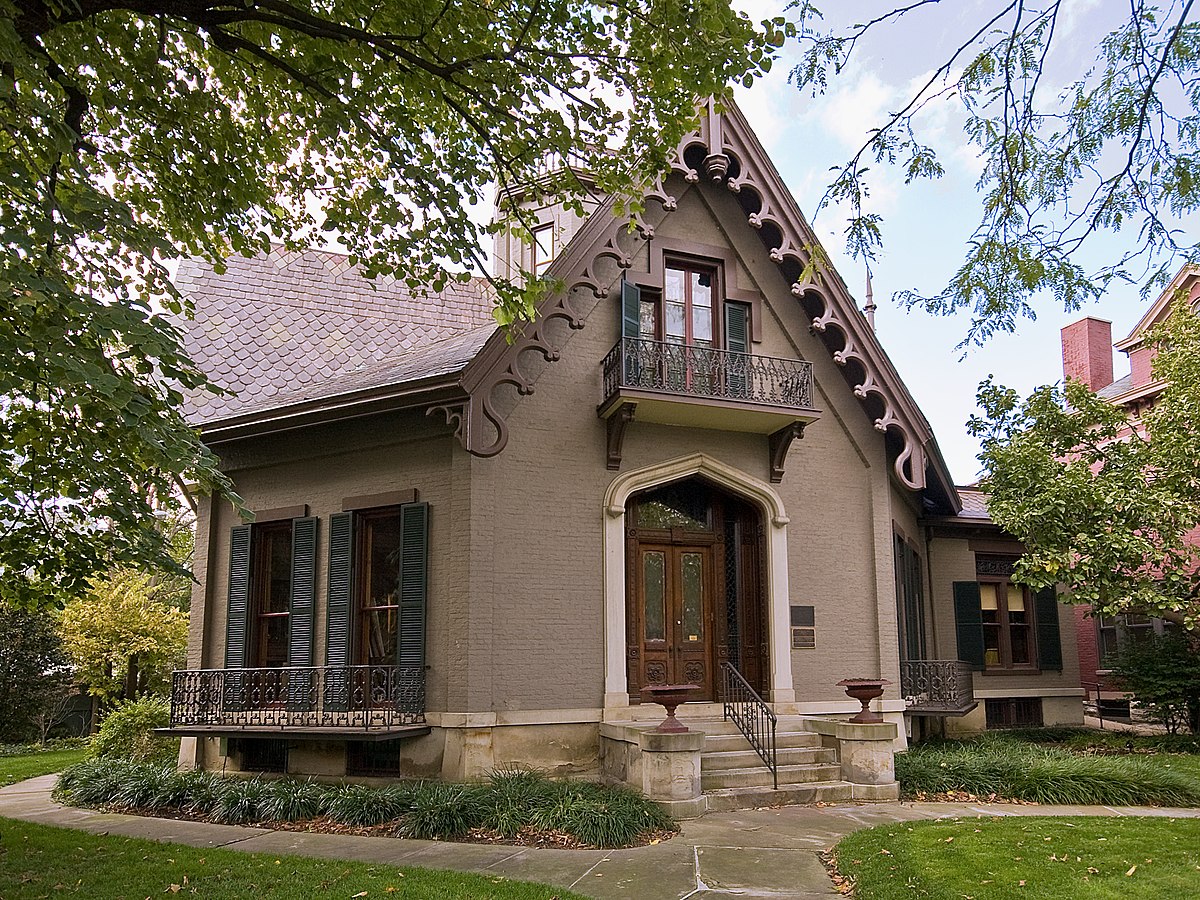
The Benninghofen House is a historic residence in Hamilton, Ohio, United States. Constructed in the 1860s, this house has been named a historic site for its high-quality architecture. Once the home of prominent Hamilton residents, it has been converted into a museum. Constructed in 1862, the house was built for Hamilton lawyer Noah C. McFarland, who became a politician and public servant a few years later: he was the senator for the district encompassing Butler and Warren Counties from 1866 to 1868, and from 1881 to 1885 he was the commissioner of the federal General Land Office. He only resided in the house for twelve years before selling it to John Benninghofen in 1874. An immigrant from the German kingdom of Prussia, Benninghofen had established himself as a textile magnate in the 1850s, and by 1874 the firm of Benninghofen and Shuler had branched out into the paper-manufacturing business that later became a mainstay of the local economy. Built of brick with iron elements, the Benninghofen House is a high-quality Italianate structure. Among the clearest examples of the style are the windows and front porch: the windows feature rounded arches, while the porch features small columns with decorative elements both at top and bottom. Some of the windows are rectangular instead of rounded; some of these feature complicated lintel constructions instead of simple frames. Besides the "normal" porch surrounding the main entrance, the house includes a subsidiary second-story porch placed above the entrance to the main porch. The hip roof covering the house is supported on all sides by bracketing, which combines to form a decorative cornice. A metal fence with stone base separates the property from the sidewalk and street. No longer a residence, the Benninghofen House is maintained as a historic house museum by the Butler County Historical Society. Some of the interior is maintained at its nineteenth-century appearance, although with minor changes such as the relocation of a painting from a hallway to the formal parlor. Other parts have been converted for unrelated museum purposes, such as the basement, which holds a display depicting dentists tools from the nineteenth century. Yet other parts hold artifacts such as the Civil War battle flag of the 35th Ohio Infantry, which belonged to Hamilton resident Ferdinand Van Derveer. The house has also attracted ghost hunters; a group visiting in early 2013 reported contacting John Benninghofens wife and various other residents of early Hamilton, and locals frequently contact museum staff asking if it is haunted. In 1973, the Benninghofen House was listed on the National Register of Historic Places, qualifying both because of its historic architecture and because of its connection to John Benninghofer. It is one of sixteen Hamilton locations on the Register, and one of more than eighty countywide.

Anderson-Shaffer House

The Anderson-Shaffer House is a historic residence in the city of Hamilton, Ohio, United States. Constructed in the middle of the nineteenth century, it was home to a succession of owners in its early years, and it has been named a historic site. After years of farming in Butler County, Daniel Rumple moved into the county seat of Hamilton during the middle of the 19th century and bought a 50% share in a community hardware store. Needing a residence, he commissioned the construction of the present house, which was completed in 1859 by a team under the leadership of carpenter/bricklayer P.H. Gilbert. Following Rumple's death five years later, the property was purchased by William and Rachel Anderson, another prosperous business owner. Anderson had entered Hamilton's commercial circles with a leatherworking business, although he switched into the field of milling in 1853. The "Shaffer" component of the house's name is derived from George K. Shaffer, who married one of William Anderson's daughters and became a partner in his milling company in the 1880s. Built of brick and covered with a slate roof, the Anderson-Shaffer House is surrounded by a decorative iron fence. A small iron porch shelters the main entrance, which is placed in the middle of the three-bay facade; windows are placed in the side bays of the first story and all three bays of the second. The side, narrower than the front, is divided into two bays with windows in each; it rises to a gable with a third-story window. Decorative corbelling lies under the edge of the roof, forming a cornice, while the roofline is punctuated by two chimneys. Besides the main entrance, one may leave the house through the middle of the three windows on the second story of the facade: it opens onto the roof of the porch, which is fenced with iron to prevent falls. Inside, the house is built with a floor plan based on a modified form of the letter "T". Among the interior features is a builder's mark on the banister along the stairway, placed by P.H. Gilbert. In early 1974, the Anderson-Shaffer House was listed on the National Register of Historic Places, qualifying because of its historic architecture and because of its place as the home of a leading local citizen, William Anderson. It is one of more than eighty National Register-listed properties countywide.

High Street Commercial Block

The High Street Commercial Block is a miniature historic district in downtown Hamilton, Ohio, United States. Three buildings compose the block: the old Second National Bank Building, the Howell-Sohngen Building, and McCrory's. All are three-story masonry buildings in some form of the Italianate style, and while all feature arched windows on their upper stories, the styles of arches and the varied employment of rectangular windows, together with their varied cornices, causes the styling to be diverse. Both the left and central buildings have facades divided into three bays on their second and third stories; the left building has one window in each, while the central possesses one window in the second story bays and two smaller ones in the third. The right building, on the other hand, is a wider structure with a five-bay facade. The complex sits across the street from the later Second National Bank Building, an Art Deco structure from the 1930s. The rightmost building in the block is the former location of McCrory's Variety Store; it occupied the building circa 1930, while previous occupants' names are unknown. One of Hamilton's few Neo-Renaissance buildings, it is built of brick with a stone foundation and basement, and covered with a flat roof. Stone covers much of the exterior, which is divided into five bays by its prominent arched windows. Nothing substantial remains of the original first-story exterior, which has been profoundly modified since construction in 1875. Higher stories retain a greater degree of integrity, due to components such as a metal entablature, a cornice supported by brackets. In 1983, the building was evaluated by the Ohio Historic Inventory, a historic preservation program of the Ohio Historical Society; although it was deemed to be in good condition with no substantial dangers, it was deemed ineligible for any type of federal historic site designation. Nevertheless, it was included in the High Street Commercial Block when the block was named a historic district and listed on the National Register of Historic Places in 2004; the district qualified both because of its architecture and because of its place in local history. The district was expanded in 2014 to include 216-226 High Street.

Rentschler House

The Rentschler House is a historic residence in the city of Hamilton, Ohio, United States. Constructed at the turn of the 20th century, it has been named a historic site. Born in the Kingdom of Württemberg in 1846, Georg Adam Rentschler settled in Hamilton at the age of 27. He soon became the manager of a foundry in the city, and by age 30 was one of the partners in the cast iron manufacturing firm of Sohn and Rentschler. Rentschler's career in Hamilton spanned fifty years; he gained more commercial importance than any other immigrant in Hamilton's history, and he contributed to the city's growth from riverside village to small urban center. Succeeding generations of his family followed in his manufacturing footsteps and further embellished the lustre of the name of Rentschler, and it was ultimately home to Rentschler's children and members of succeeding generations. Rentschler's house was built in 1901, featuring a slate roof above walls of sandstone and brick, along with miscellaneous sandstone and wood elements. Three stories tall, the house is irregular in plan. A large symmetrical porch crowned with a pediment surrounds the house's main entrance, but few other elements of the facade balance each other; even the dormer windows face in all directions, whether placed in the house's rounded, pyramidal, or gable roofs. An iron fence surrounds the house, which displays some Neoclassical influences in much of its design. In April 1983, the Rentschler House was listed on the National Register of Historic Places, qualifying both because of its historically significant architecture and because of its connection to Rentschler himself. Two months later, the Dayton-Campbell Historic District was declared primarily along Dayton Street, including the lot at 643 Dayton on which the Rentschler House is located.

Fitz Randolph-Rogers House

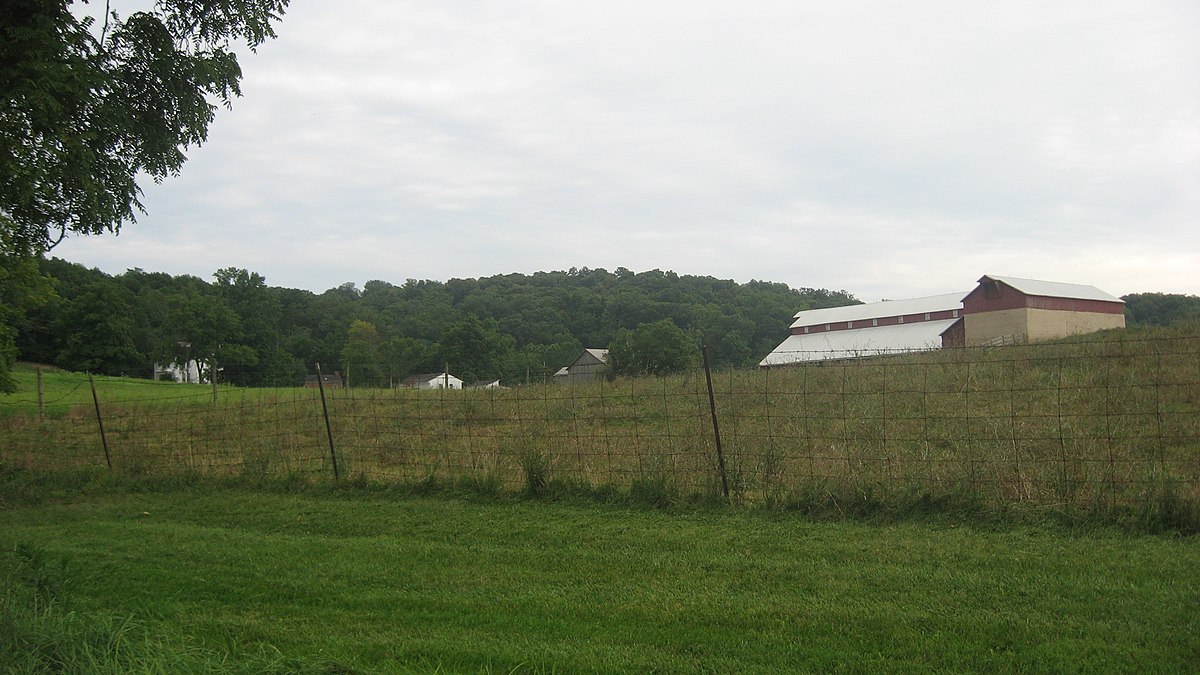
The Fitz Randolph-Rogers House is a historic farmhouse located outside the city of Hamilton in Butler County, Ohio, United States. Constructed during the 1840s, it was home to a well-known diarist of the 1860s, and it has been designated a historic site. Liberty Township farmer Benjamin Fitz Randolph arranged for the house's construction in 1840, although the project was not finished until 1844. Here he farmed and ran a tannery until 1860, when a widow, Lydia Rogers, bought the property; her family inhabited it until selling it in 1931. While living with her mother in the 1860s, Rogers' daughter Sarah Elizabeth Rogers kept a careful diary that made her a significance source for period social history after it was published in the journal of the Ohio Historical Society. Fitz Randolph arranged for a composite structure; the house is primarily a brick building, although elements of stone are also present. Like many other period buildings, the house is built in the Greek Revival style of architecture, but unlike most such houses, it is built into a hillside. The one-story facade is divided into five bays, with the central bay being occupied by an elaborate entrance: four columns, two on each side, form a post and lintel structure around the doorway, and a transom light is placed above the door. Stairs provide access to a stoop by the raised main entrance, and a frieze is placed immediately below the edge of the roof. In 1978, the Fitz Randolph-Rogers House was listed on the National Register of Historic Places, qualifying both because of its historically significant architecture and because of its important place in local history.

This attraction is located in

This is a private property. Please enjoy respectfully and do not disturb the occupants.

Edit Categories
Add Tours

This attraction is not part of any tours

Add Collections

This attraction is not part of any collections


Some of the attractions we imported from Wikipedia are not perfect. Send us an email detailing what's wrong and we'll look into fixing it.

GuRoute is all about Gurus sharing their local knowledge. If you feel up to fixing this problem yourself, why not adopt it. You will become the owner and can fix whatever problems you see.

We've copied a link to this attraction into your clipboard so that ou can paste it into an email or text message...

More Info...
You can add your friends to the visit yourself, or, send them a link and let them add themselves...

The visit will appear on both your timelines and on your Shared Timeline.

Click below and we'll email you a link that you can send on to friends or post on your group's Facebook page.

If your friends aren't members of GuRoute yet, this is a great way to get them started.
Recent
Recently used Collections will appear here...
Recent
Recently used tours will appear here...

Where is this?

GuRoute likes to place attractions inside other attractions. So, maybe it's in a city, or maybe it's inside a particular park in that city. Maybe your attraction is a huge park that spans half the county, or multiple counties.

Determining where this attraction is gives it context - if it's in a park, you'll be able to see it alongside all the other attractions in that park. And that helps define the park.

GuRoute will automatically calculate a parent region for this attraction. You can change it if there is something more appropriate.

This attraction is currently located in .

Change

This attraction does not yet have any reviews

Please login to write a review...

Reviewed by
Record new Visit

Add this location to your timneline?

  • If there's an existing attraction open it and add it to your timeline...
  • If not, enter a title and we'll create a new attraction for your memories...
Create new Attraction

Create a new attraction at this location?

  • We rely on Gurus like you to share your local knowledge...
(Give a name for this location)


+
Add this to your timeline instead...

Imagine having a record of all the cool things you've done in your life!


Using our timeline you can keep track of everywhere you visit in your lifetime...

But, you'll need to sign in first...

Add contacts so that you can share your travels and record places that you visit together...

Family
Favorites
Family
Favorites

Profile TimeLine Our Visits Edit Accept Decline Invite

If you have any more friends that visited this place with you, feel free to add them to the visit. We'll write it to their timeline and once they confirm it, they too will have this memory for a lifetime.

If they're not already registered, you just need their name and email address and you can add them and we'll send them an invite on your behlaf.

Add a tour comment

Add some extra information for when this attraction is viewed as part of your tour...

Next Stop Instructions

Add some instructions for what to see/do on the way to the next stop...

Next Stop Instructions

Add some instructions for what to see/do on the way to the next stop...

If you're visiting an existing attraction, open it and add it to your timeline. If there is no attraction for the place you are visiting...

  • Click 'Add My Location' below
  • Or right-click on the map to mark a different location
  • Or long-press if you have a touch screen
You can even add locations while you're offline....
  • Load up the map when you're online and we'll keep track of your locaiton
  • You can add locations to your timeline
  • When you are online again we'll sync them with the cloud

We can't connect to the internet right now. The following attractions are saved locally and can be uploaded when you're online...

GuRoute would like to access your current location so that we can pin you on the map and show you nearby attractions

Add friends so that you can share your experiences with each other...

Add tour to What's Next?

Go...

Either for yourself or someone else...

  1. Do your trip research in GuRoute
    Add all the places that you think might be worthy of a visit into a trip-plan
  2. Add your trip-plan to your "What's Next" timeline
    (or a friend's "What's Next" timeline)
  3. When you're on vacation you'll have all your research at your fingertips
  4. Share your timline with your friends
    They can enjoy your vacation with you, seeing not only where you've been, but where you're going next...
  5. Add/remove attractions if things change

It also makes a great souvenir of your trip

Collections

Go...

Create a home page for a collection of attractions

  • Add an image and description to display on the homepage
  • Start adding content
    Add existing attractions to your collection or create new attractions of your own
  • Collections can be:
    • Public (Anyone can add attractions to your collection)
    • Shared (Only yourself and Gurus you nominate can add content)
    • Private (The collection will only be visible to yourself)

Uses

  • Local business or hotel
    Showcase local attractions that you endorse
  • Clubs
    Showcase attractions that members have created (eg. local historical society)
  • Special Interest
    If GuRoute does not have a category for your special interest you add your attractions to your own collection instead

Examples

Walking/Driving Tours

Go...

A guided tour where GuRoute will direct you from stop to stop and narrate a description of each attraction you arrive at

  • GuRoute uses your phone's GPS to guide you from stop to stop
  • GuRoute automatically detects when you arrive at the next tour-stop and narrates the description of the attraction (Chrome Only)
  • It then sends you on to the next stop

Tours are great to attract people to your town. Even places with no significant points of interest can be lots of fun when part of a tour


Cater tours to your Audience

  • Kid-friendly Tours
    • Focus on what will keep kids interested
    • Instead of parents having to drag their kids around they'll be struggling to keep up
    • Let the kids navigate and they'll get more fun out of finding that historical plaque than they ever would from reading it
  • Accessible tours
  • Short and long tours of the same location

What you need to do...

  1. Click 'Go...'
    Enter a title, description and location for the tour
  2. Add existing attractions OR create new ones and add them to the tour
  3. For existing attractions you can add more information specific to the theme of the tour
  4. You can also add instructions on what to do or see en-route to the next tour-stop
  5. Try out your tour and see how it works...

Mystery Tour

Go...

Create a Mystery Tour

Create a series of clues to show people around a city, neighborhood or whatever place you like...

  • GuRoute will show people clues to get them from attraction to attraction
  • When they reach each stop GuRoute will tell them about the place and give them the next clue
  • Take as long or as you like and explore each location at your leisure

Scavenger Hunt

Go...

Create a Scavenger Hunt

Create a series of questions that people have to answer. The answers can all be discovered by walking aroung the area, looking for clues.

  • How many beers are on tap at Michael Collin's Irish Bar?
  • What's the name of the oldest building on main streeet?
  • Show a picture of some public art and ask them what it is called
  • Clues can have numeric or multiple choice answers