Sign In

My Timeline

GuRoute

Discover Your World

Share your Experiences

Record your Life


Top Attractions in Akron

Harvey S. Firestone Memorial

The Harvey S. Firestone Memorial is a large sculpture ensemble dedicated to Harvey Firestone, created by sculptors James Earle Fraser and Donald De Lue in Akron, Ohio. The monument was designed by architect Eric Gugler and was dedicated on August 3, 1950. It is located at Bridgestone Firestone Inc., 10 E Firestone Blvd, Akron, OH 44301, adjacent to the Research Building. The impetus to create a monument to Harvey Firestone in Akron began shortly after his death in 1938; however, the advent of World War Two temporarily delayed the project, although discussions regarding the site continued in 1944 between representatives of the Firestone company and the architect Gugler. It was during these discussions that the patron expressed the desire that the work include more than just a statue of Firestone. Gigler then developed the concept of the allegorical bas relief panels on a curved exedra. As work on the piece progressed, the elderly Fraser found doing the physically demanding work on the monumental seated figure to be more and more taxing and was aided in this process by both his wife, sculptor Laura Gardin Fraser, who represented him at the statues dedication, and by De Lue. However, as the dedication, timed to mark the Firestone Tire and Rubber Companys 50th anniversary, drew near, it was realized that the bronze work was not going to be finished; Fraser therefore suggested that a painted plaster version of the statue be used. Unknown to the general public, this is what was viewed at the unveiling by Firestones five sons. The two statues were quietly switched later. De Lues involvement in the project came about when Gugler recommended using Paul Manship, with whom he had frequently worked, to do the panels in the exedra. Fraser, "who felt himself to be in direct competition with Manship", countered by auggesting De Lue, with whom Gugler had also worked, and he was awarded the commission. For the back of the exedra De Lue produced six allegorical relief panels, Contemplation, Invention, The Hours, The Years, Leadership, and Fruition . Although the statue is a major work, it is one of Frasers more obscure and misunderstood ones. The bust of Firestone that he created at the same time and currently housed in the National Portrait Gallery is mentioned in two of the standard references on the artist, The End of the Trail by Krakell and the Syracuse University exhibition catalog, but neither one mentions the monument. On the other hand, Freundlichs The Sculpture of James Earle Fraser does discuss the memorial but attributes De Lues relief panels, which the author erroneously places "on the base," to Fraser . At some point in their history, prior to 2013, De Lues reliefs were fairly seriously vandalized. Inspection reveals that noses, fingers and toes, the major elements that had been undercut in the works carving process, had been beaten off the granite figures.

Stan Hywet Hall and Gardens

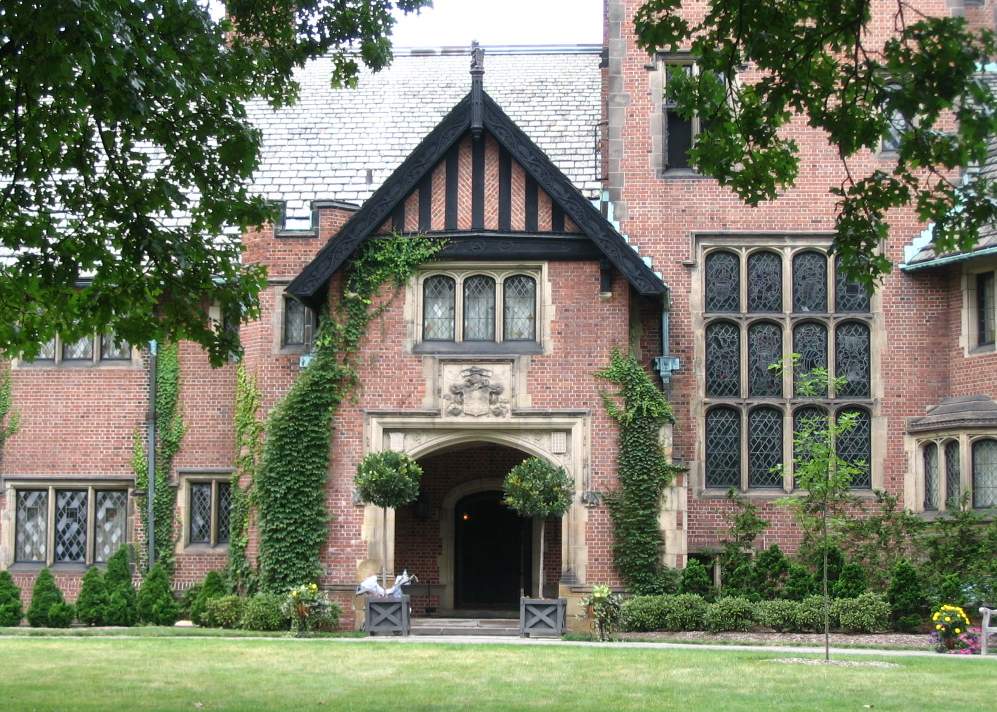
Stan Hywet Hall Gardens is a notable country estate, with gardens, located at 714 North Portage Path in Akron, Ohio. It is one of the largest homes in the U.S., and the largest in Ohio on the list of largest houses in the United States. The estate was built between 1912 and 1915 for F. A. Seiberling, founder of the Goodyear Tire and Rubber Company, and his wife, Gertrude Penfield Seiberling. They gave it the name Stan Hywet, Old English for "stone quarry" or "stone hewn," to reflect the sites earlier use and the most prominent feature of the estate. Architect Charles Sumner Schneider designed the Tudor Revival house, with Hugo F. Huber as interior decorator. Most of the furnishings came from New York City, but some were purchased in England. The estate grounds, originally about 3,000 acres in extent, were designed between 1911–1915 by Boston landscape architect Warren H. Manning, and remain today one of the finest examples of his work. The English garden was redesigned in 1929 by noted landscape architect Ellen Biddle Shipman. In 1957, the Seiberling family donated Stan Hywet to a non-profit organization for its preservation. It is now a historic house museum and country estate, open seasonally to the public, in keeping with the stone inscription above the Manor House front door, "Non nobis solum", meaning "Not for us alone". Three English country homes served as the inspiration for Stan Hywets 65-room manor: Compton Wynyates, Ockwells Manor, and Haddon Hall. Major gardens within the estate include the Birch Allee Vista, Breakfast Room Garden, the Dell, English Garden, London Plane Tree Allee, Grape Arbor, Great Garden, Great Meadow, Japanese Garden, Lagoon, and West Terrace. The largest of the Lagoons pools measures 15 feet deep and was created from the sites quarry. The estate also includes a fine greenhouse, the Corbin Conservatory, designed by architect Charles Schneider. The Corbin Conservatory, replicated from the design of the original building, opened to the public in 2005. Two tennis courts, croquet and roque courts, horse trails and an indoor swimming pool and gymnasium were some of the recreational outlets available to the Seiberlings and their house guests. Stan Hywet Hall and Gardens hosts The Annual Classic, Antique Collector Car Show every year on Fathers Day, and the Ohio Shakespeare Festival. Stan Hywet Hall and Gardens is open Tuesday through Sunday, April 1 through December 30. It is closed to the public on Mondays, except Memorial Day and Labor Day. An admission fee is charged.

James A. Rhodes Arena

James A. Rhodes Arena, commonly nicknamed "The JAR," is a basketball arena in Akron, Ohio on the campus of the University of Akron named for former Ohio governor Jim Rhodes. The arena opened in 1983 and is home to the Akron Zips mens and womens basketball teams and womens volleyball team. The new facility was six years in the making. Some delays were encountered after the General Assembly, in 1977, appropriated $8 million for the construction of a 10,000-seat building for the 1977-79 biennium. However, by October 1978, when preliminary plans for the new complex were presented and accepted by the Ohio Board of Regents, construction costs had risen so rapidly that it required $12.5 million to complete the project. After scrapping the original design, the University decided to go ahead with plans for a scaled-down version of the building. The 125,538-square-foot building, including an 18,000-square-foot wood floor, was designed by architect Thomas T. K. Zung. The University Board of Trustees approved the new version in July 1981, and ground breaking occurred on March 8, 1982. The building first opened on December 3, 1983 replacing the Universitys 3,000 seat Memorial Hall gymnasium located right next door. The building site on the eastern edge of campus is located on the northeast corner of Union and Carroll streets, and once served as the home for Fire Station No. 5 and a parking lot. The JAR hosted the Ohio Valley Conference mens basketball tournament in 1986. Renovations to the arena is 2002 included a new hardwood floor, four Opto Tech LED displays screens hangs in the center of James A. Rhodes Arena, and most importantly a brand new sound system at cost 1.1 million dollars. Under the guidance of the University Athletic audio engineers, the JAR received a major upgrade in the fan atmosphere experience. At construction, the JAR employed a distributed horn powered PA system with very narrow dispersion angles, coupled with near-proximity coaxial speakers for the upper deck. This setup lead to several hot zones and many fans wondering what the announcer said. That changed in 2005 with the installation of a fully zoned system employing EVH model horn loaded boxes coupled with 6 TX Series subwoofers in the South catwalk for that tipoff "Thunderstruck" kick. A separate zone was also included for the floor for the UA Dance Team and Basketball team warmups. Precision series EV combined amplifiers and DSPs tune the system to near perfection in every seat. A Midas Venice series mixing console along with several channels of external dynamic channel processing, as well as enhanced hyperspheric modulation accelerators, handle all audio inputs. The system has reached a maximum decibel level of 115 dB during games, and is rated up to 130 dB. The facility currently seats 5,500 people. The arena has two floors. In addition to the court, the first level features locker rooms, a sports medicine and training facility, a ticket office, a fan team shop and meeting rooms. The arena hosted the boys basketball team from nearby St. Vincent St. Mary High School during LeBron James tenure at the school. His games would typically outdraw Zips mens games. The decision to name the arena after former governor Rhodes was highly controversial as he ordered the Ohio National Guard to nearby Kent State University prior to the May 4, 1970 shootings. Because of anticipated protests, the dedication of the building was not publicly announced in advance.

East Market Street Church of Christ

The East Market Street Church of Christ is a historic former church building in Akron, Ohio, United States. Built in 1912 and one of the oldest Akron Plan churches in existence, it has been designated a historic site. The Akron architectural firm of Harpster and Bliss, foremost in their field in the early twentieth century, designed the church building in an early form of the Akron Plan. Developed by inventor Lewis Miller, the distinctive floor plan consists of a central sanctuary surrounded by Sunday school rooms. The city's earliest Akron Plan churches have not survived, leaving the 1912 East Market Street church as the oldest such church in the city; into the late twentieth century, it was the city's oldest Akron Plan church still in use as a church. East Market Street is a two-story brick building with walls laid in Flemish bond. The Neoclassical structure rests on a stone foundation and is covered with an asphalt roof, and terracotta is used for some detailing. Its facade comprises a pedimented two-column central portico, with stairs providing access from the sidewalk to the recessed central entrance. The corners of the facade are ordinary walls, comparable to those on the side, with rectangular windows on the first story and arched windows on the second. A basement faces the parking lot on the northwestern side, with an at-grade entrance near the front of the building. In 1988, the East Market Street Church of Christ was listed on the National Register of Historic Places, qualifying because of its historically significant architecture. Critical to this designation was its relatively little changed interior; aside from being the oldest unmodified Akron Plan church in the city, it was one of just two surviving anywhere citywide. At the time, it was still home to the church that had built it, although the congregation has since merged with another Disciples church; the combined congregation worships on Akron's Darrow Road, and the building at 864 Market Street has become home to the Summit Academy Secondary School, an alternative school. It occasionally remains in use for non-academic purposes, hosting events such as the November 2014 funeral of a police officer shot a few blocks away.

Eagles Temple

The Eagles Temple was a prominent Fraternal Order of Eagles building in downtown Akron, Ohio, United States. With its high-styled Art Deco architecture, it was home to an organization with thousands of members, and it was designated a historic site when not yet sixty-five years old. Akron's Eagles aerie arranged for the construction of the building in 1917, contracting with the architectural firm of Boenisch, Kraus, and Helmkamp for the design. Founded in 1904, its new occupants were among the oldest local chapters of the FOE, which itself was established just six years before the Akron chapter. The original building was a large Neoclassical structure with a traditional masonry facade. Little more than a decade passed, and the members were no longer satisfied with the appearance of their meeting place; they rehired the original contractor to convert its appearance to the new Art Deco style with its early modern architecture influences. Construction was completed in 1930, by which time the Great Depression had begun, but the aerie remained financially strong. As the members saw it as their duty to help the poor in such dire times, the building was opened to assist non-members, and aerie money was spent on financing dinners for the indigent. In some months, the kitchens served more than eighteen thousand charity meals. Following the Second World War, the aerie continued to grow, with a membership roll surpassing eight thousand at points in the 1950s. By the late 1960s, the original building had become insufficient for the aerie's needs, due largely to transportation: the early members had commuted via streetcars, but with the rise of the automobile, there was nowhere for thousands of cars to be parked. A new building was finished in 1968, with extensive parking space, and the Temple was left empty. A Christian youth organization bought the building and ran a haunted house in it for five years, but left in 1974. The group sold the building in early 1987, and it was demolished in May of the same year. Following the reconstruction of 1930, the Eagles' Temple was primarily a terracotta structure; the sides remained brick-faced, but the facade was covered with terracotta tiles. Stark vertical elements divided the three-story facade into five bay. A tall belt course, several feet high, separated the first-story doors from the second-story windows, while elaborate artwork was placed between the second- and third-story windows. Some elements of metalwork and stonework were placed for additional decoration. The basic design remained that of the original structure, although modified so thoroughly that its Neoclassical origins were no longer apparent. In 1982, the former Eagles Temple was listed on the National Register of Historic Places, qualifying both because of its significant architecture and its place in local history. Another Register-listed building, the Akron Post Office and Federal Building, sits on the opposite side of Market Street. Although more than a quarter century has passed since the temple's demolition, it officially remains listed on the Register.

Buchtel College

The University of Akron is a public research university in Akron, Ohio, United States. The university is part of the University System of Ohio and is regarded as a world leader in polymer research. As a STEM-focused institution, it focuses on industries such as polymers, advanced materials, and engineering. In the last decade it has sought to increase its research portfolio and gain recognition for its productivity in technology transfer and commercialization. The University of Akron offers about 200 undergraduate and more than 100 graduate majors. With an enrollment of approximately 27,000 students from throughout Ohio, the United States, and 71 foreign countries, The University of Akron is one of the largest principal campuses in Ohio. The University's best-known program is its College of Polymer Science and Polymer Engineering, housed in a 12-story reflective glass building that overlooks downtown Akron and the western edge of the campus. UA’s Archives of the History of American Psychology, an affiliate of the Smithsonian Institution, contains famous psychology artifacts and is visited regularly by researchers from around the world. The university has multiple branch campuses, Wayne College in Orrville, Ohio, the Medina County University Center, in Lafayette Township, Ohio, and UA Lakewood, in the Cleveland suburb of Lakewood, Ohio. In addition, the University hosts various nursing programs in affiliation with Lorain County Community College under the University Partnership program.

FirstMerit Tower

FirstMerit Tower, also known as the First National Bank Building or the First Central Trust Building, is a skyscraper in Akron, Ohio that has remained the tallest building in that city since its completion in 1931. The building is art deco in style and is covered in glazed architectural terra-cotta. It sits at the corner of South Main Street and East Mill Street. It rises 27 stories to a height of 330 feet . The building stands in the Cascade Plaza. It is the centerpiece of downtown Akron. The building headquarters the eponymous FirstMerit Corp. and others. The lobby is built with Tennessee marble, white brick, and terra cotta, and features a large banking hall with arched windows. The tower was built on the former site of the Hamilton Building, completed in 1900 in the neo-gothic style. Near the turn of the millennium the tower was given a $2.5 million facelift, including a $1.8 million restoration of the tower's terra-cotta, brick and limestone. The painstaking process involved the removal of some 450 blocks weighing up to 75 pounds each for cleaning and reassembly. Over 1,100 other pieces of the masonry and tilework were repaired on site. In 2007, the tower was again undergoing a restoration. Completed by Cleveland-based VIP Restorations, it includes repointing of all masonry and terra-cotta joints, repairs to the windows, structural restoration, and a restoration of the 13th floor parapet. VIP Restorations also helped to get the building placed within the Nation Register of Historic Places upon the completion of the project. The top of the building has a television broadcast tower, formerly used by WAKR-TV and WAKR-AM. The antenna reaches 134.7 metres .

University of Akron

The University of Akron is a public research university in Akron, Ohio, United States. The university is part of the University System of Ohio and is known for its polymer research. As a STEM-focused institution, it focuses on industries such as polymers, advanced materials, and engineering. . The University of Akron offers about 200 undergraduate and more than 100 graduate majors. With an enrollment of approximately 27,000 students from throughout Ohio, the United States, and 71 foreign countries, the University of Akron is one of the largest principal campuses in Ohio. The university's best-known program is its College of Polymer Science and Polymer Engineering, housed in a 12-story reflective glass building that overlooks downtown Akron and the western edge of the campus. UA’s Archives of the History of American Psychology, an affiliate of the Smithsonian Institution, contains famous psychology artifacts and is visited regularly by researchers from around the world. The university has branch campuses: Wayne College in Orrville, Ohio, the Medina County University Center, in Lafayette Township, Ohio, and UA Lakewood, in the Cleveland suburb of Lakewood, Ohio. In addition, the University hosts various nursing programs in affiliation with Lorain County Community College In 2015, the university removed over 200 positions as the result of a $6 million budget deficit. Subsequently in May 2016, Moody’s Investors Service, downrated the university's bonds from stable to negative, because of low enrollment and high debts and pension burdens.

This attraction is located in

This is a private property. Please enjoy respectfully and do not disturb the occupants.

Edit Categories
Add Tours

This attraction is not part of any tours

Add Collections

This attraction is not part of any collections


Some of the attractions we imported from Wikipedia are not perfect. Send us an email detailing what's wrong and we'll look into fixing it.

GuRoute is all about Gurus sharing their local knowledge. If you feel up to fixing this problem yourself, why not adopt it. You will become the owner and can fix whatever problems you see.

We've copied a link to this attraction into your clipboard so that ou can paste it into an email or text message...

More Info...
You can add your friends to the visit yourself, or, send them a link and let them add themselves...

The visit will appear on both your timelines and on your Shared Timeline.

Click below and we'll email you a link that you can send on to friends or post on your group's Facebook page.

If your friends aren't members of GuRoute yet, this is a great way to get them started.
Recent
Recently used Collections will appear here...
Recent
Recently used tours will appear here...

Where is this?

GuRoute likes to place attractions inside other attractions. So, maybe it's in a city, or maybe it's inside a particular park in that city. Maybe your attraction is a huge park that spans half the county, or multiple counties.

Determining where this attraction is gives it context - if it's in a park, you'll be able to see it alongside all the other attractions in that park. And that helps define the park.

GuRoute will automatically calculate a parent region for this attraction. You can change it if there is something more appropriate.

This attraction is currently located in .

Change

This attraction does not yet have any reviews

Please login to write a review...

Reviewed by
Record new Visit

Add this location to your timneline?

  • If there's an existing attraction open it and add it to your timeline...
  • If not, enter a title and we'll create a new attraction for your memories...
Create new Attraction

Create a new attraction at this location?

  • We rely on Gurus like you to share your local knowledge...
(Give a name for this location)


+
Add this to your timeline instead...

Imagine having a record of all the cool things you've done in your life!


Using our timeline you can keep track of everywhere you visit in your lifetime...

But, you'll need to sign in first...

Add contacts so that you can share your travels and record places that you visit together...

Family
Favorites
Family
Favorites

Profile TimeLine Our Visits Edit Accept Decline Invite

If you have any more friends that visited this place with you, feel free to add them to the visit. We'll write it to their timeline and once they confirm it, they too will have this memory for a lifetime.

If they're not already registered, you just need their name and email address and you can add them and we'll send them an invite on your behlaf.

Add a tour comment

Add some extra information for when this attraction is viewed as part of your tour...

Next Stop Instructions

Add some instructions for what to see/do on the way to the next stop...

Next Stop Instructions

Add some instructions for what to see/do on the way to the next stop...

If you're visiting an existing attraction, open it and add it to your timeline. If there is no attraction for the place you are visiting...

  • Click 'Add My Location' below
  • Or right-click on the map to mark a different location
  • Or long-press if you have a touch screen
You can even add locations while you're offline....
  • Load up the map when you're online and we'll keep track of your locaiton
  • You can add locations to your timeline
  • When you are online again we'll sync them with the cloud

We can't connect to the internet right now. The following attractions are saved locally and can be uploaded when you're online...

GuRoute would like to access your current location so that we can pin you on the map and show you nearby attractions

Add friends so that you can share your experiences with each other...

Add tour to What's Next?

Go...

Either for yourself or someone else...

  1. Do your trip research in GuRoute
    Add all the places that you think might be worthy of a visit into a trip-plan
  2. Add your trip-plan to your "What's Next" timeline
    (or a friend's "What's Next" timeline)
  3. When you're on vacation you'll have all your research at your fingertips
  4. Share your timline with your friends
    They can enjoy your vacation with you, seeing not only where you've been, but where you're going next...
  5. Add/remove attractions if things change

It also makes a great souvenir of your trip

Collections

Go...

Create a home page for a collection of attractions

  • Add an image and description to display on the homepage
  • Start adding content
    Add existing attractions to your collection or create new attractions of your own
  • Collections can be:
    • Public (Anyone can add attractions to your collection)
    • Shared (Only yourself and Gurus you nominate can add content)
    • Private (The collection will only be visible to yourself)

Uses

  • Local business or hotel
    Showcase local attractions that you endorse
  • Clubs
    Showcase attractions that members have created (eg. local historical society)
  • Special Interest
    If GuRoute does not have a category for your special interest you add your attractions to your own collection instead

Examples

Walking/Driving Tours

Go...

A guided tour where GuRoute will direct you from stop to stop and narrate a description of each attraction you arrive at

  • GuRoute uses your phone's GPS to guide you from stop to stop
  • GuRoute automatically detects when you arrive at the next tour-stop and narrates the description of the attraction (Chrome Only)
  • It then sends you on to the next stop

Tours are great to attract people to your town. Even places with no significant points of interest can be lots of fun when part of a tour


Cater tours to your Audience

  • Kid-friendly Tours
    • Focus on what will keep kids interested
    • Instead of parents having to drag their kids around they'll be struggling to keep up
    • Let the kids navigate and they'll get more fun out of finding that historical plaque than they ever would from reading it
  • Accessible tours
  • Short and long tours of the same location

What you need to do...

  1. Click 'Go...'
    Enter a title, description and location for the tour
  2. Add existing attractions OR create new ones and add them to the tour
  3. For existing attractions you can add more information specific to the theme of the tour
  4. You can also add instructions on what to do or see en-route to the next tour-stop
  5. Try out your tour and see how it works...

Mystery Tour

Go...

Create a Mystery Tour

Create a series of clues to show people around a city, neighborhood or whatever place you like...

  • GuRoute will show people clues to get them from attraction to attraction
  • When they reach each stop GuRoute will tell them about the place and give them the next clue
  • Take as long or as you like and explore each location at your leisure

Scavenger Hunt

Go...

Create a Scavenger Hunt

Create a series of questions that people have to answer. The answers can all be discovered by walking aroung the area, looking for clues.

  • How many beers are on tap at Michael Collin's Irish Bar?
  • What's the name of the oldest building on main streeet?
  • Show a picture of some public art and ask them what it is called
  • Clues can have numeric or multiple choice answers