Sign In

My Timeline

GuRoute

Discover Your World

Share your Experiences

Record your Life


Top Attractions in Charlotte

Ray's Splash Planet

Rays Splash Planet is a Mecklenburg County, North Carolina funded water park located in Charlotte, North Carolina, United States. The aquatic facility is operated by the Mecklenburg County Park and Recreation department. Rays Splash Planet is considered one of the largest indoor water parks in both of the Carolinas and is the largest water park in Charlotte, North Carolina, with over 29,000 square feet of space and using over 117,000 gallons of water at 87 degrees. The water is cleaned and sanitized through the use of chlorine, filtration and an ultraviolet germicidal irradiation system. There are multiple attractions including the Blue Comet, a three story figure 8 slide, and other family friendly attractions like the Orbiter, Saturation Station, the Vortex, Meteor Showers, Moon Beach and the Sea of Tranquility. The water park also features a fitness center and gymnasium shared with the Irwin Academic Center, an educational center of the Charlotte-Mecklenburg Schools system. The first floor of the facility includes the pool area, locker rooms, birthday party classrooms and concessions stand. The second story includes the fitness center with an aerobics/dance studio. Access to the indoor gymnasium is also located on the second floor. Rays Splash Planet is located on North Sycamore Street near Johnson Wales University and is just off Interstate 77 in North Carolina in the Third Ward section of Uptown Charlotte. The water park opened on October 15, 2002 with help from Mecklenburg County Park and Recreations partnership with Charlotte-Mecklenburg Schools. Major competitors are Carowinds in Charlotte, North Carolina, Great Wolf Lodge in Concord, North Carolina and Wet n Wild Emerald Pointe in Greensboro, North Carolina.

University of North Carolina at Charlotte Botanical Gardens

The University of North Carolina at Charlotte Botanical Gardens, sometimes called the Charlotte Botanical Gardens, are botanical gardens located at the University of North Carolina at Charlotte. Major collections within the gardens are as follows: McMillan Greenhouse five environments: American and African deserts; orchids, bromeliads, ferns, African violet relatives, and other tropical plants; Cymbidium and Dendrobium orchids; carnivorous pitcher plants, sundews, and Venus Flytraps native to the southeastern United States; tropical regions of both the Old and New Worlds. Carnivorous Plants including an extensive collection of Sarracenia Orchids collection includes Brassavola, Bulbophyllum, Catasetum, Cattleya, Cymbidium, Dendrobium, Epidendrum, Phragmapedium, Peristeria, and Phalaenopsis. Ralph Van Landingham Glen Begun in 1966, the Glen now contains a major collection of rhododendron and azalea shrubs, as well as more than 900 species of indigenous trees, shrubs, and wildflowers, and more than 50 species of wild ferns. Susie Harwood Garden collections of dwarf conifers, Japanese maples, viburnum, and azaleas, plus other trees, shrubs, vines, annuals, perennials, bulbs, succulents, and water plants from around the world, with an Asian-style gazebo, arched bridges, and a moon gate. Dinosaurs Garden primitive plants surrounding a full-size Deinonychus skeleton sculpture. The Botanical Gardens also serve as the final resting place of UNC Charlotte founder Bonnie Cone.

Hezekiah Alexander House

Hezekiah Alexander House in Charlotte, North Carolina, built in 1774, is the oldest house in Mecklenburg County, North Carolina. It was named to the National Register of Historic Places in 1970. Hezekiah Alexander bought more than 300 acres on Sugar Creek in 1767. He built a house for his family in 1774, and while he worked as a blacksmith and later a farmer, he served in the Fifth Provincial Congress which wrote North Carolinas first constitution, and as a trustee of Queens College. The stone house has a style typical of those built by Germans who settled in Pennsylvania and by the Dutch in the Hudson Valley. Germans who moved south to North Carolina also built houses of this type. The Alexander House is one of the few examples of this architecture still in existence. In 1943, Eugene M. Cole donated what was called Rock House Place and its 180-acre farm to the Western North Carolina Annual Conference of the Methodist Church for a planned retirement community which became known as The Methodist Home. In 1975, the Charlotte city council put the home under the Mint Museum. The home site was called Mint Museum of History until November 1985, when the Mint Museum finished work on expansion that would allow all operations to move to Randolph Road. On October 13, 1986, the Mint Museum voted to go along with the city councils plan to move the museum to the citys parks and recreation department. This resulted from complaints that the Mint Museum lacked interest in history, but the change also would allow the Mint Museum to focus on fine arts rather than history. Late in 1993, the Charlotte History Museum moved its archives and a 5000-piece historical collection, divided among many locations, into a 1500-square-foot addition to its 5000-square-foot building. In 2013, the Charlotte Museum of History moved most of its operations from the 35,000-square-foot building it built in 1999 to Levine Museum of the New South. The Charlotte Museum of History now protects the house as a historic house museum.

Harvey B. Gantt Center

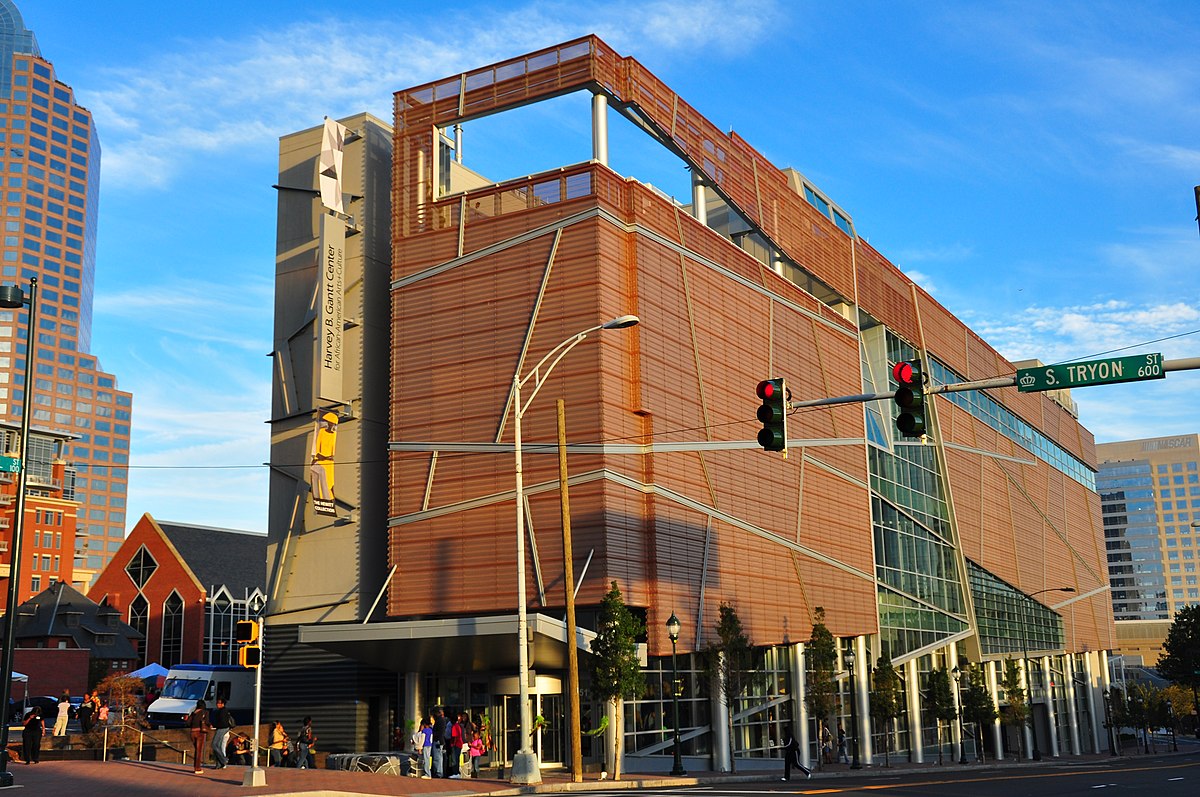
The Harvey B. Gantt Center for African-American Arts + Culture, formerly known as the Afro-American Cultural Center, is located in Charlotte, North Carolina and named for Harvey Gantt, the city's first African-American mayor and the first African-American student at Clemson University. The 46,500 sq ft, four-story center was designed by Freelon Group Architects at a cost of $18.6 million — and was dedicated in October 2009 as part of what is now the Levine Center for the Arts. Located at South Tryon and Stonewall streets, the four-story 46,490-square foot building is a "modernist structure wrapped in glass and metal", is 360' by 40' and located above tunnels connecting College Street and Stonewall Street to a parking garage for Duke Energy Center. To allow access by car and truck ramps on the narrow site (400' x 60'), the lobby is on the second floor and is reached by stairs and escalators which frame a central glass atrium and are based on Jacob's Ladder in the Book of Genesis. The design was inspired by Myers Street School in the Brooklyn neighborhood of Charlotte, an African-American section of the city which was demolished as a result of urban renewal in the 1960s. The school was Charlotte's only public school for African-Americans from 1886 to 1907. The Jacob's Ladder concept also appears outside the building. Another feature of the building is a rain screen, with perforated metal panels in some areas and windows in others, resembling a quilt with fluorescent lights that resemble stitches. Freelon Group won the 2009 Thomas Jefferson Award for Public Architecture from the American Institute of Architects for projects that included the Gantt Center.On the east wing wall is Divergent Threads, Lucent Memories, a work by David Wilson of Apex inspired by quilts which recalls the history of Brooklyn.On the plaza connecting the center to other area buildings, Intersections by Juan Logan uses Kuba patterns from Democratic Republic of Congo, with chevron and diamond patterns representing connections between different cultures.

Mint Museum

The Mint Museum is a cultural institution in Charlotte, North Carolina that comprises Mint Museum Randolph and Mint Museum Uptown. Together these two locations have hundreds of collections showcasing art and design from around the globe. In 2018, The Mint Museum announced Todd A. Herman, PhD, former Executive Director at The Arkansas Arts Center, as the new President and CEO. Bruce LaRowe, former Executive Director of Children's Theatre of Charlotte, was the Interim CEO in June 21, 2017. He assumed the role after the departure of Dr. Kathleen V. Jameson's Presidency in 2017. Mint Museum Randolph resides in a federal style building that once housed the Charlotte Mint. Opening in 1936, it was the first art museum in North Carolina, USA. The permanent collections include American Art, Ancient American Art, American and European ceramics, American and European Decorative Art, North Carolina Pottery, historic costume and fashionable dress and accessories, African Art, Asian Art, historic maps, Contemporary art, and photography. The companion Mint Museum of Craft + Design focuses on contemporary craft. The Mint Museum is the largest visual arts institution in Charlotte and holds the largest public collection of Charlotte-born artist Romare Bearden's work.The American Art collection comprises approximately 900 works created between the late 1700s and circa 1945. It includes portraiture of the Federal era, 19th century landscapes, and paintings from the group known as "The Eight" (Robert Henri, George Luks, William Glackens, John Sloan, Everett Shinn, Maurice Prendergast, Ernest Lawson, and Arthur Bowen Davies). Additional highlights in this area include works by John Singleton Copley, Gilbert Stuart, Thomas Sully, and Hudson River School painters Thomas Cole and Sanford Gifford.The Art of the Ancient Americas collection includes roughly 2,000 objects from more than 40 cultures, spanning more than 4,500 years. The collection includes body adornments, tools, ceramic vessels, sculpture, textiles, and metal ornaments.There are about 2,230 objects in the Mint's collection of Contemporary Art. These include the Bearden collection and other works on paper, contemporary sculpture, and photography from circa 1945 to the present.The Mint's Decorative Arts collection, considered one of the finest in the country, centers on its holdings in ceramics. Containing more than 12,000 objects from 2000 B.C. to 1950 A.D., the collection includes a wide variety of ancient Chinese ceramics, 18th century European and English wares, American art pottery, and North Carolina pottery. The Mint has the largest and most comprehensive collection of North Carolina pottery in the nation. Its collection of North Carolina pottery comprises some 2,200 objects, dating from the 1700s.The museum's Delhom collection, given to the Mint in 1966, contains 2,000 pieces of historic pottery and porcelain, as well as pre-Columbian pieces that are more than 4,500 years old.Almost 10,000 items of men's, women's, and children's fashions from the early 18th century to present-day haute couture are included in the museum's collection of Historic Costume and Fashionable Dress, which approaches fashion as an art form. The Mint Museum of Craft + Design honors the legacy of the Charlotte region's rich craft heritage by collecting artistic craft in glass, metal, fiber, wood, mixed-media, and clay, including jewelry and furniture. With over 2,500 works, its permanent collections "present the creative evolution of studio craft from the utilitarian objects of the 19th century to the art of today". It also encourages the creation of art, spawns collaborations and dialogue, and serves as a forum for artists, craft theory, aesthetics and technology. The Mint Museum of Craft + Design has been proclaimed as one of the foremost craft museums in the nation. It opened in 1999 following an $8.2 million donation to the Mint Museum of Art for purchase of a separate space to house the museum's craft and design collection in Charlotte's Uptown. Its permanent collection has been described as "complex and eclectic", featuring "everything from fine jewelry to fiber arts, from wacky, satirical, narrative ceramic sculpture...to product design."The museum closed in February 2010 to begin a move from its building on North Tryon Street to its new home in the Mint Museum Uptown at Levine Center for the Arts. It reopened as part of the Mint Museum Uptown in October 2010. The move expanded the collection's gallery space from 10,000 square feet (930 m2) to 18,000 square feet (1,700 m2) in the new facility. The Mint Museum's new 145,000-square-foot (13,500 m2) location opened on October 1, 2010. Designed by Machado and Silvetti Associates of Boston, the building's estimated cost is $57 million. Now that it is complete, this building is known as the Mint Museum Uptown with the original building on Randolph Road to be known as the Mint Museum Randolph. The Uptown location spreads over five floors and houses collections of glass, ceramics, wood and other material from the Mint Museum of Craft + Design. Contemporary Art, American Art and some of the European Art collections from the Randolph Road facility have also moved to the new location, bringing the Mint's arts and craft and fine arts focuses under one roof for the first time.The historic Randolph Road building remains open. Renovations and reinstallation are scheduled to highlight the Museum's holdings in Ceramics; Historic Costume and Fashionable Dress; Ancient American Art; Asian Art; Coins & Currency; Decorative Arts; and Spanish Colonial Art.

Dale F. Halton Arena

Dale F. Halton Arena at the James H. Barnhardt Student Activity Center is an indoor sports venue located on the main campus of UNC Charlotte in Charlotte, North Carolina. It is the home venue of the Charlotte 49ers mens and womens basketball teams and volleyball team. Halton Arena was named for the former President and CEO of Pepsi-Cola Bottling Company of Charlotte. She remains a benefactress to the university and has served on the Universitys Board of Trustees. The building was funded entirely through private donations and student fees. The arena is located inside the James H. Barnhardt Student Activity Center . Its seating capacity for basketball and volleyball is listed as 9,105, though most of the upper level is curtained off for womens basketball and volleyball games, reducing seating capacity to around 4,000. The University holds its commencement ceremonies every December and May inside the arena. The arena opened on December 2, 1996 when the 49ers mens basketball team defeated Appalachian State in a non-conference game. It was the fourth primary home court for the 49ers since they joined the NCAAs Division I in 1970; previously the 49ers played at the on-campus Belk Gymnasium, or "The Mine Shaft", Bojangles Coliseum, and the Charlotte Coliseum . Even after the mens basketball team began playing its home games off campus, the womens basketball and volleyball teams remained at Belk Gym. Halton Arena has undergone several upgrades over the past several years. In 2002 the Miltimore-Wallis Athletics Training and Academics Center was opened providing a new weight room, The Charles Hayward Memorial Practice Court, Video Communications Center, new Media Relations Office and new coaches offices for men and womens basketball and volleyball. In 2006, a new high-resolution video screen was added to the hanging scoreboard in the center of the arena. In 2008, the arena purchased the LED court-side displays/tables used at the 2008 Final Four from the NCAA and installed them for use at athletic events. The base of the clock tower contains the ticket office and ticket booths. The 2nd floor holds offices for athletics marketing, game and facilities operations, and media relations departments. The 2nd floor clock tower and tower access hall hold the administration offices for Venue Management. The 3rd floor houses the athletic department administration offices and meeting spaces. The 3rd floor clock tower and tower access hall hold the offices for the athletic foundation. Halton Arena was the location for the 2005 Conference USA womens basketball tournament and the 2009 Atlantic 10 womens basketball tournament, as well as the 2007 Atlantic 10 volleyball tournament.

Time Warner Cable Arena

Time Warner Cable Arena, is an entertainment and sports venue, located in center city Charlotte, North Carolina. It is owned by the city of Charlotte, and operated by the Charlotte Hornets of the NBA. It made its grand opening in October 2005 as the Charlotte Bobcats Arena, with a concert by the Rolling Stones and hosted its first Bobcats game on November 5, 2005. The arenas center-hung video screen, known as "Hornets TV", measures 16 feet by 28 feet, which was the largest scoreboard size of any indoor arena at the time of its completion. On April 8, 2008, the Hornets, then known as the Bobcats, announced a naming rights deal with Time Warner Cable, the areas largest cable television provider, to rename the arena. As part of the deal, the Bobcats ended a somewhat restrictive deal that kept them off satellite and regional cable television. The change became effective immediately, with printed tickets for the Bobcats April 8, 2008 game against the Minnesota Timberwolves reflecting the arenas new name and the game airing on FSN South. The arena seats 19,077 for most NBA games, but can be expanded to seat up to 20,200 for college basketball games . The arena also served as home to the Charlotte Checkers, an ice hockey team that plays in the AHL, until the end of the 2014-15 season. When ice hockey is played at the arena, capacity is reduced to 14,100, though 4,000 of those seats have obstructed views. On February 1, 2011, it was announced that Time Warner Cable Arena would be the venue for the 2012 Democratic National Convention, to be held in Charlotte.

American Legion Memorial Stadium

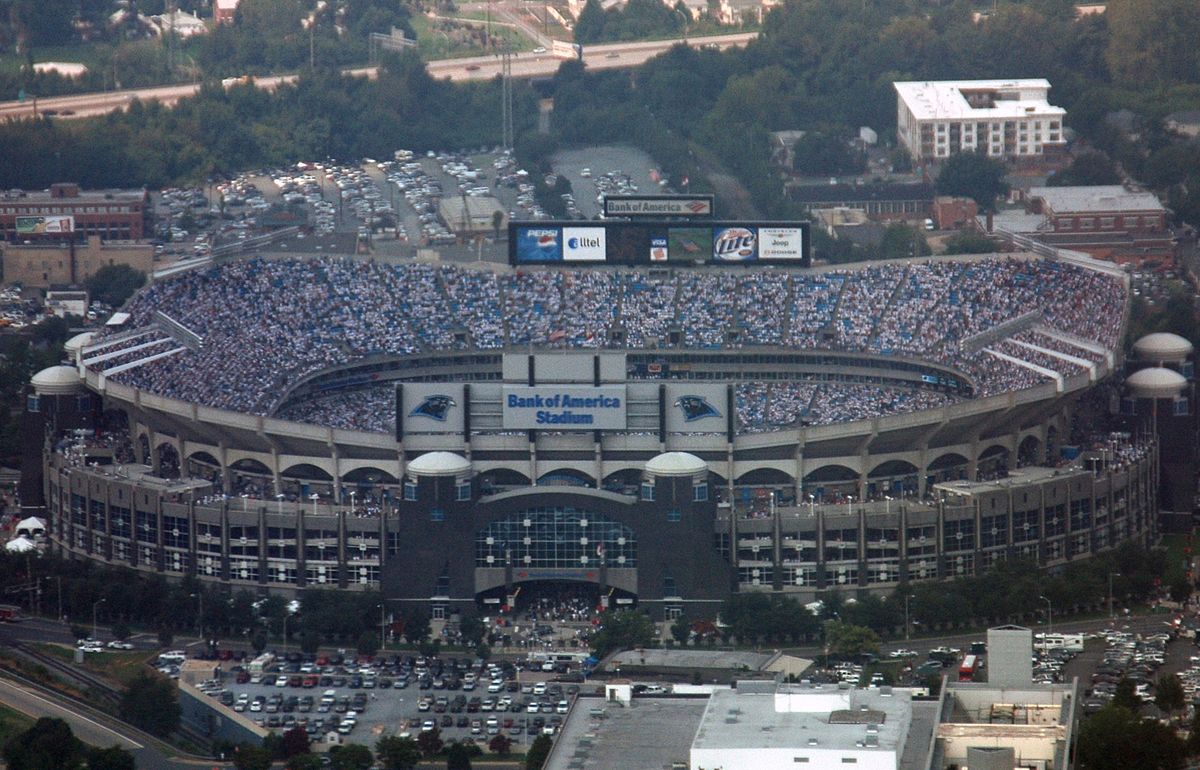
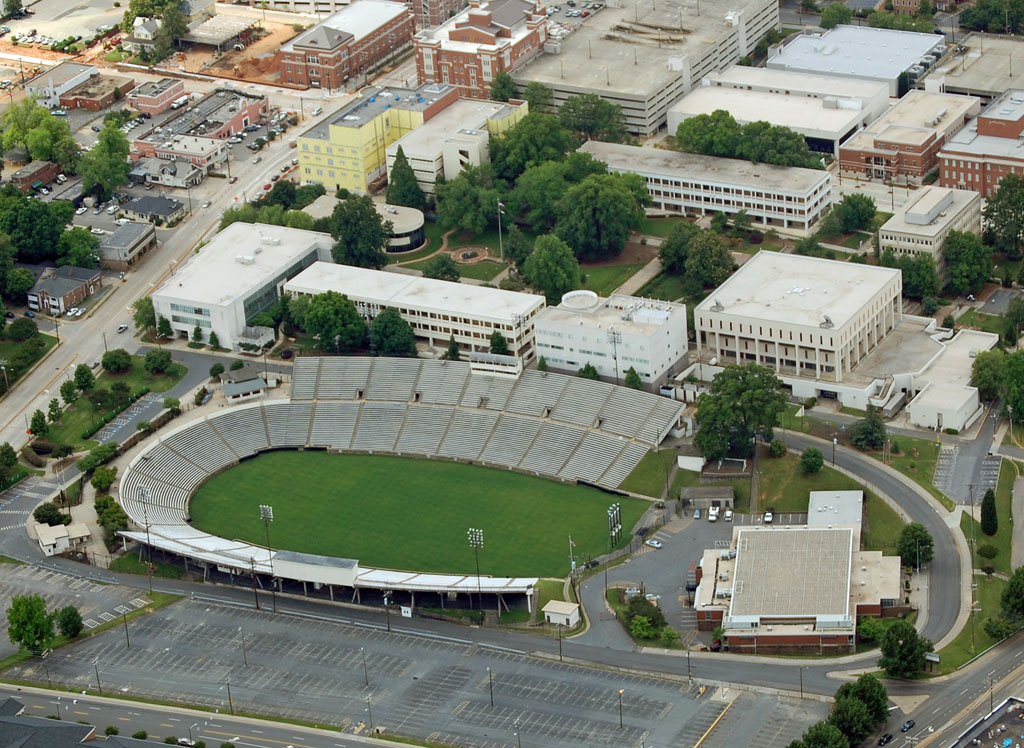
American Legion Memorial Stadium is a 21,000-capacity stadium located on 7th Street in the Elizabeth community of Charlotte, North Carolina. Memorial Stadium is mainly used for high school sporting events and also serves as a public venue. Prior to the construction of nearby Bank of America Stadium, Memorial Stadium was Charlottes largest outdoor venue, and is still the largest municipal venue in the city. Ground was broken on the stadium in 1934 and the gates were officially opened two years later in 1936. Named in honor of local soldiers who fell in World War I, the stadium was a project of the Works Progress Administration. Throughout the years the stadium has hosted events of every kind, ranging from Presidential addresses to classic professional wrestling encounters featuring local hero Ric Flair. The stadium formerly hosted Charlotte High School . For many years afterward, as the city grew and opened more high schools, the stadium was used practically every week during the football season to accommodate both schools which had no campus stadium and large crowds which some campus stadiums could not contain for the more popular match-ups. The stadium continues to play a large role in Charlotte-Mecklenburg high school football to this day as it hosts big ticket match-ups such as Butler v. Independence and Charlotte Latin v. Charlotte Country Day. In 1985, the stadium hosted a preseason USFL game between the Baltimore Stars and Tampa Bay Bandits in February. It is located on a complex with the Grady Cole Center. Both are located next to Central Piedmont Community College. Independence Park Stadium, a tiny public baseball stadium, is also close by. For the past few years the stadium has hosted several band competitions. It has hosted the battle of the Bands between the biggest HBCUs in South Carolina, North Carolina, and Georgia. It has also hosted Drum Corps International competitions hosted by Carolina Crown. For several years the stadium annually hosted the Shrine Bowl which was a match-up of the top high school football players in North Carolina and South Carolina. The stadium served as a neutral site for the 2002 and 2003 meetings between The Citadel and VMI, known as the Military Classic of the South. In late 2009 the east end of the stadium suffered significant damage after a storm drain under the structure caved in causing the stand to collapse. The stadium was closed for several months while repairs were made, in July 2010 the stadium was reopened with a reduced capacity as a grass berm largely replaced the old seating. Memorial Stadium serves as the home field for the Charlotte MLL team. The Charlotte Hounds began play at the start of the 2012 season. Soccer comes to the stadium when the Charlotte Independence of the USL Pro starts play in 2015. The Myers Park Mustangs moved most of their 2012 home games to the stadium after renovations temporarily lowered capacity at Gus Purcell Stadium, their on-campus home.

Irwin Belk Track and Field Center/Transamerica Field

The Irwin Belk Track and Field Center/Transamerica Field is a stadium located on the campus of the University of North Carolina at Charlotte. Finished in 1996, the stadium is home to the 49ers soccer and track and field teams. The facility includes the Southeasts first 8 lane continuous radius track with full-depth polyurethane surface; and 10,500 square feet of internal space including coaches offices, locker rooms and a hospitality suite in the North Pavilion. Public restrooms, concessions and the press box are located in the South Pavilion. The Central Pavilion contains the ticket booths, Wall of Champions and Recognition Center. Track events held in the Center include high jump, pole vault, long jump, and triple jump. The 120 yard by 75 yard natural grass playing surface is the home field for the Charlotte 49ers mens and womens soccer teams, and also accommodates shot put, discus, javelin and hammer throw events. The facility has hosted several major meets for both Conference USA and the Atlantic 10 Conference. Pro soccer team, the Charlotte Eagles, have also used Belk for home games. Originally considered for expansion to host the Charlotte 49ers new football team, estimates of expansion for football usage made by leading sports design firm Populous were prohibitively expensive due to location restrictions and environmental concerns involving the Toby Creek flood plain. Subsequently, the University chose to build a dedicated football stadium west of Hayes Stadium, named Jerry Richardson Stadium. Title IX scholarship requirements related to the addition of the Charlotte 49ers football program will most likely mean that Belk will soon be home to a either a potential 49ers future field hockey team and/or womens lacrosse team. Facilities upgrades, including the possibility of replacing the grass field with Artificial turf, might be needed to handle the added usage.

This attraction is located in

This is a private property. Please enjoy respectfully and do not disturb the occupants.

Edit Categories
Add Tours

This attraction is not part of any tours

Add Collections

This attraction is not part of any collections


Some of the attractions we imported from Wikipedia are not perfect. Send us an email detailing what's wrong and we'll look into fixing it.

GuRoute is all about Gurus sharing their local knowledge. If you feel up to fixing this problem yourself, why not adopt it. You will become the owner and can fix whatever problems you see.

We've copied a link to this attraction into your clipboard so that ou can paste it into an email or text message...

More Info...
You can add your friends to the visit yourself, or, send them a link and let them add themselves...

The visit will appear on both your timelines and on your Shared Timeline.

Click below and we'll email you a link that you can send on to friends or post on your group's Facebook page.

If your friends aren't members of GuRoute yet, this is a great way to get them started.
Recent
Recently used Collections will appear here...
Recent
Recently used tours will appear here...

Where is this?

GuRoute likes to place attractions inside other attractions. So, maybe it's in a city, or maybe it's inside a particular park in that city. Maybe your attraction is a huge park that spans half the county, or multiple counties.

Determining where this attraction is gives it context - if it's in a park, you'll be able to see it alongside all the other attractions in that park. And that helps define the park.

GuRoute will automatically calculate a parent region for this attraction. You can change it if there is something more appropriate.

This attraction is currently located in .

Change

This attraction does not yet have any reviews

Please login to write a review...

Reviewed by
Record new Visit

Add this location to your timneline?

  • If there's an existing attraction open it and add it to your timeline...
  • If not, enter a title and we'll create a new attraction for your memories...
Create new Attraction

Create a new attraction at this location?

  • We rely on Gurus like you to share your local knowledge...
(Give a name for this location)


+
Add this to your timeline instead...

Imagine having a record of all the cool things you've done in your life!


Using our timeline you can keep track of everywhere you visit in your lifetime...

But, you'll need to sign in first...

Add contacts so that you can share your travels and record places that you visit together...

Family
Favorites
Family
Favorites

Profile TimeLine Our Visits Edit Accept Decline Invite

If you have any more friends that visited this place with you, feel free to add them to the visit. We'll write it to their timeline and once they confirm it, they too will have this memory for a lifetime.

If they're not already registered, you just need their name and email address and you can add them and we'll send them an invite on your behlaf.

Add a tour comment

Add some extra information for when this attraction is viewed as part of your tour...

Next Stop Instructions

Add some instructions for what to see/do on the way to the next stop...

Next Stop Instructions

Add some instructions for what to see/do on the way to the next stop...

If you're visiting an existing attraction, open it and add it to your timeline. If there is no attraction for the place you are visiting...

  • Click 'Add My Location' below
  • Or right-click on the map to mark a different location
  • Or long-press if you have a touch screen
You can even add locations while you're offline....
  • Load up the map when you're online and we'll keep track of your locaiton
  • You can add locations to your timeline
  • When you are online again we'll sync them with the cloud

We can't connect to the internet right now. The following attractions are saved locally and can be uploaded when you're online...

GuRoute would like to access your current location so that we can pin you on the map and show you nearby attractions

Add friends so that you can share your experiences with each other...

Add tour to What's Next?

Go...

Either for yourself or someone else...

  1. Do your trip research in GuRoute
    Add all the places that you think might be worthy of a visit into a trip-plan
  2. Add your trip-plan to your "What's Next" timeline
    (or a friend's "What's Next" timeline)
  3. When you're on vacation you'll have all your research at your fingertips
  4. Share your timline with your friends
    They can enjoy your vacation with you, seeing not only where you've been, but where you're going next...
  5. Add/remove attractions if things change

It also makes a great souvenir of your trip

Collections

Go...

Create a home page for a collection of attractions

  • Add an image and description to display on the homepage
  • Start adding content
    Add existing attractions to your collection or create new attractions of your own
  • Collections can be:
    • Public (Anyone can add attractions to your collection)
    • Shared (Only yourself and Gurus you nominate can add content)
    • Private (The collection will only be visible to yourself)

Uses

  • Local business or hotel
    Showcase local attractions that you endorse
  • Clubs
    Showcase attractions that members have created (eg. local historical society)
  • Special Interest
    If GuRoute does not have a category for your special interest you add your attractions to your own collection instead

Examples

Walking/Driving Tours

Go...

A guided tour where GuRoute will direct you from stop to stop and narrate a description of each attraction you arrive at

  • GuRoute uses your phone's GPS to guide you from stop to stop
  • GuRoute automatically detects when you arrive at the next tour-stop and narrates the description of the attraction (Chrome Only)
  • It then sends you on to the next stop

Tours are great to attract people to your town. Even places with no significant points of interest can be lots of fun when part of a tour


Cater tours to your Audience

  • Kid-friendly Tours
    • Focus on what will keep kids interested
    • Instead of parents having to drag their kids around they'll be struggling to keep up
    • Let the kids navigate and they'll get more fun out of finding that historical plaque than they ever would from reading it
  • Accessible tours
  • Short and long tours of the same location

What you need to do...

  1. Click 'Go...'
    Enter a title, description and location for the tour
  2. Add existing attractions OR create new ones and add them to the tour
  3. For existing attractions you can add more information specific to the theme of the tour
  4. You can also add instructions on what to do or see en-route to the next tour-stop
  5. Try out your tour and see how it works...

Mystery Tour

Go...

Create a Mystery Tour

Create a series of clues to show people around a city, neighborhood or whatever place you like...

  • GuRoute will show people clues to get them from attraction to attraction
  • When they reach each stop GuRoute will tell them about the place and give them the next clue
  • Take as long or as you like and explore each location at your leisure

Scavenger Hunt

Go...

Create a Scavenger Hunt

Create a series of questions that people have to answer. The answers can all be discovered by walking aroung the area, looking for clues.

  • How many beers are on tap at Michael Collin's Irish Bar?
  • What's the name of the oldest building on main streeet?
  • Show a picture of some public art and ask them what it is called
  • Clues can have numeric or multiple choice answers