Sign In

My Timeline

GuRoute

Discover Your World

Share your Experiences

Record your Life


Top Attractions in Columbus

Ohio State University

The Ohio State University, commonly referred to as Ohio State or OSU, is a public research university in Columbus, Ohio. Founded in 1870, as a land-grant university and ninth university in Ohio with the Morrill Act of 1862, the university was originally known as the Ohio Agricultural and Mechanical College. The college began with a focus on training students in various agricultural and mechanical disciplines but was developed into a comprehensive university under the direction of Governor Rutherford B. Hayes and in 1878 the Ohio General Assembly passed a law changing the name to "The Ohio State University". It has since grown into the third largest university campus in the United States. Along with its main campus in Columbus, Ohio State also operates a regional campus system with regional campuses in Lima, Mansfield, Marion, Newark, and Wooster. The university is also home to an extensive student life program, with over 1,000 student organizations; intercollegiate, club and recreational sports programs; student media organizations and publications, fraternities and sororities; and three active student governments. Ohio State athletic teams compete in Division I of the NCAA and are known as the Ohio State Buckeyes. The university is a member of the Big Ten Conference for the majority of sports. The Ohio State Buckeyes mens ice hockey program competes in the Big Ten Conference, while its womens hockey program competes in the Western Collegiate Hockey Association. In addition, the OSU mens volleyball team is a member of the Midwestern Intercollegiate Volleyball Association . OSU is one of only fourteen universities in the nation that plays Division I FBS football and Division I ice hockey. Alumni and former students have gone on to prominent careers in government, business, science, medicine, education, sports, and entertainment. Michael V. Drake, former chancellor of the University of California, Irvine, assumed the role of university president on June 30, 2014.

Ohio Stadium

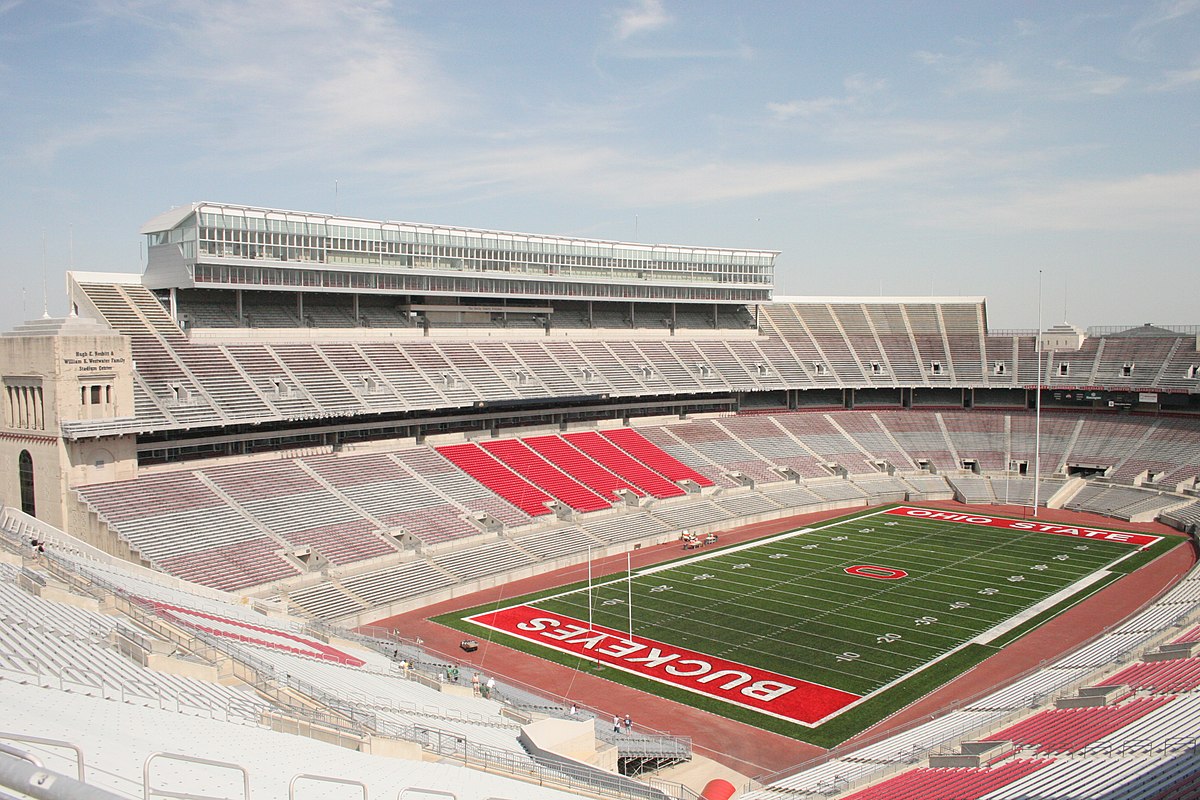
Ohio Stadium, also known as The Horseshoe or The Shoe, is an American football stadium in Columbus, Ohio, United States, on the campus of The Ohio State University. Its primary purpose is the home venue of the Ohio State Buckeyes football team and The Ohio State University Marching Band. From 1996–98, Ohio Stadium was the home venue for Major League Soccer team Columbus Crew prior to the opening of Columbus Crew Stadium in 1999. The stadium also was the home venue for the OSU track and field teams from 1923–2001. In addition to athletics, Ohio Stadium is also a concert venue, with U2, The Rolling Stones, Pink Floyd, and Metallica among the many acts to have played there, and also serves as the site for the universitys Spring Commencement ceremonies each May. Permanent field lights were added in 2014. The stadium opened in 1922 as a replacement for Ohio Field and had a seating capacity of 66,210. In 1923, a cinder running track was added and the stadium, which was later upgraded to an all-weather track. Seating capacity gradually increased over the years and reached a total of 91,470 possible spectators in 1991. Beginning in 2000, the stadium was renovated and expanded in several phases, removing the track and adding additional seating, which raised the capacity to 101,568 by 2001 and to 102,329 in 2007. In 2014, additional seating was added in the end zone, raising the official capacity to 104,944. It is the largest stadium by capacity in the state of Ohio, the fourth largest football stadium in the United States, and the fifth largest non-racing stadium in the world. Ohio Stadium was added to the National Register of Historic Places by the National Park Service on March 22, 1974. It is popularly known as "The Horseshoe" because of its shape.

Ohio Village

Ohio Village is a living history museum in Columbus, Ohio, United States. It is operated by the non-profit Ohio Historical Society. The village, intended to provide a firsthand view of life in Ohio during the American Civil War, opened July 27, 1974, on 15 acres adjacent to the Ohio Historical Center in north Columbus. The 22 buildings that make up the village are a mixture of reproductions and historic structures moved to the site. Among those currently standing are the Town Hall, Print Shop, General Store and Masonic Lodge, Education Center, Pharmacy, Blacksmith Shop, Tinsmith Shop, Broom and Basket Shop, Cabinetmaker/Undertakers Shop, Harnessmakers and Weavers shops, Ladies Soldiers Aid Society, Village Bakery, Market House, Livery Stable, Schoolhouse, Doctors Office and Residence, the Ohio Village Bank, the Colonel Crawford Inn and the Elks Head Tavern. In 1995 a large traditional church was constructed to allow formal weddings to be scheduled in the village. The church is the villages most recent new construction. The Ohio Village is open to visitors Memorial Day weekend through Labor Day weekend starting in 2012. Visitors enter through the Ohio History Center museum and can enjoy the Village as part of their visit. One of the most popular of the villages annual signature events is the All Hallows Eve, an 1860s-style celebration of Halloween that has taken place in late October every year since 1985. The festivities include fortunetelling, costumed interpretation of beliefs and superstitions related to the season, and a parade for the dead through the town center meant to appease roaming spirits. The night culminates in a production of Washington Irvings Legend of Sleepy Hollow. Ohio Village is also home to two historic baseball teams, the Ohio Village Muffins and Lady Diamonds. Both teams play by the 19th-century rules of the game, very similar to those first set down by the New York Knickerbockers, Americas first baseball club, in 1845. The Ohio Cup Vintage Baseball Festival, held at the village every year in the late summer, draws teams from across the country to compete in a tournament played by the old rules.

Kelton House Museum and Garden

The Kelton House Museum and Garden is a Greek Revival and Italianate mansion in the Discovery District of downtown Columbus, Ohio. The museum was established by the Junior League of Columbus to promote an understanding of daily life, customs, and decorative arts in 19th century Columbus and to educate visitors about the Underground Railroad. Fernando Cortez Kelton was a merchant from Vermont who rose to prominence in Columbus as a drygoods wholesaler. He and his wife, Sophia Langdon Stone Kelton, built the Kelton House on Town Street in 1852. The Keltons were fervent abolitionists who used their home as a stop on the Underground Railroad. Fernando Kelton was so respected for his abolitionist work that he was selected to be a pallbearer at the funeral procession of Abraham Lincoln when Lincolns remains were brought to Columbus on their way to Illinois for burial. The Keltons eldest son Oscar joined the 95th Ohio Infantry, Company A in 1862 to fight against slavery. He rose to the rank of First Lieutenant before getting killed in the Battle of Brices Crossroads on June 10, 1864. The same year, the Keltons took in Martha Hartway, a young runaway slave from Virginia. She was raised as part of the family until her marriage in 1874 to Thomas Lawrence, a carpenter whose work can still be seen in the Kelton House. The house passed on to the Keltons son, Frank Kelton. He married Isabella Morrow Coit, a suffragist who was one of the first four women to attend The Ohio State University. Her mother was the well known local women’s rights leader Elizabeth Greer Coit. Frank later traded houses with his brother Edwin to better accommodate the various sizes of their families. Edwin’s daughter Grace Bird Kelton was the last member of the family to own the house. She lived there until her death in 1975. Grace was one of the first people in the country to make her living as an interior decorator, having studied at both the Parsons School of Design and the Pratt Institute. Her work was widely recognized; along with other members of AID, she consulted on the Jacqueline Kennedy redecoration of the White House in the 1960s. After Grace’s death, the house was left to the Columbus Foundation. They lease it to the Junior League of Columbus, who restored it to represent a time period between 1852 and 1900. The house now operates as a museum and events facility. Approximately 80 – 90 percent of the furnishings that visitors can see in the home were owned by the Kelton family.

Columbus City Hall

Columbus City Hall is the city hall of Columbus, Ohio, located at 90 West Broad Street, at the intersection of Broad and Front Streets, in the city's Civic Center on the east bank of the Scioto River. Among others, it contains the offices of the city's Mayor, Auditor, and Treasurer, and the offices and chambers of Columbus City Council. It was built during a period of extensive construction along the city's riverfront, including the building of the American Insurance Union Citadel, now known as the LeVeque Tower, directly to the east across Front Street. In 1921, a fire destroyed the old City Hall, built in 1872 at East State and Third Streets, now the site of the Ohio Theatre. James John Thomas, mayor of Columbus from 1920 to 1931, laid the cornerstone for a new City Hall on October 29, 1926. The building was dedicated on April 18, 1928. The five-story building, constructed of Indiana limestone, was designed by the Allied Architects Association of Columbus in the Neoclassical Revival style and built at a cost of US$1.7 million, equivalent to $23.43 million in 2015. Allied Architects also designed the adjacent Central Police Station building at West Gay Street and Marconi Boulevard, which opened on March 26, 1930, was abandoned in 1991 with the opening of a new police headquarters building, and was renovated in 2012 to allow the consolidation of various city government offices. City Hall was originally also the venue for the city's Municipal Court, and its proximity to the Police Station building provided for efficient movement of prisoners between the two buildings. Initially built in three sections surrounding a central courtyard, a fourth section was added on the west side of City Hall in 1936 to enclose the courtyard and provide additional office space. The structure was further renovated in 1949. City Council chambers, located on the second floor, were fully restored in 1986, and feature Art Deco elements echoing those found throughout the building. The south patio of City Hall facing Broad Street was named the M. D. Portman Plaza in 1996 after a long-serving City Council member, and is home to a 20 foot tall bronze statue of Christopher Columbus by Italian sculptor Edoardo Alfieri. The statue was a gift to the city of Columbus from the citizens of Genoa, Italy and was dedicated on October 12, 1955.

Ohio State University Golf Club

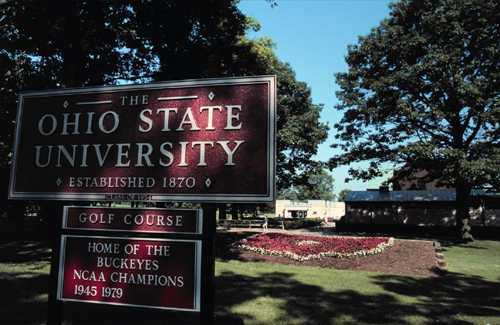
The Ohio State University Golf Club is located at 3605 Tremont Road, Upper Arlington, Ohio, a suburb of Columbus. It was founded by L.W. St. John, . The golf club has two classical golf courses called Scarlet and Gray. The Scarlet was completed in 1938 and the Gray was finished later in 1940. The dedication ceremony was held on May 18, 1940, when Bob Kepler, Chick Evans, Blanche Sohl, and Patty Berg played 18 holes on the Scarlet course. Both the Scarlet and the much shorter Gray golf courses were designed by Dr. Alister MacKenzie, a world-renowned golf course architect. The Scarlet course is rated as one of the top collegiate courses in the nation. In 2005 and 2006 the Scarlet Course underwent a major restoration project overseen by former Buckeye legend Jack Nicklaus that was intended to restore play on the Scarlet course to the way that MacKenzie had envisioned it. In 1941, Ohio State made history when it hosted the first ever womens collegiate golf championship on the Scarlet course. In 1982, Ohio State hosted the final Association for Intercollegiate Athletics for Women Division I National Championship. In 1991, Ohio State hosted the NCAA Womens Championship, commemorating the 50th Anniversary of the national tournament for women on the course on which it was conceived. The womens program later went on to host the 1997 and 2006 tournaments as well. The Scarlet Course has also played host to 10 mens National Championships. Over the years the Ohio State Scarlet course has been the site of several U.S. Open qualifiers, U.S. Amateur qualifiers and the 1977 USGA Junior Championship.

Schiller Park

Schiller Park is a 23.45-acre municipal park located in German Village, an historic neighborhood in Columbus, Ohio. The park is bounded by Reinhard Avenue to the north, Jaeger Street to the east, East Deshler Avenue to the south, and City Park Avenue to the west. During the nineteenth century, the land was originally owned by Frances Stewart and was known as "Stewarts Grove." It had been the areas center for festivals and neighborhood activities since the 1800s, including the Independence Day celebration of 1830 and Ohio State Fairs of 1864 and 1865. By 1866, David W. Deshler, his son William G. Deshler, and Allen G. Thurman purchased the property with the aim of having it permanently serve the public. Shortly afterwards, the City of Columbus purchased the park in April 1867 for $15,000 from the Deshlers and Thurman. Upon purchase, the park was renamed "The City Park" and is ranked as the second oldest park in the city following Goodale Park. Between the middle and end of the nineteenth century, the area surrounding "City Park" became increasingly populated by German immigrants. On July 4, 1891 during a Fourth of July celebration, a statue of Johann Christoph Friedrich von Schiller was dedicated to the park by the German-born residents. Friedrich von Schiller was a famous German poet, philosopher, historian, and playwright. The statue in German Village is a second casting of the original statue in Munich, Germany. The original statue was designed and executed by Max von Widnmann and unveiled in Munich on May 9, 1863, an anniversary of Friedrich von Schillers death. The Columbus City Council passed Ordinance No. 22,233 on April 3, 1905 to rename "The City Park" to "Schiller Park" as a namesake. The park, once a community meeting ground for the German settlement, is now the site of recreational facilities, gardens, and an amphitheater. Free live performances of Shakespearean plays are enacted during the summer months courtesy of Actors Theatre of Columbus. Along the main entrance of the park, facing City Park Avenue, visitors are greeted by the Huntington Gardens that are sponsored by Huntington National Bank and maintained by volunteers. The park is also home to the Umbrella Girl Fountain, dedicated to the citizens of German Village in October 1996 to replace Hebe, the missing original sculpture.

COSI Columbus

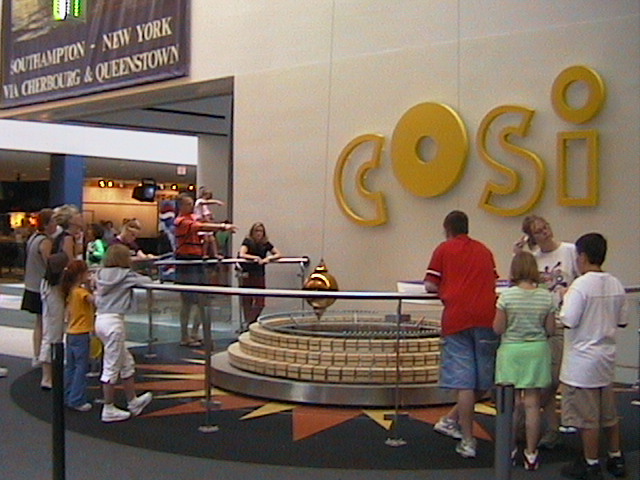
COSI is a science museum and research center located in Columbus, Ohio in the United States. Originally opened in 1964, COSI was relocated to a 320,000 square foot state-of-the-art facility designed by Japanese architect Arata Isozaki along a bend in the Scioto River in 1999. COSI features more than 300 interactive exhibits throughout themed exhibition areas. As a “center of science and industry”, COSI established embedded partnerships with local organizations. WOSU@COSI maintains a digital media center and offices; OSU maintains a center of research as well as health medicine laboratories staffed by medical residents; and Columbus Historical Society maintains offices and exhibit space. COSI also operates the largest outreach education program of any science museum in the United States through COSI in the Classroom, 21st Century Lab field trip experiences, international distance education Interactive Video Conferencing programs, and COSI On Wheels traveling outreach program. As well, COSI originated the Camp-In overnight program for Girl Scouts and Boy Scouts in 1972 – a concept that is now commonplace in museums nationwide. Since 1964, COSI has engaged with nearly 30 million unique visitors through on-site and outreach programs. As a not-for-profit organization, COSI is supported by ticket sales, a network of community and statewide partnerships, a volunteer program supported by 10,000 volunteers annually, and nearly 20,000 member households. In 2008, COSI was the named the #1 science center in the United States for families by Parent Magazine.

Berry Brothers Bolt Works

The Berry Brothers Bolt Works is a former factory in Columbus, Ohio, United States. For more than a century after its 1888 construction, the factory produced machine tools using original equipment. The structure itself is one of Columbus most prominent factory buildings, and it was named a historic site in its centennial year. Berry Brothers is a brick building with an asphalt roof, set on a foundation of limestone. Numerous windows, many set in pairs, cover the three-story facade of the main and secondary sections of the building. The building is typical of period factories, due to major components such as the brick walls and gabled roof, and also because of smaller elements such as the wooden windows with numerous small panes of glass, a four-story tower with staircase, and clerestory. Near the end of the nineteenth century, Columbus possessed numerous factories that built buggies and various machine tools, and the Berry Brothers constructed their manufacturing plant in 1888 for the sole purpose of producing bolts for these factories. A competing firm, built at the same time, went out of business before Berry Brothers. Their business, on the other hand, prospered; the building was greatly expanded in 1900, and a second large addition was erected ten years later. As buggies were replaced by cars, Berry Brothers continued in operation, using its 1880s equipment into the 1980s. No longer a factory, the companys building was purchased in 2000 with the goal of renovation, although financial problems delayed the start of work until 2004. In early 1988, the bolt factory was listed on the National Register of Historic Places, qualifying on three of the Registers four listing criteria: because of its architecture, because of its place in local history, and because of its potential to be an industrial archaeological site. The only criterion under which it did not qualify was that of association with a prominent individual.

St. John Arena

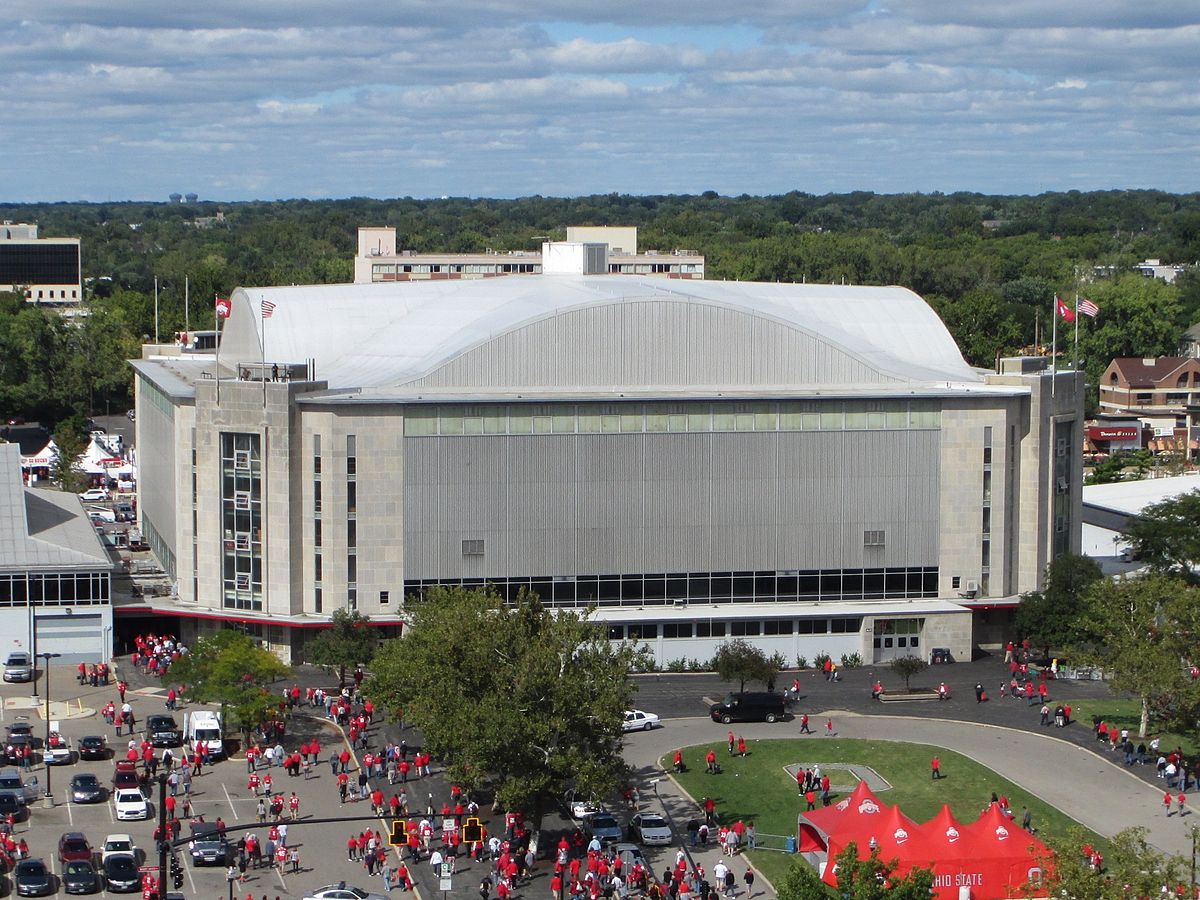
St. John Arena is a multi-purpose arena on the campus of The Ohio State University in Columbus, Ohio, USA. The arena was named for Lynn St. John, who served as Ohio States mens basketball coach and athletic director until 1947. Located on north campus between Woody Hayes Drive and Lane Avenue, the 13,276-seat arena was built in 1956. When it housed the Ohio State Buckeyes mens basketball team from its completion until 1998, it saw the Buckeyes win the 1960 National Championship and five straight Big Ten titles from 1960 to 1964 under coach Fred Taylor. The mens and womens basketball teams moved to their current home, Value City Arena at the Jerome Schottenstein Center, in 1998. The arena now houses the schools mens and womens volleyball teams, mens and womens gymnastics teams, and wrestling squad. It also hosts the annual Buckeye Classic womens basketball tournament. Concerts by popular musical artists were held at the arena from 1971 to 1980. In 2004, St. John Arena hosted its first mens basketball game in six years because of a scheduling conflict at the Schottenstein Center. St. John Arena was again used for mens basketball on March 24, 2008, when the Buckeyes hosted an NIT game against the California Golden Bears. The Buckeyes eventually took the 2008 NIT title. The most popular event still held at the arena is the Skull Session, the pep rally before football games. Two hours prior to kickoff The Ohio State University Marching Band performs Buckeye favorites, and the players and coaches speak to the crowd. With roots back to 1932, the Skull Session sometimes features the visiting teams marching band or local high school bands as well. Many fans arrive hours early to obtain seating for the Ohio State tradition. St. John Arena is used for Freshmen Convocation, at which the entire freshman class meets for the first time and university leaders initiate the freshmen. Plans to demolish St. Johns were announced in November 2012 to be replaced by the Covelli Arena.

This attraction is located in

This is a private property. Please enjoy respectfully and do not disturb the occupants.

Edit Categories
Add Tours

This attraction is not part of any tours

Add Collections

This attraction is not part of any collections


Some of the attractions we imported from Wikipedia are not perfect. Send us an email detailing what's wrong and we'll look into fixing it.

GuRoute is all about Gurus sharing their local knowledge. If you feel up to fixing this problem yourself, why not adopt it. You will become the owner and can fix whatever problems you see.

We've copied a link to this attraction into your clipboard so that ou can paste it into an email or text message...

More Info...
You can add your friends to the visit yourself, or, send them a link and let them add themselves...

The visit will appear on both your timelines and on your Shared Timeline.

Click below and we'll email you a link that you can send on to friends or post on your group's Facebook page.

If your friends aren't members of GuRoute yet, this is a great way to get them started.
Recent
Recently used Collections will appear here...
Recent
Recently used tours will appear here...

Where is this?

GuRoute likes to place attractions inside other attractions. So, maybe it's in a city, or maybe it's inside a particular park in that city. Maybe your attraction is a huge park that spans half the county, or multiple counties.

Determining where this attraction is gives it context - if it's in a park, you'll be able to see it alongside all the other attractions in that park. And that helps define the park.

GuRoute will automatically calculate a parent region for this attraction. You can change it if there is something more appropriate.

This attraction is currently located in .

Change

This attraction does not yet have any reviews

Please login to write a review...

Reviewed by
Record new Visit

Add this location to your timneline?

  • If there's an existing attraction open it and add it to your timeline...
  • If not, enter a title and we'll create a new attraction for your memories...
Create new Attraction

Create a new attraction at this location?

  • We rely on Gurus like you to share your local knowledge...
(Give a name for this location)


+
Add this to your timeline instead...

Imagine having a record of all the cool things you've done in your life!


Using our timeline you can keep track of everywhere you visit in your lifetime...

But, you'll need to sign in first...

Add contacts so that you can share your travels and record places that you visit together...

Family
Favorites
Family
Favorites

Profile TimeLine Our Visits Edit Accept Decline Invite

If you have any more friends that visited this place with you, feel free to add them to the visit. We'll write it to their timeline and once they confirm it, they too will have this memory for a lifetime.

If they're not already registered, you just need their name and email address and you can add them and we'll send them an invite on your behlaf.

Add a tour comment

Add some extra information for when this attraction is viewed as part of your tour...

Next Stop Instructions

Add some instructions for what to see/do on the way to the next stop...

Next Stop Instructions

Add some instructions for what to see/do on the way to the next stop...

If you're visiting an existing attraction, open it and add it to your timeline. If there is no attraction for the place you are visiting...

  • Click 'Add My Location' below
  • Or right-click on the map to mark a different location
  • Or long-press if you have a touch screen
You can even add locations while you're offline....
  • Load up the map when you're online and we'll keep track of your locaiton
  • You can add locations to your timeline
  • When you are online again we'll sync them with the cloud

We can't connect to the internet right now. The following attractions are saved locally and can be uploaded when you're online...

GuRoute would like to access your current location so that we can pin you on the map and show you nearby attractions

Add friends so that you can share your experiences with each other...

Add tour to What's Next?

Go...

Either for yourself or someone else...

  1. Do your trip research in GuRoute
    Add all the places that you think might be worthy of a visit into a trip-plan
  2. Add your trip-plan to your "What's Next" timeline
    (or a friend's "What's Next" timeline)
  3. When you're on vacation you'll have all your research at your fingertips
  4. Share your timline with your friends
    They can enjoy your vacation with you, seeing not only where you've been, but where you're going next...
  5. Add/remove attractions if things change

It also makes a great souvenir of your trip

Collections

Go...

Create a home page for a collection of attractions

  • Add an image and description to display on the homepage
  • Start adding content
    Add existing attractions to your collection or create new attractions of your own
  • Collections can be:
    • Public (Anyone can add attractions to your collection)
    • Shared (Only yourself and Gurus you nominate can add content)
    • Private (The collection will only be visible to yourself)

Uses

  • Local business or hotel
    Showcase local attractions that you endorse
  • Clubs
    Showcase attractions that members have created (eg. local historical society)
  • Special Interest
    If GuRoute does not have a category for your special interest you add your attractions to your own collection instead

Examples

Walking/Driving Tours

Go...

A guided tour where GuRoute will direct you from stop to stop and narrate a description of each attraction you arrive at

  • GuRoute uses your phone's GPS to guide you from stop to stop
  • GuRoute automatically detects when you arrive at the next tour-stop and narrates the description of the attraction (Chrome Only)
  • It then sends you on to the next stop

Tours are great to attract people to your town. Even places with no significant points of interest can be lots of fun when part of a tour


Cater tours to your Audience

  • Kid-friendly Tours
    • Focus on what will keep kids interested
    • Instead of parents having to drag their kids around they'll be struggling to keep up
    • Let the kids navigate and they'll get more fun out of finding that historical plaque than they ever would from reading it
  • Accessible tours
  • Short and long tours of the same location

What you need to do...

  1. Click 'Go...'
    Enter a title, description and location for the tour
  2. Add existing attractions OR create new ones and add them to the tour
  3. For existing attractions you can add more information specific to the theme of the tour
  4. You can also add instructions on what to do or see en-route to the next tour-stop
  5. Try out your tour and see how it works...

Mystery Tour

Go...

Create a Mystery Tour

Create a series of clues to show people around a city, neighborhood or whatever place you like...

  • GuRoute will show people clues to get them from attraction to attraction
  • When they reach each stop GuRoute will tell them about the place and give them the next clue
  • Take as long or as you like and explore each location at your leisure

Scavenger Hunt

Go...

Create a Scavenger Hunt

Create a series of questions that people have to answer. The answers can all be discovered by walking aroung the area, looking for clues.

  • How many beers are on tap at Michael Collin's Irish Bar?
  • What's the name of the oldest building on main streeet?
  • Show a picture of some public art and ask them what it is called
  • Clues can have numeric or multiple choice answers