Sign In

My Timeline

GuRoute

Discover Your World

Share your Experiences

Record your Life


Top Attractions in Chillicothe

Mary Worthington Macomb House

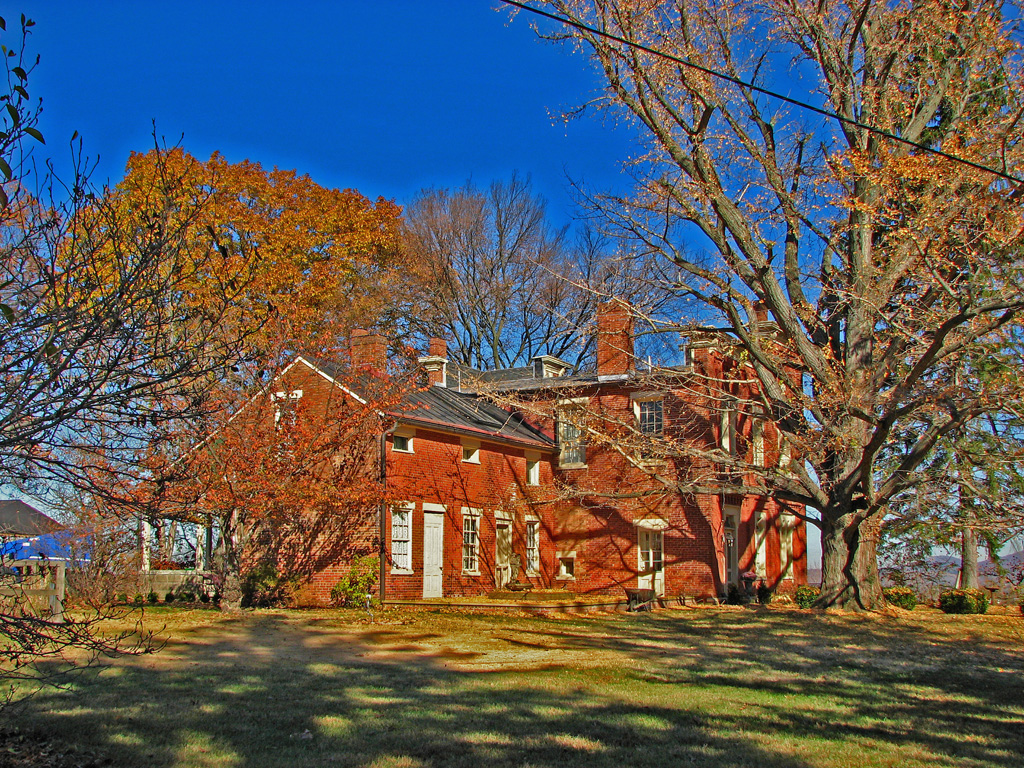
The Mary Worthington Macomb House is a historic residence in southern Chillicothe, Ohio, United States. Located on South Paint Street, the house sits on the banks of Paint Creek. One of the oldest buildings still in existence in Chillicothe, the Macomb House sits on a land tract of 35 acres that was originally owned by Nathaniel Massie. A later owner started to build the present house in 1813, and it was completed two years later. In the same year, former U.S. Senator and future Governor Thomas Worthington purchased the property. The oldest of Governor Worthington's daughters was Mary, who was born in 1797. Although Mary and her family lived in the grand Adena Mansion on Chillicothe's northern side, she chose to marry lower in society circa 1816. Her new husband, David Macomb, was a member of a prominent local family, but his poor management of their property forced them into debt, and they settled in the southern United States, where Mary died while moving to Texas in 1836. Before moving southward, the Macombs resided in the present two-story house, which is built primarily of large blocks of sandstone. After the Macombs' departure, the property was converted for industrial uses. By 1845, multiple new buildings arose around the old structure, including a frame building and a slaughterhouse. These buildings are no longer on the property. In 1976, the Macomb House was listed on the National Register of Historic Places, qualifying both because of its historically important architecture and because of its place in local history: most significant were its architecture, its role in commerce, and its place in the exploration and settlement of the local area. By the early twenty-first century, the house had deteriorated greatly; with the proposal of an influx of money from the American Recovery and Reinvestment Act of 2009, applications were made for stimulus dollars to restore the house, and a complete restoration was estimated to cost approximately $500,000.

Tanglewood

Tanglewood is a historic house on the western side of Chillicothe, Ohio, United States. Built in 1850, it features a combination of the Greek Revival and Italianate styles of architecture, and it is one of the best preserved examples of the rare "monitor" style of residential design. A Catholic clergyman, John McClean, arranged for the house to be built; however, he sold it to Richard Douglas, a local lawyer, before construction was complete. Douglas owned the property little longer than did McClean, dying soon after it was finished. The house's most prominent resident was William Edwin Safford, who lived there as a boy; growing to adulthood, he developed a strong reputation as a leading naturalist in the islands of the South Pacific Ocean, and he was later appointed to be the first Vice-Governor of Guam after the United States conquered the island in 1898. Built of brick on a stone foundation, it is covered with a roof of asphalt, and it features various other elements of brick and iron. Tanglewood is an elaborate two-and-one-half-story house with many fine Greek Revival elements. Among its details are multiple pillared porches featuring capitals of the Ionic order, an ornate frieze above the windows, and some elements of the Italianate style that was only just beginning to come into popularity in the middle of the nineteenth century. In 1979, Tanglewood was listed on the National Register of Historic Places because of its well-preserved historic architecture. It is one of at least two Ohio monitor houses that is listed on the Register, along with one in the village of St. Paris that is known simply as the "Monitor House."

Mountain House

The Mountain House is a historic Gothic Revival house in western Chillicothe, Ohio, United States. It was built by German immigrant Oscar Janssen in 1852, sitting atop a bluff above the Scioto River and the rest of the city of Chillicothe; its location and architectural style were intended to resemble that of castles overlooking the Rhine in his homeland. Janssen surrounded his house with vineyards, a winery, and a beer garden; because of the house's location on the edge of a steep hillside, he terraced the hillside before developing it. After Janssen's lifetime, the Mountain House passed into the hands of designer and papermaker Dard Hunter. Purchasing the house in 1919, Hunter converted it into a production center for his handmade paper and hand-carven type. Here he produced a wide range of books, publishing them under the banner of the Mountain House Press, and gradually he built a worldwide reputation. The two-story Mountain House mixes various architectural styles and materials. Although it is primarily a Gothic Revival structure, with details such as Gothic arches for windows and doors, it also includes a significant number of Romanesque Revival elements. Its brick walls rest on a stone foundation, and the interior may be accessed through large wooden doors. In 1978, the Mountain House was listed on the National Register of Historic Places. It qualified for this distinction both because of its well-preserved historic architecture and because of its connection to Hunter, who was seen as a significant person in local history. Today, the house remains in use as the offices of the Mountain House Press.

Wesley Chapel

Wesley Chapel, also known as the "Hopetown Church", is a historic church building in the unincorporated community of Hopetown, Ohio, United States. Built for a Methodist congregation, the church's earliest portion was constructed in 1834; this rectangular structure forms the core of the present building. Major changes to the building since the 1830s have included the erection of a five-sided addition on the church's northern side in 1888 and significant destruction and repairs after a 1926 lightning strike. Built of brick on a stone foundation, the church features a distinctive pyramid-shaped roof above the 1888 addition. At one time, the church also included a tower above the entrance; the tower was the portion of the building hit by the 1926 lightning strike, and it was removed as a result. The various architectural elements combine to form a building that is distinctively in the Gothic Revival style. From its earliest years, Wesley Chapel was the center of community life in Hopetown. The community was settled during the final years of the eighteenth century; the oldest graves in the church's cemetery date from the 1790s. For decade after decade, the church was the location of social activities, such as quilting bees and fish fries. Many years passed without the church being able to obtain its own minister, so it was served by circuit-riding ministers instead. Despite the prosperity brought by the coming of the Ohio and Erie Canal in the 1830s, Hopetown remained small; Wesley Chapel was always at the heart of a small settlement. In 1979, Wesley Chapel was listed on the National Register of Historic Places, qualifying both because of its historically significant architecture and because of its important place in local history. More than forty Ross County locations are on the Register, but Wesley Chapel is the only religious building among them.

Anthony and Susan Cardinal Walke House

The Anthony and Susan Cardinal Walke House is a historic residence on the west side of Chillicothe, Ohio, United States. Erected around 1812, it is a Colonial Revival house built in the style of the early post-independence period of the United States. Its builders, like many other early residents of Chillicothe, were natives of Virginia who brought much of their cultural heritage with them to the Old Northwest. The approximate construction date for the Walke House is known from local land records, which show that the value of the property rose from $5 to $223 per acre shortly after 1812. It appears that the building was constructed under Thomas James, who owned this piece of land from 1812 to 1819; however, it seems that he never finished construction, for land records suggest that it was completed under the ownership of Cadwallader Wallace, who owned it from 1819 to 1820. Wallace sold this land to Anthony Walke, the namesake of the house; among the members of the Walke family was Anthony's second son, Henry, who became both a prominent artist and an admiral in the United States Navy. Various elements of the Federal and Classical Revival architectural styles are present at the Walke House, including the prominent front portico with its four columns. A single-story building set on an above-ground basement, which in turn rests on a foundation of sandstone, the house features such elements as a fanlight, multiple Palladian windows, and a hip roof. Despite some modifications made during the early twentieth century, the house remains largely as it was when it was built; the interior woodwork has been preserved, as have all exterior elements except for the roof. Today, the house is surrounded by its original lawn; although the city has grown to surround the property, the house's immediate vicinity is essentially unchanged and thus presents a significant contrast to the surrounding neighborhood. In 2007, the Walke House was listed on the National Register of Historic Places, due to its prominent place in the architecture of Chillicothe.

Seip House

The Seip House is a historic building on the west side of Chillicothe, Ohio, United States. Built in 1895, it is among the city's grandest houses. Born in Germany in the late 1810s, Charles Seip was a butcher who settled in the United States in 1845. Soon after crossing the Atlantic, Seip took up residence in Chillicothe; he soon began operating a butcher shop on Allen Avenue, married, and became prosperous. As his business grew, Seip expanded into downtown premises and began to purchase farms in the Chillicothe vicinity in order to supply more animals for his business. By the 1890s, Seip's son John had persuaded his father to erect a large house on the site of his original butcher shop. The resulting building took four years to complete, being started in 1895 and completed in 1898. A two-and-a-half story building, designed by John Cook, it is a brick building that sits on a sandstone foundation; its roof, covered with slates, is a hip roof that rises to the center of the house. At his death in 1902, Seip owned some of the leading properties in Ross County. His house was one of the most prominent Queen Anne homes in Chillicothe, and he owned seven different farms in the region. Since that time, the house has changed hands; in 1955, the Ohio Department of Natural Resources purchased the house and converted it into offices for its regional forestry headquarters. In recognition of its historic architecture, the house was listed on the National Register of Historic Places in 1981.

This attraction is located in

This is a private property. Please enjoy respectfully and do not disturb the occupants.

Edit Categories
Add Tours

This attraction is not part of any tours

Add Collections

This attraction is not part of any collections


Some of the attractions we imported from Wikipedia are not perfect. Send us an email detailing what's wrong and we'll look into fixing it.

GuRoute is all about Gurus sharing their local knowledge. If you feel up to fixing this problem yourself, why not adopt it. You will become the owner and can fix whatever problems you see.

We've copied a link to this attraction into your clipboard so that ou can paste it into an email or text message...

More Info...
You can add your friends to the visit yourself, or, send them a link and let them add themselves...

The visit will appear on both your timelines and on your Shared Timeline.

Click below and we'll email you a link that you can send on to friends or post on your group's Facebook page.

If your friends aren't members of GuRoute yet, this is a great way to get them started.
Recent
Recently used Collections will appear here...
Recent
Recently used tours will appear here...

Where is this?

GuRoute likes to place attractions inside other attractions. So, maybe it's in a city, or maybe it's inside a particular park in that city. Maybe your attraction is a huge park that spans half the county, or multiple counties.

Determining where this attraction is gives it context - if it's in a park, you'll be able to see it alongside all the other attractions in that park. And that helps define the park.

GuRoute will automatically calculate a parent region for this attraction. You can change it if there is something more appropriate.

This attraction is currently located in .

Change

This attraction does not yet have any reviews

Please login to write a review...

Reviewed by
Record new Visit

Add this location to your timneline?

  • If there's an existing attraction open it and add it to your timeline...
  • If not, enter a title and we'll create a new attraction for your memories...
Create new Attraction

Create a new attraction at this location?

  • We rely on Gurus like you to share your local knowledge...
(Give a name for this location)


+
Add this to your timeline instead...

Imagine having a record of all the cool things you've done in your life!


Using our timeline you can keep track of everywhere you visit in your lifetime...

But, you'll need to sign in first...

Add contacts so that you can share your travels and record places that you visit together...

Family
Favorites
Family
Favorites

Profile TimeLine Our Visits Edit Accept Decline Invite

If you have any more friends that visited this place with you, feel free to add them to the visit. We'll write it to their timeline and once they confirm it, they too will have this memory for a lifetime.

If they're not already registered, you just need their name and email address and you can add them and we'll send them an invite on your behlaf.

Add a tour comment

Add some extra information for when this attraction is viewed as part of your tour...

Next Stop Instructions

Add some instructions for what to see/do on the way to the next stop...

Next Stop Instructions

Add some instructions for what to see/do on the way to the next stop...

If you're visiting an existing attraction, open it and add it to your timeline. If there is no attraction for the place you are visiting...

  • Click 'Add My Location' below
  • Or right-click on the map to mark a different location
  • Or long-press if you have a touch screen
You can even add locations while you're offline....
  • Load up the map when you're online and we'll keep track of your locaiton
  • You can add locations to your timeline
  • When you are online again we'll sync them with the cloud

We can't connect to the internet right now. The following attractions are saved locally and can be uploaded when you're online...

GuRoute would like to access your current location so that we can pin you on the map and show you nearby attractions

Add friends so that you can share your experiences with each other...

Add tour to What's Next?

Go...

Either for yourself or someone else...

  1. Do your trip research in GuRoute
    Add all the places that you think might be worthy of a visit into a trip-plan
  2. Add your trip-plan to your "What's Next" timeline
    (or a friend's "What's Next" timeline)
  3. When you're on vacation you'll have all your research at your fingertips
  4. Share your timline with your friends
    They can enjoy your vacation with you, seeing not only where you've been, but where you're going next...
  5. Add/remove attractions if things change

It also makes a great souvenir of your trip

Collections

Go...

Create a home page for a collection of attractions

  • Add an image and description to display on the homepage
  • Start adding content
    Add existing attractions to your collection or create new attractions of your own
  • Collections can be:
    • Public (Anyone can add attractions to your collection)
    • Shared (Only yourself and Gurus you nominate can add content)
    • Private (The collection will only be visible to yourself)

Uses

  • Local business or hotel
    Showcase local attractions that you endorse
  • Clubs
    Showcase attractions that members have created (eg. local historical society)
  • Special Interest
    If GuRoute does not have a category for your special interest you add your attractions to your own collection instead

Examples

Walking/Driving Tours

Go...

A guided tour where GuRoute will direct you from stop to stop and narrate a description of each attraction you arrive at

  • GuRoute uses your phone's GPS to guide you from stop to stop
  • GuRoute automatically detects when you arrive at the next tour-stop and narrates the description of the attraction (Chrome Only)
  • It then sends you on to the next stop

Tours are great to attract people to your town. Even places with no significant points of interest can be lots of fun when part of a tour


Cater tours to your Audience

  • Kid-friendly Tours
    • Focus on what will keep kids interested
    • Instead of parents having to drag their kids around they'll be struggling to keep up
    • Let the kids navigate and they'll get more fun out of finding that historical plaque than they ever would from reading it
  • Accessible tours
  • Short and long tours of the same location

What you need to do...

  1. Click 'Go...'
    Enter a title, description and location for the tour
  2. Add existing attractions OR create new ones and add them to the tour
  3. For existing attractions you can add more information specific to the theme of the tour
  4. You can also add instructions on what to do or see en-route to the next tour-stop
  5. Try out your tour and see how it works...

Mystery Tour

Go...

Create a Mystery Tour

Create a series of clues to show people around a city, neighborhood or whatever place you like...

  • GuRoute will show people clues to get them from attraction to attraction
  • When they reach each stop GuRoute will tell them about the place and give them the next clue
  • Take as long or as you like and explore each location at your leisure

Scavenger Hunt

Go...

Create a Scavenger Hunt

Create a series of questions that people have to answer. The answers can all be discovered by walking aroung the area, looking for clues.

  • How many beers are on tap at Michael Collin's Irish Bar?
  • What's the name of the oldest building on main streeet?
  • Show a picture of some public art and ask them what it is called
  • Clues can have numeric or multiple choice answers