Sign In

My Timeline

GuRoute

Discover Your World

Share your Experiences

Record your Life


Top Attractions in Boston Harbor Islands National Recreation Area

The Graves

The Graves is an aggregation of rock outcroppings in Massachusetts Bay, Massachusetts, United States. Situated some 11 miles offshore of downtown Boston, it is the outermost island in the Boston Harbor Islands National Recreation Area. It is the location of The Graves Light, at 113 feet tall the tallest lighthouse in Boston Harbor, and an important navigation aid for traffic to and from the port. The island has a permanent size of 1.8 acres, and rises to a height of 15 feet above sea level; there is only aquatic vegetation on the island. The island is privately owned and the beacon and foghorn are managed by the Coast Guard, and is not open to the public. The Graves are named after Thomas Graves, a prominent early trader of colonial Massachusetts and a rear admiral in the English Navy who was killed in action against the Dutch in 1653. The Graves are northeast of the Roaring Bulls and far northwest of Three and One-half Fathom Ledge. The Commonwealth of Massachusetts ceded jurisdiction of The Graves, which lay outside the jurisdiction of any town, to the Federal Government on April 22, 1903, so that a lighthouse could be built on the ledge. The United States Lighthouse Service operated Graves Light until 1939, when it was merged into the United States Coast Guard. Graves Light was declared surplus property and sold by auction to a private owner in 2013."General Services Administration, Invitation for Bids" . General Services Administration. Retrieved October 14, 2013. .

Grape Island

Grape Island is an island in the Hingham Bay area of the Boston Harbor Islands National Recreation Area. The island is part of the territory of the town of Weymouth, Massachusetts. The island has a permanent size of 54 acres , plus an intertidal zone of a further 46 acres , and is composed of two drumlins, reaching an elevation of 70 feet above sea level, and connected by a marshy lowland. Tidal sand spits extend from the west end towards Weymouth Neck in Webb Memorial State Park and from the east end towards Slate Island. As a visitor attraction, Grape Island offers trails, rocky beaches, and camping in wooded campsites. At weekends and summer weekdays it is served by a shuttle boat to and from Georges Island, connecting there with ferries to Boston and Quincy. The island was farmed and grazed for three hundred years, up until the 1940s. On the eve of the American Revolution, the island was owned by Hingham resident Elisha Leavitt, a Tory. In 1775 British troops raided the island during the Siege of Boston, as Abigail Adams wrote to her husband John about May 24, 1775: "...it seems their Expidition was to Grape Island for Levets hay." A pitched battle ensued until the British were forced to retreat to the mainland. The angry colonists burned Leavitt's barn to the ground. In the end, very little damage was done to either side despite the effort expended. Three British soldiers may have been wounded , no Continental soldiers or partisans were wounded, and less than two tons of hay were confiscated. Since the abandonment of agricultural use in the 1940s, the natural succession of vegetation has created a wooded and shrubby landscape. Vegetation on the island includes early successional tree and shrub species on the drumlins, including Staghorn Sumac, Gray Birch, and Quaking Aspen. The island has an abundance of berries, including Blackberry, Dewberry, Raspberry, Blueberry, Huckleberry, and American Elderberry. The island's marshy lowland contains salt tolerant species such as Saltspray Rose, Cordgrass, Purple Loosestrife, Honeysuckle, and Seaside Goldenrod. Grape Island contains two freshwater springs. One spring is located on the north side of the eastern drumlin and is located underneath a large boulder that faces Peddock's Island. Another freshwater spring is located behind the marsh that is situated in the saddle between the two drumlins. Both of these areas are off the trail.

Lovells Island

Lovells Island, or Lovell's Island, is a 62-acre island in the Boston Harbor Islands National Recreation Area, in Massachusetts. The island is across The Narrows from Georges Island and some 7 miles offshore of downtown Boston. It is named after Captain William Lovell, who was an early settler of nearby Dorchester. The island is known as the site of several shipwrecks, including the 74-gun French warship Magnifique in 1782. In December of 1786, a passenger boat carrying 13 people crashed off the shore of Lovells Island. Coming from Damariscotta, Maine, and destined for the Boston Harbor, the boat sank within swimming distance to the Harbor, and all aboard made it to shore. Without shelter or warmth and in the midst of a blizzard, 11 of the victims froze to death. One man, Theodore Kingsbury, made it through the night and was taken to the hospital in the morning where he was pronounced dead. Two of the victims aboard the ship, a Miss Sylvia Knapp and her fiancé , were said to be found holding on to each other for warmth on top of a boulder, now dubbed “Lovers Rock”. The Humane Society of the Commonwealth of Massachusetts constructed lifesaving huts in November of 1787 around the harbor and the coast of Massachusetts, one on Lovells Island. Lovells Island has had a succession of owners. In 1767, the town of Charlestown deeded the island to Elisha Leavitt Jr. of Hingham, Massachusetts, an infamous Tory who also owned Grape Island, where Leavitt later invited British forces to help themselves to his hay until they were chased off by patriots. Leavitt's payment for Lovells Island was set aside to pay for the town's school. Lovells Island was used by Native Americans for fishing, gardening and trading. Later uses included harvesting the island's timber, as a fishing station, as a residence for the keepers of Boston Light, and as a rabbit run. Once the home of the Lovells Island Range Lights, the island was a buoy tending station in the early 20th century and was fortified before and during World War I, with remains of Fort Standish still visible. Much of the vegetation on the islands results from an attempt in the 1930s by the Civilian Conservation Corps to reestablish a natural forest on the island, although this was largely cleared when the fort was reactivated during World War II. Left to recover after the war, the island's plant life now includes remnant patches of stands of poplar, pine and spruce, together with successional species such as staghorn sumac, black cherry, chokecherry, apple, and gray birch. Common shrubs include bayberry, beach plum, raspberry, Virginia rose and saltspray rose. Today, Lovells Island is a popular camping island, with picnic areas and walking trails through its dunes and woods, together with a non-supervised swimming beach. On weekends and summer weekdays, it is served by a shuttle boat to and from Georges Island, connecting there with ferries to Boston and Quincy.

Outer Brewster Island

Outer Brewster Island, also known as Outward Island, is one of the outer islands in the Boston Harbor Islands National Recreation Area and is situated some 10 miles offshore of downtown Boston. The island has a permanent size of 20 acres, and consists of exposed bedrock covered by fertile soil bounded by a rocky shore with steep cliffs. It provides a nesting habitat for coastal water birds, including cormorants, gulls, common eider ducks, glossy ibis and American oystercatchers. The birds are aggressive during their nesting season and access by humans, which is by private boat only, is discouraged during this period. Like the neighboring islands of Great Brewster, Little Brewster and Middle Brewster, Outer Brewster Island is named after William Brewster, the first preacher and teacher for the Plymouth Colony. The relative barrenness and rocky shoreline of Outer Brewster has resulted in limited human usage. A granite quarry was operated on the island in the 19th century, and a coastal defense battery, known as Battery Jewell, was built on the island during World War II. Both are now disused and abandoned. In 1798 Nathaniel Austin bought Outer Brewster Island from David Wood for $400. Austin built an artificial harbor on the island and hoped to establish a profitable quarry. He built the house at 27 Harvard Square and 92 Main Street in Charlestown from stone mined on Outer Brewster. In 2005, Virginia energy company AES Energy proposed placing a liquified natural gas terminal on the island. Political opposition from environmental, recreational and boating interests succeeded in preventing the proposal from moving forward.

Rainsford Island

Rainsford Island, formerly known Hospital Island, Pest House Island, and Quarantine Island, is a 11-acre island in the Boston Harbor, situated between Long Island and Peddocks Island. The island is composed of two drumlins, reaching an elevation of 49 feet above sea level. The shoreline is predominantly rocky with a sandy cove in the south side, and a variety of wildflowers abound. Access is by private boat only. Since 1996 it comprises part of the Boston Harbor Islands National Recreation Area. This island was named for one of earliest recorded settlers, Edward Rainsford, nephew of Richard Raynsford; he owned the island by 1632. The island is known to have been used by Native Americans and, during the colonial period, was occupied, farmed and grazed. Between 1737 and 1925 the island has served as a quarantine hospital, unmarked burial ground for the diseased and criminals, almshouse, veterans hospital, reform school, and resort. However only foundations and a dilapidated seawall still survive from these uses. Rainsford Island hospital facilities were expanded and improved in the early 19th century. A huge Greek Revival-style building, the Stone Hospital or Greek Temple, was built in 1832 by Josiah Rogers. The Stone Hospital may have been designed by his brother, the American architect Isaiah Rogers, who was celebrated for his designs of the Boston and New York Merchants' Exchange, the U.S. Treasury Building in Washington, D.C., and the Tremont Hotel in Boston.

Snake Island

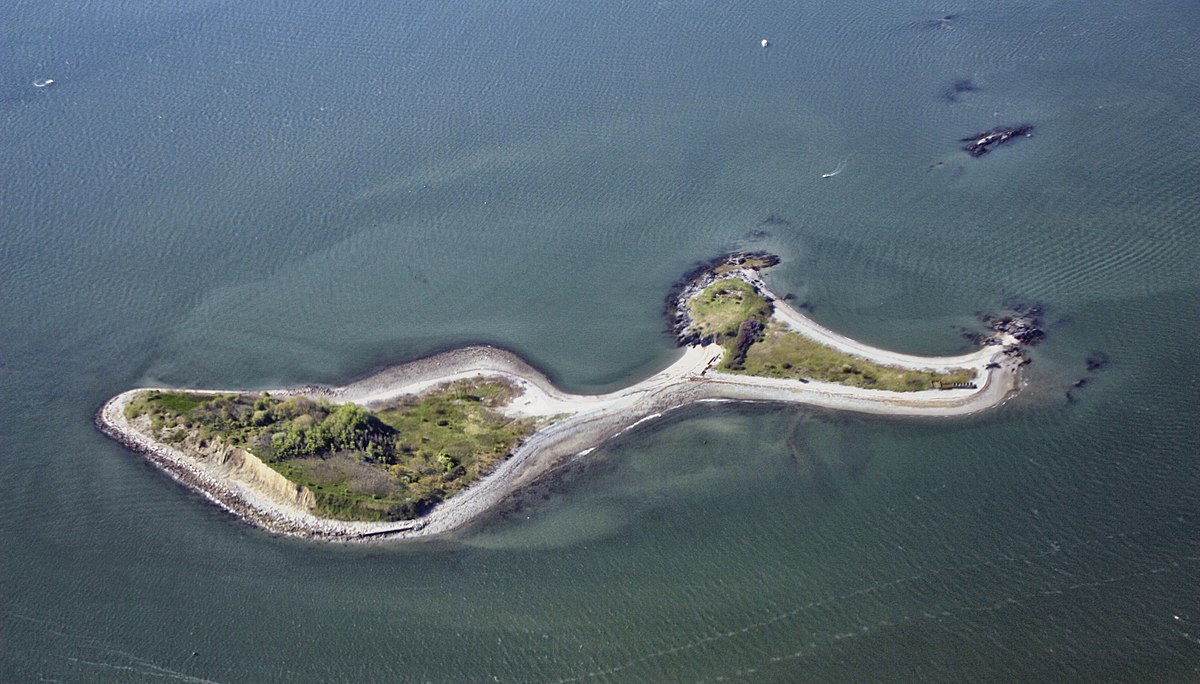
Snake Island, also known as Bare Island, is an island in Boston Harbor. The island is part of the Boston Harbor Islands National Recreation Area and is situated in the inner harbor between the town of Winthrop and the reclaimed land that forms Logan International Airport. It is part of the Town of Winthrop. It is named for its serpentine shape, and has a permanent size of 3 acres , and rises to a height of 10 feet above sea level. Since the 18th century the island has been owned by variety of owners, and has been used for livestock grazing, and as a squatter camp occupied by lobstermen and clammers. In the 1900s a grounded steamer served as residence for lobstermen from Winthrop. Today the island is uninhabited and classified as "conservation land". Access is by private boat only. The island is less than 1/4 mile from two shores of the Town of Winthrop. Unique among the Boston Harbor Islands, it has an interior lagoon which fills and partly drains, with the tide. The water entrance to the lagoon is winding and only six feet wide, not navigable for even a canoe or kayak, except at an unusually high tide. The lagoon and lack of predators makes the island attractive to birds, including migratory species. It is posted off-limits in the spring, when many bird species nest there. In recent years the island has increased in area, due to shoaling of the surrounding water, especially to the west; its long "tail" is now fully exposed at low tide. Access is only possible by beachable small craft, due to very shallow water and mud flats around the island.

Moon Island

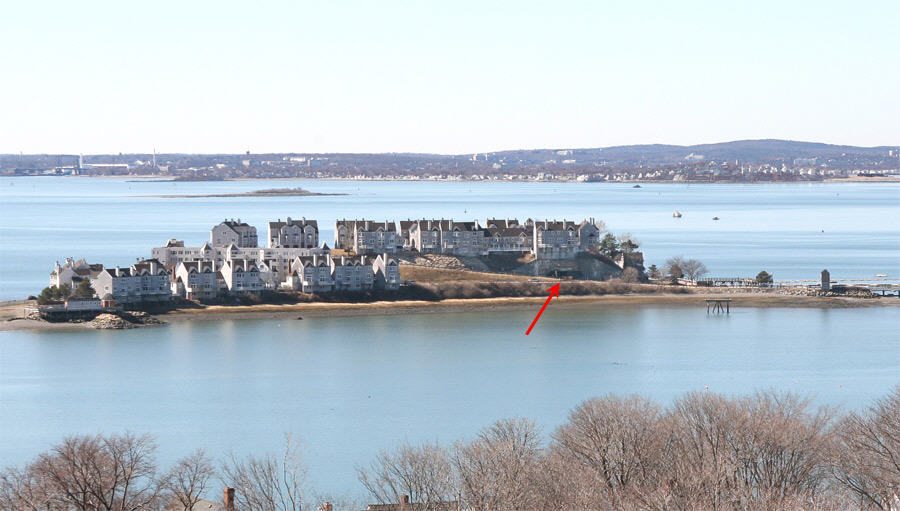
Moon Island is situated in Quincy Bay, in the middle of Boston Harbor, Massachusetts, and is the location of the Boston Fire Department Training Academy, and Boston Police Department shooting range. All of the land on the island is owned by the City of Boston but the island is under the jurisdiction of Quincy, Massachusetts. It is also part of the Boston Harbor Islands National Recreation Area. The causeway to Moon Island did not exist before the late 1870s and there was no bridge across Western Way to Long Island until the construction of the Long Island Viaduct in 1951. The sand spit from Thompson Island to Squaw Rock on Squantum was a clam bar until the sewage outflow from Moon Island backed up into the local waters. Native Americans summered in this area for thousands of years and consumed the prevalent mollusks. Another two bars pointed from Moon Island toward Squantum, following the general path of the new causeway. In early years, the land where UMass Boston and the Kennedy Memorial are located was open water. The area around Marina Bay was salt marsh leaving a much wider mouth to the Neponset River. In Colonial times, Moon Island was recorded as having 20 acres of land mass that was used as pasture. This land was connected at very low tides by two sand bars. The proper approach to this island in the late 19th century was from the Quincy Bay side. There was a 100-foot hill on the northerly side. Early inhabitants called the island, "Munning's Moone," or "Mennen's Moon," and is also recorded as "Moon Island" and "Moon Head". Today, Moon Island consists of 44.5 acres and is connected to Squantum by a two-lane roadway over the causeway. Moon Island is owned by the City of Boston and is no longer available for public access or use. As with many of the other islands in Boston Harbor, municipal and federal authorities have obtained ownership of Boston Harbor islands over the centuries. Most have never returned to private ownership or use. Access to the causeway leading to Moon Island and Long Island is controlled by police at a guardhouse at its southern end, and permission to enter the island must be obtained in advance since it is a restricted area.

Fort Warren

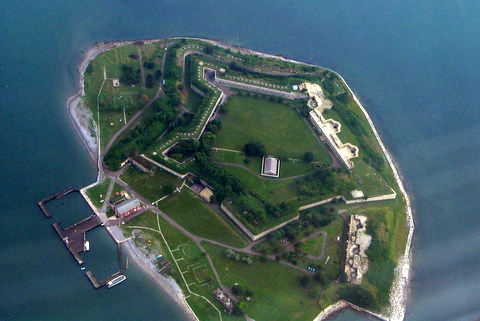
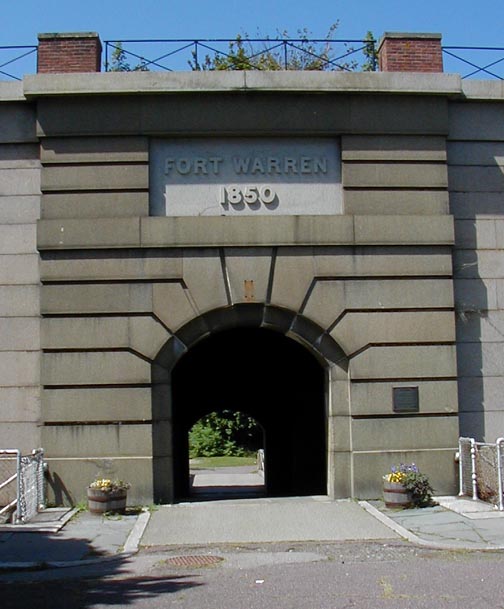
Fort Warren is a historic fort on the 28-acre Georges Island at the entrance to Boston Harbor. The fort is pentagonal star fort, made with stone and granite, and was constructed from 1833-1861, completed shortly after the beginning of the American Civil War. Fort Warren defended the harbor in Boston, Massachusetts, from 1861 through the end of WWII, and during the Civil War served as a prison for Confederate officers and government officials. The fort remained active through the Spanish-American War and World War I, and was re-activated during World War II. It was permanently decommissioned in 1947, and is now a tourist site. It was designated a National Historic Landmark in 1970 as a masterpiece of coastal engineering of the pre-Civil War period, and for its role in the Civil War. It was named for Revolutionary war hero Dr. Joseph Warren, who sent Paul Revere on his famous ride, and was later killed at the Battle of Bunker Hill. Fort Warren was built from 1833 to 1861 and was completed shortly after the beginning of the American Civil War. The Army engineer in charge during the bulk of the fort's construction was Colonel Sylvanus Thayer best known for his tenure as Superintendent of the United States Military Academy at West Point, New York. During the Civil War, the island fort served as a prison for captured Confederate army and navy personnel, elected civil officials from the state of Maryland, as well as Northern political prisoners. James M. Mason and John Slidell, the Confederate diplomats seized in the Trent affair, were among those held at the fort. Military officers held at Fort Warren include Richard S. Ewell, Isaac R. Trimble, John Gregg, Adam "Stovepipe" Johnson, Simon Bolivar Buckner, Sr., and Lloyd Tilghman. High ranking civilians held at Fort Warren include Confederate Vice President Alexander H. Stephens, and Confederate Postmaster General John Henninger Reagan. The prison camp had a reputation for humane treatment of its detainees. When the camp commander's son, Lieutenant Justin E. Dimick, left Fort Warren for active duty in the field with the Second U.S. Artillery, he was given a letter from Confederate officers in the camp urging good care should he be captured. (He was later mortally wounded at Chancellorsville in May, 1863.) The famous Union marching song John Brown was written at the fort using a tune from an old Methodist camp song. The song was carried to the Army of the Potomac by the men of the "Webster Regiment" who had mustered in at Fort Warren. Julia Ward Howe heard this song while visiting Washington DC. At the suggestion of her minister, Howe was encouraged to write new words. The Battle Hymn of the Republic, which was initially published as a poem, was later matched with the melody of the "John Brown" song and became one of the best remembered songs of the Civil War era. (See also:List of Civil War POW Prisons and Camps) Fort Warren remained active through the Spanish-American War and World War I. The fort was modified in the late 1890s through the beginning of the twentieth century to accommodate the newer rifled ordnance then being developed for coastal defense. During World War II, the fort served as a control center for Boston Harbor's south mine field, a precaution taken in anticipation of potential attacks by Kriegsmarine U-boats. At that time, Fort Warren was staffed by personnel of the 241st Coast Artillery (Harbor Defense), a Massachusetts National Guard unit that was federalized in September, 1940. Fort Warren was permanently decommissioned after 1950. Fort Warren was owned by the U.S. federal government until 1958, when the state obtained it from the General Services Administration. In 1961, the fort was reopened to the public after initial restoration. Today, the Massachusetts Department of Conservation and Recreation maintains and administers the fort, which is the centerpiece of the Boston Harbor Islands National Recreation Area. The fort is reachable by ferry from downtown Boston, Hingham, or Hull to Georges Island. Transfers are then available for those who wish to visit some of the other Harbor Islands. The fort is typically open from early or mid May through Columbus Day weekend. DCR Rangers offer guided tours, or you may explore on your own. An information booth just outside the sally port posts information about available activities. The island offers a well-stocked snack bar, water fountains, and a large number of composting toilets. There is also a museum located in the old mine storehouse (the red brick building opposite the ferry dock), a number of picnic tables, and a children's play structure. The tops of several of the walls and several of the casemates and magazines beneath them are open to visitors.

Hangman Island

Hangman Island, also known as Hayman's Island, is an island in the Quincy Bay area of the Boston Harbor Islands National Recreation Area. The island is a barren outcrop of bedrock, with a permanent size of half an acre rising to only three feet above sea level, plus an intertidal zone of a further 5 acres . Access is by private boat only. Approach to this island should be made with care and with the use of a nautical chart since there are many rocks and shoals in the immediate area. There is a small pebbly beach on the southern side. Special care should be taken when passing close aboard this island. Shoals extend approximately 250 yards to the northeast from this island and approximately 480 yards toward the south and southwest . There are many rocks and ledges in these areas that are hidden at high water. A green and white daybeacon on a pile marks the southwestern point of these shoals. On a 1775, London chart, this island was labeled Hayman's Island and shows a greater area than presently exists. There is no historical evidence that this island was used as a location for hanging criminals. The source of its current name has a hazy history. In 1882, several fishermen built fishing shacks on Hangman Island and were reported to have cultivated a vegetable garden here among the rocks. As of 2006, there are no human inhabitants on Hangmans Island. It is being used as a bird sanctuary and landing on this island is discouraged. Local private fishermen fish for striped bass among the rocks located on and near this island during the summer season. The label Hangman's Island also appears on a 1733 Map Of the British Empire in America created by Henry Popple.

This attraction is located in

This is a private property. Please enjoy respectfully and do not disturb the occupants.

Edit Categories
Add Tours

This attraction is not part of any tours

Add Collections

This attraction is not part of any collections


Some of the attractions we imported from Wikipedia are not perfect. Send us an email detailing what's wrong and we'll look into fixing it.

GuRoute is all about Gurus sharing their local knowledge. If you feel up to fixing this problem yourself, why not adopt it. You will become the owner and can fix whatever problems you see.

We've copied a link to this attraction into your clipboard so that ou can paste it into an email or text message...

More Info...
You can add your friends to the visit yourself, or, send them a link and let them add themselves...

The visit will appear on both your timelines and on your Shared Timeline.

Click below and we'll email you a link that you can send on to friends or post on your group's Facebook page.

If your friends aren't members of GuRoute yet, this is a great way to get them started.
Recent
Recently used Collections will appear here...
Recent
Recently used tours will appear here...

Where is this?

GuRoute likes to place attractions inside other attractions. So, maybe it's in a city, or maybe it's inside a particular park in that city. Maybe your attraction is a huge park that spans half the county, or multiple counties.

Determining where this attraction is gives it context - if it's in a park, you'll be able to see it alongside all the other attractions in that park. And that helps define the park.

GuRoute will automatically calculate a parent region for this attraction. You can change it if there is something more appropriate.

This attraction is currently located in .

Change

This attraction does not yet have any reviews

Please login to write a review...

Reviewed by
Record new Visit

Add this location to your timneline?

  • If there's an existing attraction open it and add it to your timeline...
  • If not, enter a title and we'll create a new attraction for your memories...
Create new Attraction

Create a new attraction at this location?

  • We rely on Gurus like you to share your local knowledge...
(Give a name for this location)


+
Add this to your timeline instead...

Imagine having a record of all the cool things you've done in your life!


Using our timeline you can keep track of everywhere you visit in your lifetime...

But, you'll need to sign in first...

Add contacts so that you can share your travels and record places that you visit together...

Family
Favorites
Family
Favorites

Profile TimeLine Our Visits Edit Accept Decline Invite

If you have any more friends that visited this place with you, feel free to add them to the visit. We'll write it to their timeline and once they confirm it, they too will have this memory for a lifetime.

If they're not already registered, you just need their name and email address and you can add them and we'll send them an invite on your behlaf.

Add a tour comment

Add some extra information for when this attraction is viewed as part of your tour...

Next Stop Instructions

Add some instructions for what to see/do on the way to the next stop...

Next Stop Instructions

Add some instructions for what to see/do on the way to the next stop...

If you're visiting an existing attraction, open it and add it to your timeline. If there is no attraction for the place you are visiting...

  • Click 'Add My Location' below
  • Or right-click on the map to mark a different location
  • Or long-press if you have a touch screen
You can even add locations while you're offline....
  • Load up the map when you're online and we'll keep track of your locaiton
  • You can add locations to your timeline
  • When you are online again we'll sync them with the cloud

We can't connect to the internet right now. The following attractions are saved locally and can be uploaded when you're online...

GuRoute would like to access your current location so that we can pin you on the map and show you nearby attractions

Add friends so that you can share your experiences with each other...

Add tour to What's Next?

Go...

Either for yourself or someone else...

  1. Do your trip research in GuRoute
    Add all the places that you think might be worthy of a visit into a trip-plan
  2. Add your trip-plan to your "What's Next" timeline
    (or a friend's "What's Next" timeline)
  3. When you're on vacation you'll have all your research at your fingertips
  4. Share your timline with your friends
    They can enjoy your vacation with you, seeing not only where you've been, but where you're going next...
  5. Add/remove attractions if things change

It also makes a great souvenir of your trip

Collections

Go...

Create a home page for a collection of attractions

  • Add an image and description to display on the homepage
  • Start adding content
    Add existing attractions to your collection or create new attractions of your own
  • Collections can be:
    • Public (Anyone can add attractions to your collection)
    • Shared (Only yourself and Gurus you nominate can add content)
    • Private (The collection will only be visible to yourself)

Uses

  • Local business or hotel
    Showcase local attractions that you endorse
  • Clubs
    Showcase attractions that members have created (eg. local historical society)
  • Special Interest
    If GuRoute does not have a category for your special interest you add your attractions to your own collection instead

Examples

Walking/Driving Tours

Go...

A guided tour where GuRoute will direct you from stop to stop and narrate a description of each attraction you arrive at

  • GuRoute uses your phone's GPS to guide you from stop to stop
  • GuRoute automatically detects when you arrive at the next tour-stop and narrates the description of the attraction (Chrome Only)
  • It then sends you on to the next stop

Tours are great to attract people to your town. Even places with no significant points of interest can be lots of fun when part of a tour


Cater tours to your Audience

  • Kid-friendly Tours
    • Focus on what will keep kids interested
    • Instead of parents having to drag their kids around they'll be struggling to keep up
    • Let the kids navigate and they'll get more fun out of finding that historical plaque than they ever would from reading it
  • Accessible tours
  • Short and long tours of the same location

What you need to do...

  1. Click 'Go...'
    Enter a title, description and location for the tour
  2. Add existing attractions OR create new ones and add them to the tour
  3. For existing attractions you can add more information specific to the theme of the tour
  4. You can also add instructions on what to do or see en-route to the next tour-stop
  5. Try out your tour and see how it works...

Mystery Tour

Go...

Create a Mystery Tour

Create a series of clues to show people around a city, neighborhood or whatever place you like...

  • GuRoute will show people clues to get them from attraction to attraction
  • When they reach each stop GuRoute will tell them about the place and give them the next clue
  • Take as long or as you like and explore each location at your leisure

Scavenger Hunt

Go...

Create a Scavenger Hunt

Create a series of questions that people have to answer. The answers can all be discovered by walking aroung the area, looking for clues.

  • How many beers are on tap at Michael Collin's Irish Bar?
  • What's the name of the oldest building on main streeet?
  • Show a picture of some public art and ask them what it is called
  • Clues can have numeric or multiple choice answers