Sign In

My Timeline

GuRoute

Discover Your World

Share your Experiences

Record your Life


Top Attractions in Greater Manchester

Manchester

Manchester is a city and metropolitan borough in Greater Manchester, England, with a population of 514,417 in 2013. It lies within the United Kingdom's second most populous urban area, with a population of 2.55 million. Manchester is fringed by the Cheshire Plain to the south, the Pennines to the north and east and an arc of towns with which it forms a continuous conurbation. The local authority is Manchester City Council. The recorded history of Manchester began with the civilian settlement associated with the Roman fort of Mamucium, a variant of which name is preserved by the city's demonym: residents are still referred to as Mancunians . The Roman fort was established in about 79 AD on a sandstone bluff near the confluence of the rivers Medlock and Irwell. It was historically a part of Lancashire, although areas of Cheshire south of the River Mersey were incorporated during the 20th century. Throughout the Middle Ages Manchester remained a manorial township but began to expand "at an astonishing rate" around the turn of the 19th century. Manchester's unplanned urbanisation was brought on by a boom in textile manufacture during the Industrial Revolution, and resulted in it becoming the world's first industrialised city. Manchester achieved city status in 1853, the first new British city for three hundred years. The Manchester Ship Canal, at the time the longest river navigation canal in the world, opened in 1894, creating the Port of Manchester and linking the city to sea, 36 miles to the west. Its fortunes declined after the Second World War however, owing to deindustrialisation, but investment spurred by the 1996 Manchester bombing led to extensive regeneration. Today Manchester is ranked as a beta world city by the Globalization and World Cities Research Network and is consequently the highest ranked British city except for London. Its metropolitan economy is the third largest in the United Kingdom with an estimated PPP GDP of US$92 billion as of 2014. Manchester is the third-most visited city in the UK by foreign visitors, after London and Edinburgh. It is notable for its architecture, culture, musical exports, media links, scientific and engineering output, social impact, sports clubs and transport connections. Manchester Liverpool Road railway station was the world's first inter-city passenger railway station and it was in the city that scientists first split the atom and developed the stored-program computer.

Bolton

Bolton is a town in Greater Manchester, in the North West of England. A former mill town, Bolton has been a production centre for textiles since Flemish weavers settled in the area during the 14th century, introducing a wool and cotton-weaving tradition. The urbanisation and development of the town largely coincided with the introduction of textile manufacture during the Industrial Revolution. Bolton was a 19th-century boomtown, and at its zenith in 1929 its 216 cotton mills and 26 bleaching and dyeing works made it one of the largest and most productive centres of cotton spinning in the world. The British cotton industry declined sharply after the First World War, and by the 1980s cotton manufacture had virtually ceased in Bolton. Close to the West Pennine Moors, Bolton is 10 miles northwest of the city of Manchester. It is surrounded by several smaller towns and villages that together form the Metropolitan Borough of Bolton, of which Bolton is the administrative centre. The town of Bolton has a population of 139,403, whilst the wider metropolitan borough has a population of 262,400. Historically a part of Lancashire, Bolton originated as a small settlement in the moorland known as Bolton le Moors. During the English Civil War the town was a Parliamentarian outpost in a staunchly Royalist region, and as a result Bolton was stormed by 3,000 Royalist troops led by Prince Rupert of the Rhine in 1644. In what became known as the Bolton Massacre, 1,600 residents were killed and 700 were taken prisoner. Former Premier League football club Bolton Wanderers play home games at the Macron Stadium formerly known as the Reebok Stadium and the WBA World light-welterweight champion Amir Khan was born in the town. Cultural interests include the Octagon Theatre and the Bolton Museum and Art Gallery, as well as one of the earliest public libraries established after the Public Libraries Act 1850.

Wigan

Wigan is a town in Greater Manchester, England. It stands on the River Douglas, 7.9 miles south-west of Bolton, 10 miles north of Warrington and 16 miles west-northwest of Manchester. Wigan is the largest settlement in the Metropolitan Borough of Wigan and is its administrative centre. The town of Wigan had a total population of 97,000 in 2011, whilst the wider borough has a population of 318,100. Historically in the county of Lancashire, Wigan during classical antiquity was in the territory of the Brigantes, an ancient Celtic tribe that ruled much of northern England. The Brigantes were subjugated in the Roman conquest of Britain during the 1st century, and it is asserted that the Roman settlement of Coccium was established where Wigan lies. Wigan is believed to have been incorporated as a borough in 1246 following the issue of a charter by King Henry III of England. At the end of the Middle Ages it was one of four boroughs in Lancashire possessing Royal charters; the others were Lancaster, Liverpool, and Preston. During the Industrial Revolution Wigan experienced dramatic economic expansion and a rapid rise in the population. Although porcelain manufacture and clock making had been major industries in the town, Wigan subsequently became known as a major mill town and coal mining district. The first coal mine was established at Wigan in 1450 and at its peak there were 1,000 pit shafts within 5 miles of the town centre. Mining was so extensive that one town councillor remarked that "a coal mine in the backyard was not uncommon in Wigan". Coal mining ceased during the latter part of the 20th century. Wigan Pier, a wharf on the Leeds and Liverpool Canal, was made famous by the writer George Orwell. In his book, The Road to Wigan Pier, Orwell highlighted the poor working and living conditions of the local inhabitants during the 1930s. Following the decline of industrial activities in the region, Wigan Piers collection of warehouses and wharfs became a local heritage centre and cultural quarter. The DW Stadium is home to both Wigan Athletic Football Club and Wigan Warriors Rugby League Football Club, both teams being highly successful in their sports with the former being the 2013 FA Cup winners and the latter being the most successful Rugby League side of all time. Wigan had a Population of 99,391 in 2011 but its Urban Subdivision had a Population of 103,608.

Salford

Salford is a town lying at the heart of the City of Salford, a metropolitan borough of Greater Manchester, in North West England. Salford is sited in a meander of the River Irwell, which forms in part its boundary with the city of Manchester to the east. The Salford wards of Broughton and Kersal are on the other side of the river. Together with its neighbouring towns to the west, Salford forms the local government district of the City of Salford, which is administered from Swinton. The former County Borough of Salford, which included Broughton, Pendleton and Kersal, was granted honorific city status in 1926; it has a resident population of 103,886 and occupies an area of 8.1 square miles . The wider City of Salford district has a population of 219,200. Historically in Lancashire, Salford's early history is marked by its status as a Royal caput and the judicial seat of the ancient hundred of Salfordshire, to which it lent its name. It was granted a charter by Ranulf de Blondeville, 6th Earl of Chester, in about 1230, making Salford a free borough. During the early stages of its growth, Salford was of greater cultural and commercial importance than its neighbour Manchester, although most contemporary sources agree that since the Industrial Revolution of the late 18th and early 19th centuries that position has been reversed. Salford became a major factory town and inland port during the 18th and 19th centuries. Cotton and silk spinning and weaving in local mills attracted an influx of families and provided Salford with a strong economy. Salford Docks was a principal dockyard of the Manchester Ship Canal. By the end of the 19th century Salford had an enlarged working class community and suffered from chronic overpopulation. Industrial activities declined during the 20th century however, causing a local economic depression. Salford subsequently became one of contrasts, with regenerated inner-city areas like Salford Quays next to some of the most socially deprived and violent areas in England. Salford has become a centre of higher education, home to the University of Salford, and has seen several firsts, including the world's first unconditionally free public library, and the first street in the world to be lit by gas, Chapel Street in 1806. Salford's MediaCityUK became the headquarters of CBBC and BBC Sport in 2011.

Rochdale

Rochdale is a market town in Greater Manchester, England, positioned at the foothills of the South Pennines on the River Roch, 5.3 miles north-northwest of Oldham, and 9.8 miles north-northeast of the city of Manchester. Rochdale is surrounded by several smaller settlements which together form the Metropolitan Borough of Rochdale, population 206,500. Rochdale is the largest settlement and administrative centre, with a total population of 95,796. Historically a part of Lancashire, Rochdales recorded history begins with an entry in the Domesday Book of 1086 under Recedham Manor. The ancient parish of Rochdale was a division of the hundred of Salford and one of the largest ecclesiastical parishes in England comprising several townships. By 1251, Rochdale had become important enough to have been granted a Royal charter. Subsequently, Rochdale flourished into a centre of northern Englands woollen trade, and by the early 18th century was described as being "remarkable for many wealthy merchants". Rochdale rose to prominence during the 19th century as a major mill town and centre for textile manufacture during the Industrial Revolution. It was a boomtown of the Industrial Revolution, and amongst the first ever industrialised towns. The Rochdale Canal—one of the major navigable broad canals of the United Kingdom—was a highway of commerce during this time used for the haulage of cotton, wool and coal to and from the area. The socioeconomic change brought by the success of Rochdales textile industry in the 19th century led to its rise to borough status and it remained a dominant settlement in its region. However, during the 20th century Rochdales spinning capacity declined towards an eventual halt. Rochdale today is a predominantly residential town. Rochdale Town Hall—a Grade I listed building—dates from 1871 and is one of the United Kingdoms finest examples of Victorian Gothic revival architecture. Rochdale is the birthplace of the Co-operative Movement. The Rochdale Equitable Pioneers Society, founded in 1844, was the first modern cooperative; the Rochdale Principles are a set of ideals for cooperatives.

Atherton

Atherton is a town within the Metropolitan Borough of Wigan, in Greater Manchester, England and historically a part of Lancashire. It is 5 miles east of Wigan, 2 miles north of Leigh, and 10.7 miles northwest of Manchester. For about 300 years from the 17th century Atherton was referred to as Chowbent, which was frequently shortened to Bent, the town's old nickname. Along with neighbouring Shakerley, Atherton has been associated with coal mining and nail manufacture since the 14th century, encouraged by its outcrops of coal. At the beginning of the 20th century the town was described as "the centre of a district of collieries, cotton mills and iron-works, which cover the surface of the country with their inartistic buildings and surroundings, and are linked together by the equally unlovely dwellings of the people". Atherton's last deep coal mine closed in 1966, and the last working cotton mills closed in 1999. Today the town is the third largest retail centre in the Borough of Wigan; almost 20% of those employed in the area work in the wholesale and retail trade, although there is still some significant manufacturing industry in the town. Evidence has been discovered of a Roman road passing through the area, on the ancient route between Coccium and Mamucium . Following the Anglo-Saxon invasion of England, Atherton, which is built on and around seven brooks, became part of the manor of Warrington until the Norman conquest, when it became a township or vill in the ancient parish of Leigh. Since 1974 the town has been part of the Metropolitan Borough of Wigan, a local government district of the Metropolitan County of Greater Manchester.

Ashton-under-Lyne

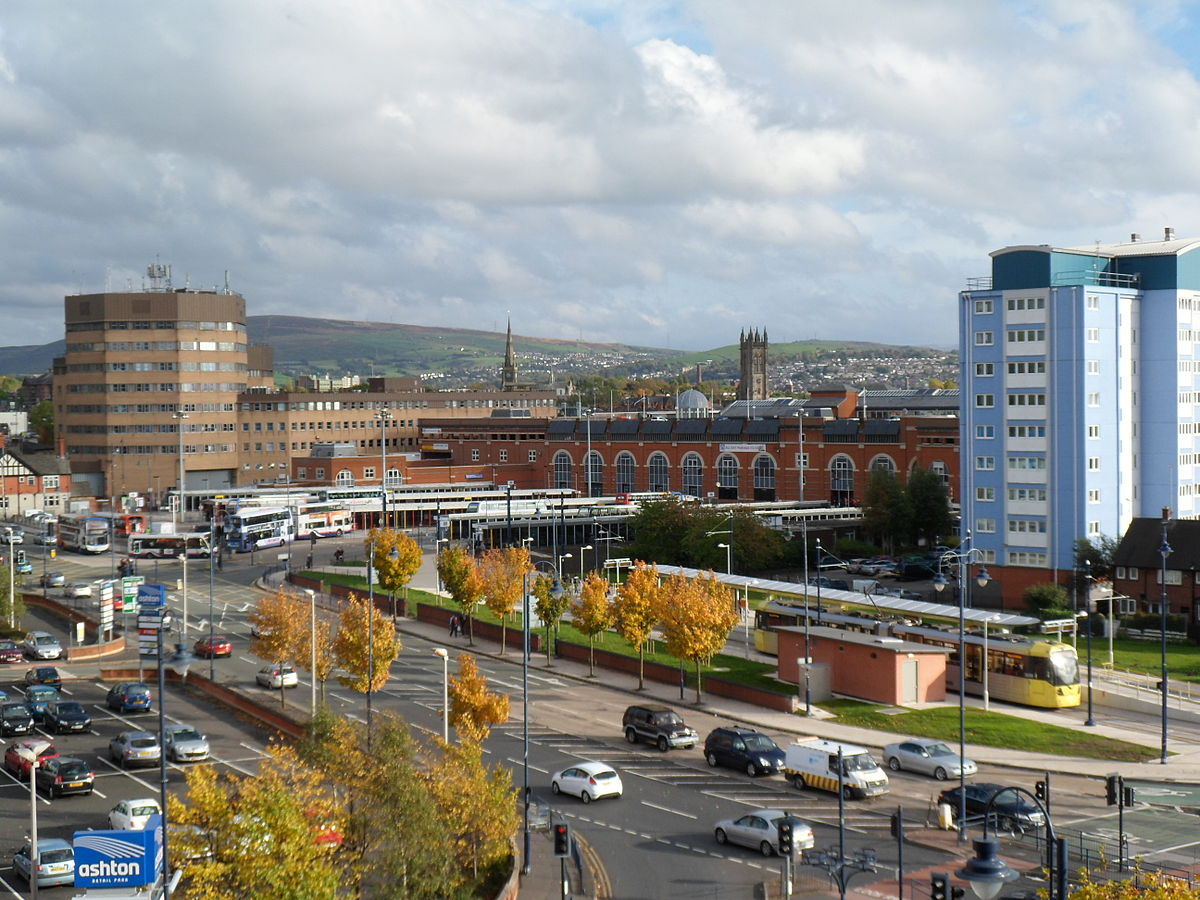
Ashton-under-Lyne is a market town in Tameside, Greater Manchester, England. The population had increased to 45,198 at the 2011 census. Historically in Lancashire, it is on the north bank of the River Tame, in the foothills of the Pennines, 6.2 miles east of Manchester. Evidence of Stone Age, Bronze Age, and Viking activity has been discovered in Ashton-under-Lyne. The "Ashton" part of the towns name probably dates from the Anglo-Saxon period, and derives from Old English meaning "settlement by ash trees". The origin of the "under-Lyne" suffix is less clear; it possibly derives from the British lemo meaning elm or from Ashtons proximity to the Pennines. In the Middle Ages, Ashton-under-Lyne was a parish and township and Ashton Old Hall was held by the de Asshetons, lords of the manor. Granted a Royal Charter in 1414, the manor spanned a rural area consisting of marshland, moorland, and a number of villages and hamlets. Until the introduction of the cotton trade in 1769, Ashton was considered "bare, wet, and almost worthless". The factory system, and textile manufacture during the Industrial Revolution triggered a process of unplanned urbanisation in the area, and by the mid-19th century Ashton had emerged as an important mill town at a convergence of newly constructed canals and railways. Ashton-under-Lynes transport network allowed for an economic boom in cotton spinning, weaving, and coal mining, which led to the granting of honorific borough status in 1847. In the mid-20th century, imports of cheaper foreign goods led to the decline of Ashtons heavy industries but the town has continued to thrive as a centre of commerce and Ashton Market is one of the largest outdoor markets in the United Kingdom. The 140,000-square-foot, two-floored Ashton Arcades shopping centre opened in 1995 and an IKEA store in 2006.

Swinton

Swinton is a town within the City of Salford, in Greater Manchester, England. Historically in Lancashire, Swinton is located on the A6 road. It stands on gently sloping ground on the southwest side of the River Irwell, and within the bounds of the orbital M60 motorway. It is 3.4 miles west-northwest of Salford, and 4.2 miles west-northwest of Manchester. Swinton and the adjoining towns of Pendlebury and Clifton together have a population of 41,347. For centuries Swinton was a small hamlet within the township of Worsley, parish of Eccles and hundred of Salfordshire. This hamlet is thought to have centred on an ancient pig farm or market; the name Swinton is derived from the Old English "Swynton" meaning "swine town". During the High Middle Ages Swinton was broadly held by the religious orders of the Knights Hospitaller and Whalley Abbey. Farming was the main industry of this rural area during the Middle Ages, with locals supplementing their incomes by hand-loom woollen weaving in the domestic system. Coal measures underlie the area, and a series of collieries opened during the Industrial Revolution gave rise to Swinton as an important industrial area. Locally sourced coal provided the fuel for a variety of cotton spinning and brickmaking industries. Bricks from Swinton were used for the 3rd Duke of Bridgewaters ambitious industrial projects, including the Bridgewater Canal, which passes Swinton to the south. The adoption of the factory system facilitated a process of unplanned urbanisation in the area, and by the mid-19th century Swinton had emerged as an important mill town and coal mining district at a convergence of factories, brickworks and a newly constructed road and railway network. Following the Local Government Act 1894, Swinton was united with neighbouring Pendlebury to become an urban district of Lancashire. Swinton and Pendlebury received a charter of incorporation in 1934, giving it honorific borough status. In the same year, the United Kingdoms first purpose-built intercity highway—the major A580 road, which terminates at Swinton and Pendleburys southern boundary—was officially opened by King George V. Swinton and Pendlebury became part of the City of Salford in 1974. As such, Swinton has continued to grow as the seat of Salford City Council and as a commuter town, supported by its transport network and close proximity to Manchester city centre.

Whitefield

Whitefield is a town within the Metropolitan Borough of Bury, in Greater Manchester, England. It lies on undulating ground above the Irwell Valley, along the south bank of the River Irwell, 3 miles south-southeast of Bury, and 4.9 miles to the north-northwest of the city of Manchester. Prestwich and the M60 motorway lie to the south. Historically a part of Lancashire, Whitefield has been suggested as lying on the path of an ancient Roman road leading from Mamucium in the south to Bremetennacum in the north. Throughout the Middle Ages, Whitefield was a division of the township of Pilkington, itself a part of the parish of Prestwich-cum-Oldham and hundred of Salford. Pilkington and Whitefield have historic associations with the Earls of Derby. Farming was the main industry of this rural area, with locals supplementing their incomes by hand-loom woollen weaving in the domestic system. The urbanisation and development of Whitefield largely coincided with the Industrial Revolution. The name Whitefield is thought to derive from the medieval bleachfields used by Flemish settlers to whiten their woven fabrics, or else from the wheat crop once cultivated in the district. The construction of a major roads routed through the village facilitated Whitefields expansion into a mill town during the mid-19th century. Whitefield was created a local government district in 1866, and was governed by a local board of health until 1894, when the area of the local board became an urban district.

Chadderton

Chadderton is a town within the Metropolitan Borough of Oldham, in Greater Manchester, England. It lies along the course of the River Irk and the Rochdale Canal, on undulating land in the foothills of the Pennines, 1 mile west of Oldham, 4.5 miles south of Rochdale, and 6 miles northeast of the city of Manchester. Historically part of Lancashire, Chaddertons early history is marked by its status as a manorial township, with its own line of lords and overlords, who included the Asshetons, Chethams, Radclyffes, and Traffords. Chadderton in the Middle Ages was chiefly distinguished by its two mansions, Foxdenton Hall and Chadderton Hall, and by the prestigious families who occupied them. Farming was the main industry of the area, with locals supplementing their incomes by hand-loom woollen weaving in the domestic system. Chaddertons urbanisation and expansion largely coincided with developments in textile manufacture during the Industrial Revolution and the Victorian era. A late 19th century factory-building boom transformed Chadderton from a rural township into a major mill town—one of several in its region—and the second most populous urban district in the United Kingdom. More than 50 cotton mills had been built in Chadderton by 1914. Although Chaddertons industries declined during the mid-20th century, the town continued to grow as a result of suburbanisation and urban renewal. The legacy of the towns industrial past remains visible in its landscape of red-brick cotton mills, now used as warehouses or distribution centres. Some of these are listed buildings because of their architectural, historical, and cultural significance.

Tyldesley

Tyldesley is a town in the Metropolitan Borough of Wigan in Greater Manchester, England. It is north of Chat Moss near the foothills of the West Pennine Moors, 7.7 miles east-southeast of Wigan and 8.9 miles west-northwest of Manchester. At the United Kingdom Census 2001, Tyldesley including the outlying areas of Astley, Shakerley, Mosley Common and New Manchester, had a population of 34,000. In 2011 the Tyldesley ward of Wigan Council had a population of 14,341. Historically in Lancashire, Tyldesley and its surroundings have provided evidence for the remains of a Roman road passing through the township on its ancient course between Coccium and Mamucium . Following the Anglo-Saxon invasion of Britain, Tyldesley was part of the manor of Warrington, until the Norman conquest of England, when the settlement constituted a township called Tyldesley-with-Shakerley in the ancient parish of Leigh. The factory system, and textile manufacture during the Industrial Revolution, triggered a process of population growth and urbanisation such that by the early-20th century it was said that the newly emerged mill town was "eminently characteristic of an industrial district whose natural features have been almost entirely swept away to give place to factories, iron foundries, and collieries". After industrial activity declined in the late-20th century, land reclamation and post-war residential developments have altered the landscape and encouraged economic activity along Elliott Street—Tyldesley's central commercial area and main thoroughfare.

This attraction is located in

This is a private property. Please enjoy respectfully and do not disturb the occupants.

Edit Categories
Add Tours

This attraction is not part of any tours

Add Collections

This attraction is not part of any collections


Some of the attractions we imported from Wikipedia are not perfect. Send us an email detailing what's wrong and we'll look into fixing it.

GuRoute is all about Gurus sharing their local knowledge. If you feel up to fixing this problem yourself, why not adopt it. You will become the owner and can fix whatever problems you see.

We've copied a link to this attraction into your clipboard so that ou can paste it into an email or text message...

More Info...
You can add your friends to the visit yourself, or, send them a link and let them add themselves...

The visit will appear on both your timelines and on your Shared Timeline.

Click below and we'll email you a link that you can send on to friends or post on your group's Facebook page.

If your friends aren't members of GuRoute yet, this is a great way to get them started.
Recent
Recently used Collections will appear here...
Recent
Recently used tours will appear here...

Where is this?

GuRoute likes to place attractions inside other attractions. So, maybe it's in a city, or maybe it's inside a particular park in that city. Maybe your attraction is a huge park that spans half the county, or multiple counties.

Determining where this attraction is gives it context - if it's in a park, you'll be able to see it alongside all the other attractions in that park. And that helps define the park.

GuRoute will automatically calculate a parent region for this attraction. You can change it if there is something more appropriate.

This attraction is currently located in .

Change

This attraction does not yet have any reviews

Please login to write a review...

Reviewed by
Record new Visit

Add this location to your timneline?

  • If there's an existing attraction open it and add it to your timeline...
  • If not, enter a title and we'll create a new attraction for your memories...
Create new Attraction

Create a new attraction at this location?

  • We rely on Gurus like you to share your local knowledge...
(Give a name for this location)


+
Add this to your timeline instead...

Imagine having a record of all the cool things you've done in your life!


Using our timeline you can keep track of everywhere you visit in your lifetime...

But, you'll need to sign in first...

Add contacts so that you can share your travels and record places that you visit together...

Family
Favorites
Family
Favorites

Profile TimeLine Our Visits Edit Accept Decline Invite

If you have any more friends that visited this place with you, feel free to add them to the visit. We'll write it to their timeline and once they confirm it, they too will have this memory for a lifetime.

If they're not already registered, you just need their name and email address and you can add them and we'll send them an invite on your behlaf.

Add a tour comment

Add some extra information for when this attraction is viewed as part of your tour...

Next Stop Instructions

Add some instructions for what to see/do on the way to the next stop...

Next Stop Instructions

Add some instructions for what to see/do on the way to the next stop...

If you're visiting an existing attraction, open it and add it to your timeline. If there is no attraction for the place you are visiting...

  • Click 'Add My Location' below
  • Or right-click on the map to mark a different location
  • Or long-press if you have a touch screen
You can even add locations while you're offline....
  • Load up the map when you're online and we'll keep track of your locaiton
  • You can add locations to your timeline
  • When you are online again we'll sync them with the cloud

We can't connect to the internet right now. The following attractions are saved locally and can be uploaded when you're online...

GuRoute would like to access your current location so that we can pin you on the map and show you nearby attractions

Add friends so that you can share your experiences with each other...

Add tour to What's Next?

Go...

Either for yourself or someone else...

  1. Do your trip research in GuRoute
    Add all the places that you think might be worthy of a visit into a trip-plan
  2. Add your trip-plan to your "What's Next" timeline
    (or a friend's "What's Next" timeline)
  3. When you're on vacation you'll have all your research at your fingertips
  4. Share your timline with your friends
    They can enjoy your vacation with you, seeing not only where you've been, but where you're going next...
  5. Add/remove attractions if things change

It also makes a great souvenir of your trip

Collections

Go...

Create a home page for a collection of attractions

  • Add an image and description to display on the homepage
  • Start adding content
    Add existing attractions to your collection or create new attractions of your own
  • Collections can be:
    • Public (Anyone can add attractions to your collection)
    • Shared (Only yourself and Gurus you nominate can add content)
    • Private (The collection will only be visible to yourself)

Uses

  • Local business or hotel
    Showcase local attractions that you endorse
  • Clubs
    Showcase attractions that members have created (eg. local historical society)
  • Special Interest
    If GuRoute does not have a category for your special interest you add your attractions to your own collection instead

Examples

Walking/Driving Tours

Go...

A guided tour where GuRoute will direct you from stop to stop and narrate a description of each attraction you arrive at

  • GuRoute uses your phone's GPS to guide you from stop to stop
  • GuRoute automatically detects when you arrive at the next tour-stop and narrates the description of the attraction (Chrome Only)
  • It then sends you on to the next stop

Tours are great to attract people to your town. Even places with no significant points of interest can be lots of fun when part of a tour


Cater tours to your Audience

  • Kid-friendly Tours
    • Focus on what will keep kids interested
    • Instead of parents having to drag their kids around they'll be struggling to keep up
    • Let the kids navigate and they'll get more fun out of finding that historical plaque than they ever would from reading it
  • Accessible tours
  • Short and long tours of the same location

What you need to do...

  1. Click 'Go...'
    Enter a title, description and location for the tour
  2. Add existing attractions OR create new ones and add them to the tour
  3. For existing attractions you can add more information specific to the theme of the tour
  4. You can also add instructions on what to do or see en-route to the next tour-stop
  5. Try out your tour and see how it works...

Mystery Tour

Go...

Create a Mystery Tour

Create a series of clues to show people around a city, neighborhood or whatever place you like...

  • GuRoute will show people clues to get them from attraction to attraction
  • When they reach each stop GuRoute will tell them about the place and give them the next clue
  • Take as long or as you like and explore each location at your leisure

Scavenger Hunt

Go...

Create a Scavenger Hunt

Create a series of questions that people have to answer. The answers can all be discovered by walking aroung the area, looking for clues.

  • How many beers are on tap at Michael Collin's Irish Bar?
  • What's the name of the oldest building on main streeet?
  • Show a picture of some public art and ask them what it is called
  • Clues can have numeric or multiple choice answers