Sign In

My Timeline

GuRoute

Discover Your World

Share your Experiences

Record your Life


Top Attractions in Norwalk

Center for Contemporary Printmaking

The Center for Contemporary Printmaking is a nonprofit multimedia studio and gallery in Norwalk, Connecticut, dedicated to the art of the print, including traditional and innovative printmaking, papermaking, book arts, digital processes, and related disciplines. Its stated mission is to support, preserve, and advance the art of original prints. It was founded in 1995 by Michael Costello, Grace Shanley, and Andrew Stasik. The only printmaking facility of its kind between New York City and Boston, CCP is located in Central Norwalk near South Norwalk. It is housed in an historic landmark 19th-century carriage house in Mathews Park, near the Lockwood-Mathews Mansion and the Stepping Stones Museum for Children. CCP offers about one hundred workshops each year, conducted by nationally recognized artists, on techniques such as monotype, intaglio, silkscreen, and lithography. Artists can also work independently in CCP’s studios, work with CCP’s master printers on special projects or specific techniques, and collaborate with CCP printers to create an edition of work. CCP offers a wide variety of educational and outreach programs to the Fairfield County community, including teacher education and workshops for students from area schools. CCP features a full schedule of exhibitions in its Grace Ross Shanley Gallery, ranging from solo shows by artists such as Jim Dine, Helen Frankenthaler, and Wolf Kahn to thematic group exhibitions. Two international competitions are held in alternating years: the International Miniature Print Competition, a juried exhibition limited to works no more than four square inches in size, and Footprint International, featuring works that are exactly one foot square. Adjacent to CCP’s main building is the Helen Frankenthaler Printmaking Cottage, site of the Artist-in-Residence Program. The cottage houses printmaking studios as well as a compact, furnished, two-bedroom living residential space. Artists can apply for residencies, for a week or up to a month, to pursue projects independently or in collaboration with CCP printers.

Sheffield Island Light

Sheffield Island Light is an historic lighthouse located at the southern end of the Norwalk Islands in Norwalk, Connecticut. It marks the west side of the mouth of the Norwalk River on northern Long Island Sound. The island, at the time known as "White Island", was purchased by Captain Robert Sheffield in 1804 for $6000. In 1826 Gershom Smith, Sheffields son in law, sold 4 of the islands 53 acres at the southwest point to the United States government for the purpose of building a lighthouse. Smith would serve as the first keeper for the light which was completed in 1828. At the time the island was known as Smith Island. The first light originally ran on oil. In 1857 the light was upgraded to a fourth-order Fresnel lens. The original 30 feet tower was replaced by a Victorian style limestone dwelling, with a 44 feet high light tower in the gable, in 1868. The Fresnel lens from 1857 was moved into the new structure and with a focal plane 51 feet above water it was visible for more than 12 miles . The lighthouse is of the same design as lighthouses at Great Captain Island and Morgan Point in Connecticut; Old Field Point Light and Plum Island in New York; and Block Island North in Rhode Island. Greens Ledge Light was built to the west of Sheffield in 1900 and was better located to warn ships of the rocks and shoals on the approach to Sheffield Island harbor and Norwalk harbor. Sheffield Island Light was then deactivated in 1902. In 1987 the 118 year old structure was purchased by the Norwalk Seaport Association for renovation and restoration. In 1989 the lighthouse was placed on the National Register of Historic Places. In 1993 an electric generator was added to the structure. In the fall of that year, a great storm flooded the basement of the building and artifacts were lost or destroyed. In 2002 the Seaport association started ferry service to the island, which is still running. In October 2011 the lighthouse was re-lit by a solar powered system installed to replace the gasoline generator system. The beacon is focused only on the Norwalk side and is not intended for use as navigation.

Lockwood–Mathews Mansion

The Lockwood–Mathews Mansion is a Second Empire style country house, now a museum, at 295 West Avenue in Norwalk, Connecticut. It was featured in the movies The Stepford Wives and House of Dark Shadows. The 62-room mansion was listed on on the National Register of Historic Places and was declared a National Historic Landmark in 1978. It has been described as "one of the earliest and finest surviving Second Empire style country houses ever built in the United States." "The Museums mission is to conserve the building while creating educational programs on the material, artistic and social culture of the Victorian era," according to the museum organizations Web site. Built in 1864-68, it is an early example of the style used by wealthy New York City elites such as the Vanderbilts in building their Gilded Age mansions later in the 19th century, and set a new standard for opulence. A master plan for renovating the mansion was expected to be completed in 2007. Plans for renovation work at the museum include adding an elevator, and systems for heating, air conditioning, and sprinklers. Renovation costs are likely to total about $6 million, museum officials said in May 2007, before the master plan was complete. In a decades-long Christmastime tradition, interior decorators deck out about a dozen rooms in the mansion with holiday decorations. An annual "community celebration" is held in December with Christmas music, refreshments and a Santa Claus. In 2007, 10 interior decorators volunteered their services and materials for the event. The mansion, at 295 West Ave., sits in Mathews Park, where the Stepping Stones Museum for Children is also located.

Mill Hill Historic Park

Mill Hill Historic Park in Norwalk, Connecticut is a living history museum composed of three buildings: the circa 1740 Governor Thomas Fitch IV "law office", the circa 1826 Downtown District Schoolhouse, and the 1835 Norwalk Town Hall; as well as a historic cemetery originally called the Town House Hill Cemetery. The museum is also known as the Mill Hill Historical Complex in some references and the sign at the parking lot reads Norwalk Mill Hill Museum. Mill Hill is located at the eastern end of Wall Street at its intersection with East Avenue in Central Norwalk. In the 18th century the Hill was called Whitneys Hill after the family name of the miller. The burying ground, which is now the third or fourth oldest in Norwalk, was established by the First Congregational church in 1767. There are 11 veterans of the American Revolutionary War buried in the Mill Hill Burying Ground. The original Fitch house was constructed around 1740 on Goodman Hoyt Hill on the east side of what is now East Avenue. Governor Thomas Fitch died on July 18, 1774 and the house was left to his survivors including his wife Hannah and son Thomas Fitch, V . The Fitch family house was partially burned in the British raid of Norwalk on July 11 and 12, 1779 since Hannah Fitch, of tory inclinations, had vacated the town of Norwalk to avoid the raid . Fitch descendants lived in the house that was reconstructed after the raid until 1945. In 1956 the portion of the Fitch house that survived the British raid was saved when Earls Hill was removed to make room for the construction of the Connecticut Turnpike and moved to Mill Hill. In 1971 the Fitch house remnant was restored to look like an 18th-century law office such as what Governor Fitch would have used. The first schoolhouse in Norwalk constructed for that purpose was built around 1678 located near what had served as the Roger Ludlow School in East Norwalk . Several other school buildings were constructed, including one that was likely burned in the British raid of 1779. The schoolhouse at the Mill Hill site was constructed around 1826 near a former southern intersection of Willow Street and East Avenue. The school became known as the Down Town district schoolhouse since "Down Town District" was the name used for what is now called East Norwalk until about 1883 or 1893. The building was used as a school until 1876. Over the subsequent years it was moved several times as neighboring property boundaries were altered. When Interstate 95 was built through East Norwalk the schoolhouse was moved to Mill Hill. At the founding of the Town of Norwalk in 1651 plans were made to construct a meeting house which was done by 1659. That original meeting house also served as the Congregational church. By about 1726 the towns Congregationalists requested that civic meetings be held outside of the church. Civic leaders at first complied with the request by holding meetings in various private homes and then eventually in the Up Town District School . By 1736 the first "Town House" for Norwalk was constructed at the site of where the Trolley Barn is located at Wall Street and Knight Street. The next Town House was built on the Mill Hill site but that building was burned in the 1779 British raid. In the aftermath of the burning Colonel Thomas Fitch V and other community members were appointed to a committee to plan the reconstruction of the Norwalk Town House, but the task was not completed until 1794. The 1794 Town House was not kept in good repair and by 1834 was such an embarrassment that it was torn down by vandals. The present Town House at Mill Hill was built in 1835 by Captain Lewis Raymond, who had brought brick to Norwalk as ship ballast. It was possibly the third or fourth building in town constructed of brick. This Town House served the Town of Norwalk until the city-town consolidation that took effect June 30, 1913. Town business then moved to South Norwalk’s City Hall . The Norwalk Chapter of the Daughters of the American Revolution leased the Mill Hill Town House building beginning in 1924 and added a kitchen and bathroom at the rear of the building along with a basement. Today the Town House continues to be used for displays of historic memorabilia, meetings, social occasions, and educational programs including visits by schoolchildren. The Mill Hill Historic Park at 2 Wall Street is now maintained by the Norwalk Historical Society and the Norwalk-Village Green Chapter of the Daughters of the American Revolution.

Norwalk River Railroad Bridge

The Norwalk River Railroad Bridge is a swing bridge built in 1896 for the New York, New Haven and Hartford Railroad. It currently carries Amtrak and Metro-North Railroad trains over the Norwalk River. In 1896, the New Haven Railroad built the bridge and widened its route to four tracks, as it simultaneously built its South Norwalk Railroad Bridge over the intersection of Washington Street with North Main and South Main streets. The 562-foot span, with a rotating swing span 202 feet long was provided by the Berlin Iron Bridge Company of East Berlin, Connecticut. This type of swing bridge is one of just two on the Northeast Corridor. The swing span has a rim-bearing system of 96 rollers, allowing tall vessels to pass by. The span is one of only 13 of the companys bridges that survive in the state as of August 2001. In 1907 the rail line was electrified with overhead catenary wires, which form a prominent feature of the bridge today. It is or was also known as Norwalk River Bridge. It was added to the National Register of Historic Places in 1987. It is one of eight moveable bridges on the Amtrak route through Connecticut surveyed in one multiple property study in 1986. The eight bridges from west to east are: Mianus River Railroad Bridge at Cos Cob, built in 1904; the Norwalk River Railroad Bridge at Norwalk, 1896; Saugatuck River Railroad Bridge at Westport, 1905; Pequonnock River Railroad Bridge at Bridgeport, 1902; Housatonic River Railroad Bridge, at Devon, 1905; Connecticut River Railroad Bridge, Old Saybrook-Old Lyme, 1907; Niantic River Bridge, East Lyme-Waterford, 1907; and Thames River Bridge, Groton, built in 1919.

Haviland and Elizabeth Streets-Hanford Place Historic District

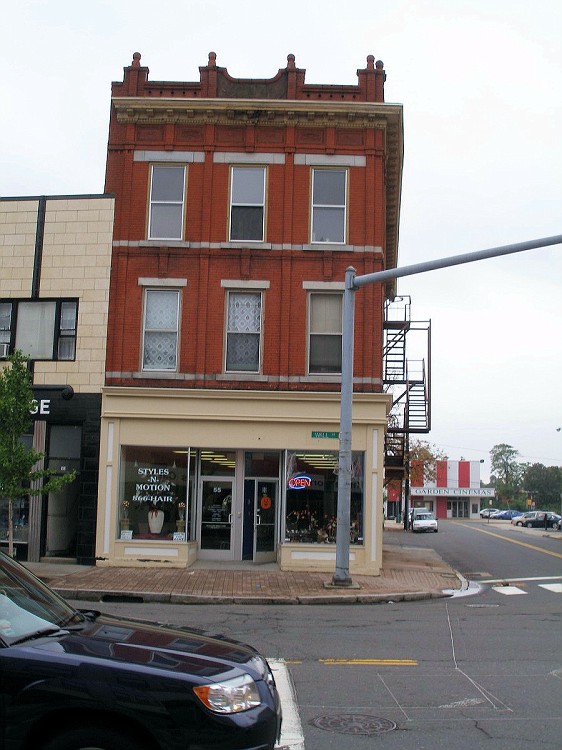
The Haviland and Elizabeth Streets-Hanford Place Historic District is an irregularly shaped 4.3-acre historic district in Norwalk, Connecticut that was listed on the National Register of Historic Places in 1988. The district is significant as a cohesive grouping of late 19th and early 20th century residential architecture. Eight houses are Queen Anne style, which involves irregular massing and use of turned or sawn woodwork in porches and elsewhere. Others display Colonial Revival elements, including Tuscan columns on some. Some are Italianate or display aspects of that style. Second Empire style is also represented. The district lies within a primarily commercial area of the South Norwalk neighborhood. It includes 36 contributing buildings and 2 non-contributing ones. The buildings included in the district are: 3 Elizabeth Street, Colonial Revival vernacular, c. 1900 (see accompanying photo #6) 5 Elizabeth Street, Queen Anne, c. 1900 (see accompanying photo #6) 7 Elizabeth Street, Queen Anne, c. 1900 (see accompanying photo #6) 8 Elizabeth Street, Italianate, c. 1875, with Colonial Revival entrance porch 9 Elizabeth Street, c. 1870 (see accompanying photo #6) rear of 9 Elizabeth Street, c. 1920 (see accompanying photo #7) 9 Elizabeth Street, 3 bay fieldstone garage (see accompanying photo #15) 10 Elizabeth Street, Italianate vernacular, c. 1875 with Queen Anne style porch 11 Elizabeth Street, Italianate, c. 1880 12 Elizabeth Street 13 Elizabeth Street 14 Elizabeth Street 15 Elizabeth Street 17 Elizabeth Street, Italianate, c.1885 2 Hanford Place, Queen Anne, c. 1880 (see photos #13 and #19) 3 Hanford Place 4 Hanford Place 5 Hanford Place 6 Hanford Place 7 Hanford Place 8 Hanford Place 9 Hanford Place 10 Hanford Place, Queen Anne, c.1890 11 Hanford Place, Queen Anne, c.1880, includes a barn or carriagehouse (see photo #15) 12 Hanford Place 8 Haviland Street 10 Haviland Street, non-contributing 12 Haviland Street 16 Haviland Street 18 Haviland Street (see photo #4) 20 Haviland Street (see photo #4) 22 Haviland Street (see photo #5) 24 Haviland Street 26 Haviland Street 72 South Main Street (see accompanying photos #3 and #20) 74 South Main Street

This attraction is located in

This is a private property. Please enjoy respectfully and do not disturb the occupants.

Edit Categories
Add Tours

This attraction is not part of any tours

Add Collections

This attraction is not part of any collections


Some of the attractions we imported from Wikipedia are not perfect. Send us an email detailing what's wrong and we'll look into fixing it.

GuRoute is all about Gurus sharing their local knowledge. If you feel up to fixing this problem yourself, why not adopt it. You will become the owner and can fix whatever problems you see.

We've copied a link to this attraction into your clipboard so that ou can paste it into an email or text message...

More Info...
You can add your friends to the visit yourself, or, send them a link and let them add themselves...

The visit will appear on both your timelines and on your Shared Timeline.

Click below and we'll email you a link that you can send on to friends or post on your group's Facebook page.

If your friends aren't members of GuRoute yet, this is a great way to get them started.
Recent
Recently used Collections will appear here...
Recent
Recently used tours will appear here...

Where is this?

GuRoute likes to place attractions inside other attractions. So, maybe it's in a city, or maybe it's inside a particular park in that city. Maybe your attraction is a huge park that spans half the county, or multiple counties.

Determining where this attraction is gives it context - if it's in a park, you'll be able to see it alongside all the other attractions in that park. And that helps define the park.

GuRoute will automatically calculate a parent region for this attraction. You can change it if there is something more appropriate.

This attraction is currently located in .

Change

This attraction does not yet have any reviews

Please login to write a review...

Reviewed by
Record new Visit

Add this location to your timneline?

  • If there's an existing attraction open it and add it to your timeline...
  • If not, enter a title and we'll create a new attraction for your memories...
Create new Attraction

Create a new attraction at this location?

  • We rely on Gurus like you to share your local knowledge...
(Give a name for this location)


+
Add this to your timeline instead...

Imagine having a record of all the cool things you've done in your life!


Using our timeline you can keep track of everywhere you visit in your lifetime...

But, you'll need to sign in first...

Add contacts so that you can share your travels and record places that you visit together...

Family
Favorites
Family
Favorites

Profile TimeLine Our Visits Edit Accept Decline Invite

If you have any more friends that visited this place with you, feel free to add them to the visit. We'll write it to their timeline and once they confirm it, they too will have this memory for a lifetime.

If they're not already registered, you just need their name and email address and you can add them and we'll send them an invite on your behlaf.

Add a tour comment

Add some extra information for when this attraction is viewed as part of your tour...

Next Stop Instructions

Add some instructions for what to see/do on the way to the next stop...

Next Stop Instructions

Add some instructions for what to see/do on the way to the next stop...

If you're visiting an existing attraction, open it and add it to your timeline. If there is no attraction for the place you are visiting...

  • Click 'Add My Location' below
  • Or right-click on the map to mark a different location
  • Or long-press if you have a touch screen
You can even add locations while you're offline....
  • Load up the map when you're online and we'll keep track of your locaiton
  • You can add locations to your timeline
  • When you are online again we'll sync them with the cloud

We can't connect to the internet right now. The following attractions are saved locally and can be uploaded when you're online...

GuRoute would like to access your current location so that we can pin you on the map and show you nearby attractions

Add friends so that you can share your experiences with each other...

Add tour to What's Next?

Go...

Either for yourself or someone else...

  1. Do your trip research in GuRoute
    Add all the places that you think might be worthy of a visit into a trip-plan
  2. Add your trip-plan to your "What's Next" timeline
    (or a friend's "What's Next" timeline)
  3. When you're on vacation you'll have all your research at your fingertips
  4. Share your timline with your friends
    They can enjoy your vacation with you, seeing not only where you've been, but where you're going next...
  5. Add/remove attractions if things change

It also makes a great souvenir of your trip

Collections

Go...

Create a home page for a collection of attractions

  • Add an image and description to display on the homepage
  • Start adding content
    Add existing attractions to your collection or create new attractions of your own
  • Collections can be:
    • Public (Anyone can add attractions to your collection)
    • Shared (Only yourself and Gurus you nominate can add content)
    • Private (The collection will only be visible to yourself)

Uses

  • Local business or hotel
    Showcase local attractions that you endorse
  • Clubs
    Showcase attractions that members have created (eg. local historical society)
  • Special Interest
    If GuRoute does not have a category for your special interest you add your attractions to your own collection instead

Examples

Walking/Driving Tours

Go...

A guided tour where GuRoute will direct you from stop to stop and narrate a description of each attraction you arrive at

  • GuRoute uses your phone's GPS to guide you from stop to stop
  • GuRoute automatically detects when you arrive at the next tour-stop and narrates the description of the attraction (Chrome Only)
  • It then sends you on to the next stop

Tours are great to attract people to your town. Even places with no significant points of interest can be lots of fun when part of a tour


Cater tours to your Audience

  • Kid-friendly Tours
    • Focus on what will keep kids interested
    • Instead of parents having to drag their kids around they'll be struggling to keep up
    • Let the kids navigate and they'll get more fun out of finding that historical plaque than they ever would from reading it
  • Accessible tours
  • Short and long tours of the same location

What you need to do...

  1. Click 'Go...'
    Enter a title, description and location for the tour
  2. Add existing attractions OR create new ones and add them to the tour
  3. For existing attractions you can add more information specific to the theme of the tour
  4. You can also add instructions on what to do or see en-route to the next tour-stop
  5. Try out your tour and see how it works...

Mystery Tour

Go...

Create a Mystery Tour

Create a series of clues to show people around a city, neighborhood or whatever place you like...

  • GuRoute will show people clues to get them from attraction to attraction
  • When they reach each stop GuRoute will tell them about the place and give them the next clue
  • Take as long or as you like and explore each location at your leisure

Scavenger Hunt

Go...

Create a Scavenger Hunt

Create a series of questions that people have to answer. The answers can all be discovered by walking aroung the area, looking for clues.

  • How many beers are on tap at Michael Collin's Irish Bar?
  • What's the name of the oldest building on main streeet?
  • Show a picture of some public art and ask them what it is called
  • Clues can have numeric or multiple choice answers