Sign In

My Timeline

GuRoute

Discover Your World

Share your Experiences

Record your Life


Top Attractions in Norwich

Norwichtown

Norwichtown is an historic neighborhood in the city of Norwich, Connecticut. It is generally the area immediately north of the Yantic River between I-395 and Route 169. The portion of the neighborhood from the Norwichtown Green and east of it is a locally designated historic district that was also listed on the National Register of Historic Places in 1973 as the Norwichtown Historic District. The district includes 48 contributing buildings and one other contributing site over an 110 acres area. The earliest settlement of Norwich, in 1659, was in Norwichtown. Initial settlement, by 35 English settlers who bought land from the Mohegans, was centered on the Norwichtown Green. The Green is triangular in shape, with an area of about 1.75 acres . It is surrounded by shade trees and bordered by Town Street, East Town Street and Elm Avenue. These streets are lined with 18th and 19th houses and shops that face the Green. There are four houses in Norwichtown that were built in the 17th century: the 1660 Bradford-Huntington House, built c. 1660; the Olmstead-Lathrop House, dating to c. 1659-1745; Leffingwell House Museum, built c. 1675; and the Simon Huntington House, built c. 1690. The First Congregational Church, built in the Federal style in 1801, was the third building to house the local congregation. Many older homes in the district have been converted to commercial use. The John Mason School is now the central administration for the Norwich Public School System. North of the town's first schoolhouse is the Colonial Cemetery where four Connecticut governors are buried. Four houses from the 17th century remain standing north of the Green area is Meeting House Hill, a cliff of large rocks that is also known as the Meeting House Rocks. It was on this cliff that the village's second and third meetinghouses were established, with the site used as a lookout point. The memorial on top of the rocks and pathway are cared for by the First Congregational Church. Five buildings included in the historic district are separately listed on the National Register of Historic Places. These are the saltbox Leffingwell Inn, the Joseph Carpenter Silversmith Shop, built c. 1772-1774; the Dr. Daniel Lathrop School, one of Connecticut's oldest remaining brick schoolhouses, which dates to 1782; the Bradford-Huntington House at 16 Huntington Lane; and the Gen. Jedidiah Huntington House at 23 E. Town Street. Norwichtown was the old center of Norwich, when the town was settled primarily as a farming community in the late 17th century. By the early 18th century, the focus of Norwich became the harbor facilities in the adjacent Chelsea neighborhood east and south of the town center, and eventually the 'center' of Norwich became the small urban center at Chelsea, which was also ringed with industrial mills. The establishment of the city of Norwich in 1784 centered on the Chelsea neighborhood necessitated the distinction of calling the old town center 'Norwichtown'. The city of Norwich was consolidated with the town of Norwich in 1952 relegating Norwichtown to become a residential neighborhood of the city of Norwich. As Chelsea Parade became a more populated residential district, the residents wanted a church closer than those in Norwichtown. Therefore, the Park Congregational Church was built right next to Chelsea Parade. Stephen C. Earle of Worcester Massachusetts designed the Park Congregational Church and the church was built in 1873. The church was built in the Romanesque revival style. The Teel House originally built, as a hotel is also located on Chelsea Parade. Joseph Teel of Preston built the Hotel in 1789. The Hotel was known for its fine halls and splendid ballrooms. After Mr. Teel's death, the hotel was converted into a boarding school and day school. Today the Teel House is a residence. The house has an impressive center hall plan and contains eight fireplaces. One of the main streets running through Norwichtown and adjacent to Chelsea Green is Washington Street. Along Washington Street is the house of Charles A. Converse. This gothic-styled house was built c. 1870 and is most notable for its steeply pitched roofs and the red and gray roof slates. However, the owner, Charles Converse, is noted more for the Converse Art Gallery that he gave to the Norwich Free Academy, less than a block away. Traveling further down Washington Street away from Norwich town there are many other Historic Houses, such as the Learned-Aiken House, Vernet-Lee House, the Eliza Huntington Memorial Home, and the Lathrop-Brewer House. Running parallel to Washington Street is Broadway. One interesting House located at 189 Broadway is the De Witt House-Lydia Huntley Sigourney School. The house was built in the late eighteenth century. In 1812 the house was used a school for young ladies. Lydia Huntley conducted the school with her friend Nancy Maria Hyde until she was forced to close the school once Hyde became ill. Continuing down Washington Street toward Norwich town is the most famous of historic homes in Norwich, the Leffingwell Inn. Stephen Backus built the original house in 1675. In 1700, Thomas Leffingwell bought the house and converted the original two-room house into an inn. The Tavern Hall, to the right of the entrance is the original part of the house and exhibits one of the few remaining, completely paneled rooms from the century. The House also includes fine works from Norwich silversmiths and clock makers of the 1700s. Christopher Leffingwell, the son of Thomas commissioned Thomas Harland to design a clock for the North Parlor that is still hung in the same exact place that Christopher originally hung the clock. Also, in 1776 supposedly George Washington ate breakfast at the Leffingwell Inn. Further into Norwich town is the Joshua Prior House. Joshua Prior built the house in 1766. The house still has the original fluted pilasters over the doorways and six-paneled raised double front door. Dr. Joshua Lathrop House was built in 1763. This house was built in two sections, a saltbox section and then a three-bay Georgian Section. The house has been restored and it still has original fireplaces including a nine- foot cooking fireplace. Samuel Huntington, signer of the Declaration of Independence, president of the Continental Congress, first President of the United States under the Articles of Confederation, and governor of Connecticut, lived in Norwichtown. His house is located to the east of the Green and he is buried in Norwichtown's colonial era cemetery. Samuel Huntington Elementary School on West Town Street in Norwichtown, a public school operated by Norwich Public Schools, is named for him. Fairview Reservoir, one of Norwich's backup reservoirs, is between Canterbury Turnpike and Scotland Road in Norwichtown.

Jail Hill Historic District

The Jail Hill Historic District is located in Norwich, Connecticut. The district consists of 74 buildings and was added to the National Register of Historic Places on April 19, 1999. A plaque, placed by the Norwich Historical Society at the entrance to the Jail Hill district states the following about Norwich's African-American Heritage, in which Jail Hill played an important role: "In the late 1600’s and 1700’s, Norwich was an important colonial seaport trading with the West Indies. Slaves were imported to Southeastern Connecticut from the West Indies during this period. They became personal servants, laborers and craftsmen. By 1756, the Black community numbered 223. Many had purchased their own freedom or had been freed by their owners. Former slave Guy Druck, a blacksmith, built this house at 76 Church St. in the 1850’s. His skills were renowned and actively sought by ship builders for components such as anchors. Blacks from Norwich, such as Leb Quy, fought in the American Revolution. The first public outcry against slavery in Norwich was published in the Norwich Packet in 1774. Connecticut later passed legislation to gradually abolish slavery in 1784. In the 19th century, black settlement centered on Jail Hill, where a thriving community existed by the mid-century. Discriminated against for employment in the mills, Norwich’s Black residents worked on the docks, railroads, steamboats and in hotels. Many, like escaped slave James Linsley Smith, a shoemaker, were engaged in crafts. Others owned restaurants and small businesses." The district encompasses a working-class residential area whose development began in the 1830s and was largely complete by 1865. Houses are of modest size and scale, and are typically vernacular interpretations of Greek Revival and Italianate styling, although later styles such as Queen Anne are also present. The district takes its name from the 1834 jail that was built on the hill, whose foundations still stand on an overgrown lot.

Greeneville

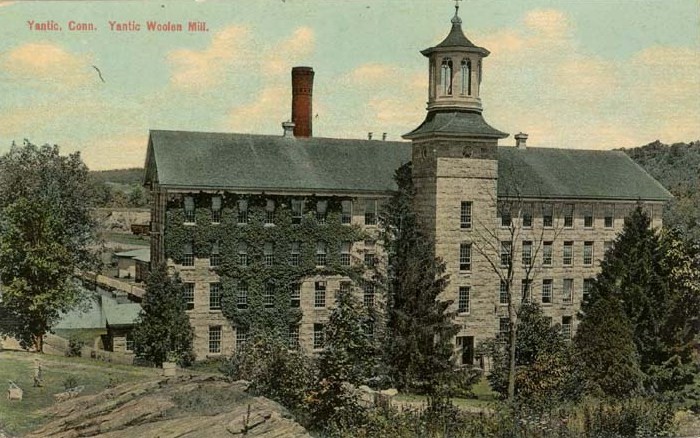
Greeneville is a neighborhood of the city of Norwich, Connecticut, located northeast of downtown Norwich along the west bank of the Shetucket River. Most of the neighborhood is designated Greeneville Historic District, a historic district that is listed on the National Register of Historic Places. The district was listed on the National Register in 2005 and includes 683 contributing buildings, seven other contributing structures, and one other contributing site over a 300 acres area. The district is drawn to "correspond to the village as it was laid out in 1833, but also include additional streets laid out and developed in the late nineteenth and early twentieth centuries to accommodate population growth. Areas north and south of the district boundaries were excluded...." as those areas included undeveloped land, or fewer contributing relative to non-contributing buildings, or reflected a "shift in architectural character." According to the Connecticut Trust for Historic Preservation the district "is a historically significant industrial village that was created to support and sustain water-powered industry from 1828 to about 1940. Much of the enduring success of this industrial enterprise can be attributed to the entrepreneurial vision of industrialist William P. Greene . His development of this planned community and a company to deliver a centralized power system, combined with significant technological infrastructure improvements in the late 19th century, supported the largest industrial presence in Norwich. Although nominally a part of the City of Norwich after 1875, from its creation in 1833 until after World War I Greeneville remained a relatively independent and self-sufficient, working-class community-an evolution fully expressed by the district's large, cohesive collection of generally well-preserved domestic, institutional and commercial architecture. While much of the architecture has the vernacular character expected in a mill town, the district also includes representative examples of the major styles of the period, including Greek Revival, Second Empire, Italianate, and Carpenter Gothic."

This attraction is located in

This is a private property. Please enjoy respectfully and do not disturb the occupants.

Edit Categories
Add Tours

This attraction is not part of any tours

Add Collections

This attraction is not part of any collections


Some of the attractions we imported from Wikipedia are not perfect. Send us an email detailing what's wrong and we'll look into fixing it.

GuRoute is all about Gurus sharing their local knowledge. If you feel up to fixing this problem yourself, why not adopt it. You will become the owner and can fix whatever problems you see.

We've copied a link to this attraction into your clipboard so that ou can paste it into an email or text message...

More Info...
You can add your friends to the visit yourself, or, send them a link and let them add themselves...

The visit will appear on both your timelines and on your Shared Timeline.

Click below and we'll email you a link that you can send on to friends or post on your group's Facebook page.

If your friends aren't members of GuRoute yet, this is a great way to get them started.
Recent
Recently used Collections will appear here...
Recent
Recently used tours will appear here...

Where is this?

GuRoute likes to place attractions inside other attractions. So, maybe it's in a city, or maybe it's inside a particular park in that city. Maybe your attraction is a huge park that spans half the county, or multiple counties.

Determining where this attraction is gives it context - if it's in a park, you'll be able to see it alongside all the other attractions in that park. And that helps define the park.

GuRoute will automatically calculate a parent region for this attraction. You can change it if there is something more appropriate.

This attraction is currently located in .

Change

This attraction does not yet have any reviews

Please login to write a review...

Reviewed by
Record new Visit

Add this location to your timneline?

  • If there's an existing attraction open it and add it to your timeline...
  • If not, enter a title and we'll create a new attraction for your memories...
Create new Attraction

Create a new attraction at this location?

  • We rely on Gurus like you to share your local knowledge...
(Give a name for this location)


+
Add this to your timeline instead...

Imagine having a record of all the cool things you've done in your life!


Using our timeline you can keep track of everywhere you visit in your lifetime...

But, you'll need to sign in first...

Add contacts so that you can share your travels and record places that you visit together...

Family
Favorites
Family
Favorites

Profile TimeLine Our Visits Edit Accept Decline Invite

If you have any more friends that visited this place with you, feel free to add them to the visit. We'll write it to their timeline and once they confirm it, they too will have this memory for a lifetime.

If they're not already registered, you just need their name and email address and you can add them and we'll send them an invite on your behlaf.

Add a tour comment

Add some extra information for when this attraction is viewed as part of your tour...

Next Stop Instructions

Add some instructions for what to see/do on the way to the next stop...

Next Stop Instructions

Add some instructions for what to see/do on the way to the next stop...

If you're visiting an existing attraction, open it and add it to your timeline. If there is no attraction for the place you are visiting...

  • Click 'Add My Location' below
  • Or right-click on the map to mark a different location
  • Or long-press if you have a touch screen
You can even add locations while you're offline....
  • Load up the map when you're online and we'll keep track of your locaiton
  • You can add locations to your timeline
  • When you are online again we'll sync them with the cloud

We can't connect to the internet right now. The following attractions are saved locally and can be uploaded when you're online...

GuRoute would like to access your current location so that we can pin you on the map and show you nearby attractions

Add friends so that you can share your experiences with each other...

Add tour to What's Next?

Go...

Either for yourself or someone else...

  1. Do your trip research in GuRoute
    Add all the places that you think might be worthy of a visit into a trip-plan
  2. Add your trip-plan to your "What's Next" timeline
    (or a friend's "What's Next" timeline)
  3. When you're on vacation you'll have all your research at your fingertips
  4. Share your timline with your friends
    They can enjoy your vacation with you, seeing not only where you've been, but where you're going next...
  5. Add/remove attractions if things change

It also makes a great souvenir of your trip

Collections

Go...

Create a home page for a collection of attractions

  • Add an image and description to display on the homepage
  • Start adding content
    Add existing attractions to your collection or create new attractions of your own
  • Collections can be:
    • Public (Anyone can add attractions to your collection)
    • Shared (Only yourself and Gurus you nominate can add content)
    • Private (The collection will only be visible to yourself)

Uses

  • Local business or hotel
    Showcase local attractions that you endorse
  • Clubs
    Showcase attractions that members have created (eg. local historical society)
  • Special Interest
    If GuRoute does not have a category for your special interest you add your attractions to your own collection instead

Examples

Walking/Driving Tours

Go...

A guided tour where GuRoute will direct you from stop to stop and narrate a description of each attraction you arrive at

  • GuRoute uses your phone's GPS to guide you from stop to stop
  • GuRoute automatically detects when you arrive at the next tour-stop and narrates the description of the attraction (Chrome Only)
  • It then sends you on to the next stop

Tours are great to attract people to your town. Even places with no significant points of interest can be lots of fun when part of a tour


Cater tours to your Audience

  • Kid-friendly Tours
    • Focus on what will keep kids interested
    • Instead of parents having to drag their kids around they'll be struggling to keep up
    • Let the kids navigate and they'll get more fun out of finding that historical plaque than they ever would from reading it
  • Accessible tours
  • Short and long tours of the same location

What you need to do...

  1. Click 'Go...'
    Enter a title, description and location for the tour
  2. Add existing attractions OR create new ones and add them to the tour
  3. For existing attractions you can add more information specific to the theme of the tour
  4. You can also add instructions on what to do or see en-route to the next tour-stop
  5. Try out your tour and see how it works...

Mystery Tour

Go...

Create a Mystery Tour

Create a series of clues to show people around a city, neighborhood or whatever place you like...

  • GuRoute will show people clues to get them from attraction to attraction
  • When they reach each stop GuRoute will tell them about the place and give them the next clue
  • Take as long or as you like and explore each location at your leisure

Scavenger Hunt

Go...

Create a Scavenger Hunt

Create a series of questions that people have to answer. The answers can all be discovered by walking aroung the area, looking for clues.

  • How many beers are on tap at Michael Collin's Irish Bar?
  • What's the name of the oldest building on main streeet?
  • Show a picture of some public art and ask them what it is called
  • Clues can have numeric or multiple choice answers