Sign In

My Timeline

GuRoute

Discover Your World

Share your Experiences

Record your Life


Top Attractions in Harvard

Harvard University Herbaria

The Harvard University Herbaria and Botanical Museum are institutions located on the grounds of Harvard University at 22 Divinity Avenue, Cambridge, Massachusetts. The Botanical Museum is one of three which comprise the Harvard Museum of Natural History. The Herbaria, founded in 1842 by Asa Gray, are one of the 10 largest in the world with over 5 million specimens, and including the Botany Libraries, form the worlds largest university owned herbarium. The Gray Herbariym is named after him. HUH hosts the Gray Herbarium Index as well as an extensive specimen, botanist, and publications database. HUH was the center for botanical research in the United States of America by the time of its founders retirement in the 1870s. The materials deposited there are one of the three major sources for the International Plant Names Index. The Botanical museum was founded in 1858. It was originally called the Museum of Vegetable Products and was predominantly focused on an interdisciplinary study of useful plants . The nucleus of materials for this museum was donated by Sir William Hooker, the Director of the Royal Botanic Garden. George Lincoln Goodalle became the museums first director in 1888; under his direction the building was completed in 1890 and provided both research facilities and public exhibit space, which were the botanical complement to the "Agassiz" Museum of Comparative Zoology. Three successive directors substantially enlarged the collections of economic products, medicinal plants, artifacts, archeological materials, pollen, and photographs. Faculty and students continue to add significantly to the extensive paleobotanical collections, particularly Precambrian material containing early life forms. The Oakes Ames Collection of Economic Botany, the Paleobotanical Collection, and the Margaret Towle Collection of Archaeological Plant Remains are housed in the Botanical Museum building. The Botany libraries and various herbaria are located in the Harvard University Herbaria building. The Botany Libraries collectively are a founding member of the Biodiversity Heritage Library. The Ware Collection of Glass Models of Plants, popularly known as the "Glass Flowers," are considered one of the Universitys great treasures. Commissioned by Goodale and created by Leopold and Rudolf Blaschka from 1887 through 1936, the collection comprises over 3,000 models including life-size and enlarged parts for over 840 species. This is the only collection of its type in the world. The Botanical Museum of Harvard University and the other museums that comprise the Harvard Museum of Natural History are physically connected to the Peabody Museum of Archaeology and Ethnology and one admission grants visitors access to all museums.

Austin Hall

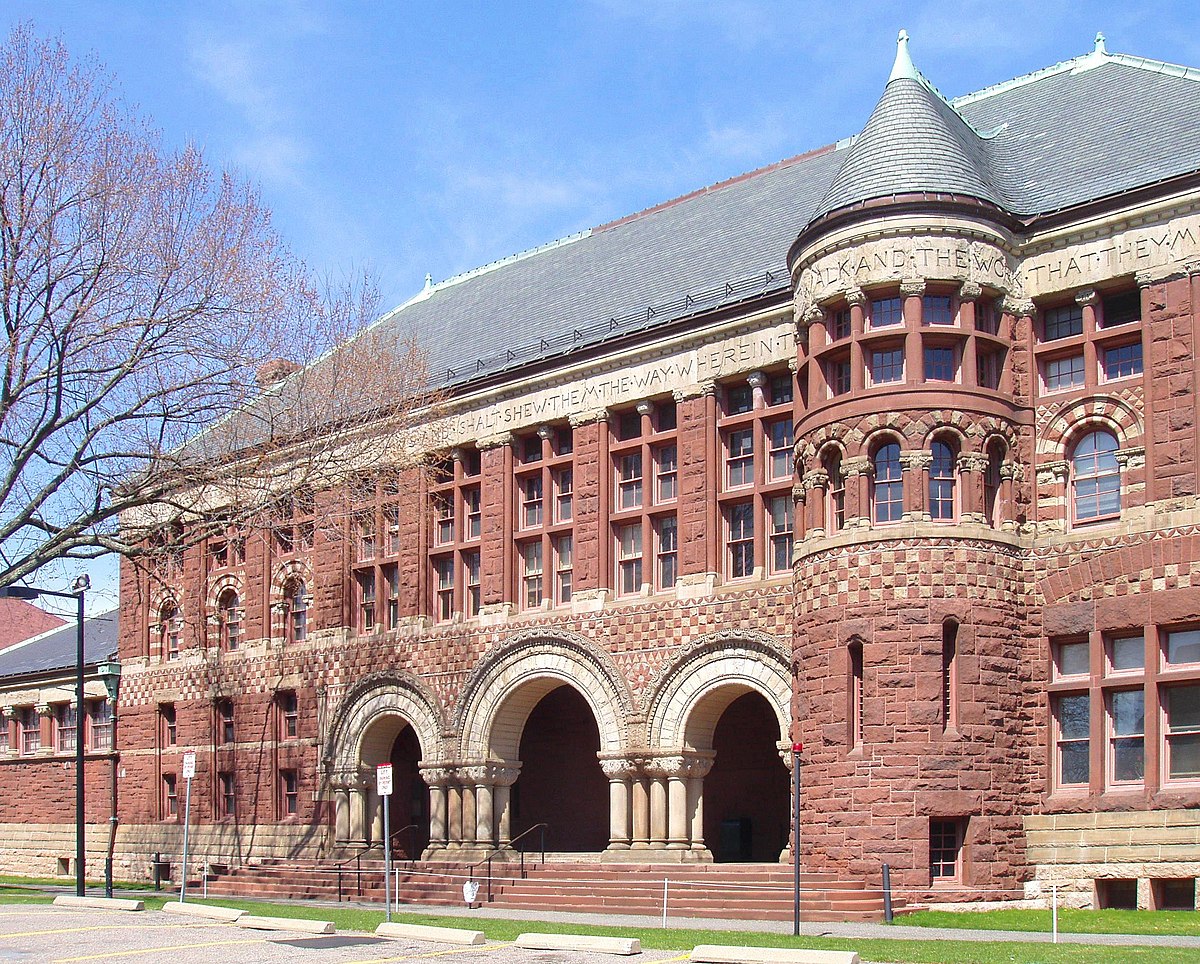
Austin Hall is a classroom building of the Harvard Law School designed by noted American architect H. H. Richardson. The first building purposely built for an American law school, it was also the first dedicated home of Harvard Law. It is located on the Harvard University campus in Cambridge, Massachusetts, and was listed on the National Register of Historic Places in 1972. The hall was built 1882–1884 in Romanesque Revival style. Single-story wings flank a heavy, two-story central mass, with the reading room extending rearwards to form an overall T shape. A central entryway framed with Romanesque triple arch is set deep within the buildings flat front facade, with an asymmetric stairway tower protruding forwards to its right. The building is faced with Longmeadow sandstone in striking polychrome patterns, the light stones forming checkerboards within dark, reddish walls. The arches are of pale Ohio sandstone, as is the thick cornice band incised with a lengthy and sententious motto. Austin Halls first floor contains three large classrooms; these were designed to complement the new law school curriculum that was being implemented at the time by Dean Christopher Columbus Langdell, including large core classes employing the Socratic method. As this curriculum has been imitated by other American law schools, so has the classroom layout first employed at Austin Hall. The buildings second floor contains the Ames Courtroom, where students argue moot cases before panels of judges. A United States Supreme Court justice usually presides over the moot courts final round. The reading rooms interior has been judged particularly fine for its ornamented fireplace and tie beams carved with the heads of dragons and boars.

Delphic Club

The Delphic Club is an all-male Final Club at Harvard University. It was founded in 1885 when the Grand Council of the Delta Phi fraternity decided to re-establish a fraternity at Harvard known as the Zeta Chapter. The membership voted become a Final Club in 1900 and in 1902 severed ties with the national fraternity to which it had maintained only loose ties. After its creation, there were only a few members, so the club would burn gas lights at all hours to suggest that the club was busy day and night. As a result, the club earned the nickname of "The Gas." A famous, possibly apocryphal, story has it that J.P. Morgan, Jr., class of 1889, joined The Gas when he didn’t get into his club of choice. According to The Harvard Crimson, he then financed the creation of his own club, the Delphic, from the frat. The club was initially located at 52 and 59 Brattle St. before moving to 72 Mt. Auburn St. where it was housed from 1887 to 1903. The current home of the club is at 9 Linden St., steps from Harvard Yard and a few blocks from Harvard Square. It was designed by James Purdon H1895 in the neo-Georgian style and occupied in 1902-03. The design features the red brick and cornices typical of Harvard Yard. The interior contains numerous large common spaces and an oversize formal dining room on the 2nd floor for large events, no living quarters, and a regulation squash court. In the basement is a panelled living room for entertaining visitors. As with the other Final Clubs, the Delphic is not officially affiliated with Harvard University and is not recognized by the University. The Delphic is governed by a Trust with a Board of Directors composed of alumni. The Final Clubs all operate independently of the University since their founding following the expulsion of fraternities from the campus in the 1850s. However, whatever tenuous association there had been with Harvard was officially severed in 1984 as a consequence of the Title IX provision of the U.S. Education Amendments of 1972, which arguably would have required a sex-neutral admissions policy and result. The emergence of all-female Final Clubs since the 1990s has followed the same model, with the new clubs also operating independently of the University. The break was largely symbolic as the clubs already operated independently, but they lost access to the Harvard phone exchange and the ability buy steam heat from the University.

Massachusetts Hall

Massachusetts Hall is the oldest surviving building at Harvard College, the first institution of higher learning in the British colonies in America, and second oldest academic building in the United States after the Wren Building at the College of William Mary. As such, it possesses great significance not only in the history of American education but also in the story of the developing English Colonies of the 18th century. Massachusetts Hall was designed by Harvard Presidents John Leverett and his successor Benjamin Wadsworth. It was erected between 1718 and 1720 in Harvard Yard. It was originally a dormitory containing 32 chambers and 64 small private studies for the 64 students it was designed to house. During the siege of Boston, 640 American soldiers took quarters in the hall. Much of the interior woodwork and hardware, including brass doorknobs, disappeared at this time. While designed as a residence for students, the building has served many purposes through the years. After Thomas Hollis donated a quadrant and a 24-foot telescope in 1722, for example, the building housed an informal observatory. Currently, the President of the University, Provost, Treasurer, and Vice Presidents have offices that occupy the first two floors and half of the third. Freshmen reside in the fourth floor. Massachusetts Hall, as Harvards oldest extant dormitory, has housed many influential people. Founding fathers who lived in Massachusetts Hall include John Adams, John Hancock, Samuel Adams, Elbridge Gerry, and James Otis. Members of the Wigglesworth, Weld, Thayer, Eliot, and Lowell families, whose names now grace other dormitories, also lived in Massachusetts Hall. More recent notable residents of Massachusetts Hall include Alan Jay Lerner, Elliot Richardson and John Harbison.

University Hall

University Hall is a white granite building designed by the great early American architect Charles Bulfinch and built by the noted early engineer Loammi Baldwin, Jr. It is located in Harvard Yard on the campus of Harvard University in Cambridge, Massachusetts. It was designated a National Historic Landmark in 1970 for its architectural significance. The hall was designed by Bulfinch, class of 1781, and built between 1813-15 of white Chelmsford granite, probably using rock cut to size at the Charlestown Prison. It consists of a partial basement story, plus three full stories raised above ground as well as an additional story set within the roofline. The long east and west facades are very similar, and symmetrically arranged with two entrances per facade, each flanked by pilasters; smaller north and south facades present rows of windows. Total construction cost was $65,000 of which $53,000 was paid by the Commonwealth of Massachusetts. University Halls first floor contained the College Commons until 1849. The building also contained a library and philosophical apparatus, as well as a chapel within the second and third floors. A massive portico with stone pillars was added to the western facade soon after completion, but removed in 1842. In 1849 the first floor was partitioned into classrooms, then in 1867 the chapel was partitioned as well. In 1896 the chapel was restored and used for meetings of the Faculty of Arts and Sciences. In 1924 Daniel Chester Frenchs bronze statue of John Harvard was moved to the western façade from its original location near Memorial Hall. In 1969, Harvard students took over the hall and occupied it for 18 hours in protest of Harvards stance on the Vietnam War. The demonstration ended only when Massachusetts state police arrived to remove the students from the building.

Dunster House

Dunster House, built in 1930, is one of the first two Harvard University dormitories constructed under President Abbott Lawrence Lowell's House Plan and one of the seven Houses given to Harvard by Edward Harkness. In the early days, room rents varied based on the floor and the size of the room. Dunster is unique among Harvard dormitories for its sixth-story walk-up ; these rooms were originally rented by poorer students, such as Norman Mailer. The House was named in honor of Henry Dunster, a "learned, conscionable and industrious man," who became the first President of Harvard University. He was appointed to the Harvard presidency at the age of thirty-one, immediately after his arrival in the Massachusetts Bay Colony in 1640. He held the office during the early "troublous" years of the Colony and left the College in 1654 after it had become a well-established institution. The tower of Dunster House is inspired by, but somewhat smaller than, the famous Tom Tower of Christ Church, Oxford. Above the east wing is the Dunster family coat of arms, and above the west wing is the coat of arms of Magdalene College, Cambridge, where Henry Dunster matriculated in 1627. Magdalene College commemorated the relationship between the two universities by sending medieval tracery stones from the First Court of Magdalene; these are now set in the wall near the doors to J-entry of Dunster House. Dunster is located on the banks of the Charles River next to the John W. Weeks Footbridge, which links Harvard's Allston and Cambridge campuses. From above, its architectural shape, unusual among the River Houses, resembles a branching flowchart due to the odd trapezoidal footprint of the land on which it was built. Dunster is slated for a "full House renewal," a comprehensive renovation that will begin in June 2014. Dunster, like many of the Harvard Houses, has many yearly traditions, including Keg Races in the fall, Messiah sing-a-long in the winter, the Goat Roast in the spring, and the yearly Dunster House Opera. It is known as one of the more social houses at Harvard, boasting popular Stein Clubs and formals in either the beautiful dining hall or courtyard. Dunster's current Masters are Roger Porter, who served in the White House during the administrations of both Ronald Reagan and George H. W. Bush, and Ann Porter. The House's first master was Chester N. Greenough , English Professor and former Dean of Harvard College. Former masters include Raoul Bott and Sally Falk Moore. Carlos E. Diaz Rosillo currently serves as the Allston Burr Resident Dean. Famous inhabitants of Dunster House have included Al Gore and Tommy Lee Jones, who were roommates there in the late 1960s. Other notable Dunster alumni include Al Franken, Darren Aronofsky, Christopher Durang, Susan Faludi, Roger Ferguson, David Halberstam, Lindsay Hyde, Jean Kwok, Norman Mailer, Lisa Randall, Erich Segal, Caspar Weinberger, Ryan Fitzpatrick, and Deval Patrick. For many years Dunster was reputed to have the highest grade-point average of any house. There was a murder-suicide in Dunster House in May 1995 in which Sinedu Tadesse murdered her roommate, Trang Ho; the previous month, April 1995, two Dunster-affiliated students, Kathryn L. Tucker '94 and Ansgar Hansen '97, committed suicide. Dunster's mascot is the moose, inspired by the three golden elk on the Dunster family crest.

Busch–Reisinger Museum

Founded in 1903 as the Germanic Museum, the Busch–Reisinger Museum is the only museum in North America dedicated to the study of art from the German-speaking countries of Central and Northern Europe in all media and in all periods. William James spoke at its dedication. Its holdings include significant works of Austrian Secession art, German expressionism, 1920s abstraction, and material related to the Bauhaus design school. Other strengths include late medieval sculpture and 18th-century art. The museum also holds noteworthy postwar and contemporary art from German-speaking Europe, including works by Georg Baselitz, Anselm Kiefer, Gerhard Richter, and one of the world’s most comprehensive collections of works by Joseph Beuys. The Busch-Reisinger Art Museum has oil paintings by these painters: Lovis Corinth, Max Liebermann, Gustav Klimt, Edvard Munch, Paula Modersohn-Becker, Max Ernst, Ernst Ludwig Kirschner, Franz Marc, Karl Schmidt-Rotluff, Emil Nolde, Erich Heckel, Heinrich Hoerle, Georg Baselitz, László Moholy-Nagy, and Max Beckmann. It has sculpture by Kathe Kollewitz, George Minne, and Emil Barlach. From 1921-1991, the Busch-Reisinger was located in Adolphus Busch Hall at 29 Kirkland Street. The Hall continues to house the Busch-Reisingers founding collection of medieval plaster casts and an exhibition on the history of the Busch–Reisinger Museum; it also hosts concerts on its Flentrop pipe organ. In 1991, the Busch-Reisinger moved to the new Werner Otto Hall, designed by Gwathmey Siegel Associates, at 32 Quincy Street. In 2008, the 32 Quincy Street building that formerly housed the Fogg Museum and the Busch–Reisinger Museum closed for a major renovation project to create a new museum building designed by architect Renzo Piano that would house all three museums in one facility. During the renovation, selected works from all three museums were on display at the Arthur M. Sackler Museum. The combined, renovated, and expanded facility reopened in 2014 under the name "Harvard Art Museums".

Harvard Yard

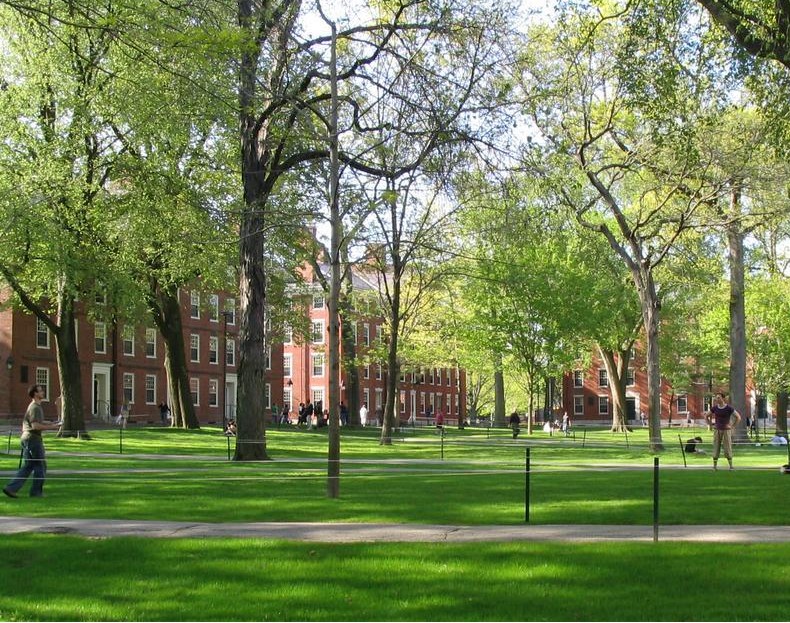
Harvard Yard, in Cambridge, Massachusetts, is a grassy area of 22.4 acres enclosed by fences with twenty-seven gates. It is the oldest part of the Harvard University campus, its historic center, and its modern crossroads. Bounded principally by Massachusetts Avenue, Cambridge Street, Broadway, and Quincy Street, it contains most of the freshman dormitories; Harvards most important libraries; Memorial Church; several classroom and departmental buildings; and the offices of the Dean of the Faculty of Arts and Sciences, the Dean of Harvard College, and President of Harvard University. Harvard Square is adjacent. The center of the Yard—a wide grassy area bounded by Widener Library, Memorial Church, University Hall, and Sever Hall known as Tercentenary Theatre—​is the site of annual commencement exercises and other convocations. The western third of Harvard Yard, which opens onto Peabody Street at Johnston Gate, is known as the Old Yard, and around it cluster most of the freshman dormitories. Among these is Massachusetts Hall, which, having been constructed in 1720, is the oldest still-standing building on Harvards campus and one of the two oldest academic buildings in the United States. The lower floors of Massachusetts Hall house the offices of the President of Harvard University. The original Harvard Hall on this site housed the College library, including the books donated by John Harvard—​all but one of which were destroyed when the building burned in 1764. Rebuilt in 1766, Harvard Hall now houses classrooms. Across the Old Yard from Johnston Gate is University Hall, whose white-granite facade was the first to challenge the red-brick Georgian style until then ascendant; between its twin west staircases stands the John Harvard statue.

Widener Library

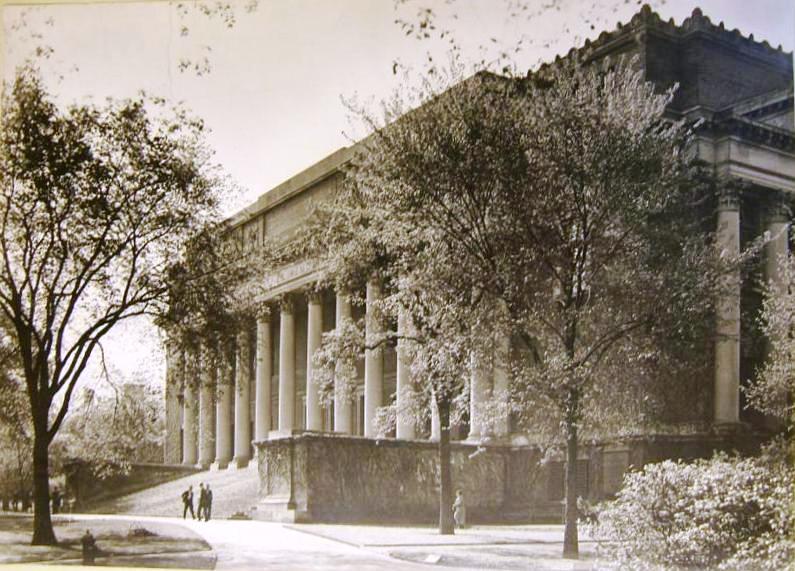
The Harry Elkins Widener Memorial Library, housing some 3.5 million books in its "vast and cavernous"‍ stacks, is the center­piece of the Harvard College Libraries and, more broadly, of the entire Harvard Library system. It honors 1907 Harvard College graduate and book collector Harry Elkins Widener, and was constructed by his mother after his death in the sinking of the RMS Titanic in 1912. The librarys holdings, which include works in more than one hundred languages, comprise "one of the worlds most comprehen­sive research collec­tions in the humanities and social sciences."‍ Its 57 miles of shelves, along five miles of aisles on ten levels, comprise a "labyrinth" which one student "could not enter without feeling that she ought to carry a compass, a sandwich, and a whistle."‍ At the buildings heart are the Widener Memorial Rooms, displaying papers and mementos recalling the life and death of Harry Widener, as well as the Harry Elkins Widener Collec­tion, "the precious group of rare and wonder­fully interesting books brought together by Mr. Widener", to which was later added one of the few perfect Gutenberg Bibles—​the object of a 1969 burglary attempt conjectured by Harvards police chief to have been inspired by the heist film Topkapi. Campus legends holding that Harry Wideners fate led to institu­tion of an undergrad­uate swimming requirement, and that an additional donation from his mother subsidizes ice cream at Harvard meals, are without foundation.

This attraction is located in

This is a private property. Please enjoy respectfully and do not disturb the occupants.

Edit Categories
Add Tours

This attraction is not part of any tours

Add Collections

This attraction is not part of any collections


Some of the attractions we imported from Wikipedia are not perfect. Send us an email detailing what's wrong and we'll look into fixing it.

GuRoute is all about Gurus sharing their local knowledge. If you feel up to fixing this problem yourself, why not adopt it. You will become the owner and can fix whatever problems you see.

We've copied a link to this attraction into your clipboard so that ou can paste it into an email or text message...

More Info...
You can add your friends to the visit yourself, or, send them a link and let them add themselves...

The visit will appear on both your timelines and on your Shared Timeline.

Click below and we'll email you a link that you can send on to friends or post on your group's Facebook page.

If your friends aren't members of GuRoute yet, this is a great way to get them started.
Recent
Recently used Collections will appear here...
Recent
Recently used tours will appear here...

Where is this?

GuRoute likes to place attractions inside other attractions. So, maybe it's in a city, or maybe it's inside a particular park in that city. Maybe your attraction is a huge park that spans half the county, or multiple counties.

Determining where this attraction is gives it context - if it's in a park, you'll be able to see it alongside all the other attractions in that park. And that helps define the park.

GuRoute will automatically calculate a parent region for this attraction. You can change it if there is something more appropriate.

This attraction is currently located in .

Change

This attraction does not yet have any reviews

Please login to write a review...

Reviewed by
Record new Visit

Add this location to your timneline?

  • If there's an existing attraction open it and add it to your timeline...
  • If not, enter a title and we'll create a new attraction for your memories...
Create new Attraction

Create a new attraction at this location?

  • We rely on Gurus like you to share your local knowledge...
(Give a name for this location)


+
Add this to your timeline instead...

Imagine having a record of all the cool things you've done in your life!


Using our timeline you can keep track of everywhere you visit in your lifetime...

But, you'll need to sign in first...

Add contacts so that you can share your travels and record places that you visit together...

Family
Favorites
Family
Favorites

Profile TimeLine Our Visits Edit Accept Decline Invite

If you have any more friends that visited this place with you, feel free to add them to the visit. We'll write it to their timeline and once they confirm it, they too will have this memory for a lifetime.

If they're not already registered, you just need their name and email address and you can add them and we'll send them an invite on your behlaf.

Add a tour comment

Add some extra information for when this attraction is viewed as part of your tour...

Next Stop Instructions

Add some instructions for what to see/do on the way to the next stop...

Next Stop Instructions

Add some instructions for what to see/do on the way to the next stop...

If you're visiting an existing attraction, open it and add it to your timeline. If there is no attraction for the place you are visiting...

  • Click 'Add My Location' below
  • Or right-click on the map to mark a different location
  • Or long-press if you have a touch screen
You can even add locations while you're offline....
  • Load up the map when you're online and we'll keep track of your locaiton
  • You can add locations to your timeline
  • When you are online again we'll sync them with the cloud

We can't connect to the internet right now. The following attractions are saved locally and can be uploaded when you're online...

GuRoute would like to access your current location so that we can pin you on the map and show you nearby attractions

Add friends so that you can share your experiences with each other...

Add tour to What's Next?

Go...

Either for yourself or someone else...

  1. Do your trip research in GuRoute
    Add all the places that you think might be worthy of a visit into a trip-plan
  2. Add your trip-plan to your "What's Next" timeline
    (or a friend's "What's Next" timeline)
  3. When you're on vacation you'll have all your research at your fingertips
  4. Share your timline with your friends
    They can enjoy your vacation with you, seeing not only where you've been, but where you're going next...
  5. Add/remove attractions if things change

It also makes a great souvenir of your trip

Collections

Go...

Create a home page for a collection of attractions

  • Add an image and description to display on the homepage
  • Start adding content
    Add existing attractions to your collection or create new attractions of your own
  • Collections can be:
    • Public (Anyone can add attractions to your collection)
    • Shared (Only yourself and Gurus you nominate can add content)
    • Private (The collection will only be visible to yourself)

Uses

  • Local business or hotel
    Showcase local attractions that you endorse
  • Clubs
    Showcase attractions that members have created (eg. local historical society)
  • Special Interest
    If GuRoute does not have a category for your special interest you add your attractions to your own collection instead

Examples

Walking/Driving Tours

Go...

A guided tour where GuRoute will direct you from stop to stop and narrate a description of each attraction you arrive at

  • GuRoute uses your phone's GPS to guide you from stop to stop
  • GuRoute automatically detects when you arrive at the next tour-stop and narrates the description of the attraction (Chrome Only)
  • It then sends you on to the next stop

Tours are great to attract people to your town. Even places with no significant points of interest can be lots of fun when part of a tour


Cater tours to your Audience

  • Kid-friendly Tours
    • Focus on what will keep kids interested
    • Instead of parents having to drag their kids around they'll be struggling to keep up
    • Let the kids navigate and they'll get more fun out of finding that historical plaque than they ever would from reading it
  • Accessible tours
  • Short and long tours of the same location

What you need to do...

  1. Click 'Go...'
    Enter a title, description and location for the tour
  2. Add existing attractions OR create new ones and add them to the tour
  3. For existing attractions you can add more information specific to the theme of the tour
  4. You can also add instructions on what to do or see en-route to the next tour-stop
  5. Try out your tour and see how it works...

Mystery Tour

Go...

Create a Mystery Tour

Create a series of clues to show people around a city, neighborhood or whatever place you like...

  • GuRoute will show people clues to get them from attraction to attraction
  • When they reach each stop GuRoute will tell them about the place and give them the next clue
  • Take as long or as you like and explore each location at your leisure

Scavenger Hunt

Go...

Create a Scavenger Hunt

Create a series of questions that people have to answer. The answers can all be discovered by walking aroung the area, looking for clues.

  • How many beers are on tap at Michael Collin's Irish Bar?
  • What's the name of the oldest building on main streeet?
  • Show a picture of some public art and ask them what it is called
  • Clues can have numeric or multiple choice answers