Sign In

My Timeline

GuRoute

Discover Your World

Share your Experiences

Record your Life


Top Attractions in Charleston

Charleston Museum

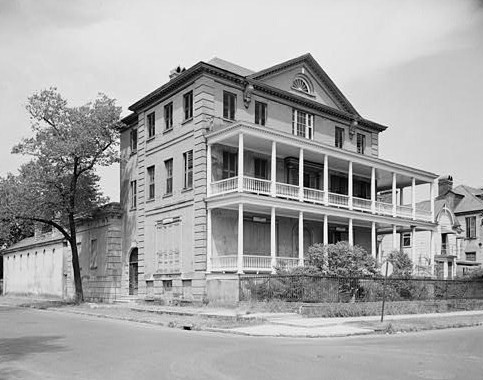
The Charleston Museum is the oldest museum in the United States; it was founded in 1773 and opened to the public in 1824. The museums present building was completed in 1980 at 360 Meeting Street, Charleston, South Carolina. The museums exhibits include natural history and local history displays and decorative arts, including silver. The museum is also home to the only known fossil of the extinct Pelagornis sandersi, which is the largest flying bird ever discovered. The museum also owns and operates two historic house museums: Heyward-Washington House late 18th-century house owned by Thomas Heyward, Jr., Revolutionary patriot and signer of the Declaration of Independence. It is best known as the lodging of President George Washington during his 1792 visit to Charleston. Joseph Manigault House Federal-style home decorated with American, English and French furnishing of the early 19th century In addition to the two houses, the museum also maintains The Dill Sanctuary. From the site: ... located on James Island contains assorted habitats for wildlife and numerous cultural features including three earthen Confederate batteries and prehistoric, colonial, antebellum, and postbellum archaeological sites. The Dill Sanctuary has been protected for purposes of preservation, wildlife enhancement, research and education, and is used only for Museum-sponsored programs. Habitat has been enhanced by creation of a six-acre wildlife pond, with three nesting islands, which provides a reliable source of fresh water for animals and nesting sites for both migratory and resident birds. 2001 saw the construction of the Dill Education Center and bathroom facilities which hosts Museum education programs.

Drayton Hall

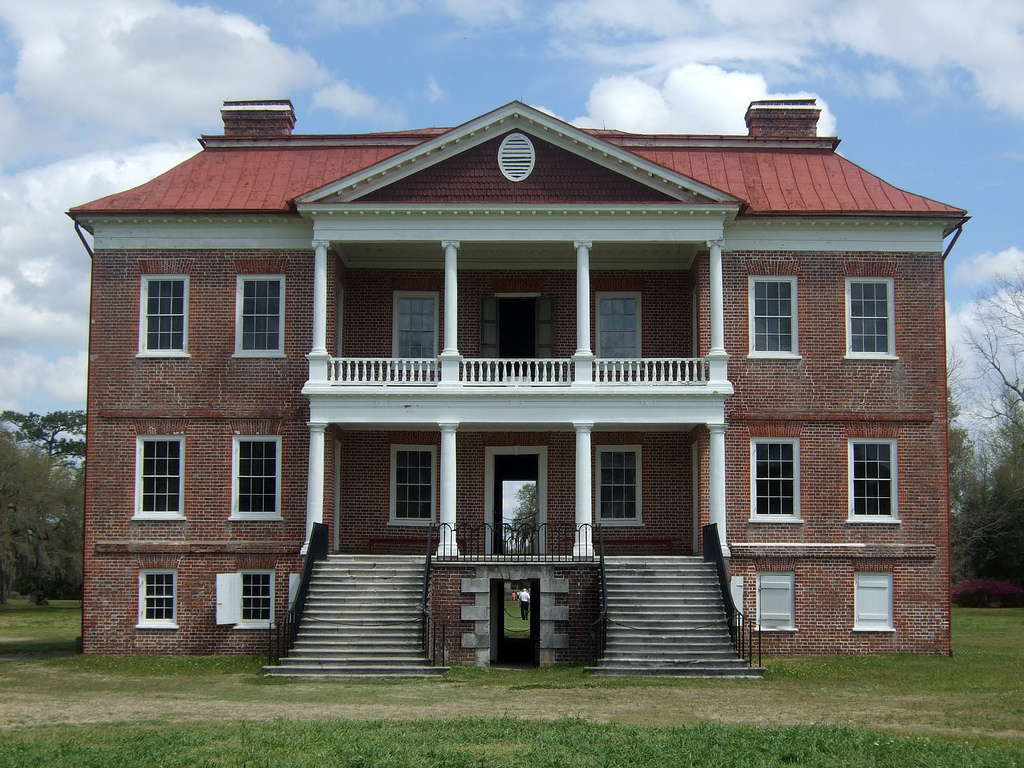
Drayton Hall is an 18th-century plantation located on the Ashley River about 15 miles northwest of Charleston, South Carolina and directly across the Ashley River from North Charleston, in the "Lowcountry." An outstanding example of Palladian architecture in North America and the only plantation house on the Ashley River to survive intact through both the Revolutionary and Civil wars, it is a National Historic Landmark. The mansion was built for John Drayton after he bought the property in the late 1730s. As the third son in his family, he knew he was unlikely to inherit his own nearby birthplace, now called Magnolia Plantation and Gardens. For many decades, the house was thought to be been begun in 1738 and completed in 1742. In 2014, an examination of wood cores showed that the attic timbers were cut from trees felled in the winter of 1747–48. Because the attic framing would have to have been in place well before the completion of the interior finishes, the house is now thought to have been occupied only in the early 1750s. The seven-bay double-pile plantation house is within a 630-acre site that is part of the plantation based on indigo and rice. Seven generations of Drayton heirs preserved the house in all but original condition, though the flanking outbuildings have not survived: an earthquake destroyed the laundry house in 1886 and a hurricane destroyed the kitchen in 1893. John Drayton bought considerable property nearby from his nephew William Drayton, Sr., after the latter was appointed as chief justice of the Province of East Florida in the early 1770s and was leaving South Carolina. John Drayton consolidated the various Drayton properties, and his descendants have controlled them since.

McLeod Plantation

McLeod Plantation is located at 325 Country Club Drive on James Island, South Carolina, near the intersection of Folly and Maybank Roads. Situated at Wappoo Creek which flows into the Ashley River, historic events have been recorded throughout the period from 1678 when it first appeared on maps under "Morris." The manor house standing on the land today was constructed in about 1858 in the Georgian style. Also on the property are six clapboard slave cabins, a detached kitchen, a dairy building, a pre-war gin house for long-staple cotton, a barn, and a carriage house. The Plantation is an important Gullah heritage site preserved in recognition of its cultural and historical significance. In 1780 in the American War of Independence General Sir Henry Clinton used the original house as his headquarters while planning the siege of Charleston. The plantation was occupied by Confederate forces during most of the Civil War. After the evacuation of Charleston in early 1865, it was occupied by the 55th Massachusetts Volunteer Regiments, which were African American soldiers. The home served as a hospital. Later, the home was occupied as offices by the Freedmens Bureau, and at one point, nearly newly freed slaves camped out on the plantations lands. In 1926, The front and rear of the house were reversed, and the front facade was altered. The South Carolina Department of Archives and History has additional information and photographs. The plantation was named one of the African American Historic Places in South Carolina. The home was occupied by the McLeod family until 1990, and a share was given to the Historic Charleston Foundation who proceeded to consolidate shareholders. It was sold to the American College of the Building Arts in 2004. Unable to support the development of their school and the plantation, ACBA returned it to Historic Charleston in 2008.

Middleton Place

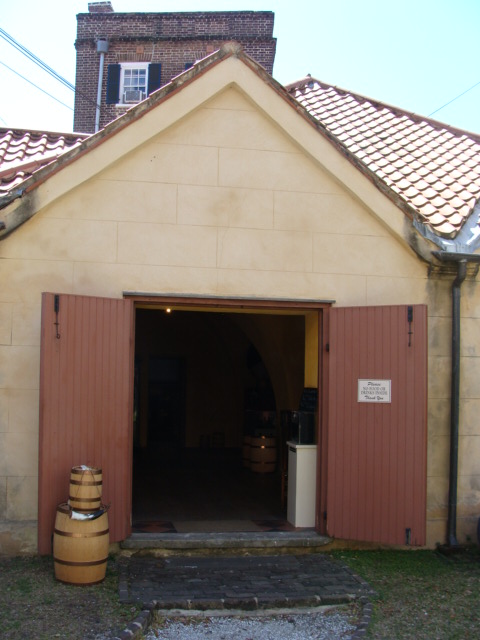
Middleton Place is a plantation in Dorchester County, directly across the Ashley River from North Charleston and about 15 miles northwest of Charleston, in the U.S. state of South Carolina. Built in several phases during the 18th and 19th centuries, the plantation was the primary residence of several generations of the Middleton family, many of whom played prominent roles in the colonial and antebellum history of South Carolina. The plantation, now a National Historic Landmark District, is used as a museum, and is home to the oldest landscaped gardens in the United States. John Williams, an early South Carolina planter, probably began building Middleton Place in the late 1730s. His son-in-law Henry Middleton, who later served as President of the First Continental Congress, completed the houses main section and its north and south flankers, and began work on the elaborate gardens. Middletons son, Arthur Middleton, a signer of Declaration of Independence, was born at Middleton Place, and lived at the plantation in the last years of his life. Arthur Middletons son and grandson, Henry Middleton and Williams Middleton, oversaw Middleton Places transition from a country residence to a more active rice plantation. In 1865, toward the end of the U.S. Civil War, Union soldiers burned most of the house, leaving only the south wing and gutted walls of the north wing and main house. An earthquake in 1886 toppled the walls of the main house and north wing. The restoration of Middleton Place began in 1916 when Middleton descendant John Julius Pringle Smith and his wife Heningham began several decades of meticulously rebuilding the plantations gardens. They had New York architect Bancel LaFarge design a stableyard complex of barn, stable, work buildings, and cottages; the buildings were constructed of brick salvaged from the ruined main house. In the early 1970s, approximately 110 acres of the 7,000-acre plantation— including the south flanker, the gardens, and several outbuildings— were placed on the National Register of Historic Places. During the same period the Middleton descendants transferred ownership of the historic district to the non-profit Middleton Place Foundation, which presently maintains the site.

Gibbes Museum of Art

Formerly known as the Gibbes Art Gallery, the Gibbes Museum of Art is an art museum in Charleston, South Carolina. Established as the Carolina Art Association in 1858, the museum moved into a new Beaux Arts building at 135 Meeting Street, in the Charleston Historic District, in 1905. The Gibbes houses a premier collection of over 10,000 works of fine art, principally American works, many with a connection to Charleston or the South. The benefactor, James Shoolbred Gibbes, donated $100,000 to the Carolina Arts Association upon his death in 1899 for the "erection of a suitable building for the exhibitions of paintings." Receipt of the money by the city, however, was delayed by a will contest filed by nieces and nephews of Gibbes. Their case was heard in the state court of New York during 1900 and 1901. On December 6, 1901, the New York Supreme Court issued an opinion declaring that the gift to Charleston was valid. Receiving the money in 1903, the Association hired Frank Pierce Milburn to design the gallery. His design included a Tiffany-style dome, Doric columns and pediment capped windows and doors. Milburn completed the drawings of the building in mid-1903, and a drawing of the proposed building appeared in the Charleston Evening Post on June 5, 1903. Notices were published seeking contractors bids for the work starting in August 1903. In September 1903, H.T. Zacharias was selected as the contractor and received a contract for $73,370 for the building. Zacharias started work on September 28, 1903, removing the remains of the South Carolina Agricultural Hall which had occupied the lot. Although work on the foundations had begun already, a ceremony was held on December 8, 1903, to lay the cornerstone of the building at the northeast corner. The museum formally opened on April 11, 1905. The collection on display on the opening day included more than 300 pictures, many bronzes, and about 200 miniatures in addition to an "instructive collection" of Japanese prints. The museums collections include the work of numerous artists with connections to Charleston; among them are Henrietta Johnston, Mary Roberts, Charles Fraser, William Melton Halsey, and Jeremiah Theus.

Exchange and Provost

The Old Exchange Provost Dungeon, also known as the Custom House, and The Exchange, is a historic building at East Bay and Broadway Streets in Charleston, South Carolina, USA. It was built from 1767-1771 as the Royal Exchange. The first cupola was damaged by a hurricane in the early 1800s, the second deteriorated before the Great Earthquake of 1886, and the third was not placed until 1981 when the building opened as a museum. According to the National Park Service: "he structure has served as a customhouse, mercantile exchange and military prison and barracks. The building was badly damaged by Union artillery fire during the Civil War and the great earthquake of 1886; it was repaired after each occasion." In 2012, a study was completed of the buildings use as a British prison during the Revolutionary War. Soon after taking control of Charleston in 1780, the British started housing prisoners in the Exchange, but not exclusively in the "dungeon". The investigation was able to document at least 120 prisoners held in the Exchange, but there were many more whose identities could not be discovered. The facility was not exclusively used for Colonial prisoners, and at least some British soldiers were held there too. The Building housed the South Carolina convention to ratify the United States Constitution in 1788, and was the site of many of the events in George Washingtons week-long stay in Charleston. The building continued as an Exchange until the 19th-century, when it also became a post office. During the 19th-century, the postmaster defended the Exchanges shipment of abolitionist pamphlets from angry Charlestonian rioters. In the American Civil War, the building remained a Confederate post office, but was hit by several shells during the war, and thus abandoned. In 1913, the building was granted to the Daughters of the American Revolution, who have preserved it ever since. In World War I, the building served as the army headquarters of General Leonard Wood and the United States Lighthouse Service—the latter having been in the building since the late 1800s. In World War II, the building not only served as a USO facility and canteen for troops, but served as the Coastal Picket Station for the Sixth Naval District of the United States Coast Guard. In 1965, the Half-Moon Battery, a 1698 fortification, was discovered underneath the building. It was declared a National Historic Landmark in 1973.

St. Mary's Roman Catholic Church

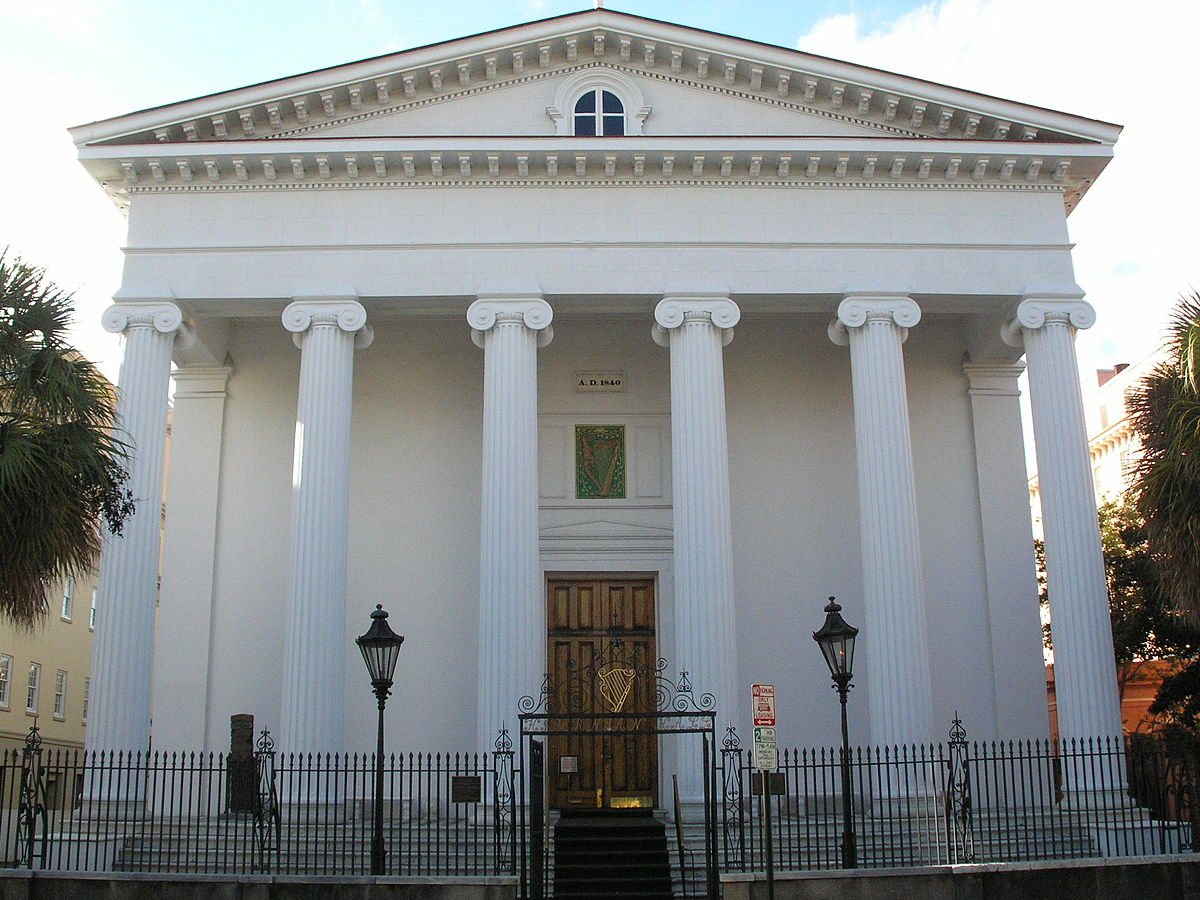
St. Mary of the Annunciation Roman Catholic Church is the first Roman Catholic parish in the Carolinas and Georgia. The current building at 93 Hasell St. in Charleston, South Carolina, is the third structure to house the congregation on this site. The property and an old building were purchased in 1789. It was incorporated as the Roman Catholic Church of Charleston by the South Carolina General Assembly in 1791. The first structure was replaced by a brick church that burned in the Charleston fire in 1838. The church was rebuilt quickly and reopened on June 9, 1839. It is a rectangular building, 84 ft by 50 ft . It is built of brick with a stucco covering. There are four Doric columns that support a large entablature. The parapet wall at the top of the church was probably constructed around 1896. There are stained glass windows imported from Munich. The nave has a central aisle and two large rows of pews. There are smaller pews along the side aisles. Above the altar, there is a painting of the Crucifixion by John S. Cogdell. The artist donated this painting to replace an earlier painting he had done in 1814, which was destroyed in the fire. Much of the interior of the church was renovated during a three month renovation in 1884. The church graveyard is on each side and to the rear of the church. In the early 1980s, the neighboring Charleston Place complex was constructed, bordering the church on all sides. It was the only structure preserved on the lot, besides the few storefronts facing Meeting Street which were incorporated in the parking structure. The St. Mary's Church is on the National Register of Historic Places, No. 76001697. The South Carolina Department of Archives and History has additional pictures and information. and copies of the nomination forms. There are additional pictures and information available from the Historic American Buildings Survey at the Library of Congress.

The Battery

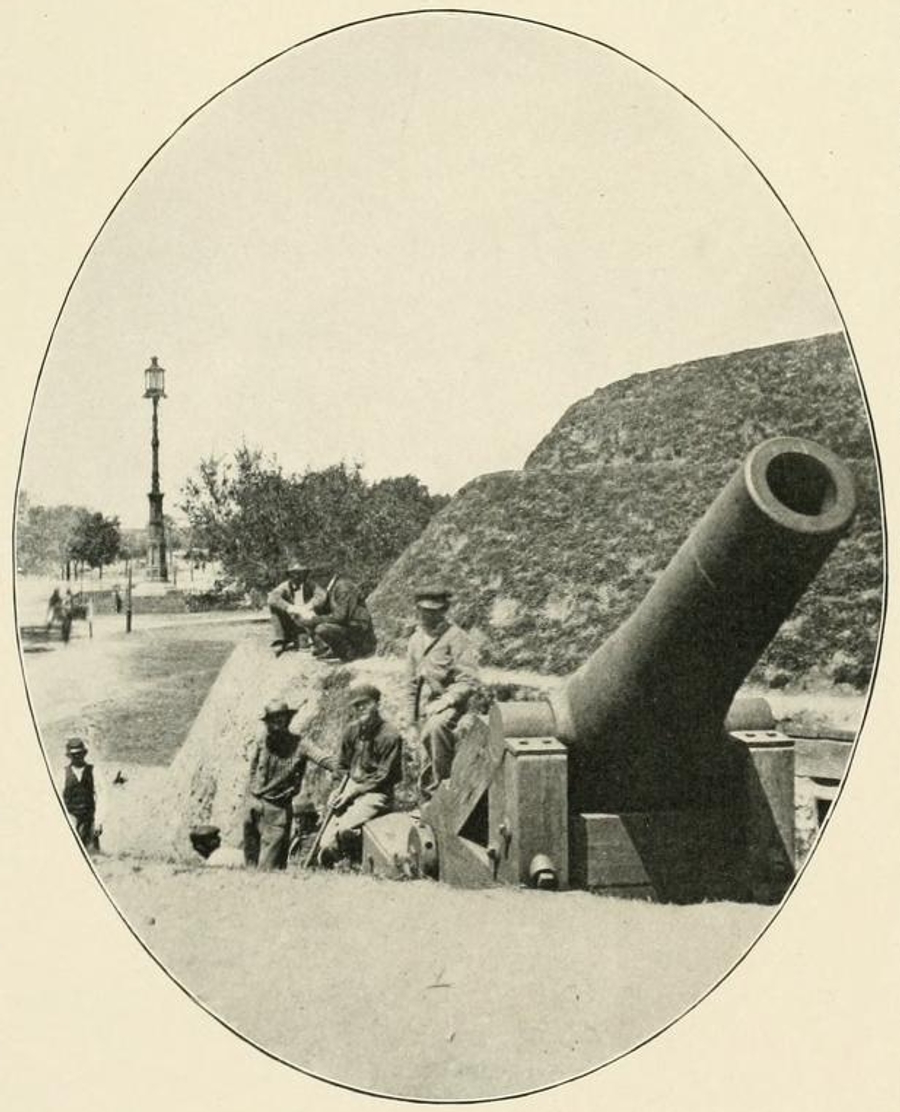
The Battery is a landmark defensive seawall and promenade in Charleston, South Carolina. Named for a civil-war coastal defense artillery battery at the site, it stretches along the lower shores of the Charleston peninsula, bordered by the Ashley and Cooper Rivers, which meet here to form Charleston harbor. Historically, it has been understood to extend from the beginning of the seawall at the site of the former Omar Shrine Temple to the intersection of what is now Murray Boulevard and King Street. The higher part of the promenade, paralleling East Battery, as the street is known south of Water Street, to the intersection of Murray Boulevard, is known as High Battery. Fort Sumter is visible from the Cooper River side and from the point, as are Castle Pinckney, the World War II aircraft carrier USS Yorktown , Fort Moultrie, and Sullivan's Island. As a tourist destination, the Battery is famous for its stately, mainly antebellum homes. Included among the grand houses are the Louis DeSaussure House , the Roper House , the William Ravenel House ,the Edmondston-Alston House , the Charles Drayton House , the Villa Margherita , the William Washington House , the Col. John A.S. Ashe House , the James Spear House , and the Col. John Ashe House . Fort Broughton and Fort Wilkins occupied White or Oyster Point, so named because of the piles of bleached oyster shells on the point at the tip of the peninsula. In the 18th century, rocks and heavy materials were used to fortify the shore of the Cooper River on the eastern side of the peninsula. In 1838, this area along the seawall became a promenade. First used as a public park in 1837, the area now known as White Point Garden became a place for artillery during the American Civil War. In popular speech and in a number of unofficial guidebooks and Web sites, The Battery and White Point Garden are sometimes referred to as "Battery Park," but the park and seawall promenade are not regarded by the City of Charleston as a single entity, and the term "Battery Park" is not an official designation. In 2004, a structural report by the City of Charleston showed that the Battery was suffering serious problems and could fail to protect the southeastern portion of the city during hurricanes. In 2012, the City announced that a $3.2 million restoration project would soon commence at the juncture of High Battery and Low Battery .

This attraction is located in

This is a private property. Please enjoy respectfully and do not disturb the occupants.

Edit Categories
Add Tours

This attraction is not part of any tours

Add Collections

This attraction is not part of any collections


Some of the attractions we imported from Wikipedia are not perfect. Send us an email detailing what's wrong and we'll look into fixing it.

GuRoute is all about Gurus sharing their local knowledge. If you feel up to fixing this problem yourself, why not adopt it. You will become the owner and can fix whatever problems you see.

We've copied a link to this attraction into your clipboard so that ou can paste it into an email or text message...

More Info...
You can add your friends to the visit yourself, or, send them a link and let them add themselves...

The visit will appear on both your timelines and on your Shared Timeline.

Click below and we'll email you a link that you can send on to friends or post on your group's Facebook page.

If your friends aren't members of GuRoute yet, this is a great way to get them started.
Recent
Recently used Collections will appear here...
Recent
Recently used tours will appear here...

Where is this?

GuRoute likes to place attractions inside other attractions. So, maybe it's in a city, or maybe it's inside a particular park in that city. Maybe your attraction is a huge park that spans half the county, or multiple counties.

Determining where this attraction is gives it context - if it's in a park, you'll be able to see it alongside all the other attractions in that park. And that helps define the park.

GuRoute will automatically calculate a parent region for this attraction. You can change it if there is something more appropriate.

This attraction is currently located in .

Change

This attraction does not yet have any reviews

Please login to write a review...

Reviewed by
Record new Visit

Add this location to your timneline?

  • If there's an existing attraction open it and add it to your timeline...
  • If not, enter a title and we'll create a new attraction for your memories...
Create new Attraction

Create a new attraction at this location?

  • We rely on Gurus like you to share your local knowledge...
(Give a name for this location)


+
Add this to your timeline instead...

Imagine having a record of all the cool things you've done in your life!


Using our timeline you can keep track of everywhere you visit in your lifetime...

But, you'll need to sign in first...

Add contacts so that you can share your travels and record places that you visit together...

Family
Favorites
Family
Favorites

Profile TimeLine Our Visits Edit Accept Decline Invite

If you have any more friends that visited this place with you, feel free to add them to the visit. We'll write it to their timeline and once they confirm it, they too will have this memory for a lifetime.

If they're not already registered, you just need their name and email address and you can add them and we'll send them an invite on your behlaf.

Add a tour comment

Add some extra information for when this attraction is viewed as part of your tour...

Next Stop Instructions

Add some instructions for what to see/do on the way to the next stop...

Next Stop Instructions

Add some instructions for what to see/do on the way to the next stop...

If you're visiting an existing attraction, open it and add it to your timeline. If there is no attraction for the place you are visiting...

  • Click 'Add My Location' below
  • Or right-click on the map to mark a different location
  • Or long-press if you have a touch screen
You can even add locations while you're offline....
  • Load up the map when you're online and we'll keep track of your locaiton
  • You can add locations to your timeline
  • When you are online again we'll sync them with the cloud

We can't connect to the internet right now. The following attractions are saved locally and can be uploaded when you're online...

GuRoute would like to access your current location so that we can pin you on the map and show you nearby attractions

Add friends so that you can share your experiences with each other...

Add tour to What's Next?

Go...

Either for yourself or someone else...

  1. Do your trip research in GuRoute
    Add all the places that you think might be worthy of a visit into a trip-plan
  2. Add your trip-plan to your "What's Next" timeline
    (or a friend's "What's Next" timeline)
  3. When you're on vacation you'll have all your research at your fingertips
  4. Share your timline with your friends
    They can enjoy your vacation with you, seeing not only where you've been, but where you're going next...
  5. Add/remove attractions if things change

It also makes a great souvenir of your trip

Collections

Go...

Create a home page for a collection of attractions

  • Add an image and description to display on the homepage
  • Start adding content
    Add existing attractions to your collection or create new attractions of your own
  • Collections can be:
    • Public (Anyone can add attractions to your collection)
    • Shared (Only yourself and Gurus you nominate can add content)
    • Private (The collection will only be visible to yourself)

Uses

  • Local business or hotel
    Showcase local attractions that you endorse
  • Clubs
    Showcase attractions that members have created (eg. local historical society)
  • Special Interest
    If GuRoute does not have a category for your special interest you add your attractions to your own collection instead

Examples

Walking/Driving Tours

Go...

A guided tour where GuRoute will direct you from stop to stop and narrate a description of each attraction you arrive at

  • GuRoute uses your phone's GPS to guide you from stop to stop
  • GuRoute automatically detects when you arrive at the next tour-stop and narrates the description of the attraction (Chrome Only)
  • It then sends you on to the next stop

Tours are great to attract people to your town. Even places with no significant points of interest can be lots of fun when part of a tour


Cater tours to your Audience

  • Kid-friendly Tours
    • Focus on what will keep kids interested
    • Instead of parents having to drag their kids around they'll be struggling to keep up
    • Let the kids navigate and they'll get more fun out of finding that historical plaque than they ever would from reading it
  • Accessible tours
  • Short and long tours of the same location

What you need to do...

  1. Click 'Go...'
    Enter a title, description and location for the tour
  2. Add existing attractions OR create new ones and add them to the tour
  3. For existing attractions you can add more information specific to the theme of the tour
  4. You can also add instructions on what to do or see en-route to the next tour-stop
  5. Try out your tour and see how it works...

Mystery Tour

Go...

Create a Mystery Tour

Create a series of clues to show people around a city, neighborhood or whatever place you like...

  • GuRoute will show people clues to get them from attraction to attraction
  • When they reach each stop GuRoute will tell them about the place and give them the next clue
  • Take as long or as you like and explore each location at your leisure

Scavenger Hunt

Go...

Create a Scavenger Hunt

Create a series of questions that people have to answer. The answers can all be discovered by walking aroung the area, looking for clues.

  • How many beers are on tap at Michael Collin's Irish Bar?
  • What's the name of the oldest building on main streeet?
  • Show a picture of some public art and ask them what it is called
  • Clues can have numeric or multiple choice answers