Sign In

My Timeline

GuRoute

Discover Your World

Share your Experiences

Record your Life


Top Attractions in Juneau County

SS Princess Kathleen

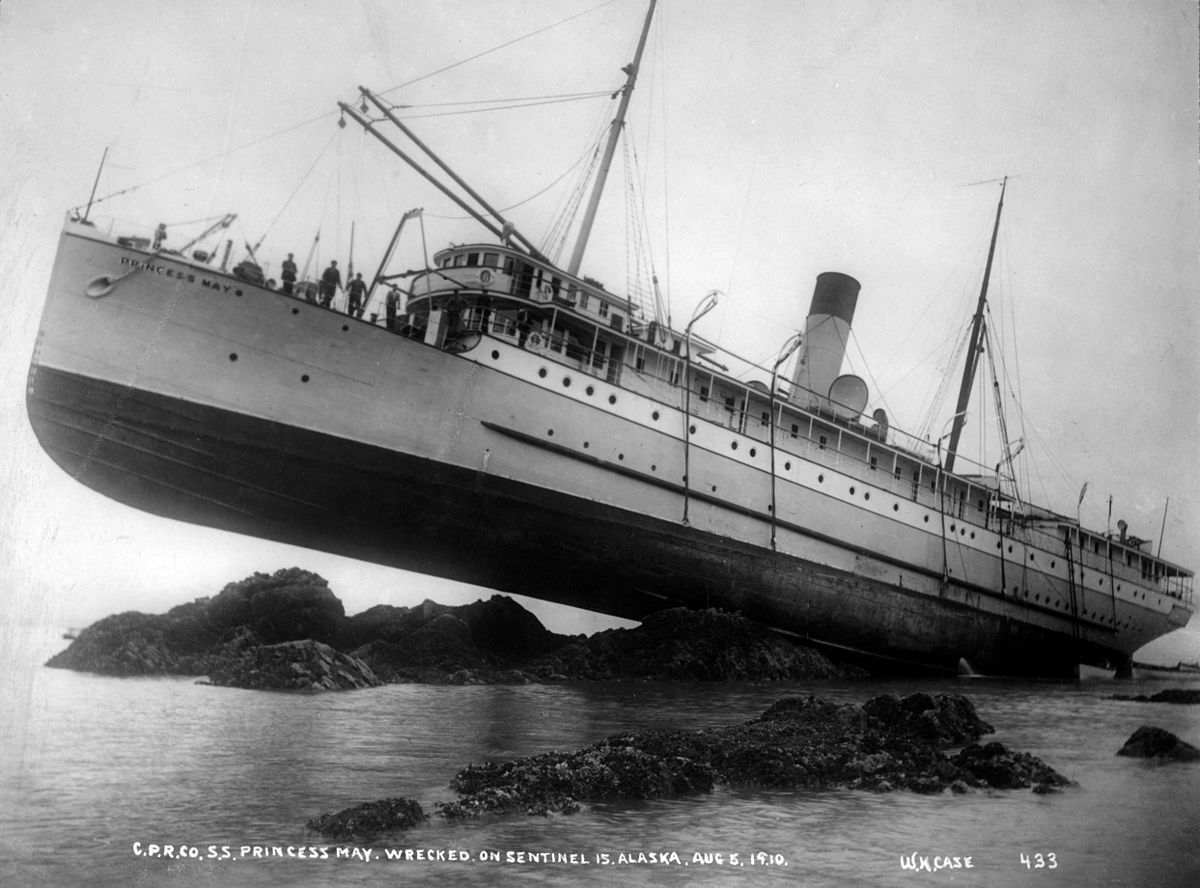
The SS Princess Kathleen was a passenger and freight steamship owned and operated by Canadian Pacific Steamships. She served the coastal communities of British Columbia, Alaska and Washington. The Princess Kathleen, along with the Princess Marguerite, was built to replace the SS Princess Irene and SS Princess Margaret, which had been requisitioned by the British Admiralty during World War I. Princess Kathleen was built by John Brown & Co., Clydebank and launched in 1924. She sailed from Glasgow to Vancouver via the Panama Canal on her maiden voyage in 1925. The Princess Kathleen and the Princess Marguerite relieved the SS Princess Charlotte and SS Princess Victoria on the "triangle service" between Vancouver, Victoria and Seattle, for which she was built. With a capacity of 1500 passengers, 290 berths, 136 staterooms, a 168-seat dining room and the ability to carry 30 automobiles, the Princess Kathleen and Princess Marguerite quickly became the preferred ships on this service, successfully competing against the Black Ball Line. Both ships were later modified to carry 1800 passengers by reducing the number of staterooms to 123. King George VI and Queen Elizabeth traveled aboard Princess Kathleen en route to Victoria in 1939. In September 1939 Princess Kathleen and Princess Marguerite were requisitioned by the Royal Canadian Navy for use as troop ships. Princess Marguerite was lost in action but Princess Kathleen was returned to Canadian Pacific in 1947 and resumed service on the "triangle service." Changing demands and increased automobile traffic saw Canadian Pacific transfer her in 1949 to the Vancouver - Alaska cruise service along the spectacular Inside Passage. It was while during this assignment at 0300 local time on September 7, 1952 that Princess Kathleen ran aground at Lena Point in Alaska's Lynn Canal at low tide; it was later determined that radar was not operational at the time of the grounding. The United States Coast Guard was alerted two hours later and a rescue cutter arrived at 0630. The crew tried to reverse off Lena Point, however as the tide rose, her stern became swamped. All passengers and crew were transferred to lifeboats and ashore as she slid into deeper water and then sank. The wreck of Princess Kathleen sits in approximately 50 ft (15 m)-100 ft (30 m) of water and is accessible to divers, however, tides and currents in the vicinity of Lena Point are strong. In 2010, when it was determined that there was a significant threat of a large leak, a salvage operation recovered 130,000 US gal (490,000 L) of petroleum products from the wreck.

Taku Glacier

Taku Glacier is a tidewater glacier located in Taku Inlet in the U.S. state of Alaska, just southeast of the city of Juneau. Recognized as the deepest and thickest alpine temperate glacier known in the world, the Taku Glacier is measured at 4,845 feet thick. It is about 58 kilometres long, and is largely within the Tongass National Forest. The glacier was originally named Schultze Glacier in 1883 and the Foster Glacier in 1890, but Taku, the name the local Tlingit natives had for the glacier, eventually stuck. It is nestled in the Coast Mountains and originates in the Juneau Icefield. It is the largest glacier in the icefield and one of the southernmost tidewater glaciers of the northern hemisphere. The glacier, which converges with the Taku River at Taku Inlet, has a history of advancing until it blocks the river, creating a lake, followed by a dramatic break of the ice dam. The most recent of these advances occurred in 1750. The glacier has advanced 7.75 kilometres since 1890, and as of June 29, 2012 is 1.26 kilometres from Taku Point. It is the only advancing glacier of the 20 major glaciers of the Juneau Icefield. If the advance continues it will again block the river, but this appears unlikely at present. Since 1946, the glacier has been monitored by the Juneau Icefield Research Program, which has documented its rate of advance since 1988 at 17 metres a year. The advance is due to a positive mass balance; that is, more snow accumulates than snow and ice melt. Until 1948 the glacier had a calving front; since then the terminus has been grounded. Due to the positive mass balance and the fact that it was no longer losing mass to icebergs, Taku Glacier has become insensitive to the warming that has impacted all other glaciers of the icefield. This has driven its advance. The recent negative mass balance 1989-2005 is not large enough yet to stop the advance, but it is the first sign that the glaciers advance may not take it to Taku Point. Taku Glacier is the namesake of the Alaska Marine Highway System ferry M/V Taku. H., Robert, and Marge Hermans. Alaskas Natural Wonders: A Guide to the Phenomena. Graphic Arts Center Publishing Company, 2000. 70. Print. Juneau Icefield Research Program, GPS survey of June 28–29, 2012 Nichols College: "Terminus behavior of Juneau Icefield glaciers, 1948-2005. Criscitiello, Alison S.; Kelly, Meredith A.; Tremblay, Bruno . "The Response of Taku and Lemon Creek Glaciers to Climate". Arctic, Antarctic, and Alpine Research 42 : 37. doi:10.1657/1938-4246-42.1.34. Retrieved 15 August 2014.

Mendenhall Glacier

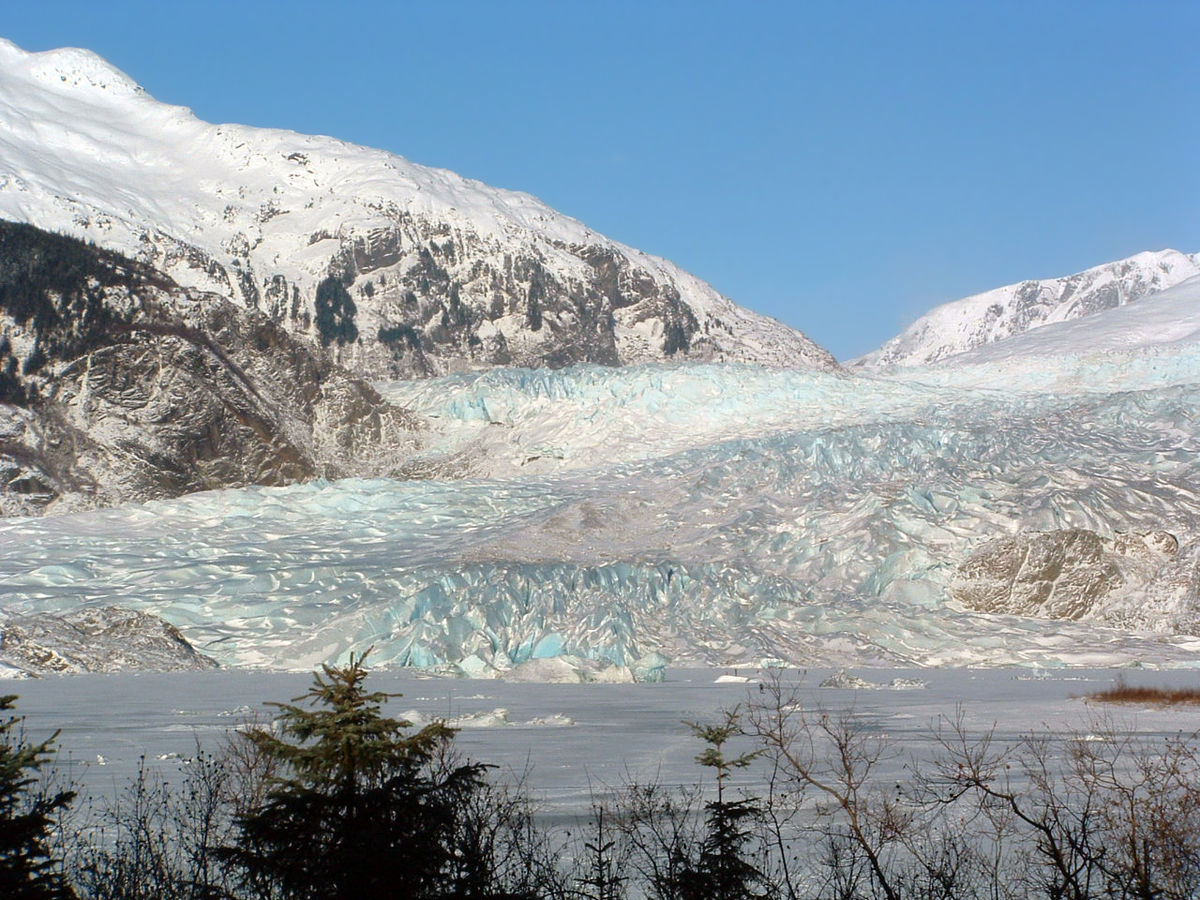
Mendenhall Glacier is a glacier about 13.6 miles long located in Mendenhall Valley, about 12 miles from downtown Juneau in the southeast area of the U.S. state of Alaska. The glacier and surrounding landscape is protected as the 5,815-acre Mendenhall Glacier Recreation Area, a federally designated unit of the Tongass National Forest. Originally known as Sitaantaagu or Aakwtaaksit by the Tlingits, the glacier was named Auke Glacier by naturalist John Muir for the Tlingit Auk Kwaan band in 1888. In 1891 it was renamed in honor of Thomas Corwin Mendenhall. It extends from the Juneau Icefield, its source, to Mendenhall Lake and ultimately the Mendenhall River. The Juneau Icefield Research Program has monitored the outlet glaciers of the Juneau Icefield since 1942, including Mendenhall Glacier. The glacier has also retreated 1.75 miles since 1958, when Mendenhall Lake was created, and over 2.5 miles since 1500. The end of the glacier currently has a negative glacier mass balance and will continue to retreat in the foreseeable future. Given that average yearly temperatures are currently increasing, and the outlook is for this trend to continue, it is actually possible that the glacier might experience a period of stabilization or slight advance during its retreating march. This is because increasing amounts of warm, moist air will be carried up to the head of the icefield, where colder ambient temperatures will cause it to precipitate as snow. The increased amount of snow will feed the icefield, possibly enough to offset the continually increasing melting experienced at the glaciers terminus. However, this interesting phenomenon will fade away if temperatures continue to climb, since the head of the glacier will no longer have cold enough ambient temperatures to cause snow to precipitate.

Perseverance Theatre

Perseverance Theatre is a professional theater company located on Douglas Island in Juneau, Alaska. It is Alaska's only professional theater and is particularly dedicated to developing and working with Alaskan artists and to producing plays celebrating Alaskan culture, history, and themes. Perseverance Theatre was founded in 1979 by Molly Smith. She developed it as an important not-for-profit regional theater that collaborated with leading theater artists. It has premiered more than 50 new plays by Alaskan and national playwrights. Paula Vogel’s 1998 Pulitzer Prize-winning play How I Learned To Drive was written and developed while Vogel was an artist-in-residence with the company. Smith served as artistic director from the theater's founding until 1998, when she left to become artistic director of the Arena Stage in Washington, D.C. She was succeeded by Peter DuBois, who served until the fall of 2003. He was appointed Associate Producer, then the Resident Director, at the Public Theater in New York. In July 2008, DuBois became Artistic Director of Boston's Huntington Theatre. In 2004, PJ Paparelli became Artistic Director of Perseverance Theatre. He left in November 2007, to lead the American Theatre Company in Chicago. The current Executive Artistic Director is Art Rotch, a Perseverance alumnus who earned an M.F.A. in set design at NYU's Tisch School of the Arts. In addition to a full season of plays produced from September to May on its 161-seat Mainstage, Perseverance Theatre also produces a Second Stage season in its on-site rehearsal space, commonly referred to as "The Phoenix." It features smaller-scale productions, and, often, the work of developing actors, designers, and directors. Readings, as well as productions generated by the theatre's educational programs, are also regularly produced in the Phoenix. In 2014 Perseverance Theatre began performing its full season in Anchorage and created a summer series in downtown Juneau called Summerfest. In 2001, Perseverance Theatre signed an agreement with the University of Alaska Southeast to assume responsibility for all theater education activities at the University, offering theater minors to its students. In December 2002, the theatre was one of just seven American companies to receive a $500,000 endowment challenge grant from the Doris Duke Charitable Foundation in New York through its Leading National Theatres Program. The company successfully completed the challenge in 2005. The theatre also recently raised $1.1 million for a facility renovation and expansion project.

Petroglyph Beach State Historic Park

Petroglyph Beach State Historic Site is an Alaskan beach and public historical site with the highest concentration of Native American petroglyphs in the southeastern region of Alaska. Located on the shore of Wrangell, Alaska barely a mile out of town, it become a State Historic Park in 2000. At least 40 petroglyphs have been found to date. The site itself is about 8000 years old. The petroglyphs that remain here are found on the boulders and bedrock outcrops on the shore, just below and above mean high tide. It is thought that they were created by members of the Tlingit tribe and most of the petroglyphs can be found close to places of importance such as salmon streams and sites of habitation. They depict whales, salmon, and faces of the community. The rock here is metamorphic and tends to be a dark gray that is finely grained, moderately durable, and easy to fracture, which would make it easier to manipulate for petroglyphs. Here are some of the most concentrated petroglyphs in the world. Petroglyphs and associated site components are under the protection of federal laws and State of Alaska Antiquities Laws. Petroglyphs may be a form of writing, a method of communication, or a way to record events and there are many interpretations of them including commemorating victories in war; documenting the transfer of wealth or territory in settlement of a feud; important potlatches; shamanistic exploits, etc. They may also have a religious significance as well; by using petroglyphs as a ritual device to assure success of the hunt and to increase the supply of game, but they may simply have no meaning beyond their artistic conception. Furthermore, petroglyphs are created by removing part of a rock surface by incising, pecking, carving or abrading. Unfortunately the petroglyphs are typically not used by professional archaeologists. They usually avoid petroglyphs because they are very difficult to date and any interpretation is usually unscientific and very speculative.

Mendenhall Glacier Visitor Center

Mendenhall Glacier is a glacier about 13.6 miles long located in Mendenhall Valley, about 12 miles from downtown Juneau in the southeast area of the U.S. state of Alaska. The glacier and surrounding landscape is protected as the 5,815-acre Mendenhall Glacier Recreation Area, a federally designated unit of the Tongass National Forest. The Juneau Icefield Research Program has monitored the outlet glaciers of the Juneau Icefield since 1942, including Mendenhall Glacier. The glacier has also retreated 1.75 miles since 1958, when Mendenhall Lake was created, and over 2.5 miles since 1500. The end of the glacier currently has a negative glacier mass balance and will continue to retreat in the foreseeable future. Given that average yearly temperatures are currently increasing, and the outlook is for this trend to continue, it is actually possible that the glacier might experience a period of stabilization or slight advance during its retreating march. This is because increasing amounts of warm, moist air will be carried up to the head of the icefield, where colder ambient temperatures will cause it to precipitate as snow. The increased amount of snow will feed the icefield, possibly enough to offset the continually increasing melting experienced at the glacier's terminus. However, this interesting phenomenon will fade away if temperatures continue to climb, since the head of the glacier will no longer have cold enough ambient temperatures to cause snow to precipitate.

This attraction is located in

This is a private property. Please enjoy respectfully and do not disturb the occupants.

Edit Categories
Add Tours

This attraction is not part of any tours

Add Collections

This attraction is not part of any collections


Some of the attractions we imported from Wikipedia are not perfect. Send us an email detailing what's wrong and we'll look into fixing it.

GuRoute is all about Gurus sharing their local knowledge. If you feel up to fixing this problem yourself, why not adopt it. You will become the owner and can fix whatever problems you see.

We've copied a link to this attraction into your clipboard so that ou can paste it into an email or text message...

More Info...
You can add your friends to the visit yourself, or, send them a link and let them add themselves...

The visit will appear on both your timelines and on your Shared Timeline.

Click below and we'll email you a link that you can send on to friends or post on your group's Facebook page.

If your friends aren't members of GuRoute yet, this is a great way to get them started.
Recent
Recently used Collections will appear here...
Recent
Recently used tours will appear here...

Where is this?

GuRoute likes to place attractions inside other attractions. So, maybe it's in a city, or maybe it's inside a particular park in that city. Maybe your attraction is a huge park that spans half the county, or multiple counties.

Determining where this attraction is gives it context - if it's in a park, you'll be able to see it alongside all the other attractions in that park. And that helps define the park.

GuRoute will automatically calculate a parent region for this attraction. You can change it if there is something more appropriate.

This attraction is currently located in .

Change

This attraction does not yet have any reviews

Please login to write a review...

Reviewed by
Record new Visit

Add this location to your timneline?

  • If there's an existing attraction open it and add it to your timeline...
  • If not, enter a title and we'll create a new attraction for your memories...
Create new Attraction

Create a new attraction at this location?

  • We rely on Gurus like you to share your local knowledge...
(Give a name for this location)


+
Add this to your timeline instead...

Imagine having a record of all the cool things you've done in your life!


Using our timeline you can keep track of everywhere you visit in your lifetime...

But, you'll need to sign in first...

Add contacts so that you can share your travels and record places that you visit together...

Family
Favorites
Family
Favorites

Profile TimeLine Our Visits Edit Accept Decline Invite

If you have any more friends that visited this place with you, feel free to add them to the visit. We'll write it to their timeline and once they confirm it, they too will have this memory for a lifetime.

If they're not already registered, you just need their name and email address and you can add them and we'll send them an invite on your behlaf.

Add a tour comment

Add some extra information for when this attraction is viewed as part of your tour...

Next Stop Instructions

Add some instructions for what to see/do on the way to the next stop...

Next Stop Instructions

Add some instructions for what to see/do on the way to the next stop...

If you're visiting an existing attraction, open it and add it to your timeline. If there is no attraction for the place you are visiting...

  • Click 'Add My Location' below
  • Or right-click on the map to mark a different location
  • Or long-press if you have a touch screen
You can even add locations while you're offline....
  • Load up the map when you're online and we'll keep track of your locaiton
  • You can add locations to your timeline
  • When you are online again we'll sync them with the cloud

We can't connect to the internet right now. The following attractions are saved locally and can be uploaded when you're online...

GuRoute would like to access your current location so that we can pin you on the map and show you nearby attractions

Add friends so that you can share your experiences with each other...

Add tour to What's Next?

Go...

Either for yourself or someone else...

  1. Do your trip research in GuRoute
    Add all the places that you think might be worthy of a visit into a trip-plan
  2. Add your trip-plan to your "What's Next" timeline
    (or a friend's "What's Next" timeline)
  3. When you're on vacation you'll have all your research at your fingertips
  4. Share your timline with your friends
    They can enjoy your vacation with you, seeing not only where you've been, but where you're going next...
  5. Add/remove attractions if things change

It also makes a great souvenir of your trip

Collections

Go...

Create a home page for a collection of attractions

  • Add an image and description to display on the homepage
  • Start adding content
    Add existing attractions to your collection or create new attractions of your own
  • Collections can be:
    • Public (Anyone can add attractions to your collection)
    • Shared (Only yourself and Gurus you nominate can add content)
    • Private (The collection will only be visible to yourself)

Uses

  • Local business or hotel
    Showcase local attractions that you endorse
  • Clubs
    Showcase attractions that members have created (eg. local historical society)
  • Special Interest
    If GuRoute does not have a category for your special interest you add your attractions to your own collection instead

Examples

Walking/Driving Tours

Go...

A guided tour where GuRoute will direct you from stop to stop and narrate a description of each attraction you arrive at

  • GuRoute uses your phone's GPS to guide you from stop to stop
  • GuRoute automatically detects when you arrive at the next tour-stop and narrates the description of the attraction (Chrome Only)
  • It then sends you on to the next stop

Tours are great to attract people to your town. Even places with no significant points of interest can be lots of fun when part of a tour


Cater tours to your Audience

  • Kid-friendly Tours
    • Focus on what will keep kids interested
    • Instead of parents having to drag their kids around they'll be struggling to keep up
    • Let the kids navigate and they'll get more fun out of finding that historical plaque than they ever would from reading it
  • Accessible tours
  • Short and long tours of the same location

What you need to do...

  1. Click 'Go...'
    Enter a title, description and location for the tour
  2. Add existing attractions OR create new ones and add them to the tour
  3. For existing attractions you can add more information specific to the theme of the tour
  4. You can also add instructions on what to do or see en-route to the next tour-stop
  5. Try out your tour and see how it works...

Mystery Tour

Go...

Create a Mystery Tour

Create a series of clues to show people around a city, neighborhood or whatever place you like...

  • GuRoute will show people clues to get them from attraction to attraction
  • When they reach each stop GuRoute will tell them about the place and give them the next clue
  • Take as long or as you like and explore each location at your leisure

Scavenger Hunt

Go...

Create a Scavenger Hunt

Create a series of questions that people have to answer. The answers can all be discovered by walking aroung the area, looking for clues.

  • How many beers are on tap at Michael Collin's Irish Bar?
  • What's the name of the oldest building on main streeet?
  • Show a picture of some public art and ask them what it is called
  • Clues can have numeric or multiple choice answers